What if the most “malignant,” high‑volume, constantly-in-the-OR program on your rank list is actually the place most likely to burn you out, teach you bad habits, and give you worse outcomes than the supposedly “soft” program you’re dismissing?
Let’s go straight at the sacred cow:
The myth that “cutting” programs – brutal hours, constant operating, sink‑or‑swim culture – automatically produce better surgeons.
They do not.
Sometimes they produce technically solid but unsafe surgeons. Sometimes just exhausted ones. Occasionally excellent ones – but not because of the toxicity.
You’re not choosing a gym where “no pain, no gain” is the motto. You’re choosing where you’ll learn to operate on real people who bleed and sue and die. Different stakes.
We’ll pull apart the myth and then talk about what actually predicts whether a program will make you a good surgeon.
The Myth: “If You’re Not Miserable, You’re Not Learning”
You’ve heard versions of this already:
- “We’re a cutting program. You’ll be in the OR all the time.”
- “We work harder than anywhere else… that’s why our residents come out strong.”
- “If you want lifestyle, go to [insert derided program name]. If you want to be a surgeon, come here.”
Sounds hardcore. Also sounds like bravado covering for poor structure.
Here’s what the data and experience actually show:
Case volume has a ceiling effect.
You need a certain minimum volume to become competent. Beyond that point, doubling volume doesn’t double skill. It just adds fatigue and more chances to repeat the same mistakes faster.Fatigue wrecks performance.
Cognitive and psychomotor performance tank with sleep deprivation. Multiple studies across surgery show increased errors, slower task completion, and worse vigilance when residents are wiped out. You do not become magically immune because you “want it more.”Toxic cultures do not correlate with better outcomes.
High psychological safety and structured feedback environments outperform “shame and blame” cultures in aviation, critical care, and surgery. This isn’t feel‑good theory; it’s safety science.
But the myth persists because the loudest people in the room are usually the ones who survived those environments and then retrofitted a heroic story on top of their trauma.
“I did 110 hours a week and look how good I am.”
Sure. But how many people silently washed out, burned out, or now quietly avoid complex cases because they never got real teaching—just volume and fear?
What The Evidence Actually Says About Training Quality
Let’s look at the pieces that matter: case numbers, supervision, structure, and outcomes.
1. Case Volume: Necessary, Not Sufficient
You need cases. Real ones. Not just skin closures at midnight.
Studies on surgical competency generally support three things:
- There’s a threshold volume for basic competency in most procedures.
- Early, deliberate practice (repeatedly doing similar procedures with feedback) helps much more than scattered random volume.
- After you pass that threshold, performance gains come mainly from quality of feedback, complexity of cases, and active coaching, not just more repetitions.
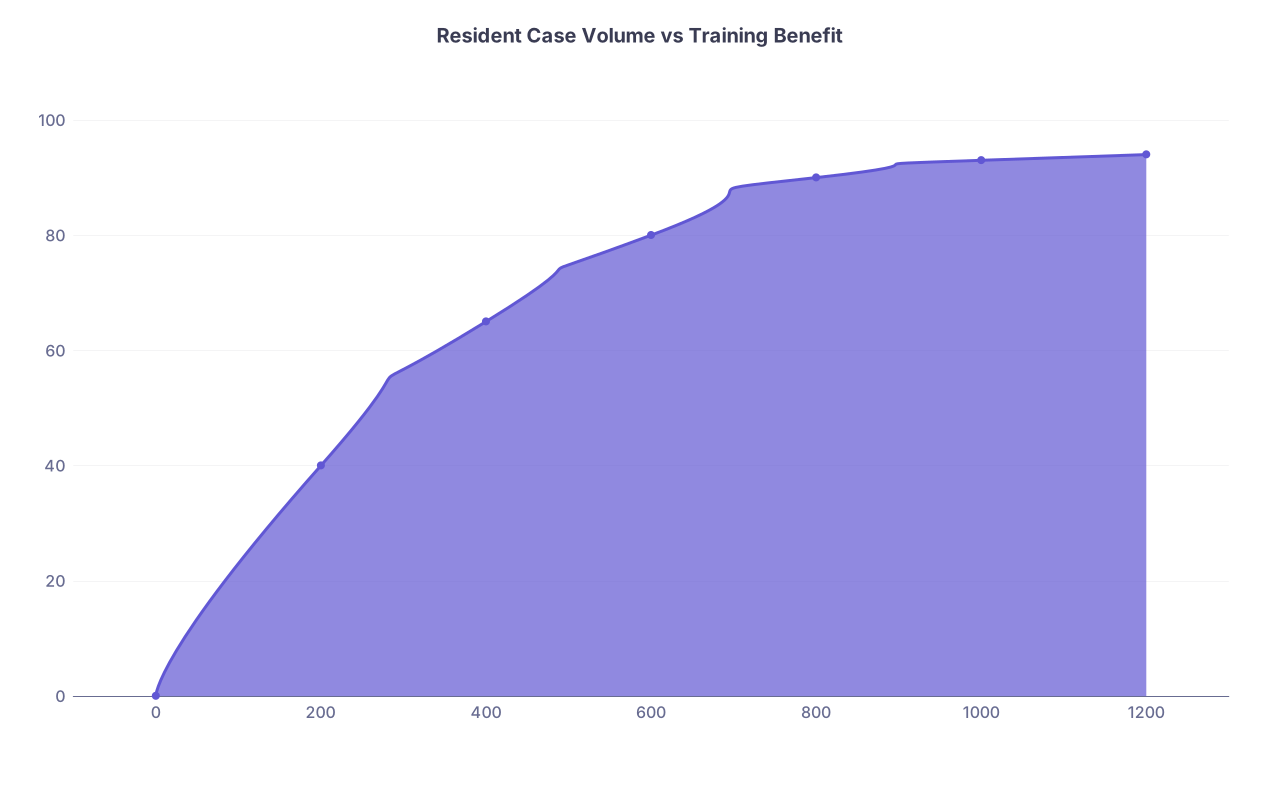
If Program A graduates residents with 800 cases and Program B graduates them with 1,200, B isn’t automatically “better.”
If A’s residents got reliable teaching, structured step‑wise autonomy, and real feedback and B’s residents mostly struggled alone at 2 a.m., A may produce better surgeons.
| Category | Value |
|---|---|
| 0 | 0 |
| 200 | 40 |
| 400 | 65 |
| 600 | 80 |
| 800 | 90 |
| 1000 | 93 |
| 1200 | 94 |
Notice the curve. Big gains early. Then it flattens. A so‑called “cutting” program that brags you’ll do “twice the cases” may be selling diminishing returns wrapped in suffering.
2. Supervision vs “Go Figure It Out”
Here’s an uncomfortable truth:
Some programs use “autonomy” as a euphemism for under‑supervision.
(See also: 7 Common Mistakes Students Make on Surgical Away Rotations for more.)
I’ve watched chiefs do a laparotomy essentially alone because the attending was “in the room” but on their phone, barely glancing up. The resident thought they had great autonomy. The nurse thought they had zero backup. The patient just had bad luck.
High‑quality surgical training has:
- Clear graduated responsibility (intern – PGY2 – senior – chief)
- Real attending presence during key steps
- Honest feedback beyond “good job” or “that was terrible”
Programs that constantly brag “you’ll operate alone as an intern” are telling you more about their coverage gaps than their commitment to your education.
Boards and ACGME do not give extra credit for cowboy culture. They care if graduates can safely operate – and increasingly they care about outcomes and professionalism.
3. Structure vs Chaos
Look at how the strongest surgical programs run things:
- Protected teaching conferences that actually happen
- Simulation labs used deliberately for laparoscopy, endoscopy, anastomosis practice
- Internal assessments of each resident’s weaknesses, not just “you need more reps”
Compare that to the “cutting” shops that advertise:
“You’ll get all the cases you want; we’re too busy to bother with simulation or formal teaching.”
Translation:
We’ll throw you in. If you learn, it’s on you. If you don’t, we’ll blame your work ethic.
Chaos can feel exciting as a medical student on a sub‑I. As a PGY‑2 with a bowel injury at 3 a.m. and no real senior support, it feels different.
How “Cutting” Programs Can Backfire
Here’s where the myth really falls apart: when you look at what kind of surgeons these environments actually produce.
1. Technical Skill Without Judgment
A certain type of program produces residents who can technically do a Whipple but:
- Don’t know when not to operate
- Underestimate risk
- Blow off non‑operative management
- Struggle with communication and team leadership
Why? Because the culture equates “aggressive surgery” with “good surgery.” Volume becomes the identity.
I’ve seen graduates of these programs as new attendings who operate early, often, and long… and have complication rates that quietly make their partners nervous. They were never taught to hit the brakes. Just the gas.
2. Burnout and Early Exit
Data on resident burnout is ugly across all of medicine, but surgical fields are special. “Malignant” programs reliably have:
- Higher burnout rates
- More residents contemplating leaving
- More residents quietly shifting to less intense practices later
Residency shapes your identity. If the identity is “I am only valuable when I’m killing myself,” you carry that into practice. Until something breaks: your body, your relationship, your patient’s trust.
None of this shows up on the program’s glossy brochure or the chair’s pitch about “our residents are warriors.”
3. Bad Habits That Stick
Residents in barely-supervised, high‑volume settings often learn:
- Sloppy tissue handling (“we’re fast here”)
- Shortcuts on documentation and consent
- Casual attitudes toward minor complications
These habits are brutally hard to unlearn. Muscle memory plus ego is a powerful combination.
The myth says: “You’ll refine it later.” Reality: patterns formed under stress, early, in a culture that rewards speed over reflection rarely magically morph into meticulous, outcomes‑focused practice.
What Actually Predicts a Program Will Make You a Good Surgeon
So if “cutting” is a garbage metric, what should you look at?
1. Case Mix and Graduated Responsibility
You want:
- Bread‑and‑butter cases in high enough volume
- Exposure to complex cases (ideally with real teaching)
- A clear progression: early assistance → doing parts → doing whole case with supervision → leading cases as chief
Ask residents specifically:
- “When did you first close a laparotomy skin to skin?”
- “Who decides when you move from assisting to leading?”
- “As a PGY‑3, what cases are yours?”
Vague answers = red flag.
2. Culture of Feedback and Psychological Safety
This isn’t fluff. If you can’t ask, “What went wrong?” you don’t improve, you just hide errors.
Signs a program gets this right:
- M&M is about systems, decisions, and improvement – not pure humiliation
- Residents can describe specific feedback that changed their practice
- Faculty names come up repeatedly as “great teachers,” not just “great surgeons”
If a program’s selling point is, “We’re old‑school, we don’t do that soft stuff,” translate that as, “We haven’t updated in 20 years and we think yelling is pedagogy.”
3. Outcomes and Where Graduates End Up
No program is going to hand you their complication rates. But you can ask:
- “Where do your grads go?” Fellowship match patterns tell a story. Do they consistently place in strong fellowships that actually operate, not just prestige names?
- “How comfortable do your chiefs feel going straight into practice?” If the answer is, “Most need a fellowship just to feel safe doing general cases,” that’s telling.
| Metric | Program X - “Cutting” | Program Y - Structured |
|---|---|---|
| Avg total cases at graduation | 1200 | 900 |
| Formal teaching conferences/wk | 0–1 (often canceled) | 3 (protected) |
| Sim lab use | Rare | Regular, required |
| Chiefs feel OR‑ready (self‑report) | 50% | 80% |
| Residents reporting high burnout | 70% | 35% |
If you reflexively choose Program X because “1200 > 900,” you’re falling for the myth.
How To Interrogate Programs About The “Cutting” Myth On Interview Day
You’re not going to ask, “Are you malignant?” Everyone lies or spins.
But you can ask questions that expose reality.
Questions to faculty
“How do you balance resident autonomy with patient safety?”
Watch for concrete examples versus slogans.“Can you describe a time when a resident made a mistake in the OR and what happened next?”
You’re listening for blame vs coaching.“What has changed in your training model in the last 5 years?”
If the answer is essentially “nothing,” be suspicious.
Questions to residents (away from faculty)
- “If you had to rank this program’s strengths and weaknesses in one sentence each, what would they be?”
- “What time did you leave yesterday? Is that typical?”
- “Who are the top 2 attendings you actually learn from? Who do you dread?”
- “Do you feel safe saying ‘I don’t know’ in the OR?”
If they proudly tell you, “We’re always here till 9 or 10; we live in the OR,” that’s not automatically a plus. Ask yourself: doing what? Cutting? Scut? Waiting? Retracting endlessly?

| Step | Description |
|---|---|
| Step 1 | Interview Day |
| Step 2 | Ask faculty about autonomy |
| Step 3 | Ask residents off record |
| Step 4 | Realistic program picture |
| Step 5 | Red flag - spin or dysfunction |
| Step 6 | Consistent stories |
The Trap of Ego and Fear
The myth survives because it preys on two things in applicants:
Ego:
“I’m tough. I can handle more. I don’t want a ‘soft’ program.”
Translation: I’m afraid of being seen as weak.Fear of inadequacy:
“What if I pick an easier program and come out less prepared?”
Translation: I don’t trust that structure and teaching could beat chaos and suffering.
I’ve watched applicants trade away psychological safety, mentorship, and sane hours for the promise of being “a beast in the OR.” Some do fine. Some end up bitter, disengaged, or overcompensating for holes in their training later.
Your job is not to prove how much you can suffer. Your job is to become a safe, thoughtful, technically excellent surgeon. Those are different goals.
So, Do “Cutting” Programs Graduate Better Surgeons?
Reality:
- High‑volume, high‑acuity can be fantastic for training – if paired with real supervision, structured feedback, and a culture that prioritizes outcomes and learning over chest‑thumping.
- “Cutting” as code for “we destroy you, good luck” is not a marker of excellence. It’s a marker of laziness and inertia in education.
- The best surgeons I know did not train at the most famously malignant programs. They trained where people actually taught them.
When you rank programs, strip away the mythology:
- Ignore the macho branding.
- Look for structure, feedback, and culture.
- Remember: your goal is not to survive residency. Your goal is to graduate as a surgeon patients should actually trust.