The current obsession with robotics is quietly leading applicants into terrible general surgery residency choices.
If you let the robot console drive your rank list, you’re playing the wrong game.
You are not training to be a robot jockey. You are training to be a surgeon who can operate—open, laparoscopic, sometimes robotic—on sick, complex humans, at 2 a.m., without a safety net. Lose sight of that, and you’ll wake up PGY‑3 with weak operative skills, no autonomy, and a shiny Da Vinci that did more for the brochure than for your training.
Let me walk you through the biggest robotics‑related selection errors I see over and over—and how to avoid getting burned.
Mistake #1: Treating “High Robotics Volume” as a Proxy for “Good Operative Training”
Programs know what you want to hear: “We’re a high‑volume robotic center.”
Applicants nod, starry‑eyed, and stop asking hard questions.
Here’s the problem: “We do a lot of robotics” does not automatically mean:
- You will get console time
- You will become a safe independent surgeon
- You will learn open and laparoscopic fundamentals
It often means: attendings do a lot of robotics. You retract. You hold the camera. You maybe drive the robot for lymph nodes if they’re feeling generous.
I’ve seen residents at “robot heavy” programs with:
- Beautiful case logs for robotic cholecystectomies and hernias
- Embarrassingly low numbers for open colectomies, emergent laparotomies, and solid organ trauma
- No real sense of spatial judgment without a 3D console and wristed instruments doing the fine motor work for them
That is a catastrophic tradeoff.
If you end up somewhere that funnels every straightforward case to the robot—especially when an open or laparoscopic approach would be faster, cheaper, and totally appropriate—you can easily graduate with holes in your foundation.
Here’s the red flag mindset to avoid:
“If they have multiple robots and advertise a robotics curriculum, this must be a strong surgical program.”
No. Those are marketing features, not guarantees of training quality.
Mistake #2: Ignoring How Robotics Can Cannibalize Your Bread‑and‑Butter Experience
The riskiest robotics environment for a resident isn’t the place that does none. It’s the place that does robotics badly—where the hype exceeds the training reality.
What does “badly” look like?
- Every basic hernia goes to a robot because attendings like it
- Elective cholecystectomies that should be easy lap cases turn into slower, robot‑only days
- Attendings keep the console for efficiency and RVUs; residents get bedside ports and stapling
- The robot is used as a toy on cases that don’t need it, but avoided for complex ones where you might actually learn something
You end up with a hollow case log: high numbers, low independence.
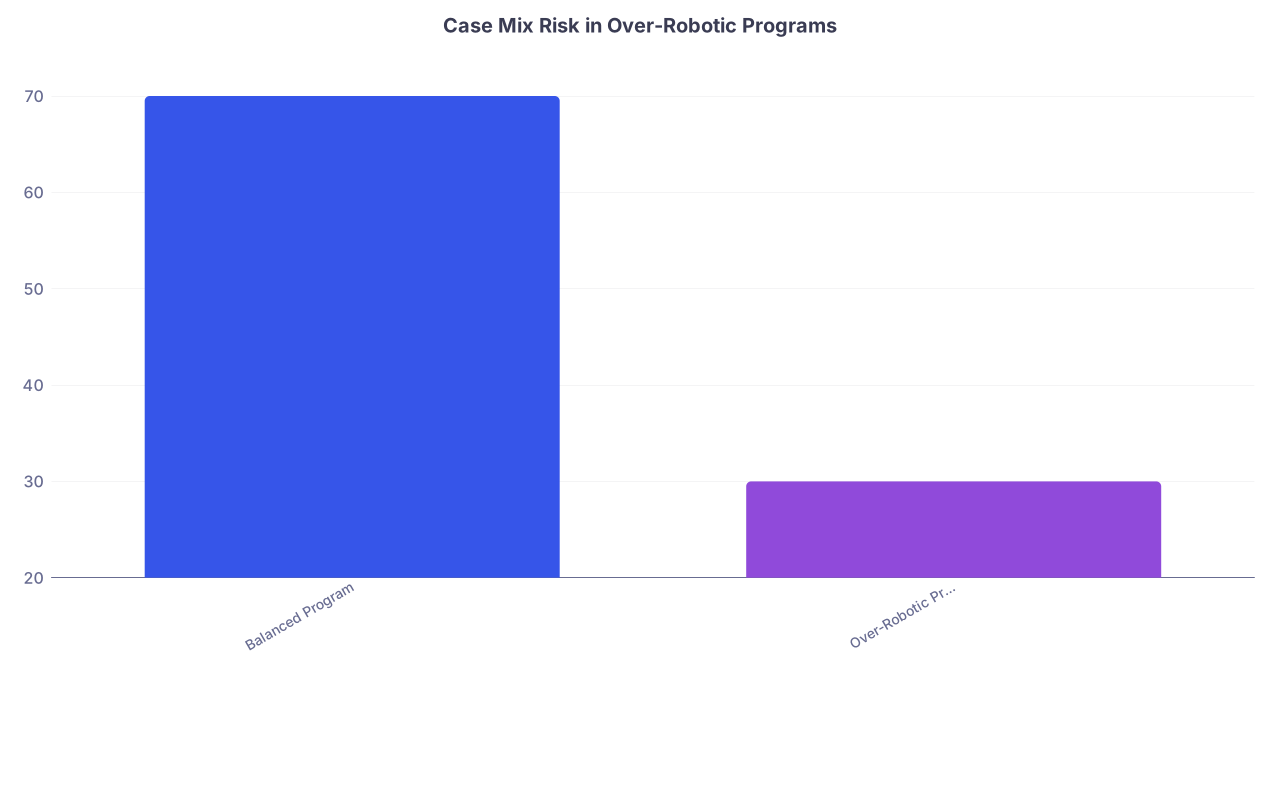
| Category | Value |
|---|---|
| Balanced Program | 70 |
| Over-Robotic Program | 30 |
Interpret that roughly as: in a balanced program, most teaching value comes from core open and laparoscopic cases, with robotics layered in thoughtfully. In an over‑robotic program, robotics can displace those fundamental experiences instead of complementing them.
Questions you should be asking on interview day:
- “What percentage of your basic cases (cholecystectomy, inguinal hernia, colectomy) are done open, lap, and robot?”
- “How often do senior residents scrub as primary surgeon on open cases vs console cases?”
- “What does a typical on‑call night look like—how many emergent open cases do you get?”
If no one can answer with specifics—or they quickly pivot to “We’re a national leader in robotic volume”—be very careful.
Mistake #3: Confusing Institutional Prestige with Resident Exposure
This one bites a lot of people.
You see: “We’re a national training center for robotics. We host proctors and industry courses. Our attendings are key opinion leaders.”
What you don’t immediately see is:
- Those same attendings have visiting surgeons watching
- Cases are tightly choreographed for efficiency and demonstration
- The resident is often the bedside assistant so the “show” runs smoothly
- Console time goes to faculty and fellows to maintain institutional status and outcomes
I’ve watched residents brag during interviews: “We have three dual‑console robots.” Then a fellow quietly admits later: “Yeah, the second console is mostly for other attendings, not for the chiefs.”
If there’s a robotics fellowship—especially multiple—it can absolutely cut into your exposure. Not everywhere, but more often than programs admit.
You need to explicitly ask:
- “Do your robotics fellows take console time that might otherwise go to chiefs?”
- “By graduation, what’s the average number of independent console cases residents perform?”
- “Are residents or fellows first priority for case assignments?”
If they dodge, or give you a vague “Everyone gets plenty of experience,” assume the fellows are getting first dibs.
Mistake #4: Letting Industry Branding Seduce You
The logos, the glossy photos, the fancy “Robotics Institute” name—none of that operates a bowel anastomosis at 3 a.m.
Programs love being early adopters. Industry loves putting their name on banner institutions. Applicants love the idea that they’re “on the cutting edge.”
But you’re not applying to be a brand ambassador. You’re applying to be safe and competent.
Here’s where I see people get fooled:
- A program has a fancy robotics simulation lab… but residents rarely get protected time to use it
- They advertise “robotic certification” but it’s basically an online module plus a handful of non‑independent cases
- They talk about “research opportunities in robotics” but give no details about actual surgical mentoring or outcomes
| Claim on Website | What You Must Clarify |
|---|---|
| "High-volume robotic center" | Who gets console time—attendings, fellows, or residents? |
| "Dedicated robotics curriculum" | How many hours? Required? Protected? |
| "Robotic certification by PGY-5" | Defined criteria or just a checkbox? |
| "Multiple robotic platforms" | How many residents actually use each? |
| "National robotics training hub" | Does that increase or decrease your autonomy? |
Do not assume that because a program is “big” in robotics nationally, it’s good for you personally as a resident. Those are very different things.
Mistake #5: Not Understanding How Robotics Shapes Your Future Practice (Or Doesn’t)
A harsh truth: a huge portion of graduating general surgeons will not have routine access to robots in their first jobs.
If you want academic MIS, colorectal, or bariatrics at a tertiary center—yes, robotics is increasingly relevant. But if you end up:
- At a community hospital with one shared robot and no block time
- In a rural or critical access setting with zero robotic infrastructure
- In a private group where the older partners don’t trust or want robotic cases
Your bread and butter will be open and lap. Period.
Over‑emphasizing robotics in residency selection can leave you:
- Underprepared for non‑robotic approaches
- Less efficient in standard lap cases because you leaned too heavily on robotic articulation
- Disappointed and frustrated when your first job doesn’t “support your training”
The question isn’t “Will I have robotic skills?” The question is “Will I be an excellent surgeon without needing a robot to function?”
You want robotics as an add‑on, not a crutch.
So when you hear residents at a program gush, “Almost everything we do elective is robotic,” your follow‑up thought shouldn’t be “Cool!” It should be “So where are you getting your lap and open volume from?”
Mistake #6: Believing Robotics Can Compensate for Weak Clinical or Operative Culture
This one is sneaky.
Some programs use robotics as window dressing to hide deeper problems:
- Weak operative autonomy overall
- Attendings who don’t like to teach and use technology as another barrier between you and the case
- Toxic call schedules where you’re too exhausted to care about technical nuance
- Poor clinical teaching, so you can’t even evaluate when robotic vs open vs lap is appropriate
Robotics will not fix:
- A malignant culture
- Poor mentorship
- Disorganized teaching
- Dysfunctional OR flow
I’ve seen applicants say, “Yeah, I got weird vibes from the residents, but they have incredible robotic opportunities, so I’m ranking them high.” That’s backward.
If the base training environment is bad, your robotics experience will just be bad plus expensive.
On interview day, pay more attention to:
- How residents talk about attendings when no one else is listening
- Whether chiefs sound like confident decision‑makers or glorified assistants
- How much weight they put on “cool tech” versus “we operate a ton and actually run the service”
If the only thing residents seem excited about is the robot, you should be worried.
Mistake #7: Not Asking for Real Data on Resident Robotics Experience
You wouldn’t accept hand‑wavy answers about trauma volume or chief case numbers. Don’t accept them for robotics either.
Push for specifics:
- “What’s the median number of console cases by PGY‑5?”
- “What percentage of those are done with the resident as true primary surgeon?”
- “Do you log bedside assist cases differently from console cases?”
- “Is there a threshold for being ‘robotic credentialed’ when you graduate?”
And then, critically, cross‑check:
- Talk to multiple residents—junior AND senior. If juniors say “We get a ton of robotics” but seniors hesitate, believe the seniors.
- Ask how they actually feel about their readiness to do robotic cases independently if they went to a mid‑sized community job tomorrow.
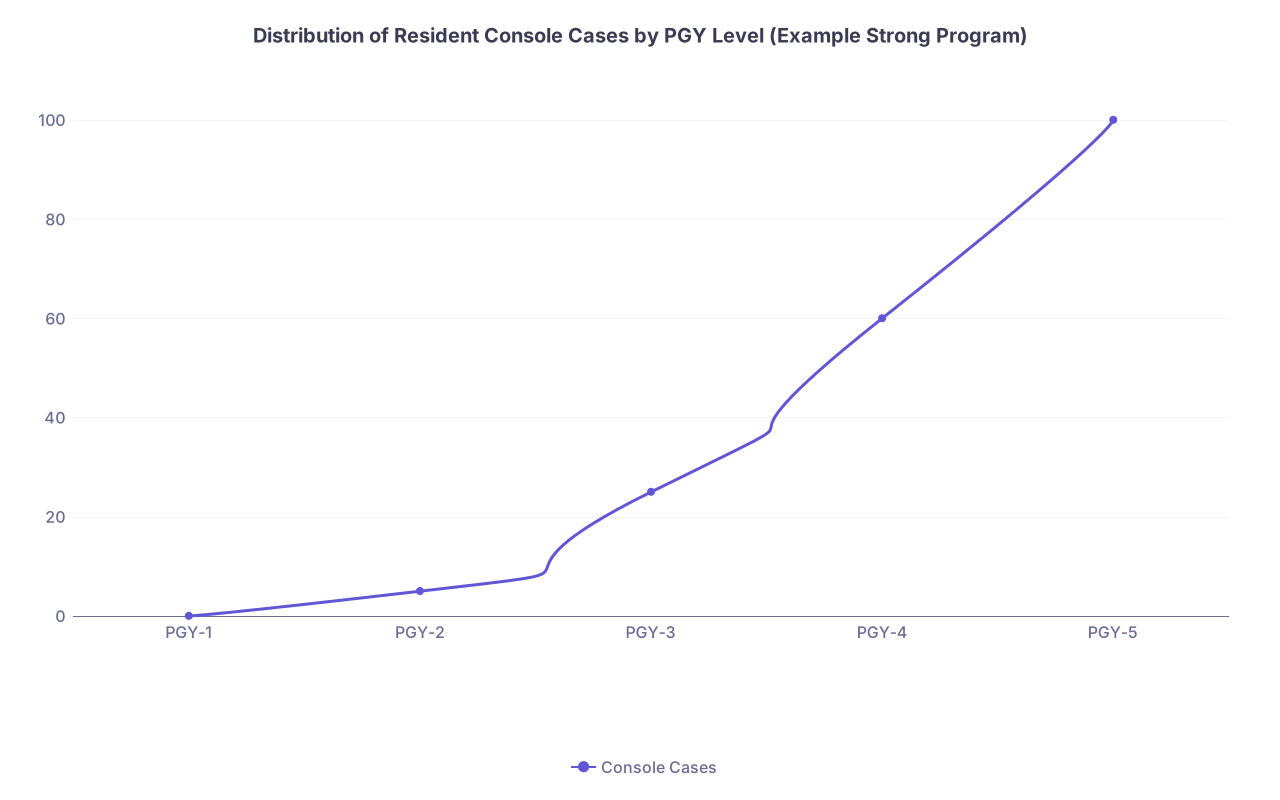
| Category | Console Cases |
|---|---|
| PGY-1 | 0 |
| PGY-2 | 5 |
| PGY-3 | 25 |
| PGY-4 | 60 |
| PGY-5 | 100 |
You’re looking for a gradual, structured build in autonomy, not a last‑minute PGY‑5 scramble to hit some arbitrary number.
If a program cannot show you any meaningful tracking or outcomes of their robotics “curriculum,” it’s probably more aspirational than real.
Mistake #8: Overfitting Your Rank List to a Single Technology
The fastest way to sabotage your future is to rank programs almost entirely based on robotics access and reputation.
Here’s the reality: you have no idea what general surgery will mean for you 10–15 years from now. You might be:
- A community generalist mostly doing lap and open
- A trauma surgeon living in the ICU
- A breast surgeon who rarely, if ever, touches a robot
- A colorectal or MIS specialist who does robotics every day
- Burned out and desperate for a lower‑acuity job where tech is the last thing on your mind
Anchoring your entire training to a single current technology is a short‑sighted move.
Robotics should be:
- A factor, yes
- A tiebreaker between two otherwise strong programs, maybe
- The primary driver of your decision, never
What you absolutely cannot afford to compromise on:
- Breadth and depth of open and laparoscopic training
- Case volume and real operative autonomy
- Supportive teaching culture
- Solid outcomes, strong clinical exposure, and graduated responsibility
If you sacrifice those for an extra robot in the OR, you’re making a mistake you won’t fully feel until PGY‑4.
Mistake #9: Failing to Distinguish Between “Exposure” and “Competence”
A lot of programs will say, “Oh yes, our residents get plenty of exposure to robotics.”
Exposure is a useless word. You don’t need exposure. You need skill.
Exposure means:
- You’ve been in the room
- You’ve held a port
- You’ve seen someone else drive the robot
Competence means:
- You can dock the robot efficiently
- You can do the critical parts of a standard case from start to finish
- You can troubleshoot instrument collisions, poor visualization, and bleeding
- You can decide when not to use the robot
Those are wildly different things.
You need to probe hard:
- “Do seniors perform entire robotic cases skin‑to‑skin under supervision?”
- “When complications occur during robotic cases, are residents allowed to manage them, including converting to open?”
- “Do residents ever feel like they’re just there to make robotic days run faster for attendings?”
If residents say things like “We get exposure” or “We’re always around robotics,” but struggle to give real examples of independent maneuvers they perform, that’s a major warning sign.
Putting It Together: A Sanity Check Framework
You’re choosing a general surgery residency with robotics as an adjunct, not a robotics residency with some general surgery on the side. Here’s a practical way to sanity‑check your thinking.
On a blank sheet, for each program you’re considering, rate from 1–5:
- Open operative volume and autonomy
- Laparoscopic training and independence
- Clinical teaching and culture
- Resident wellbeing and support
- Robotics opportunity AND actual resident console autonomy
If “5. Robotics” is the only thing at 4–5 and everything else is 2–3, that program should drop on your list, not rise.
If multiple programs are strong across 1–4, and one has a thoughtfully integrated robotics curriculum where residents clearly get structured console time, then yes—use robotics as a tiebreaker in its favor. That’s how it should function: as a bonus, not a blinder.
FAQ: Robotics and General Surgery Residency (5 Questions)
1. Should I avoid programs that have very little robotics?
No, you shouldn’t automatically avoid them. A program with excellent open and laparoscopic training, strong autonomy, and a healthy culture but limited robotics is often a better choice than a tech‑flashy, weak‑training program. If your long‑term goal is an academic robotics‑heavy subspecialty (e.g., colorectal, MIS), then yes, you’ll want some meaningful robotic exposure. But do not sacrifice basic surgical competence for the illusion of tech “cutting edge.”
2. How can I tell if residents actually get console time instead of just bedside assisting?
Ask very specific questions to multiple residents at different levels. “On your last 10 robotic cases, how many did you drive the console for the critical portions?” “By PGY‑4, what parts of a standard robotic colectomy or hernia do you typically perform independently?” Listen for concrete answers, not vague enthusiasm. Also ask whether fellows are present and how they share or compete for console time. Hesitation, joking about “fighting for the console,” or “it depends which attending” are subtle red flags.
3. Does having a robotics fellowship at a program always hurt resident experience?
Not always, but it often dilutes resident opportunity, especially if the program isn’t intentional. In a well‑run system, fellows focus on the most complex cases and advanced techniques while residents still get core robotic cases and primary console time. In a poorly structured environment, fellows vacuum up nearly all robotic autonomy. Your job is to figure out which one you’re looking at by asking directly whether fellow presence reduces resident case numbers or independence.
4. How important is “robotic certification” during residency for getting a job?
Programs love to advertise “robotic certification by graduation,” but the reality is that hospital credentialing is highly variable and often depends more on your logged cases, references, and institutional policies than on a certificate from residency. A flimsy internal “certificate” without real case numbers and demonstrated competency is basically a souvenir. Focus on programs where you can build a robust case log with truly independent portions of cases; that will matter more than a line on your CV saying “robotics certified.”
5. What’s the single biggest warning sign that a program is overvaluing robotics at the expense of training?
The strongest red flag: residents rave about technology but sound weak or uncertain when you ask about open and laparoscopic autonomy, especially for emergencies. If you hear “We don’t do many open cases anymore” or “Most straightforward cases are robotic now” and no one can tell you where they’re getting high‑stakes open experience—trauma, perforations, obstructions—that’s dangerous. Your priority should be programs that turn you into a competent, independent general surgeon first, who also happens to be comfortable with robots, not the other way around.
Open your tentative rank list right now and mark every program where robotics was one of your top three reasons for ranking it highly. For each of those, write down—specifically—how that program will make you a better general surgeon independent of the robot. If you can’t answer that clearly, you need to rethink where that program belongs.