What do you do when you realize, halfway through PGY‑2, that your “chill” surgical program has so little penetrating trauma that you feel unprepared every time a GSW rolls in?
If you are choosing a surgical residency and not taking trauma volume seriously, you are setting yourself up for that exact sick-to-your-stomach feeling. I have seen it too many times:
- The applicant who swore they wanted “strong operative experience” but never asked what that meant for trauma.
- The MS4 who ranked the “nice” medium-sized city over the slightly rougher neighborhood—only to discover their nights are full of cholecystitis and appendicitis, not real trauma.
Let me be blunt: underestimating trauma volume is one of the most common, and most regretted, mistakes among surgery residents once they hit PGY‑2 and PGY‑3. By then, you are the one holding the knife, not the student scribbling in the corner.
You do not want to realize too late that your trauma log is embarrassingly thin.
Why Trauma Volume Matters More Than You Think
Most MS4s undervalue trauma. They focus on:
- Case numbers for elective cases
- Fellowship match lists
- Research prestige
Trauma? They wave it off. “I am not going into trauma or acute care surgery anyway.”
Here is the problem with that logic.
Trauma is where you actually learn to be a surgeon under pressure
Elective hernia at 10 a.m. with your favorite attending is not where you figure out who you are as a surgeon. Trauma and emergency general surgery are where:
- You learn to make fast, high‑stakes decisions with incomplete information.
- You gain comfort with hemodynamically unstable patients.
- You get real reps with damage control, packing, emergent laparotomies, vascular control.
You can be “good” in elective days and still completely freeze when the paramedics yell, “BP 60 systolic, GSW to the abdomen, ETA 2 minutes.”
If your residency does not expose you to enough of those scenarios, you will feel it. So will your patients.
Your future job may depend on this—whether you like trauma or not
Most general surgeons in the real world:
- Take call at hospitals that see blunt trauma at a minimum.
- Deal with ruptured aneurysms, perforated ulcers, bowel ischemia, gunshot wounds, car crashes.
- Staff community hospitals where the “trauma surgeon” is just…the general surgeon who happens to be on.
If you plan to:
- Work in a smaller city
- Cover community call
- Join a general surgery group
…you cannot hide from trauma and acute emergencies. You will be the person the ED calls at 3 a.m. You must not be the attending who thinks, “I wish I had actually done more of this in residency.”
Your confidence as a senior resident depends on those PGY‑2 and PGY‑3 trauma reps
I see this pattern all the time:
- PGY‑1: You follow orders and push the stretcher.
- PGY‑2: You start making your own calls and running parts of resuscitations.
- PGY‑3 and PGY‑4: You are essentially the trauma leader overnight.
If you train at a low‑volume center, your first time making serious trauma decisions may be far later than it should be. You will graduate on paper. On paper you will meet ACGME minimums.
But you will know, deep down, that your trauma experience is thin.
The Silent Trap: How Applicants Underestimate Trauma Volume
No one goes into this thinking, “I hope I match at a place with weak trauma.” They just do not know how to read the signs.
Here is how people fool themselves.
Mistake #1: Equating “Level I Trauma Center” with high trauma volume
This is the classic rookie error.
A program says:
“We are a Level I trauma center.”
The applicant hears:
“Great, tons of trauma, box checked.”
Reality: being designated Level I does not guarantee you the volume or hands‑on experience you think you are getting.
You can have:
- A Level I center that sees fewer major traumas than a busy Level II in a dangerous corridor.
- A Level I that hands every interesting case to trauma/critical care fellows while residents retract and close.
You need to know the actual numbers and the role of residents.
Mistake #2: Confusing “interesting trauma” with “enough trauma”
Med students love “cool cases”:
- A single GSW to the heart
- A motorcycle crash splenic rupture
- A stab wound to the liver
They see one wild case on a sub‑I and assume there must be tons of similar trauma year‑round. Not necessarily. That may have been the most dramatic case of the month.
If staff say things like:
- “You picked a great week to be here, we have actually had some traumas.”
- “Usually it is quieter than this.”
- “We have not seen many penetrating cases recently.”
Believe them. They are not being modest. That is a warning.
Mistake #3: Forgetting about fellow hogging
Fellowship programs can quietly destroy resident experience if the culture is wrong.
Trauma critical care, surgical critical care, vascular, and MIS fellowships can all draw cases away from residents when they are designed poorly. In some trauma centers:
- Fellows run every trauma activation.
- Fellows take the key parts of the cases—vascular control, bowel resection, damage control.
- Seniors get relegated to second assistant or “skin to skin but not the important part.”
Applicants love hearing: “We have lots of fellowships—great educational environment!”
But they rarely ask: “How are cases divided between fellows and residents?”
You should.
How to Actually Evaluate Trauma Volume (Not the Fantasy Version)
If you do not want to be the PGY‑2 regretting your rank list, you must stop relying on vibes and slogans.
You need objective data and specific questions.
1. Look at regional context and catchment area
Trauma volume starts long before the hospital door. Geography matters.
Red flags for low trauma volume:
- Affluent suburb, little violent crime.
- Surrounded by higher‑level trauma centers that poach the serious cases.
- Competing trauma centers within a short distance splitting volume.
Green flags for high trauma volume:
- Only Level I or Level II trauma center in a large geographic radius.
- Urban location with known blunt and penetrating trauma load.
- Regional referral pattern: air transfers from multiple smaller hospitals.
If a program is in a “nice quiet town” with three hospitals calling themselves trauma centers, someone is not getting many major cases. Often that “someone” is the residents.
| Setting Type | Likely Trauma Volume | Risk for Residents |
|---|---|---|
| Single Level I in city | High | Fellow hogging |
| Multiple Level I in city | Split / variable | Thin experience possible |
| Level II in large rural | Surprisingly high | Strong blunt trauma |
| Affluent suburb center | Low to moderate | Weak trauma exposure |
| State safety-net hospital | Very high | Intense but valuable |
2. Ask for specific numbers—not vague adjectives
If you get hand‑wavy answers on interview day, that is not an accident.
You want:
- Annual trauma activation numbers
- Penetrating vs blunt percentages
- Emergent laparotomies per year
- Average logged trauma cases per graduate
You might hear people say:
- “We are very busy.” → Meaningless.
- “We see a good mix of blunt and penetrating trauma.” → Still meaningless.
- “We get a ton of motor vehicle crashes.” → Ask “How many?”
Push for numbers like:
- “How many trauma activations per year?”
- “What percentage are penetrating?”
- “On a typical trauma call night, how many activations does the PGY‑2 or 3 personally see?”
If they cannot answer, or sidestep with jokes about being “always slammed,” file that under “data they do not want you to see.”
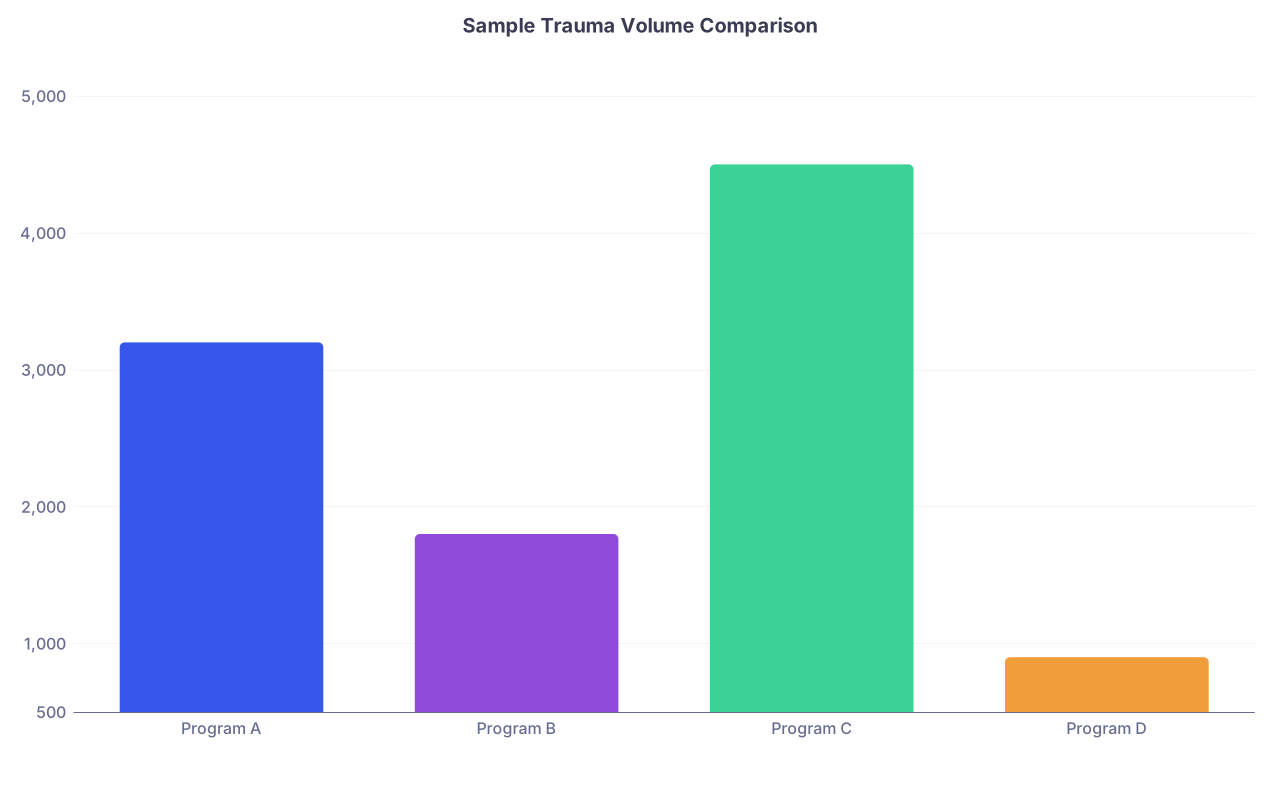
| Category | Value |
|---|---|
| Program A | 3200 |
| Program B | 1800 |
| Program C | 4500 |
| Program D | 900 |
3. Clarify who actually runs the trauma
You need to understand the chain of command in the trauma bay.
Ask bluntly:
- “On nights, who runs the trauma bay—fellow, chief, or mid‑level residents?”
- “Are PGY‑2s or 3s expected to lead primary surveys under supervision?”
- “Can a PGY‑3 perform emergent laparotomies with attending backup, or does the fellow always scrub in and lead?”
Look for signs that residents are primary:
- Seniors present cases and call priorities.
- PGY‑2/3s regularly perform chest tubes, central lines, femoral lines, FAST exams.
- Residents can articulate clear expectations: “By PGY‑3, you are running most traumas overnight; by PGY‑4, you are functionally trauma chief.”
Bad sign: An awkward pause, then someone says “Well, it depends” three times in a row.
The PGY‑2 Reality Check: What Regret Looks Like
Let us talk about what this mistake feels like on the inside. Because that is what you are trying to avoid.
Scenario 1: The underprepared senior on community call
You matched at a medium city program. Level I trauma center, “busy enough.” Lots of electives, strong fellowships.
Trauma? You did:
- A few nights as a PGY‑2 with mostly falls and MVCs
- Limited penetrating trauma—mostly “we stabilized and transferred”
- Trauma fellows ran essentially everything interesting
Now you are PGY‑4 visiting a community hospital for an away rotation.
A GSW to the abdomen comes in. The local team looks at you like you are the trauma expert.
You realize:
- You have never actually led a trauma laparotomy from incision to closure.
- You have never had to make the real‑time choice: pack vs resect vs temporary closure.
- You have never done true damage control under real pressure; you mostly watched.
That is when the regret hits. Not on Match Day. Two, three, four years later.
Scenario 2: The fellowship applicant with thin trauma experience
You decide you might want trauma/critical care or acute care surgery after all.
During interviews you realize other candidates:
- Have far more logged trauma cases.
- Have led many more resuscitations.
- Can describe complex trauma operations they actually performed, not just observed.
You, on the other hand, sound like a medical student talking about trauma. You know the theory. You do not have the scars.
That gap was created when you ranked programs without really caring about trauma volume. You thought you would never need it.
Red Flags During Interviews and Sub‑Is
You can catch a weak trauma experience before you ever rank the program—if you know what to look and listen for.
Culture clues you should not ignore
Pay attention to how people talk about trauma:
- “Trauma is kind of slow here, which is nice.” → Nice for lifestyle, bad for training.
- “We do not get a lot of penetrating trauma, mostly falls and MVCs.” → Common, but can still be workable if blunt volume is high. Ask for numbers.
- “Trauma fellows really streamline the care.” → Translation: they run it.
Watch how residents react when you ask about trauma:
- Do they light up and start telling detailed stories? Good sign.
- Do they shrug and pivot to talking about elective cases? Be careful.
- Do they joke about “scut work” and paperwork for trauma? That usually means they are not owning the clinical decisions.
Schedule structure that quietly erodes your exposure
Look at how they schedule trauma/acute care surgery rotations.
Danger patterns:
- Trauma rotation heavily front‑loaded in PGY‑1 with little responsibility, light exposure later. You will not remember much from your intern trauma month when you hit senior call.
- Trauma split between multiple services, diluting your time actually present for activations.
- Too many off‑service rotations during prime trauma months (summer nights, holidays).
Ask:
- “How many dedicated trauma/acute care months does each resident get, and at what PGY levels?”
- “On trauma months, are residents in the OR or stuck upstairs in the ICU or on floor work all night?”
If they brag about never leaving by 5 p.m. on trauma, that is not the flex they think it is.
Balancing Lifestyle vs Trauma Exposure (Without Lying to Yourself)
You are allowed to care about quality of life. You are allowed to dislike gunshots at 3 a.m. But do not lie to yourself about the trade‑offs.
The seductive low‑volume program
On the trail, low‑volume centers sell:
- “Great work‑life balance.”
- “Very manageable call.”
- “You will have time for research, hobbies, and family.”
All good things. But here is what that can hide:
- A thin trauma log that barely meets minimums.
- Limited real‑world experience managing exsanguinating patients.
- Weak confidence when you hit independent practice.
You can have a life and still train somewhere with robust trauma. You just cannot have constant comfort plus robust trauma. Those are rarely paired.
Matching your career plan to trauma reality
Be honest about your direction:
If you are leaning toward:
Acute care surgery / trauma / critical care
You should aggressively prioritize high‑volume trauma centers where residents lead resuscitations and do the hard parts of operations.General surgery with community call
You still need significant trauma and emergency general surgery exposure. You want to graduate having personally felt the weight of being the first call for bad nights.Highly sub‑specialized, minimal general call jobs (e.g., lab‑heavy HPB or thoracic in academic centers)
You might “get away” with less trauma. But jobs like that are limited. You may not get your dream niche right away. You might be stuck taking general call for years.
Do not build your entire training plan around an idealized future job that may not materialize.

| Step | Description |
|---|---|
| Step 1 | Choose Surgery Residency |
| Step 2 | Prioritize high volume trauma |
| Step 3 | Moderate to high trauma needed |
| Step 4 | Some trauma still valuable |
| Step 5 | Busy Level I, strong resident role |
| Step 6 | Solid regional or busy Level II |
| Step 7 | Avoid extremely low trauma programs |
| Step 8 | Future Plan Clear |
Concrete Steps to Avoid This Matching Mistake
If you want protection from PGY‑2 regret, do the following now—while you still can change your rank list.
On interviews, always ask:
- “Roughly how many trauma activations per year?”
- “What percentage are penetrating?”
- “By PGY‑3, what is my role in the trauma bay on nights?”
On sub‑Is, keep a quiet tally:
- How many real trauma activations in a week?
- How many emergent OR trips?
- How often are residents leading vs just present?
Email a chief resident after your interview:
- Ask them: “If you were choosing again and cared about trauma exposure, would you still pick this place? Why or why not?”
- Chiefs are much more honest by email or in one‑on‑one conversations than on formal interview days.
Look up crime and injury patterns for the catchment area:
- You do not need epidemiology training. A basic understanding of the region will tell you a lot about potential trauma volume.
Compare your top programs side by side:
| Factor | Program 1 | Program 2 | Program 3 |
|---|---|---|---|
| Trauma activations/yr | 3,500 | 1,200 | 4,200 |
| Penetrating % | 25% | 5% | 30% |
| Resident-led resus? | Yes | Limited | Yes |
| Fellows in trauma? | No | Yes | Yes |
If you lay it out like this and still pick the lowest‑volume, fellow‑dominated option, then at least you are doing it with your eyes open.
FAQ (Exactly 3 Questions)
1. If I know I never want trauma or ACS, can I safely ignore trauma volume when ranking programs?
You can downgrade it, but you should not ignore it. Even if you never practice as a trauma surgeon, general surgeons routinely manage emergencies: perforations, obstructions, ruptures, and blunt trauma. A residency with near‑zero meaningful trauma leaves you fragile when patients do not follow your clean elective schedule. Also, career plans change; plenty of residents who “hate trauma” as MS4s end up in acute care surgery once they discover they are actually good at it.
2. Is a busy Level II trauma center sometimes better than a famous Level I for resident trauma experience?
Yes, absolutely. A busy Level II without fellows, where residents run the trauma bay and staff all emergent cases, can produce far more competent trauma surgeons than a brand‑name Level I where fellows own everything. The designation matters less than actual volume and who touches the patients. I would rather you train where you lead 200 real resuscitations than where you watch 400 from the back of the room.
3. How can I tell if fellows are going to steal all the trauma cases from residents?
Ask very specific, uncomfortable questions. “On a typical penetrating abdominal trauma at 2 a.m., who is the primary surgeon—resident or fellow?” “As a PGY‑4, how many independent trauma laparotomies will I have done?” Watch how quickly and directly people answer. If residents give vague responses, joke about “fighting with fellows” for cases, or say “it depends who is on,” that is a red flag. Programs that truly protect resident experience are proud of it and will say so clearly.