It is 10:45 p.m. You just finished a combined ENT–plastics call night. You loved the airway drama and endoscopic sinus work. You also loved the facial trauma and the idea of complex reconstructions. Your notes app has two lists: “ENT pros” and “Plastics pros.” They are both long. They are both compelling. And your rank list deadline is not moving.
You are not “keeping an open mind.” You are stuck. And if you are honest, you are scared of choosing wrong.
Let us fix that. Seven days. One structured plan. At the end, you will not have zero doubt, but you will have a defensible, reality‑based choice you can live with.
Ground Rules Before You Start The 7 Days
Before we go day by day, set the frame:
You are choosing problems, not prestige.
Every specialty has:- Annoying patients
- Boring days
- Dumb paperwork
So stop asking, “Which is cooler?” and start asking, “Which daily problems do I mind least?”
You are choosing constraints as much as opportunities.
- Call patterns
- Fellowship requirements
- Private practice realities
These matter more for your happiness than one impressive flap you saw on Instagram.
You commit to doing the work.
This 7‑day plan only works if you actually complete the tasks. Not skim them on your phone between TikToks.
Print a calendar. Block off 60–90 minutes each day. That is your decision lab.
Day 1 – Brutally Honest Self‑Audit
Today is about you, not the specialties.
Step 1: The 10‑Minute Unfiltered Brain Dump
Open a document. Title it: “ENT vs Plastics – Raw Thoughts – [Today’s Date].”
Set a timer for 10 minutes. Type without editing:
- What excites you about ENT?
- What excites you about plastics?
- What worries you about each?
- What kind of OR days do you picture for yourself at age 40?
No polishing. You are not submitting this to a PD. You are scraping your real thoughts out of your head.
Step 2: Core Preference Checkpoints
Now rate yourself (1–5) for each domain. Be honest, not aspirational.
| Domain | 1 (Low) | 5 (High) |
|---|---|---|
| Enjoys microsurgery | ||
| Enjoys endoscopy | ||
| Tolerates long complex cases | ||
| Likes clinic volume | ||
| Loves anatomy | ||
| Needs visual/aesthetic control | ||
| Comfortable with massive variety |
Fill it out. Then ask:
- Do I need variety or do I get overwhelmed by it?
- Do I prefer deep subspecialization (e.g., all sinus, all ear) or broad case mix?
- How much do I care about external appearance versus function?
Already, you are going to see subtle leanings. Do not overinterpret yet. Just notice.
Day 2 – Understand the Training Pathways (No Instagram Filter)
Now you map out what your life actually looks like from now until independent practice in each path.
Step 1: Write Out the Timelines
For each specialty, write:
ENT (Otolaryngology–Head & Neck Surgery)
- Residency: 5 years (PGY1 integrated, 4 advanced years)
- Common fellowships: laryngology, rhinology, otology/neurotology, facial plastic & reconstructive surgery, head & neck oncologic surgery, pediatrics, sleep, etc.
Plastic Surgery
- Integrated: 6 years total (PGY1–6)
- Independent track: 3 years after a full surgical residency (general surgery, ENT, ortho, etc.)
- Common fellowships: microsurgery, hand, craniofacial, aesthetic, burn, gender affirmation, etc.
Now you layer what is actually common:
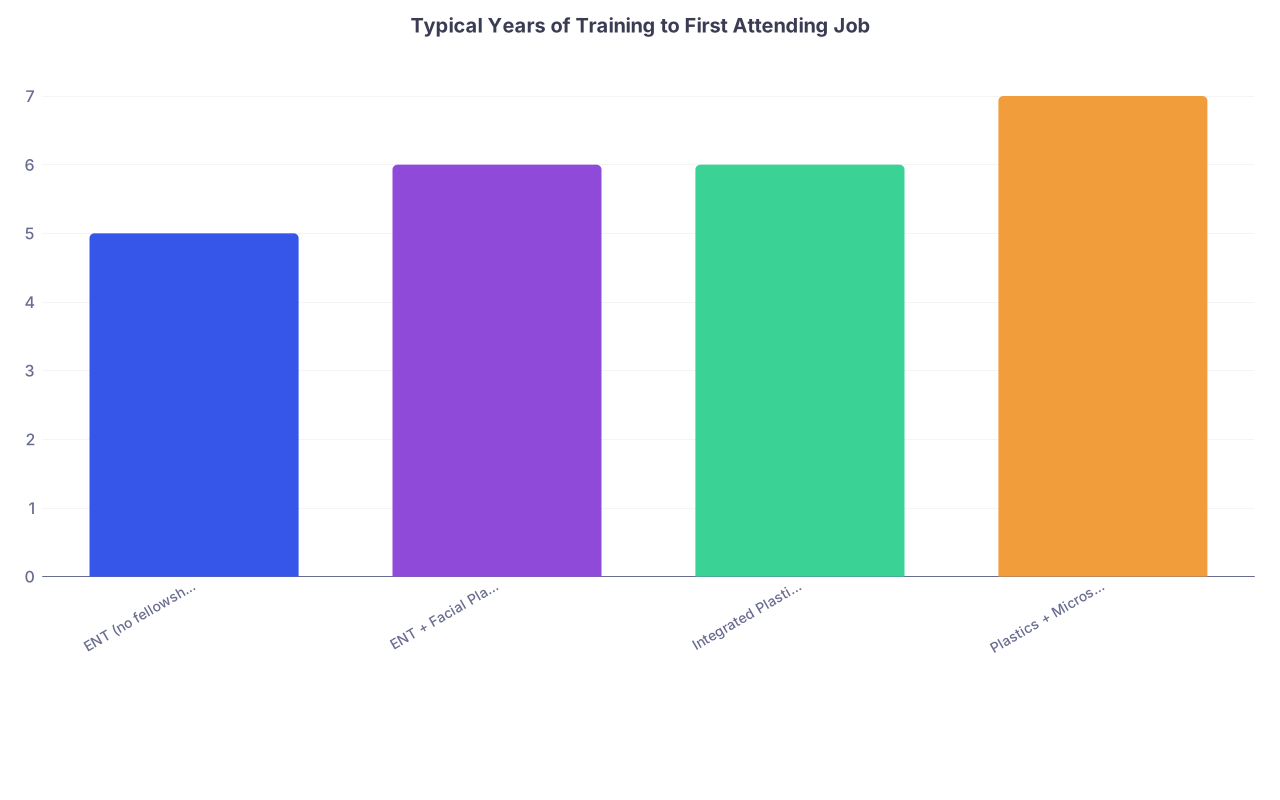
| Category | Value |
|---|---|
| ENT (no fellowship) | 5 |
| ENT + Facial Plastics | 6 |
| Integrated Plastics (no fellowship) | 6 |
| Plastics + Microsurgery | 7 |
Step 2: Reality Notes for Each Path
Write three bullets each:
ENT realities you have seen:
- High volume clinic days with dizzy/fatigue/sinus patients
- Call: airway emergencies, epistaxis, post‑tonsil bleed, neck abscess
- OR: sinus, thyroid, parotid, neck dissections, ear surgery, airway work
Plastics realities you have seen:
- Long recon cases, multiple anastomoses in one day
- Cosmetic clinic: lots of expectation management and minor revisions
- Bread and butter in many practices: hand, skin cancer, breast recon, trauma
If you realize you actually have very thin exposure to one side, note that. We fix it later.
Day 3 – Patient, Case, and Clinic Preference: What You Actually Like Doing
Today you get specific. Not “I like surgery.” Everybody applying to either of these likes surgery.
Step 1: Daily Work Profile – ENT vs Plastics
Use this rough, stereotyped breakdown as a starting point. Then adjust it based on what you’ve actually seen.
| Aspect | ENT (Community Mix) | Plastics (Community Mix) |
|---|---|---|
| Clinic % | 50–60% | 40–60% |
| OR % | 40–50% | 40–60% |
| Typical Clinic | Sinus, ear infections, hearing loss, hoarseness | Skin cancer, hand issues, post-op follow-ups, minor cosmetic |
| Typical OR | Sinus, tonsils, thyroid, parotid, tympanoplasty, airway | Breast recon, hand, skin cancer, trauma, local flaps, occasional big cases |
| Emergencies | Airway, epistaxis | Trauma, bites, hand, replant |
Is this perfectly accurate everywhere? No. But it forces you to confront some truths:
- ENT has a lot of chronic problem management (sinus, hearing, voice).
- Plastics has a lot of defect and deformity reconstruction and post‑op management.
Step 2: Case Autopsy – What Lit You Up
Pull your logbook or just your memory. List:
- 3 ENT cases you loved
- 3 ENT cases you disliked
- 3 plastic surgery cases you loved
- 3 plastic surgery cases you disliked
For each, write one sentence: “I liked/disliked this because…”
Example:
- Loved: “Two‑team free fibula for mandibular reconstruction – loved the micro, the anatomy, and the multi‑step planning.”
- Hated: “Full day of ear tubes and T&A – felt repetitive and unstimulating.”
- Loved: “Endoscopic sinus with skull base approach – enjoyed the anatomy and endoscopic coordination.”
- Hated: “Seven‑hour cosmetic case with frequent back‑and‑forth about millimeter differences – felt tedious and high‑pressure for marginal functional impact.”
Patterns will emerge. Look specifically at:
- Endoscopy vs open surgical work
- Microsurgery vs non‑micro
- Repetitive but efficient vs long and intricate
- Cosmetic focus vs purely functional focus
Day 4 – Lifestyle, Call, and Money: The Boring Stuff That Runs Your Life
This is where people lie to themselves. They say lifestyle “does not matter that much.” Then they have kids and suddenly it matters more than anything.
Step 1: Honest Lifestyle Tolerance
Ask yourself, in writing:
- How many nights of call per month can I realistically tolerate long term (age 40+)?
- Do I care if my clinic days are slammed with lower‑acuity visits?
- Do I want to build a purely cosmetic practice, a purely reconstructive practice, or a mixed practice?
Then, general patterns (yes, there are exceptions):
ENT call
- Airway emergencies can be terrifying but finite.
- A lot of bleed management and abscesses.
- Often shared with multiple partners; in some settings, frequency is decent.
Plastics call
- Trauma, hand injuries, dog bites, facial lacs, replantations.
- Can be heavy in trauma centers and often consult‑driven (ED, other services).
- Some places: lots of middle‑of‑the‑night “rule out hand tendon” that are normal exams.
Step 2: Income and Practice Models (Without Fantasy)
Ignore Instagram surgeons with private jets. Focus on normal distribution.
Very simplified and generalized, but fine for your decision:
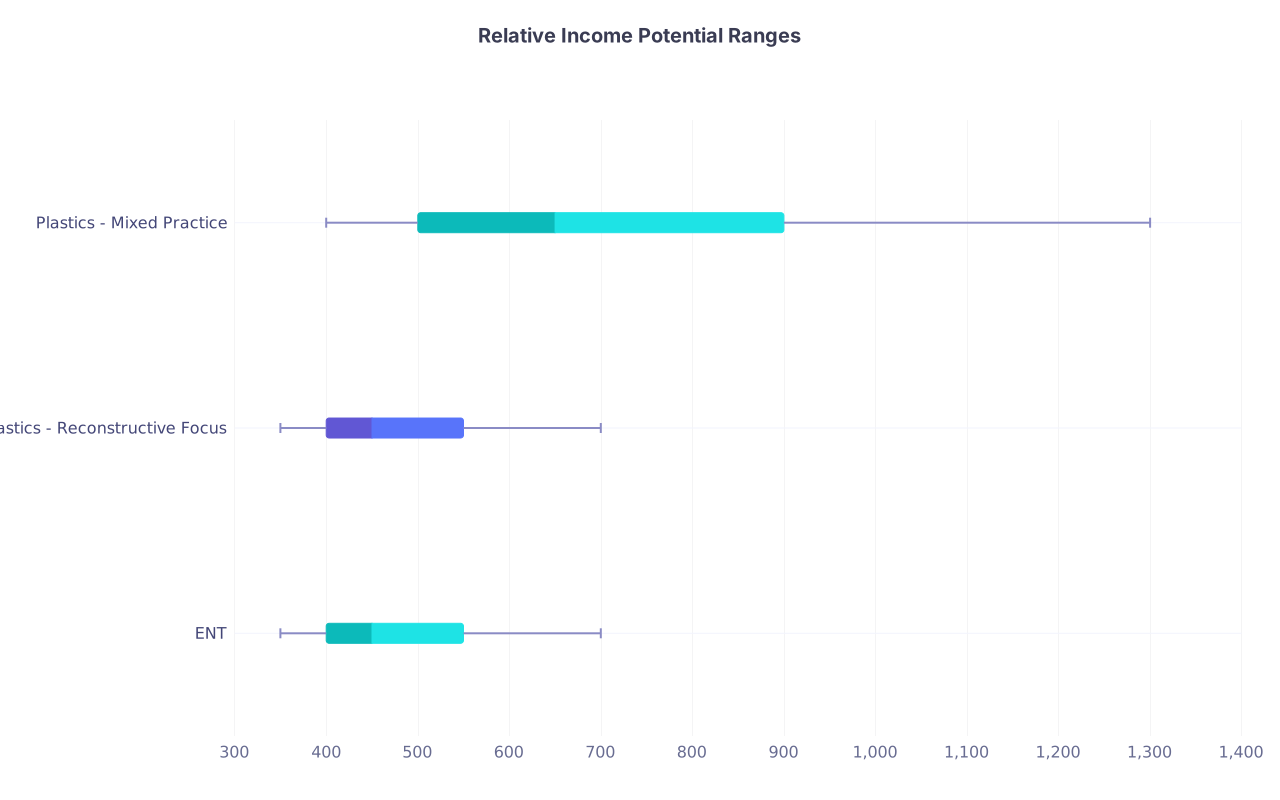
| Category | Min | Q1 | Median | Q3 | Max |
|---|---|---|---|---|---|
| ENT | 350 | 400 | 450 | 550 | 700 |
| Plastics - Reconstructive Focus | 350 | 400 | 450 | 550 | 700 |
| Plastics - Mixed Practice | 400 | 500 | 650 | 900 | 1300 |
- ENT: relatively stable demand, good reimbursement from bread‑and‑butter cases.
- Plastics: floor can be similar to ENT if largely reconstructive; ceiling can be much higher with a strong aesthetic practice in the right market. But that ceiling comes with risk, business stress, and market saturation.
Write down:
- How comfortable am I with business risk and marketing myself?
- Do I want a specialty where insurance‑based work alone can support the life I want?
If your stomach tightens thinking about running a cosmetic business, take that seriously.
Day 5 – Fellowship and Long‑Term Identity
Now we get to the crux of many ENT vs Plastics debates: facial plastics and reconstructive work. This is where people get confused.
Step 1: Decide What You Want to Be “The X Surgeon For”
At 45, what sentence do you want associated with you?
- “She is the go‑to sinus surgeon in town.”
- “He is the cancer and free flap guy.”
- “She is the facelift and rhinoplasty person for the region.”
- “He is the hand and micro guru.”
Write 3 identity sentences you would be happy owning. Then mark which are:
- ENT‑leaning
- Plastics‑leaning
- Either (e.g., facial plastics can be reached from both)
Step 2: Understand the Cross‑Over Zone
Key reality:
- Facial plastics can be reached via:
- ENT + Facial Plastic & Reconstructive Surgery fellowship
- Plastic Surgery + Craniofacial/aesthetic focus
Differences I have seen repeatedly:
ENT‑route facial plastics:
- Often stronger in nasal airway, sinus, skull base, head & neck anatomy, and functional airway work.
- Can do excellent rhinoplasty, facial reconstruction, skin cancer work, etc.
- Typically less breast/body unless they deliberately cross‑train.
Plastics‑route facial/aesthetic:
- Broader exposure to soft tissue techniques, fat grafting, body contouring, breast, and global aesthetics.
- Often deeper immersion in cosmetic business models and marketing.
- Craniofacial can add a lot of complex bony facial work.
Write two lists:
- Things only ENT gives me that I care about.
- Things only Plastics gives me that I care about.
If your lists are vague, you have not thought deeply enough yet. Fix that before sleep.
Day 6 – Targeted Conversations and Shadowing (Fast, Focused, No Fluff)
By now you have thoughts. You need external data and real talk.
Step 1: Schedule or Complete 3 Conversations
You want:
- An ENT attending or senior resident who likes their life.
- A Plastic Surgery attending or senior resident who likes their life.
- At least one person (either side) who is candidly burned out or disillusioned.
Your script (adjust to your style):
“I am trying to decide between ENT and Plastics. I am not asking ‘which is better.’ I want to understand what you like least about your specialty, and if you had a PGY2 redo button, would you pick the same field?”
Specific questions to ask:
- What are three things about your daily work that people outside the specialty do not understand?
- What parts of your job drain you the most?
- How would you describe the culture of your field in one word?
- If your own kid with my personality asked your advice, what would you say?
Take notes immediately after each conversation. Do not filter. Just capture.
Step 2: Micro‑Shadow (If Feasible)
If you can, spend:
- Half a day in a busy ENT clinic
- Half a day in a busy plastics clinic
And at least one OR block on each side if schedules line up.
Your goal is not to see “cool cases.” It is to observe:
- How attendings talk to staff and patients
- How much time is spent on paperwork/EMR
- How much joy or misery lives in the room
Bring a small notepad. Jot down impressions like:
- “Plastics clinic – lots of back‑and‑forth about expectations, some tension around cosmetic outcomes.”
- “ENT clinic – many quick visits, a lot of chronic rhinitis and hearing issues, but efficient flow.”
Day 7 – Decision Grid, Forced Choice, and Contingency Plan
This is where you stop floating in ambiguity and actually decide.
Step 1: Build a Weighted Decision Grid
Make a short list of what matters most to you (no more than 7 items). Example:
- OR case type fit
- Comfort with clinic mix
- Lifestyle/call tolerance
- Identity/fellowship options
- Future income stability
- Geographic flexibility
- Training length tolerance
Assign each a weight 1–5 based on how important it is to you (5 = critical).
Then score ENT and Plastics (1–5) for how well each fits that criterion for you, not in abstract.
Example skeleton:
| Criterion | Weight (1–5) | ENT Score (1–5) | Plastics Score (1–5) |
|---|---|---|---|
| OR case type fit | 5 | ||
| Clinic mix fit | 4 | ||
| Lifestyle/call | 4 | ||
| Identity/fellowship fit | 5 | ||
| Income stability | 3 | ||
| Business tolerance | 3 | ||
| Training length | 2 |
Multiply Weight × Score for each cell, sum ENT and Plastics.
Is this perfectly scientific? No. But it forces prioritization, which is what you have been avoiding.
Step 2: The “No Data Left” Test
Ask yourself:
- Is there any critical piece of information I still lack that could realistically change my decision?
- Example: “I have never seen a cosmetic plastics clinic day and I think I might want a mostly cosmetic practice.”
- If yes, write exactly what you need and how you will get it in the next 2–4 weeks (extra shadow day, call a specific mentor, etc.).
- If not, you have enough data. Your problem now is fear, not ignorance.
Be ruthless here. Endless “I just want more exposure” is usually a cover for decision paralysis.
Step 3: Forced 24‑Hour Choice
Do this alone. No friends. No parents. No PDs.
Flip a coin.
- Heads = ENT
- Tails = Plastics
When it lands, imagine: “This is it. Match email came. I matched into [coin result]. I am committed.”
Pay attention to your gut reaction:
- Relief?
- Panic?
- “Okay, I can work with this”?
This is not mystical. It just bypasses your overthinking for a second.
Then, ask bluntly:
If I could not match into one of these, which loss would hurt more?
The one you would mourn more is usually the one you care about more deeply.
Step 4: Write a One‑Page Decision Justification
Final step. No skipping.
Write one page titled: “Why I Am Choosing [ENT/Plastic Surgery].”
Include:
- My top 3 reasons for this specialty.
- My top 3 known trade‑offs or downsides I accept.
- Why I am rejecting the other field despite its pros.
- How I will feel in 5 years if this choice holds and I am content but not ecstatic. (Can I live with that?)
This document is for future you when you hit a rough patch PGY‑2 and wonder if you messed up. You will have proof that you made a deliberate, informed choice, not a panic decision.
Example: How This Might Actually Look
Let me walk you through a composite example I have seen many times.
- MS4, solid but not superstar stats.
- Loved micro cases, liked head & neck cancer, indifferent to chronic sinus disease clinic.
- Got seduced by high‑end aesthetic surgery on social media.
- Also terrified of debt.
They run the 7‑day plan.
Their grid looks like:
- OR case type: Plastics 5, ENT 4
- Clinic mix: ENT 3, Plastics 4 (less chronic dizziness, more discrete surgical issues)
- Lifestyle: ENT 4, Plastics 3 (regional data: plastics call heavier in local trauma centers)
- Identity/fellowship: tie on paper, but they realize they do not actually care about breast/body; they really only light up with face and micro.
- Income: Plastics 5, ENT 4 (ceiling higher in their mind)
- Business tolerance: ENT 4, Plastics 2 (hates self‑promotion, gets anxiety thinking about social media branding)
- Training length: ENT 4, Plastics 3 (6 vs 5 years)
Weighted sums favor ENT slightly. But the real kicker: in the coin‑flip test, when it lands Plastics, they feel a tightness in their chest thinking about the business and aesthetic pressure. When it lands ENT, they feel, “Okay. I can breathe.”
They choose ENT with a plan: head & neck + micro fellowship, maybe facial plastics later if desire holds. They mourn body/aesthetic a bit. Then they move on. Five years later, they are the regional flap and airway person, and they are fine.
Is that the right answer for everyone? Obviously not. But that is how an adult decision looks: specific, reasoned, trade‑offs acknowledged.
Quick Visual: The 7‑Day Decision Workflow

| Step | Description |
|---|---|
| Step 1 | Day 1 Self Audit |
| Step 2 | Day 2 Training Paths |
| Step 3 | Day 3 Case and Clinic Fit |
| Step 4 | Day 4 Lifestyle and Money |
| Step 5 | Day 5 Fellowship and Identity |
| Step 6 | Day 6 Conversations and Shadowing |
| Step 7 | Day 7 Decision Grid and Choice |
| Step 8 | Commit to Specialty |
| Step 9 | Targeted Extra Exposure |
| Step 10 | Enough Data? |
Frequently Asked Questions
1. What if I still feel 50/50 even after doing all 7 days?
You are not 50/50. You are scared of closing doors. After you run the decision grid and coin‑flip tests, you will almost always see small asymmetries. If after all that you remain paralyzed, force yourself to pick based on which daily clinic you prefer. You spend more of your career in clinic than a highlight‑reel OR. Choose the clinic you dislike less. That sounds unromantic. It is also how most attendings maintain sanity.
2. Should competitiveness or my Step scores decide this?
Scores and competitiveness are constraints, not primary drivers. You absolutely need to be realistic about match odds in both ENT and Plastics. If your profile makes integrated plastics nearly impossible but ENT realistic, that is relevant. But do not contort yourself into a field you fundamentally do not want purely because it is marginally easier to match. If you truly want the harder field, build an aggressive backup plan (prelim year, research, alternate specialty you also could accept) and own the risk.
3. What if I choose ENT and later realize I really want Plastics (or vice versa)?
Changing later is possible, painful, and rare. People do go from ENT to independent plastics or from general surgery to plastics, but it costs you years. If you honestly think you might only be happy as a plastic surgeon and would always wonder “what if,” you should probably aim for Plastics now and accept the risk. If you can clearly see yourself happy in ENT with a strong reconstructive or facial plastics focus, that is not a consolation prize; that is a valid, robust career path. The key is to decide now which regret you can live with more easily: never doing body/aesthetic in a plastics context, or never owning airway/ear/sinus/head & neck in an ENT context.
Key points to walk away with:
- You are not choosing which specialty is “better.” You are choosing which daily problems and trade‑offs you are willing to own for decades.
- A structured 7‑day plan beats endless vague reflection. Do the exercises, write things down, and force a decision.
- Once you choose, stop re‑litigating the case daily. Commit, work hard, and use your fellowship and practice choices to fine‑tune the career you already decided to build.