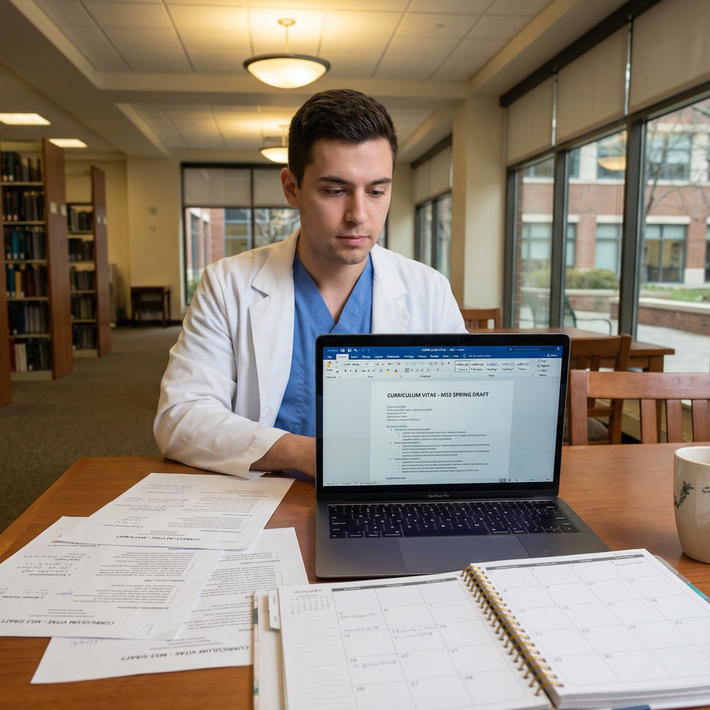
Applying for residency is one of the highest-stakes transitions in medical education. Years of exams, clerkships, and clinical evaluations culminate in a few months of forms, essays, interviews, and decisions that will shape your training and career.
Yet every year, otherwise strong candidates undermine their success by making avoidable mistakes. These are the “seven deadly sins” of residency applications—common pitfalls that can quietly weaken your application, limit your interview invitations, and ultimately affect your match outcome.
This guide breaks down each of these mistakes and shows you exactly how to avoid them, with practical tips tailored to modern residency applications, including ERAS, networking, and virtual interviewing.
Understanding the High Stakes of Residency Applications
Residency applications are more competitive and complex than ever. Programs receive hundreds (sometimes thousands) of applications for a limited number of interview spots. Reviewers often spend only a few minutes per application to decide whether to offer an interview.
To stand out, you must do more than simply meet requirements. You must:
- Present a coherent, compelling narrative across your Personal Statement, CV, and Letters of Recommendation
- Demonstrate genuine interest and good fit with each residency program
- Avoid errors that raise red flags or suggest carelessness, disorganization, or lack of professionalism
The seven “deadly sins” below are not just minor missteps—they are patterns that can seriously hurt your chances. The good news: every one of them is preventable with planning, insight, and attention to detail.
Sin #1: Neglecting Research on Residency Programs
Residency programs can quickly tell who has taken the time to understand them—and who is mass-applying without discrimination. Superficial, generic applications are a major red flag.
Why Program Research Is Critical
Every residency program is unique in:
- Training philosophy (community-focused, academic, research-intensive, primary care–oriented, etc.)
- Patient population and clinical exposure (urban underserved, rural, tertiary referral center, VA, county hospital)
- Curriculum and rotations (subspecialty exposure, elective time, call structure, night float, simulation training)
- Scholarly expectations (research, quality improvement, teaching opportunities)
- Culture and support (wellness initiatives, mentorship, diversity and inclusion efforts)
If your application suggests you don’t understand a program’s identity—or worse, that you’re a poor fit—you will often be screened out before the interview stage.
How to Research Programs Effectively
Use multiple sources, not just the program’s homepage:
Official program website
- Read the program director’s message carefully
- Review curriculum, required and elective rotations
- Note any unique tracks (research, global health, primary care, leadership, etc.)
FREIDA, NRMP, and specialty organization resources
- Look at program size, board pass rates, fellowship match outcomes
- Assess call schedule, educational structure, and benefits
Program social media (Twitter/X, Instagram, LinkedIn)
- Get a sense of culture, resident camaraderie, and day-to-day life
- Note recurring themes: research, wellness, advocacy, community outreach
Current and former residents
- Reach out via alumni networks, mentors, or LinkedIn
- Ask about strengths, challenges, and what type of applicant tends to thrive there
How to Show You’ve Done Your Homework
Tailor your Personal Statement when possible
- Reference specific aspects of a program that align with your goals
- Example: “I am particularly drawn to your program’s dedicated rotation at the county hospital and its strong emphasis on caring for uninsured and underinsured populations…”
Customize your ERAS Program Signals (if applicable)
- Use signaling strategically to show sincere interest in selected programs
Ask thoughtful questions on interview day
- Avoid generic questions you could answer from the website
- Instead ask: “How does your program support residents interested in [X]?” or “Can you describe how residents are involved in quality improvement or research?”
Neglecting research tells programs you’re not truly invested. Demonstrating insight into their specific strengths signals maturity, professionalism, and genuine interest.

Sin #2: Treating Your Personal Statement as an Afterthought
The Personal Statement remains one of the few spaces in residency applications where you can speak directly to program directors in your own voice. Yet many applicants either rush it, recycle generic content, or repeat their CV in paragraph form.
Why the Personal Statement Matters
Program leadership often uses the Personal Statement to answer:
- Who is this person beyond their scores and grades?
- Why this specialty—and is their motivation thoughtful and sustainable?
- How do they reflect on challenges, growth, and patient care?
- Will they be a good colleague, learner, and representative of our program?
A bland, cliché-filled, or error-ridden Personal Statement can drag down an otherwise strong application.
How to Craft a Strong Personal Statement
1. Lead with a focused narrative, not a dramatic cliché
Avoid overused opening lines (“I have wanted to be a doctor since I was a child”) or traumatic shock-value stories that don’t connect to your current goals.
Instead:
- Start with a concise clinical vignette, reflection, or moment that truly shaped your path to this specialty
- Follow quickly with why it matters and what it reveals about your values or interests
2. Connect your story to the specialty explicitly
Answer clearly:
- Why this specialty (and not another)?
- What aspects of the work energize you (procedures, longitudinal relationships, acute care, complex diagnostics, advocacy, etc.)?
- How have your experiences confirmed or refined this decision?
3. Show growth, not perfection
Residency programs appreciate resilience and insight:
- Discuss a challenge or setback you faced
- Emphasize what you learned, how you adapted, and how it shaped you as a future resident
- Avoid purely confessional tones without clear growth
4. Align your future goals with training needs
Briefly outline:
- What kind of physician you hope to become (academic, community, rural, subspecialty, global health, etc.)
- How residency training is a key step in that path
- General program features you value (strong mentorship, diverse patient populations, robust teaching culture), without naming one specific institution unless you truly are tailoring to that program
5. Edit for clarity, structure, and professionalism
- Keep it within typical ERAS length (often around 650–850 words; check current guidance)
- Eliminate filler phrases and redundant sentences
- Triple-check grammar, spelling, and formatting
- Ask mentors, advisors, or writing centers to review—but keep your authentic voice
A Personal Statement will not singlehandedly overcome major academic deficiencies, but a compelling, mature narrative can significantly strengthen your profile and positively influence interview decisions.
Sin #3: Settling for Weak or Generic Letters of Recommendation
Letters of Recommendation (LoRs) are often decisive in competitive specialties. A generic, lukewarm, or vague letter can hurt you more than no letter at all.
Why Strong Letters of Recommendation Are Essential
Program directors rely on LoRs to:
- Validate your clinical performance and professionalism
- Assess your communication skills, teamwork, and work ethic
- Compare you to peers (e.g., “top 10% of students I’ve worked with”)
- Predict how you will perform as a resident
A strong letter is specific, comparative, and enthusiastic. A weak letter is generic, non-committal, or faintly critical.
How to Secure Excellent Letters
1. Choose recommenders strategically
Prioritize:
- Faculty who have directly supervised you clinically
- Attending physicians in your chosen specialty (most programs specify how many are preferred)
- Mentors who know your work over time (research, QI, advocacy)
- People who genuinely like and respect you
Avoid:
- Big names who barely know you
- Faculty who seem hesitant when asked
Ask directly:
“Do you feel you can write a strong, supportive letter of recommendation for my residency application?”
2. Make it easy for them to write a strong letter
Provide:
- Your updated CV or ERAS-generated application
- Your Personal Statement draft
- A brief summary of work you did with them (clinical cases, projects, presentations)
- Any specific qualities you hope they might comment on (clinical reasoning, teamwork, reliability, leadership)
Include:
- A clear deadline (well before ERAS submission)
- Instructions on how to upload via ERAS (or other system, if applicable)
3. Manage timing and follow-up professionally
- Ask for letters at least 4–6 weeks before they are needed
- Set personal reminders to follow up 2–3 weeks before deadlines
- Send a courteous reminder if the deadline is approaching
- Always send a thank-you email once letters are submitted—and again after Match Day with your outcome
Thoughtful, specific Letters of Recommendation are powerful endorsements. Do not treat them as a last-minute checkbox.
Sin #4: Overlooking Application Deadlines and Requirements
In residency applications, missing a deadline is often equivalent to not applying at all. Programs may not even see your application if key components are late or incomplete.
The Cost of Disorganization
Common errors include:
- Submitting your ERAS application late in the cycle
- Having Letters of Recommendation arrive after interview offers are already being sent
- Missing supplemental application deadlines (where applicable)
- Incomplete exam documentation (USMLE/COMLEX scores, ECFMG certification for IMGs)
- Ignoring program-specific requirements (e.g., a minimum number of specialty LoRs, a separate supplemental essay, or a program-specific form)
Programs interpret these mistakes as signs of disorganization or lack of interest.
How to Stay Organized and On Time
1. Build a master application timeline
Include:
- ERAS opening and submission dates
- NRMP registration deadline and rank list deadlines
- Exam reporting timelines (when scores will be available)
- Program-specific deadlines and any supplemental materials
- Target dates to finalize your Personal Statement, CV, and LoRs
2. Create a tracking spreadsheet
For each program, track:
- Application status (submitted/not submitted)
- Required number and type of LoRs
- Whether supplemental applications were completed
- Deadlines and interview dates
- Notes from interactions or networking
3. Use digital systems to your advantage
- Calendar apps (with alerts) for all major milestones
- Task management tools (e.g., Trello, Notion, Google Tasks)
- Cloud storage for all documents (organized in clearly labeled folders)
4. Build in buffer time
Aim to:
- Finalize your application at least a few days before you intend to submit
- Have all LoRs requested and in progress at least a month before application submission
- Schedule and take exams with enough lead time for scores to be reported before programs review applications
Timeliness and completeness are simple but crucial signals of professionalism in residency applications.
Sin #5: Dishonesty or Inconsistency in Your Application
Residency programs take integrity extremely seriously. Any sign of dishonesty, embellishment, or inconsistency can severely damage your chances—and may have long-term consequences.
Why Integrity Matters So Much
Residency involves:
- Caring for vulnerable patients
- Documenting accurately in medical records
- Working in high-trust, high-stakes teams
- Meeting licensing and credentialing standards
Program directors must be confident that residents are honest, reliable, and transparent.
Common Red Flags
- Discrepancies between your CV and transcripts
- Inflated descriptions of roles (e.g., listing yourself as “first author” on a paper that’s only in the idea stage)
- Listing “ongoing research” with no real involvement or unrealistic claims
- Different dates or descriptions across ERAS, CV, and interview responses
- Minimizing or hiding exam failures, leaves of absence, or professionalism concerns
How to Navigate Imperfections Honestly
1. Be precise in how you list experiences
- Clearly label research as “submitted,” “in preparation,” or “published”
- Use accurate titles: research assistant, co-author, contributor, etc.
- Match dates across all documents
2. Address gaps or issues transparently
If you have:
- A leave of absence
- A failed or low board score
- Academic probation or professionalism concerns
Then:
- Work with a trusted advisor or dean to frame an honest explanation
- Focus on reflection, remediation, and growth
- Be prepared to discuss it calmly and confidently during interviews
3. Maintain consistency everywhere
- Ensure that what you say on interview day matches what’s on paper
- Double-check all dates, roles, and descriptions for accuracy
- Avoid exaggerating in conversation—interviewers recognize this quickly
Owning your story, with its imperfections, will always serve you better than trying to obscure it.
Sin #6: Failing to Highlight and Frame Your Clinical Experience
Residency programs are training clinicians. If your application doesn’t clearly communicate your clinical readiness, decision-making, and patient-centered approach, you are at a disadvantage.
Why Clinical Experience Is Central
Programs want to see that you can:
- Function effectively on a clinical team
- Handle responsibility appropriate to your level
- Communicate with patients, families, and other professionals
- Think critically and apply medical knowledge at the bedside
This applies both to U.S. graduates and international medical graduates (IMGs), for whom recent, supervised clinical experience is particularly important.
How to Showcase Clinical Experience Effectively
1. Be specific and outcome-focused on your CV
Instead of vague bullet points like:
“Participated in patient care on internal medicine rotation”
Use action-oriented, concrete descriptions:
- “Performed focused histories and physicals on 8–12 patients per day under supervision”
- “Developed daily assessment and plan, presented on rounds, and incorporated feedback”
- “Communicated diagnostic and treatment plans to patients and families with attending oversight”
2. Align experiences with your chosen specialty
For example, for Internal Medicine:
- Emphasize inpatient rotations, outpatient continuity clinics, ICU or step-down experiences
- Highlight experiences caring for patients with complex chronic disease, multi-morbidity, or diagnostic uncertainty
For Surgery:
- Describe pre-op and post-op care, OR participation, hands-on procedural skills, and teamwork under pressure
3. Integrate clinical experiences into your Personal Statement
Show:
- How specific patient encounters shaped your professional identity
- How you learned to manage uncertainty, complexity, or emotional challenges
- What you’ve discovered about your strengths and areas for growth in clinical care
4. For IMGs: Be strategic about U.S. clinical experience (USCE)
- Prioritize supervised, hands-on roles where allowed (sub-internships, electives)
- If limited to observerships, highlight what you gained in terms of understanding the U.S. healthcare system, documentation, and team dynamics
- Ensure your Letters of Recommendation comment explicitly on your clinical abilities when possible
The goal is to leave programs confident that you will transition smoothly into the role of an intern.

Sin #7: Neglecting to Network Strategically and Professionally
Networking is not about favoritism—it’s about building genuine professional relationships that can inform your decisions and occasionally open doors. Ignoring this aspect of residency applications can mean fewer insights, fewer advocates, and fewer chances to stand out.
Why Networking Matters in the Residency Match
Thoughtful networking can:
- Give you inside perspective on program culture and expectations
- Help you decide which programs truly fit your goals and values
- Lead to mentorship and advocacy from faculty who know you
- Sometimes influence which applications get a closer look during screening
In competitive specialties, a positive word from someone trusted by the program can be especially valuable.
How to Network Effectively and Ethically
1. Start with your existing circles
- Home institution faculty and residents in your chosen specialty
- Clinical and research mentors
- Student interest groups and specialty-specific organizations
Ask for:
- Honest feedback on your competitiveness and application strategy
- Suggestions of programs that might fit your profile
- Potential introductions to colleagues at other institutions (when appropriate)
2. Be present at professional spaces
- Attend national or regional conferences in your specialty (virtual or in-person)
- Participate in poster or oral presentations where possible
- Join interest groups, workshops, and networking events hosted by specialty organizations
When you meet someone:
- Introduce yourself concisely (name, medical school, specialty interest, key interests)
- Ask genuine questions about their work or program
- Exchange contact information if the conversation is substantive
3. Follow up and maintain professionalism
After meeting someone:
- Send a brief thank-you email referencing something specific you discussed
- Ask whether you may reach out again with questions as you apply
- Do not pressure them to intervene on your behalf; instead, ask for advice
If a mentor offers to contact a program on your behalf, that can be helpful, especially when it’s natural (e.g., they recently worked there or know the program director).
4. Use virtual opportunities wisely
- Attend virtual open houses and information sessions
- Come prepared with thoughtful questions that show you’ve researched the program
- Keep your video background professional and minimize distractions
- Maintain appropriate “Zoom etiquette”: good lighting, eye contact, and engagement
Done well, networking enhances—not replaces—the substance of your residency application.
Conclusion: Build a Thoughtful, Honest, and Strategic Application
Avoiding these seven deadly sins of residency applications can dramatically strengthen your chances in the Match:
- Neglecting Research on Programs – Know where and why you’re applying.
- Treating the Personal Statement as an Afterthought – Use it to communicate your story and motivations clearly.
- Settling for Weak Letters of Recommendation – Strategically secure strong, specific endorsements.
- Overlooking Deadlines and Requirements – Stay meticulously organized and ahead of schedule.
- Dishonesty or Inconsistency – Protect your integrity; own your true story.
- Failing to Highlight Clinical Experience – Demonstrate readiness to step into the role of resident.
- Neglecting to Network – Build meaningful professional relationships and seek informed guidance.
Residency Programs seek not only high-performing applicants, but also colleagues they can trust and teach for several years. Your goal is to present a cohesive, honest, and thoughtful application that reflects who you are now and who you are becoming as a physician.
Approach the process with preparation, humility, and intention—and you will maximize your chances of matching into a program where you can thrive.
Frequently Asked Questions About Residency Applications
1. What are the most important components of a strong residency application?
Programs typically weigh a combination of:
- Clinical performance and evaluations (especially core clerkships and sub-internships)
- Board scores (USMLE/COMLEX), though some specialties are moving toward more holistic review
- Letters of Recommendation (especially from within the specialty)
- Personal Statement (clarity of motivation, fit with specialty)
- CV/experiences (clinical, research, leadership, service, teaching)
- Evidence of professionalism and reliability
No single component guarantees success, but consistent strength across several areas—along with avoiding major red flags—gives you the best chance.
2. How many residency programs should I apply to?
The ideal number varies by specialty competitiveness, your individual profile, and advice from mentors. General guidelines:
- Less competitive specialties or strong applicants: fewer applications may suffice
- More competitive specialties or applicants with risk factors (exam failures, visa needs, older graduation year, etc.): more applications may be necessary
Recent data from NRMP and specialty organizations often include recommended application ranges. Review these and discuss them with your dean’s office or specialty advisors for a personalized plan.
3. How can I improve my Personal Statement for residency?
To strengthen your Personal Statement:
- Start early and draft multiple versions
- Center your narrative on genuine experiences, not what you think programs want to hear
- Clearly answer why you chose this specialty and what kind of resident you aim to be
- Show reflection and growth, not just accomplishments
- Avoid repeating your CV or listing every experience
- Seek feedback from mentors, advisors, or writing centers
- Revise several times for structure, clarity, and concision
Remember that authenticity, insight, and professionalism often matter more than dramatic stories.
4. What should I do if I have red flags (failed exams, gaps, or leaves of absence)?
First, know that many applicants with red flags still match successfully. Approach them proactively:
- Seek honest guidance from your dean’s office, advisors, or mentors
- Address the issue briefly and honestly in your application or during interviews when appropriate
- Focus on:
- What happened (succinctly, without excuses)
- What you learned from it
- Concrete steps you took to improve (study strategies, wellness changes, time management, etc.)
- Subsequent evidence of success (improved scores, strong evaluations)
Programs are often more concerned with how you responded to challenges than with the fact that you faced them.
5. How important is networking in the residency application process?
Networking can:
- Help you understand program culture and expectations
- Connect you with mentors who provide feedback and advocacy
- Occasionally increase your visibility to certain programs
However, it cannot substitute for strong fundamentals (clinical performance, exams, professionalism). Think of networking as a valuable supplement to a well-prepared application rather than a shortcut.
Focus on building genuine, respectful professional relationships. Over time, these connections will support not only your residency match, but your entire medical career.