Applying for residency is one of the highest-stakes transitions in medical education. Between drafting Personal Statements, coordinating Letters of Recommendation, organizing your CV, and preparing for interviews, even strong applicants can be tripped up by avoidable errors. Many of these mistakes are subtle—not about your scores or transcripts, but about how you present your story, your professionalism, and your fit for a program.
This guide breaks down the most common mistakes in the residency application process and provides concrete, actionable strategies to avoid them. Whether you’re just starting to prepare or are in the middle of interview season, you can use these insights to strengthen every part of your Residency Application.
Understanding the Residency Application Process
Before you can optimize your application, you need a clear, strategic overview of its major components. Most Residency Match and Applications cycles (e.g., through ERAS/NRMP in the U.S.) include:
Personal Statement: Your Professional Narrative
Your Personal Statement is more than a story; it’s your chance to connect your experiences, motivations, and goals to a specific specialty and type of training environment. Programs use it to answer questions like:
- Why this specialty?
- Why now?
- How have your experiences prepared you for residency?
- What kind of resident and colleague will you be?
Letters of Recommendation (LoRs): External Validation
Letters of Recommendation are powerful because they provide an outside, often senior, perspective on your clinical skills, professionalism, and potential. Strong LoRs:
- Offer specific examples of your work
- Compare you favorably to peers
- Comment on your clinical reasoning, communication, and teamwork
- Support your chosen specialty and career goals
Curriculum Vitae (CV): Your Professional Timeline
Your CV (or ERAS application sections) provides a structured view of your:
- Education and training
- Clinical experiences and electives
- Research, publications, and presentations
- Leadership, teaching, and volunteer work
- Awards and honors
Programs glance at this quickly; clear organization and thoughtful content selection can influence whether they read more deeply.
Interviews: Turning Paper into Person
Once you’re invited to Interviews, the focus shifts from “Can this applicant do the work?” to “Will this applicant be a good fit here?” Interviews are where you:
- Demonstrate interpersonal skills and professionalism
- Clarify your interests and career goals
- Assess whether the program’s culture, training environment, and support systems fit your needs
- Leave a memorable, positive impression that can influence rank decisions
Understanding how each component functions helps you avoid common mistakes and approach your Residency Application as a cohesive whole rather than a set of disconnected tasks.
Mistake #1: Weak or Generic Personal Statements
A weak Personal Statement is one of the most common—and most damaging—errors in residency applications. Programs read hundreds of statements every year. Generic, cliché-filled essays blur together and do nothing to distinguish you.
Common Personal Statement Pitfalls
1. Generic, interchangeable content
- Overused openings: “I have always wanted to be a doctor…”
- Vague phrases: “I am passionate about helping others,” “I love working with people”
- Statements that could apply to any specialty or any applicant
2. Failing to show specialty fit
Applicants sometimes recycle a single Personal Statement across multiple specialties—or even across very different program types within a specialty. This can make it seem like you lack clear direction or understanding of the field.
3. Being overly autobiographical with no connection to residency
Long stories about childhood illnesses, family members’ medical histories, or unrelated life events can overshadow your recent, relevant clinical experiences and professional development.
4. Telling, not showing
Saying “I am compassionate, hardworking, and a team player” without examples is weak evidence. Program directors value concrete examples far more than self-descriptions.
5. Poor structure, length, or mechanics
- Rambling, unfocused paragraphs
- Excessive length beyond one page in ERAS formatting
- Typos, grammatical errors, or awkward phrasing
How to Strengthen Your Personal Statement
1. Anchor your statement in specific, recent experiences
Choose 1–3 key experiences that:
- Happened during medical school (or recent clinical work for non-traditional applicants)
- Show your growth, resilience, and curiosity
- Illustrate why you’re drawn to this specialty
Example:
Instead of saying, “I enjoy continuity of care,” describe a specific patient you followed across multiple visits, and what you learned about longitudinal relationships, systems-based practice, and advocacy.
2. Explicitly connect your experiences to your specialty
Ask yourself:
- What aspects of this specialty energize me (procedures, long-term relationships, acute care, complex problem-solving, etc.)?
- What experiences confirmed, challenged, or deepened this interest?
- How do my values align with the culture of this field?
Then, explicitly articulate these links. Program directors shouldn’t have to infer why you belong in their specialty.
3. Show your trajectory: past, present, future
A strong Personal Statement answers:
- Past: What experiences led you toward this specialty?
- Present: What skills and strengths do you bring now?
- Future: What kind of resident and future physician do you aspire to be?
Tie these together so your narrative feels coherent and purposeful.
4. Prioritize clarity and professionalism over drama
You don’t need a traumatic story or dramatic plot twist. Admissions committees are looking for:
- Insight and reflection
- Maturity and self-awareness
- Commitment to learning and teamwork
A clear, well-written, sincere statement beat a dramatic but unfocused one every time.
5. Revise with targeted feedback
- Ask a mentor in your specialty to review for content and “fit”
- Ask someone skilled in writing to review for structure and clarity
- Always run spell-check and read it aloud to catch awkward sentences
Mistake #2: Unfocused or Weak Letters of Recommendation
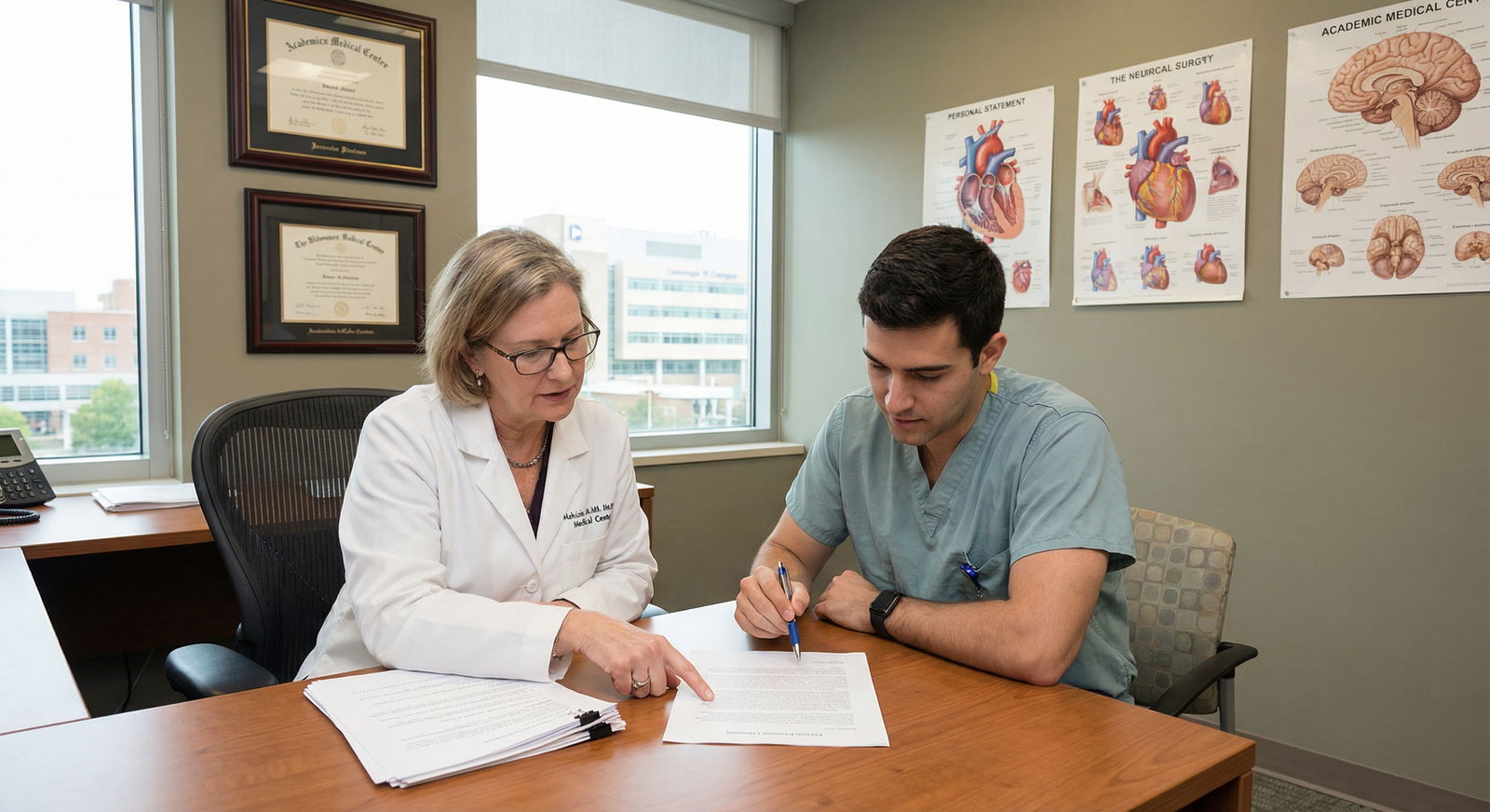
Letters of Recommendation carry significant weight in residency selection. A strong LoR can elevate your whole application, while a vague or lukewarm one can quietly hurt you.
Common LoR Mistakes
1. Choosing letter writers who barely know you
A short-time observer or a distant department chair might not be able to offer specifics, resulting in generic lines like, “This student rotated on our service and performed adequately.” These comments add little value.
2. Failing to align letters with your chosen specialty
Letters from unrelated fields are not always harmful, but they are less powerful unless they speak directly to skills that clearly translate to your specialty.
3. Not giving writers enough information or time
Rushed letters are more likely to be short, generic, or missing entirely by the application deadline.
4. Not clarifying whether the writer can provide a strong recommendation
Some faculty will agree to write a letter but may not feel strongly positive about your performance. This can result in a neutral or even subtly negative letter.
Strategies for Stronger Letters of Recommendation
1. Choose writers who know you well and can be specific
Ideal letter writers:
- Supervised you closely in a clinical setting
- Observed your clinical reasoning, communication, and teamwork
- Seem enthusiastic about your work
- Are from your chosen specialty, when possible
It is usually better to have a detailed letter from an associate professor who knows you well than a vague letter from a famous chair who barely interacted with you.
2. Ask directly and professionally
When asking for a letter, consider phrasing like:
“Do you feel you know me and my work well enough to write a strong letter of recommendation for my [specialty] residency application?”
This gives the faculty member an opportunity to decline if they can’t be strongly supportive.
3. Provide a “letter writer packet”
Include:
- Your CV or ERAS application draft
- Your Personal Statement or at least your specialty choice and career goals
- A brief paragraph reminding them of specific cases, projects, or feedback they gave you
- Deadlines and submission instructions
This helps them recall your contributions and tailor their comments.
4. Ask early—well before deadlines
Aim to ask:
- At least 4–8 weeks before submission
- Even earlier for busy faculty, department chairs, or away rotation supervisors
Polite, spaced-out reminders before the deadline are appropriate.
5. Strategically balance your letter set
For most specialties, a balanced set might include:
- 2–3 letters from your chosen specialty (if possible, including a department letter if required)
- 1 letter from another field or setting that highlights transferrable skills (e.g., ICU, internal medicine for a surgical applicant, or vice versa)
- For academic or research-focused programs, a research mentor letter can be valuable if it speaks to your work ethic and analytical skills.
Mistake #3: Overloaded or Disorganized CVs and Application Entries
Your CV and ERAS application are not meant to be a complete autobiography. Overloading them with every minor activity can make it harder for reviewers to see what truly matters.
Common CV/Application Pitfalls
1. Quantity over quality
Listing every 2-hour volunteer shift or one-off event can dilute the impact of your most meaningful experiences.
2. Poor organization and formatting
- Inconsistent dates or missing locations
- Unclear role descriptions
- Overly long bullet points or dense paragraphs
3. Exaggeration or misrepresentation
Inflating your responsibilities, titles, or time commitment is unethical and often apparent to experienced reviewers.
Building a Strong, Impactful CV
1. Prioritize relevance to residency
Focus on experiences that show:
- Clinical exposure and responsibility
- Leadership and initiative
- Teaching or mentoring
- Research and scholarly activity
- Long-term commitment and follow-through
You can still include other experiences, but give priority in description and placement to those most relevant to medical training.
2. Use clear structure and hierarchy
Organize your CV by sections, such as:
- Education
- Clinical Experiences
- Research Experience
- Publications and Presentations
- Leadership and Service
- Teaching
- Honors and Awards
- Skills (languages, technical skills, etc., if appropriate)
Within each section, use consistent formatting and reverse chronological order.
3. Write concise, specific descriptions
Use action verbs and measurable outcomes where possible:
- “Led weekly small-group sessions for 12 first-year students on physical exam skills.”
- “Coordinated scheduling and logistics for a 20-member student-run clinic; increased patient visits by 30% over one year.”
- “Assisted in data collection and statistical analysis for a multi-center study on heart failure outcomes.”
4. Be honest and ready to discuss anything listed
Anything you list can be asked about during interviews. If you can’t comfortably discuss an experience with detail and reflection, consider whether it belongs in your application.
5. Tailor emphasis by program type when possible
While you can’t rewrite your entire ERAS for each program, you can:
- Adjust which experiences you highlight in your Personal Statement
- Emphasize different aspects of your background in interview answers (e.g., research vs. community service)
Mistake #4: Underprepared and Anxious Interview Performance
Residency Interview Preparation is often underestimated. Many applicants assume their academic record will “speak for itself,” but interview days heavily influence ranking decisions.
Common Interview Mistakes
1. Limited preparation for common questions
Struggling through basic questions like “Why this specialty?” or “Tell me about yourself” signals poor preparation, not poor ability.
2. Not researching programs
Inability to answer, “What interests you about our program?” or ask specific, thoughtful questions suggests a lack of genuine interest.
3. Over-rehearsed or robotic answers
Memorized scripts can sound unnatural. Interviewers want authenticity, not theatrical performances.
4. Difficulty communicating under stress
Nervousness is normal, but if it prevents you from clearly articulating your experiences or thoughts, it can hurt your evaluation.
5. Unprofessional virtual interview setup (for online interviews)
- Poor lighting or camera angle
- Distracting background
- Unstable internet connection
- Casual attire
Effective Residency Interview Preparation Strategies
1. Develop clear, flexible “core stories”
Prepare 6–8 key stories that demonstrate:
- Teamwork and collaboration
- Dealing with conflict
- A mistake or failure and what you learned
- Managing stress or high workload
- Leadership or initiative
- A meaningful patient interaction
- Interest in your chosen specialty
You can adapt these stories to answer a variety of questions.
2. Practice aloud with mock interviews
- Use mentors, residents, or career advising offices whenever possible
- If not available, record yourself on video and review your responses
- Focus on clarity, pacing, and non-verbal communication (eye contact, posture)
3. Research each program before the interview
At a minimum, know:
- Program size and structure
- Unique tracks or strengths (e.g., research, community health, global health)
- Geographic and patient population characteristics
- Any recent changes (new program director, new rotation sites, etc.)
Use this information to tailor your answers and ask specific questions.
4. Manage nerves with structure and preparation
- Prepare your outfit, logistics, and technology (for virtual interviews) the night before
- Use brief relaxation techniques (deep breathing, short walk) before the interview
- Remind yourself: programs invited you because they already believe you can succeed—now they want to know who you are.
5. Treat every interaction as part of the interview
For in-person or virtual:
- Be professional and courteous with coordinators and residents
- Engage actively in social events or pre-interview sessions
- Avoid negative comments about other programs or individuals
Programs often ask their residents and coordinators for feedback on applicants.
Mistake #5: Neglecting Post-Interview Communication and Follow-Up
Post-interview behavior may not “make” your application, but it can influence how memorable and professional you appear. It’s also an opportunity to reinforce your interest.
Common Post-Interview Mistakes
1. Skipping thank-you notes entirely
Some programs do not weigh them heavily, but a complete lack of follow-up can feel abrupt or disinterested.
2. Sending generic, copy-paste messages
Using the same thank-you email for every interviewer makes your message feel hollow and impersonal.
3. Inappropriate or excessive communication about ranking
Overly detailed emails about how you will rank a program may be discouraged or prohibited by Match communication guidelines and can feel uncomfortable.
Professional Follow-Up Strategies
1. Send personalized thank-you emails within 24–48 hours
Each email should:
- Use your interviewer’s correct name and title
- Reference a specific topic you discussed (e.g., a research interest, a unique rotation, mentorship opportunities)
- Reiterate one or two reasons you are excited about the program
- Be concise and professional
2. Keep communication ethical and in line with Match guidelines
- Avoid asking programs how they will rank you
- Avoid making explicit commitments that you cannot keep
- Follow your specialty’s and the NRMP’s communication rules
3. Track your impressions systematically
After each interview, jot down:
- Program strengths and concerns
- Culture and resident happiness
- Faculty engagement and teaching
- Geographic and lifestyle fit
- Any “red flags” or especially positive features
This will help you create a thoughtful rank list later.
4. Use occasional, meaningful updates sparingly
If something truly significant changes after your interview (e.g., a new publication, major award, or change in personal circumstances), a brief update to the program may be appropriate—especially for your top choices. Keep it respectful and succinct.

Frequently Asked Questions (FAQs) About Common Residency Application Mistakes
1. What should I focus on in my Personal Statement to avoid common pitfalls?
Focus on clarity, specificity, and specialty fit. Use concrete examples from your recent clinical experiences to illustrate:
- Why you chose this specialty
- What skills and strengths you bring to residency
- How you’ve grown from challenges or failures
- What kind of training environment and career path you’re seeking
Avoid generic statements, excessive autobiographical detail from childhood, and vague claims about your personality without evidence. Have at least one mentor in your chosen specialty review your statement for content and tone.
2. How early should I ask for Letters of Recommendation, and how can I help my writers?
Ask potential letter writers at least 4–8 weeks before your application deadline. When you ask:
- Do so in person or via a professional email if needed
- Confirm they can write a strong letter for your chosen specialty
- Provide a packet with your CV, Personal Statement draft (or specialty choice and goals), and reminders of specific clinical experiences you shared
- Clearly communicate deadlines and submission instructions
Polite reminders as the deadline approaches are appropriate and appreciated.
3. What are common residency interview questions I should prepare for?
While every program is different, common questions include:
- “Tell me about yourself.”
- “Why did you choose this specialty?”
- “Why are you interested in our program specifically?”
- “Tell me about a time you faced a conflict on a team and how you handled it.”
- “Describe a mistake you made in clinical care and what you learned.”
- “How do you cope with stress or burnout?”
- “What are your career goals in 5–10 years?”
Prepare flexible “core stories” that you can adapt to multiple questions rather than memorized scripts. Practice answering aloud, ideally in mock interviews.
4. What should my CV and ERAS entries emphasize to avoid looking cluttered or unfocused?
Prioritize experiences that showcase:
- Clinical competence and responsibility
- Long-term commitment and follow-through
- Leadership, teaching, or organizational roles
- Research and scholarly output (if applicable to your target programs)
- Service and advocacy relevant to the patient populations you hope to serve
Use clear sections, consistent formatting, and concise bullet points. Avoid exaggerations and be ready to discuss any item in detail during interviews.
5. When and how should I send thank-you notes after residency interviews?
Aim to send brief, personalized thank-you emails within 24–48 hours of your interview. In each message:
- Address the interviewer by name and title
- Mention one or two specific topics you discussed
- Reiterate your appreciation for their time
- Reaffirm your interest in the program (without making inappropriate promises about ranking)
Avoid sending daily follow-ups or pressuring programs for ranking information. One thoughtful message per interviewer is sufficient in most cases.
By understanding and proactively avoiding these common mistakes—from Personal Statements and Letters of Recommendation to CV organization, Interview Preparation, and follow-up—you can present a cohesive, professional, and compelling Residency Application. Approach each component as part of a unified narrative about who you are, what you value in medicine, and how you will contribute as a resident. Thoughtful preparation now can significantly improve your chances of matching into a program where you’ll thrive, learn, and grow into the physician you aim to become.