
The way most new attendings handle CME is backwards. They react to emails and marketing instead of running a plan. Then they hit year three in practice, get an audit notice, and realize no one ever taught them how to build a sane CME strategy.
Let’s fix that now—while you are still in fellowship and before attending life buries you.
Step 1: Get Very Clear on What You Actually Owe
You cannot build a CME plan without hard numbers. “Around 50 credits every couple of years” is how people end up scrambling.
You need four buckets, and they often do not match:
- State medical license CME
- Specialty board MOC/CC (ABIM, ABEM, ABOG, etc.)
- Hospital/health system requirements
- Employer/professional liability requirements
Sit down one evening and actually pull the numbers.
1. State Medical Board Requirements
During fellowship you might still be using a training license. That will change. You need to know the full license requirements for the state(s) where you will practice.
Look them up on the state medical board website. Do not trust Reddit threads. Look for:
- CME hours per cycle
- Cycle length (usually 2 or 3 years)
- Any topic-specific mandates:
- Opioid prescribing / pain management
- Domestic violence
- Ethics / professionalism
- Cultural competency / implicit bias
- Human trafficking
- Infection control
Capture the exact numbers.
| State | Total CME / Cycle | Cycle Length | Required Topics (examples) |
|---|---|---|---|
| California | 50 hours | 2 years | 12 pain management / end-of-life |
| Texas | 48 hours | 2 years | 2 ethics / professional behavior |
| Florida | 40 hours | 2 years | 2 domestic violence, 2 opioids |
| New York | 50 hours | 2 years | Infection control course |
Do this for every state where you will hold a license, including telemedicine states if relevant.
2. Specialty Board Requirements
Next, your board. That could be:
- ABIM (internal medicine and subspecialties)
- ABEM (emergency medicine)
- ABS (surgery)
- ABP (pediatrics)
- ABA (anesthesiology)
- etc.
Go to your board website, log in, and find the Maintenance of Certification / Continuous Certification requirements. Common elements:
- Annual or 2-year CME/CPD point requirements
- QI/PI projects or practice assessments
- Knowledge check-in exams or longitudinal assessments
- Patient safety or professionalism modules
Boards increasingly blend “points” and traditional CME hours. So:
- Confirm which CME formats count (Category 1 only? Live vs enduring? Board-branded only or any accredited?)
- Note any deadlines that are rigid (e.g., “x points by December 31 each year”)
You want a one-page summary at the end of this: “My board wants X points by Y date, with these specific pieces.”
3. Hospital and Employer Requirements
Hospitals quietly add extra layers:
- Mandatory annual education (often online modules): fire safety, HIPAA, infection control, etc.
- Sometimes annual CME specific for privileging (e.g., sedation, airway management, ACLS renewal)
- Privileging may require proof of CME in your specialty over a recent interval
Your employer (large group, academic center, private practice) may also require:
- Minimum CME hours per year for professional staff
- Participation in morbidity & mortality conferences, tumor boards, or QA meetings (some count as CME)
During fellowship, ask:
- Your future department admin or medical staff office: “Can you email me our CME and required education summary for staff physicians?”
- HR or your recruiter: “Do you have a document summarizing CME expectations and CME allowances?”
Write it down. Numbers, topics, formats.
4. Put All Requirements in One Place
Create a one-page “CME obligations” document. Something like:
- State A license: 50 hours / 2 years, includes 3 opioid, 2 ethics
- Board: 100 points / 5 years, 20 points / year, includes 1 patient safety module / 5 years
- Hospital: annual infection control + sedation review (can count as CME)
- Employer: no extra CME, but reimburses up to $3000 and 5 days per year
This becomes your design constraints for the rest of the plan.
Step 2: Decide Your CME Strategy Before the Marketing Hits
Left alone, your “plan” will be whatever shows up in your inbox, plus the one conference your co-fellow always attends in Vegas.
That is not a strategy. That is advertising.
Instead, answer three questions about how you want to obtain CME:
- How much will be live conferences vs online enduring?
- How much will be board-branded vs independent?
- How much will be built into your job vs on your own time?
Build a Rough Mix That Fits Real Life
During fellowship, many people overestimate their future flexibility. They imagine going to three national conferences each year. Then attending life happens: clinic templates, OR schedules, coverage needs, childcare.
Be conservative.
For most new attendings, a realistic mix for the first 2–3 years:
- 25–40% from a major annual or biennial conference
- 40–60% from online CME (short modules, question banks, recorded talks)
- 10–20% from job-embedded activities (grand rounds, tumor boards, journal clubs that provide CME)
You can adjust later. But you need a default pattern.
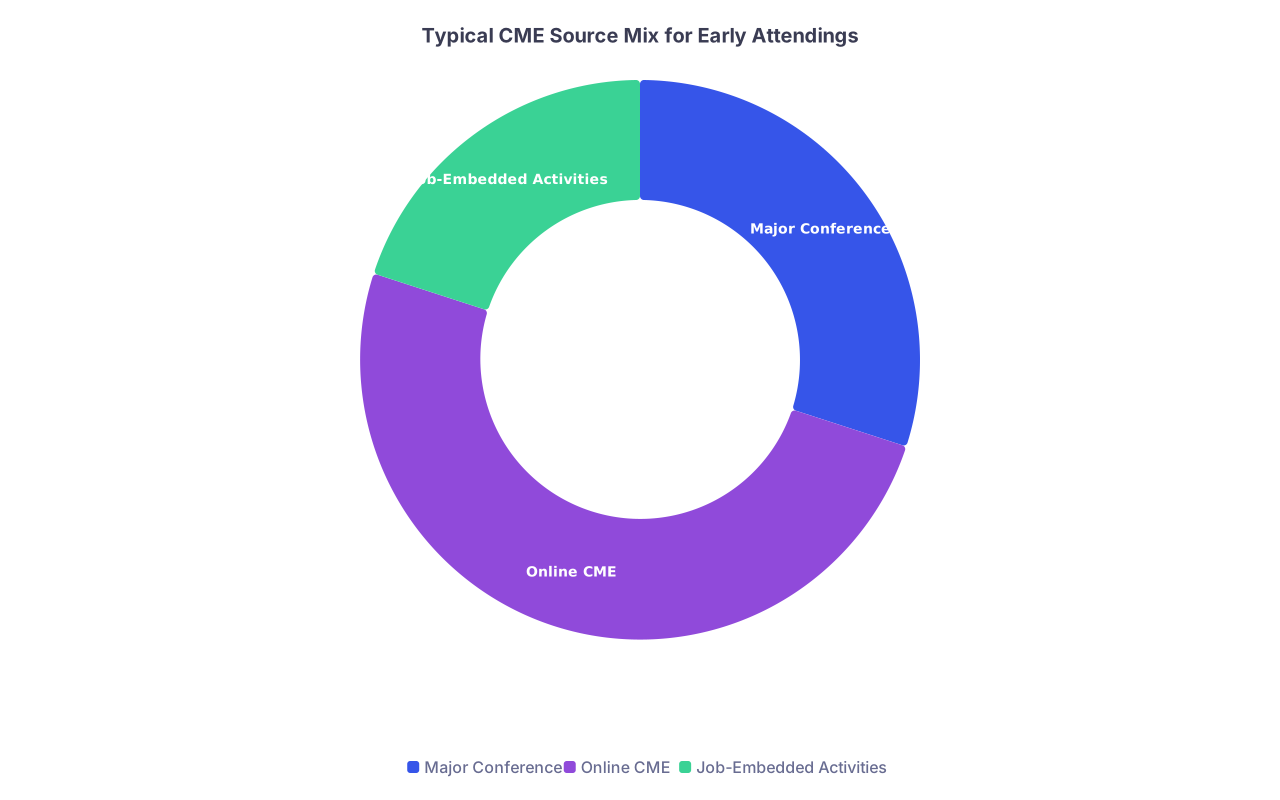
| Category | Value |
|---|---|
| Major Conference | 30 |
| Online CME | 50 |
| Job-Embedded Activities | 20 |
Pick 1–2 “Anchor” Activities
These are big, reliable CME sources you build your year around:
- A major specialty conference (e.g., ACC, ASCO, AANS, ACEP, ATS)
- A board review course (live or online) that offers a bulk of CME and MOC points
- A high-yield longitudinal online program (e.g., NEJM Knowledge+, specialty-specific question banks with CME attached)
Choose:
- One annual conference or course that aligns directly with your practice
- One online platform you actually like using
This alone often covers half or more of your CME requirements in a structured way.
Step 3: Build a 3-Year CME Calendar Now, Not Later
The transition from fellowship to attending is chaotic. Credentialing, learning your EHR, figuring out billing, surviving call.
If you do not lock in some CME structure before the chaos, you will not do it “when things calm down.” They never really do.
Year-By-Year Framework
You are moving from “trainee who passively receives teaching” to “attending who must actively ensure competence and compliance.” Treat CME like a project.
Think in 3-year blocks (most state cycles are 2–3 years; early career also shifts significantly over 3 years).
Year 0: Final Fellowship Year (Set-Up Phase)
Goals:
- Clarify all requirements (done in Step 1)
- Choose your anchor conference and online platform
- Develop a CME tracking system (more on that shortly)
- Knock out any state-mandated topic courses that you can complete early (e.g., opioid prescribing) if they are accepted pre-licensure by your state
Concrete moves:
- Reserve 1–2 CME days during fellowship (use academic time, if allowed) to complete:
- State-specific required modules (often cheap or free)
- A patient safety or professionalism course you know your board requires
- Ask program leadership if existing conferences (grand rounds, M&M) can give you official CME certificates—some fellows just never register even though the credits are available.
Year 1: First Attending Year (Stability and Survival)
Goals:
- Avoid overcommitting to travel CME
- Ensure you hit at least 50–60% of your annual CME requirement without stress
- Learn what actually fits your schedule and energy
Plan:
- Attend one major conference (ideally one that also helps your board requirements)
- Use your online platform regularly—e.g.,:
- 30 minutes 2–3 times per week
- Or a set number of modules/questions each week
Layer in:
- Department conferences that provide CME
- Any mandatory hospital CME (count these toward your total)
End of Year 1: Review your CME log. Adjust.
Year 2: Optimization Year
Goals:
- Fill gaps (topics you missed in Year 1)
- Complete any looming multi-year board obligations (e.g., a QI project or specific MOC modules)
- Shut down courses or subscriptions you are not using
If your state cycle ends after Year 2, plan backward. Example:
- Need 50 hours / 2 years
- Year 1: 30 hours
- Need at least 20 in Year 2, plus any required topics
Make intentional choices: a specific online course on opioids, a bundled state-law CME package, etc.
Year 3: Strategic and Career-Oriented CME
By now you are more stable clinically. You can direct CME toward:
- Emerging subspecialty interests
- Skills to expand your scope:
- Procedures
- POCUS
- Leadership
- Teaching/education skills
- Leadership or admin paths (quality improvement, informatics, medical education)
Your plan becomes less about scrambling to satisfy requirements and more about designing your growth.
Step 4: Set Up a Bulletproof CME Tracking System
The number one pain point I see when people hit their first audit: scattered documentation.
They have:
- PDFs in random email folders
- Half-printed certificates in a desk drawer
- Web portals that will eventually disappear or change
You want one system. Your system, not the vendor’s.
Core Components of a Good Tracking System
Use any tool you like, but it must handle:
- Log of activities (title, date, provider, credits, topic)
- Copy of certificate or proof
- Filters for:
- Year
- Topic (ethics, opioids, patient safety)
- State vs board vs general CME
You can do this in:
- A simple spreadsheet + cloud storage folder
- A dedicated CME tracking app or platform
- A note-taking app with a consistent template (Notion, OneNote, Evernote)
If you want simple and robust, a spreadsheet is enough.
Example Spreadsheet Structure
Columns:
- Date
- Activity name
- Provider (ACCME-accredited organization)
- Format (live, online, QI project, journal-based)
- Credits (Category 1 hours or board points)
- Topic tags (ethics, opioid, patient safety, etc.)
- Applies to (state X, board, hospital, general)
- Certificate file name/location
Keep certificate PDFs in a cloud folder:
- Folder:
/CME/2026-2028/ - Filenames:
2026-04-15_ACC_Annual_Meeting_8h.pdf
Once per quarter, spend 10–15 minutes updating it. That is all.
Step 5: Build CME Into Your Weekly and Monthly Rhythm
If CME is always an “extra,” it loses to real life. You need to integrate it.
Weekly Micro-Habits
Pick one or two simple habits:
- One evening per week: 30–45 minutes of online CME or question-based modules.
- Clinic downtime: If you have unscheduled time between patients, use a bookmarked CME site instead of random browsing.
- Commute (if safe): CME podcasts or audio from your online provider on the drive.
Treat these as part of your job, not unpaid overtime. You are maintaining competence and compliance.
Monthly Checkpoints
At the end of each month:
- Log what CME you completed (do not wait six months)
- Check your year-to-date total
- Check whether you have hit any topic-specific goals for the year
If you notice you are falling behind by mid-year, you can course-correct with:
- A weekend online course heavy in credits
- Extra sessions with your online platform
- Catching up on recorded grand rounds that offer CME
Step 6: Use CME to Actually Improve Your Practice (Not Just Check Boxes)
Here is where most people go wrong. They treat CME as “maintenance” instead of a tool.
You are about to step into attending life. Your CME plan should solve the real problems you will face in the first 3–5 years:
- Gaps in procedures you rarely did as a fellow.
- New responsibilities: billing, documentation, risk management.
- Leadership roles: running a service, committee work, QI projects.
Turn Pain Points into CME Targets
As you start practice, keep a short running list:
- “I keep struggling with X diagnosis.”
- “I am unsure about the safest approach for Y procedure.”
- “Our clinic keeps missing Z quality metric.”
Every few months, map those to CME opportunities:
- Targeted online course
- Workshop at a major meeting
- Journal-based CME cluster on that topic
- Quality improvement CME tied to fixing a local problem
This way you are not randomly accumulating credits. You are systematically closing real gaps.
Step 7: Avoid Common CME Traps for New Attendings
Let me be blunt about a few mistakes I see over and over.
Trap 1: Waiting Until the Last 3–6 Months of a Cycle
Symptoms:
- Binge-watching low-quality CME videos
- Buying overpriced “all-in-one” packages because there is no time left
- Stress trying to complete required topics before a license renewal deadline
Solution:
Front-load at least 50–60% of each cycle in the first half of the period. Use your 3-year plan and annual targets. Never assume “future you” will magically find free time.
Trap 2: Ignoring Topic-Specific Requirements Until Late
You end up with 80 general hours and zero in required topics.
Fix it up front:
- From your requirements sheet, list every mandatory topic and how many hours.
- Schedule them early in the cycle. Ideally, Year 0 or Year 1.
- Use bundled state-law CME courses that knock out multiple topics at once.
Trap 3: Relying Entirely on Free CME
Free is fine. Bad is not.
Problems with chasing only zero-cost CME:
- Content quality varies wildly.
- Topics are driven by sponsors, not your learning needs.
- You waste time clicking through junk to find what you want.
Use free sources intelligently (grand rounds, high-quality journals, well-known platforms), but do not be afraid to pay for:
- One excellent board review product
- One strong specialty conference
- One high-yield skills course
Your time is more valuable than the dollars you “save” by cobbling everything together from whatever is free.
Trap 4: Not Leveraging Job-Embedded CME
Many new attendings forget that:
- Tumor board
- Complex case conferences
- Morbidity and mortality
- Teaching conferences
can count as CME—if organized and accredited.
Ask your department leadership:
- “Can we get CME credit for our weekly ___ conference?”
- “Are our grand rounds accredited? How do I claim the credits?”
You might already be doing the work. You just have not claimed the credits.
Step 8: Align CME with Career Trajectory, Not Just Your Current Job
Your fellowship defined your sub-specialty. Your CME can define your niche.
Use the middle and later years of each CME cycle to push your career a little further in the direction you want:
- Thinking about education?
- Choose medical education conferences and teaching-skills workshops with CME.
- Considering leadership/administration?
- Find CME on healthcare finance, quality improvement, safety, and leadership.
- Want to grow procedural expertise?
- Pick courses with hands-on workshops and simulation labs.
You are going to spend hundreds of hours on CME over your career. If all of it is “just enough to renew,” you are leaving a lot of professional growth on the table.
Step 9: Connect CME, QI, and Board Requirements in One Integrated Plan
Your board probably expects some version of:
- CME credits / points
- Quality or practice improvement activity
- Knowledge assessments (tests or question sets)
Do not treat these as separate chores. Combine them.
For example:
- Identify a clinical problem in your practice (e.g., poor hypertension control)
- Do a brief QI project to improve it
- Use the QI activity to satisfy a board MOC QI requirement
- Present the project at a local conference that provides CME
- Use articles and modules you read around the project as additional CME
One effort. Multiple boxes checked: better care, CME, MOC points, maybe even academic output.
Step 10: Reality-Check Your Plan Against Time and Money
Before you commit to your CME plan, run it through two filters:
- Time – Is there space on your calendar?
- Money – Does it fit your CME budget?
Time Filter
Make a quick yearly calendar with:
- Planned conference(s)
- Busy clinical periods (flu season, major call stretches)
- Life obligations (family events, exams, moving, etc.)
Drop your CME activities in. If all your big items land in your busiest months, rethink them.
Use a simple principle:
No more than one major time-intensive CME event in any 3-month window during your first year as an attending.
Money Filter
Most employers offer:
- CME stipend ($1,500–$5,000 typical range)
- Paid time off specifically for CME (often 3–5 days)
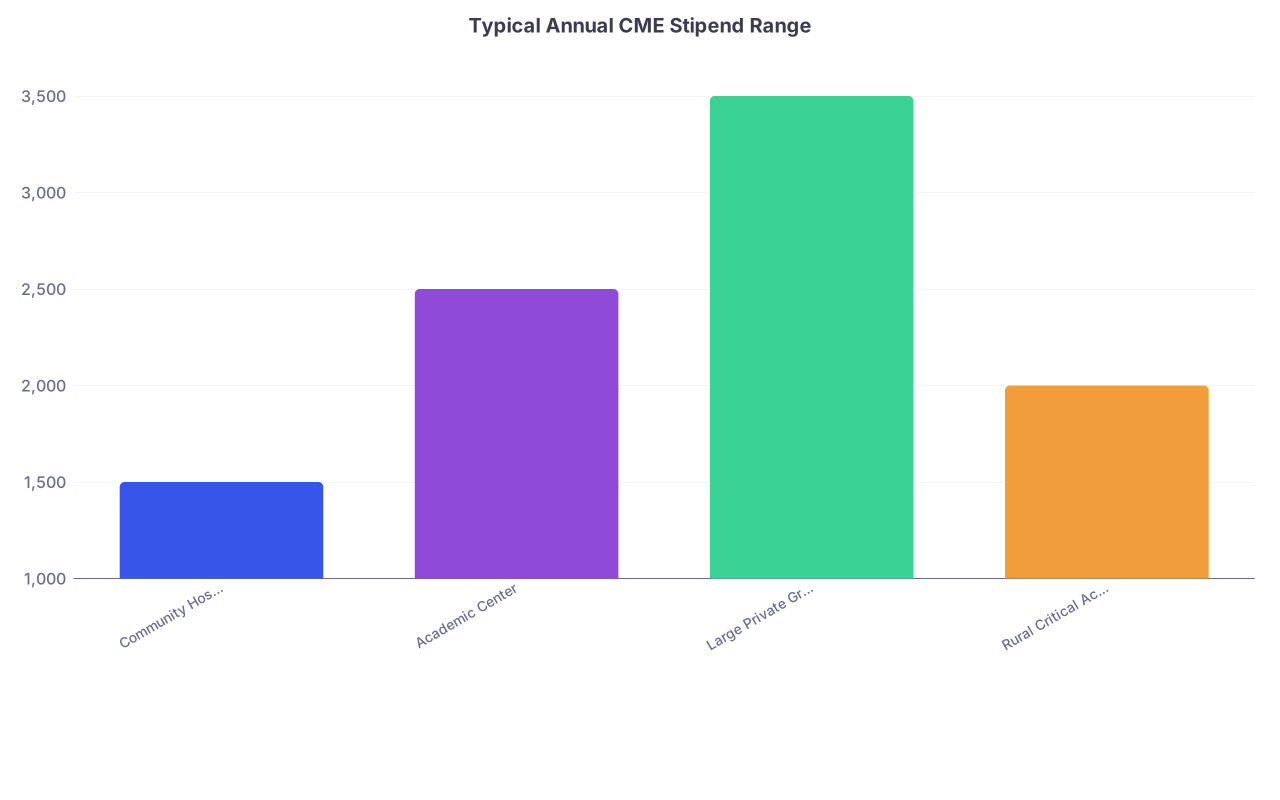
| Category | Value |
|---|---|
| Community Hospital | 1500 |
| Academic Center | 2500 |
| Large Private Group | 3500 |
| Rural Critical Access | 2000 |
Map your plan against your stipend:
- Conference registration + travel + hotel
- Online subscription costs
- Books or board materials (if CME-credit bearing)
- Miscellaneous fees
You want most of your CME spending inside the stipend. If you are paying thousands out of pocket each year, either:
- Negotiate better CME support (seriously, this is worth asking about during contract talks), or
- Shift more of your CME to low-cost, high-yield online options
Your Next Move (Do This Today)
Open a blank document and label it: CME Plan – Fellowship to Attending (Years 0–3).
Then:
Write down:
- Your state(s) of practice (or likely states)
- Your board (e.g., ABIM, ABS, etc.)
- Your planned or current employer
Spend 30–45 minutes:
- Look up the exact CME requirements for:
- Your state medical board
- Your specialty board
- Your future hospital/employer (ask an admin if needed)
- Put those numbers and topic requirements on that page.
- Look up the exact CME requirements for:
Finally, pick:
- One major conference or course you want as your anchor event.
- One online platform you know you will actually use.
Once you have that one-page summary and those two anchors chosen, you are not reacting anymore. You have the skeleton of a real CME plan—and everything else becomes just filling in the gaps on your terms, not someone else’s.