

CME and Burnout: Debunking the Idea That More CME Always Helps
What if the CME you’re cramming in at 11:30 p.m. to keep your license is actually pushing you closer to burnout rather than protecting you from it?
That’s not hypothetical. I’ve watched physicians do “wellness” CME about resilience while literally charting in another window and answering patient messages between quiz questions. Then they go home more exhausted and more cynical. But hey, they got their 1.0 AMA PRA Category 1 Credit™.
Let’s stop pretending that more CME, by default, is good for clinicians.
The Core Myth: “More CME = Better Care and Less Burnout”
The system runs on a lazy equation: if some CME is good, more must be better. State boards, hospitals, and certifying bodies ratchet up requirements. Add mandatory modules. Mandate “wellness” CME. Pile on QI projects labeled as “educational.”
Meanwhile, the evidence doesn’t back the simplistic “more is better” assumption.
There is decent evidence that high‑quality, interactive CME can improve clinician performance and sometimes patient outcomes. The classic ACCME and Cochrane-type reviews show that. Structured, case-based learning, feedback, spaced repetition, deliberate practice—those can move the needle.
But the relationship between CME quantity and burnout? That’s not the story you’ve been sold.
What the burnout data actually shows
Burnout consistently tracks with:
- Workload and administrative burden
- Loss of autonomy and control
- Time pressure and “pajama time” charting
- Misalignment between values and daily work
- Toxic culture and lack of support
It does not consistently improve just because you logged another 25 hours of didactics and half-asleep click-through modules.
In several surveys and institutional studies, physicians who report higher “after hours EHR work” and “time spent on compliance tasks” are more burned out. For a lot of clinicians, CME has been quietly moved into that “compliance task” bucket.
So the core myth is this: that CME volume is inherently protective. It is not. In many contexts, it is just another demand on an already maxed-out clinician.
When CME Becomes Just Another Stressor
Here’s the part administrators don’t want to admit: the way CME is imposed often makes it indistinguishable from other bureaucratic nonsense.
I’ve seen this exact scenario more times than I can count:
- December: giant email—“You are short 12 CME credits for maintenance of certification and 4 hours of opioid prescribing CME for state licensure.”
- Schedule: already packed with full clinic days, call, and QI meetings.
- Practical result: you burn nights and weekends on CME platforms, clicking through slides you’ll forget by next week.
That’s not education. That’s a tax on your personal time.
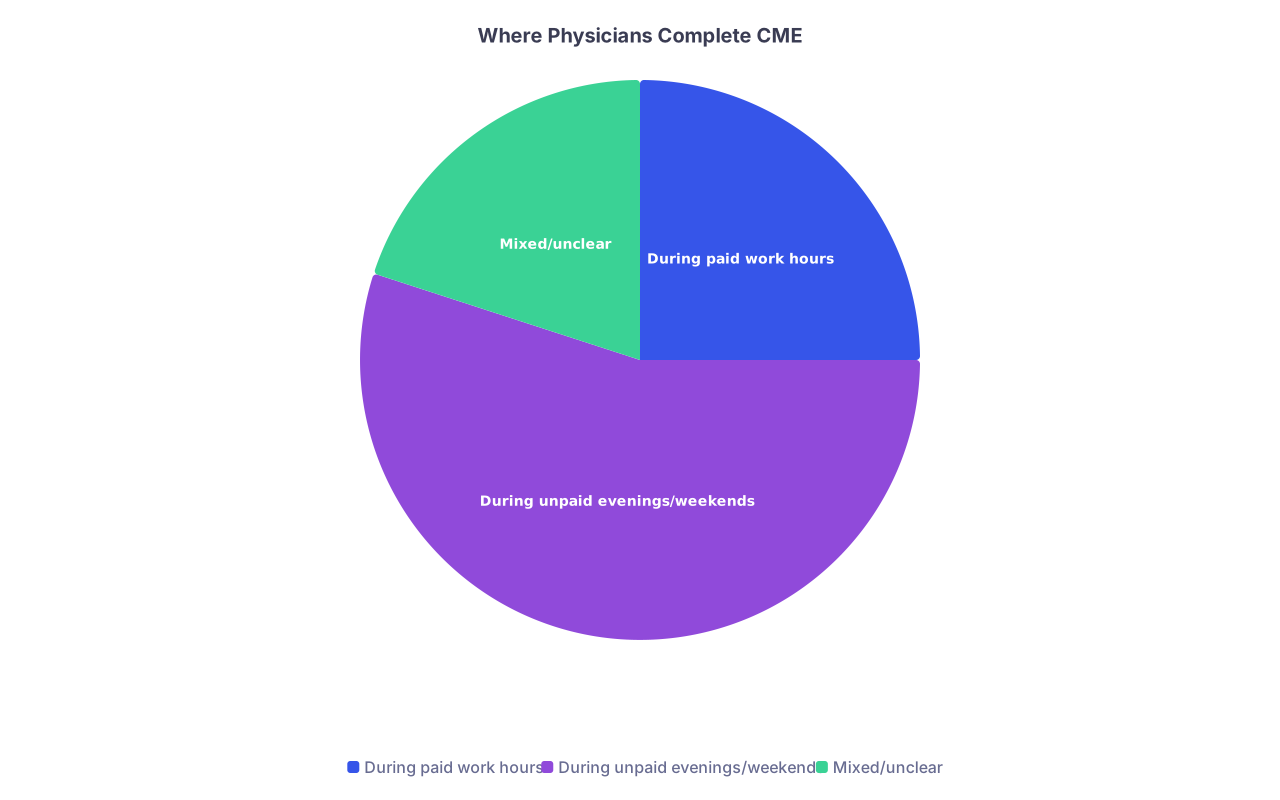
| Category | Value |
|---|---|
| During paid work hours | 25 |
| During unpaid evenings/weekends | 55 |
| Mixed/unclear | 20 |
Rough breakdowns from multiple surveys over the last decade have shown a depressing pattern: most physicians are doing CME on their own time. And once learning is decoupled from protected time and real clinical questions, it stops feeling like growth and starts feeling like theft.
The worst offenders: mandatory one-size-fits-all CME
You know the modules I mean:
- Annual HIPAA “training” that’s indistinguishable from last year’s
- Blanket opioid prescribing CME regardless of your specialty or prescribing patterns
- Harassment or bias modules that are mostly about legal risk mitigation for the institution
- “Provider wellness” modules that talk about yoga and gratitude while your schedule gets tighter
These are not designed to improve your practice. They’re designed to tick boxes for regulators and lawyers. You can feel that. That’s why so many physicians run them at 1.5x speed while half-distracted.
Do they reduce burnout? If anything, they worsen it, because they reinforce the message: “We will lecture you about resilience instead of fixing the system that’s burning you out.”
What the Evidence Actually Supports About CME
Let’s be fair. Not all CME is useless, and not all of it exacerbates burnout. When done right, CME can actually do the opposite: restore a sense of mastery, remind you why you like medicine, and give you tools that reduce friction in your daily work.
But “done right” does not mean “talking head on a recorded webinar with 10 MCQs at the end.”
The CME that actually changes behavior
Systematic reviews repeatedly show the same pattern:
- Interactive activities beat passive lectures
- Case-based learning beats abstract theory
- Multiple exposures and reinforcement beat one-off events
- Feedback, reflection, and real practice changes beat simple knowledge checks
So yes, a targeted workshop on, say, efficient EHR use, where you actually reconfigure your templates and dot phrases in real time, can reduce your documentation time and lower burnout. A serious course on advanced communication skills can make difficult conversations less draining. A well-structured morbidity and mortality conference can sharpen your thinking and improve patient care.
But notice the common thread: these activities are tightly linked to your day-to-day reality, and they either give you competence or remove friction.
They don’t just dump information on you. They change your practice.
| CME Type | Typical Format | Impact on Practice | Impact on Burnout |
|---|---|---|---|
| Interactive, case-based | Small groups, real cases, feedback | High | Often positive |
| Systems-focused, workflow | Hands-on, EHR optimizations | High | Often positive |
| Passive lectures | Didactic talks, webinars | Low–moderate | Neutral |
| Generic compliance | Click-through modules | Very low | Often negative |
The myth you’ve probably internalized is that the credit hour is the metric that matters. It isn’t. The design of the learning and the context in which you do it is what changes anything.
Where “More CME” Backfires Hard
Let me be explicit about how the “more is better” mentality causes damage.
1. Time theft from recovery and sleep
You have a finite number of hours outside work. They’re supposed to be used for three things: rest, relationships, and your own life. That’s what keeps you human.
When CME is pushed almost entirely into evenings, weekends, and “days off,” you aren’t just adding education. You’re subtracting recovery. It’s a direct trade.
There’s data linking sleep deprivation to higher burnout and errors. If your extra 25 CME hours per year came straight from sleep and family time, good luck arguing that’s a net win.
2. Cognitive overload and superficial learning
Cramming for credit near a renewal deadline is basically the opposite of the “spaced learning” we know works. You rush. You skim. You check the minimum boxes. You forget most of it within weeks.
More modules under time pressure don’t equal more competence. They equal more clutter in an already overloaded brain.
There’s a reason many seasoned clinicians can’t remember which quality-improvement acronym belongs to which initiative from last year. It all blurs together into noise.
3. Cynicism and disengagement
Burnout is not just about exhaustion. It’s about moral injury and cynicism. Feeling like the system talks about “professionalism” and “lifelong learning” while treating you like a cog.
Nothing fuels that more reliably than performative CME—especially “wellness” content—delivered in a system that won’t give you a 15-minute buffer between patients or reduce pointless clicks in the EHR.
People are not dumb. When physicians see “wellness CME” bolted on top of a schedule that’s already not humane, the message they hear is: “If you burn out, it’s your fault for not doing the wellness module right.”
That kills trust. And it kills any genuine desire to learn from those platforms.
CME That Actually Helps Burnout (Yes, It Exists)
Let’s flip it. If more CME by itself is not the solution, what kind of CME and what structure actually helps?
The answer is counterintuitive: often, it is less total volume but higher quality, integrated into your real work, plus some targeted content directly addressing the pain points that drive burnout.
Features of burnout‑reducing CME
When CME genuinely helps with burnout, I usually see at least three of these:
Protected time
The organization builds it into the schedule. Real blocks. Not “we’ll cover your patients if you can find someone to trade with.”
That signals: We value your learning and your sanity enough to pay for it with actual time.Direct link to daily pain points
Example: CME focused on reducing inbox overload, team-based care, or optimizing EHR workflows. You walk out with fewer clicks and clearer protocols. That’s burnout-protective.Autonomy and choice
You choose topics relevant to your practice and interests, instead of 12 hours of generic “physician wellness” scripted by consultants who have never staffed a night on call.Community and connection
In‑person courses or small-group virtual formats where you actually talk to colleagues about real cases and challenges. Connection is a known protective factor against burnout.Respect for your existing expertise
The best CME for experienced clinicians does not treat you like a clueless trainee. It recognizes you’re already competent and focuses on nuance, edge cases, innovation.
An example done right
I’ve seen a health system run this experiment: they gave primary care physicians four half‑days a year of protected time for CME and practice improvement. No clinic. No calls.
Half the time was used for topic updates. The other half was used for structured work on team workflows, panel management, and EHR efficiency—still CME‑accredited.
Their internal data? Burnout scores improved. Not because they had “more CME hours” (in fact the total net hours were similar) but because the CME was embedded in solving daily misery, and they stopped stealing time from evenings and weekends.
That’s the right direction.
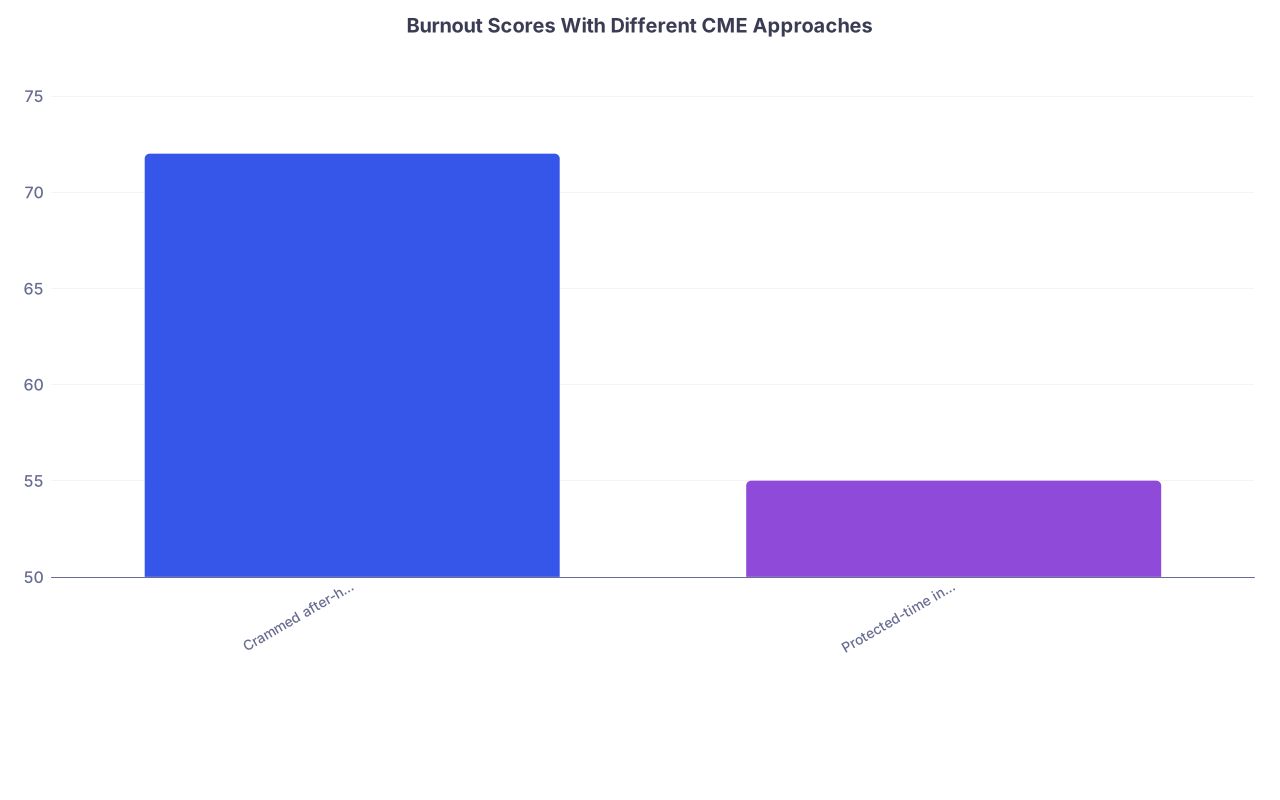
| Category | Value |
|---|---|
| Crammed after-hours CME | 72 |
| Protected-time integrated CME | 55 |
(Think of those as “burnout index” scores—higher is worse. Plenty of internal quality data looks just like this, even if it never makes it to glossy brochures.)
How You Should Think About CME, Practically
You’re not going to single-handedly rewrite state law or ABMS policy. But you can be strategic about how you interact with CME.
Three blunt pieces of advice:
Stop chasing pure volume as if more is automatically better.
Do the required minimum. Then, if you have extra capacity, spend it on things that either (a) make your daily practice easier or (b) genuinely rekindle your interest in medicine. Not random filler modules.Fight for protected time and relevance.
At the institutional level, push back on being expected to do all CME off the clock. Ask, plainly, “What protected time is allocated for this requirement?” Persist. If enough physicians refuse to donate evenings forever, policies eventually shift.Be ruthless about low‑value modules.
If a module is transparently about liability cover or bureaucracy and gives you nothing clinically useful, treat it as a compliance cost, nothing more. Don’t pretend it’s “professional development.” Save your real curiosity and energy for higher-quality learning.
If you’re in a leadership position and you keep approving more and more mandatory modules in the name of “quality” and “wellness,” be honest about what you’re doing. You’re trading away clinician time and goodwill. There better be strong evidence that the content is worth that cost. Usually, there isn’t.
The Bottom Line: More CME Is Not the Hero Here
Let me strip this down to the essentials:
CME quantity does not equal quality—or wellbeing.
A 50‑hour CME year can be worse for burnout than a 25‑hour year if those extra 25 hours are low-value, after-hours, and misaligned with your real needs.CME only helps burnout when it’s designed and scheduled to reduce real-world friction and restore meaning.
Protected time, autonomy, relevance, and genuine community matter far more than accumulating extra certificates.
If your “continuing education” feels like one more way the system takes from you without giving anything back, you’re not imagining it. The solution is not more of the same. It’s fewer, better, better-timed CME experiences that actually respect your expertise—and your humanity.


