

Mandatory CME is not the problem. Bad CME is.
The popular line you hear in hallways and on Twitter is: “Mandatory CME doesn’t change anything. It’s just a checkbox so people can keep their license.” That’s only half true. The “checkbox” part is often accurate. The “doesn’t change anything” part is lazy, and the data flat‑out contradicts it.
When CME is designed and delivered like a mindless ritual, you get mindless results. When it’s structured around behavior change and patient outcomes, it moves real numbers: mortality, readmissions, prescribing errors, adherence to guidelines. This is not speculation. It’s been measured. Repeatedly.
Let’s separate the myth from the messed‑up implementation.
Where the “CME is Useless” Myth Comes From
I have yet to meet a clinician who gets excited about clicking through a 1‑hour online module at 10:30 p.m. just to hit 50 credits before renewal. Of course that feels useless. Because it usually is.
Here’s what people are actually reacting to when they say “mandatory CME doesn’t work”:
- Slide decks recycled from five years ago, read verbatim.
- No pre‑assessment, no post‑assessment, no follow‑up. Just “Attend → Download certificate.”
- Topics chosen for convenience (or sponsorship), not for actual practice gaps.
- Zero linkage to system changes, order sets, or workflows.
- Attendance tracked; behavior and outcomes ignored.
If that is your exposure to CME, then yes, mandatory CME feels like regulatory theater. But blaming CME itself is like blaming “medications” because your patient got prescribed sugar pills.
The interesting question is not “does generic CME work?” The useful question is: when CME is done well and clinicians are required to engage in it, does it improve real outcomes?
The answer from 30+ years of literature: yes, when it follows some very specific rules.
What the Evidence Actually Shows About CME and Outcomes
Start with the high‑level data, not the anecdotes from the back row of the grand rounds auditorium.
One of the most cited overviews is the JAMA review by Davis et al. They looked at CME’s real‑world impact on physician performance and patient health. Not satisfaction. Not “felt more confident.” Hard endpoints or at least hard behaviors.
Their conclusion, boiled down: traditional, passive CME (lecture‑only, big room, no interaction) has modest to no effect; interactive, multiple‑exposure CME with practice reinforcement does change behavior and can improve patient outcomes.
That pattern has been repeated in multiple systematic reviews.
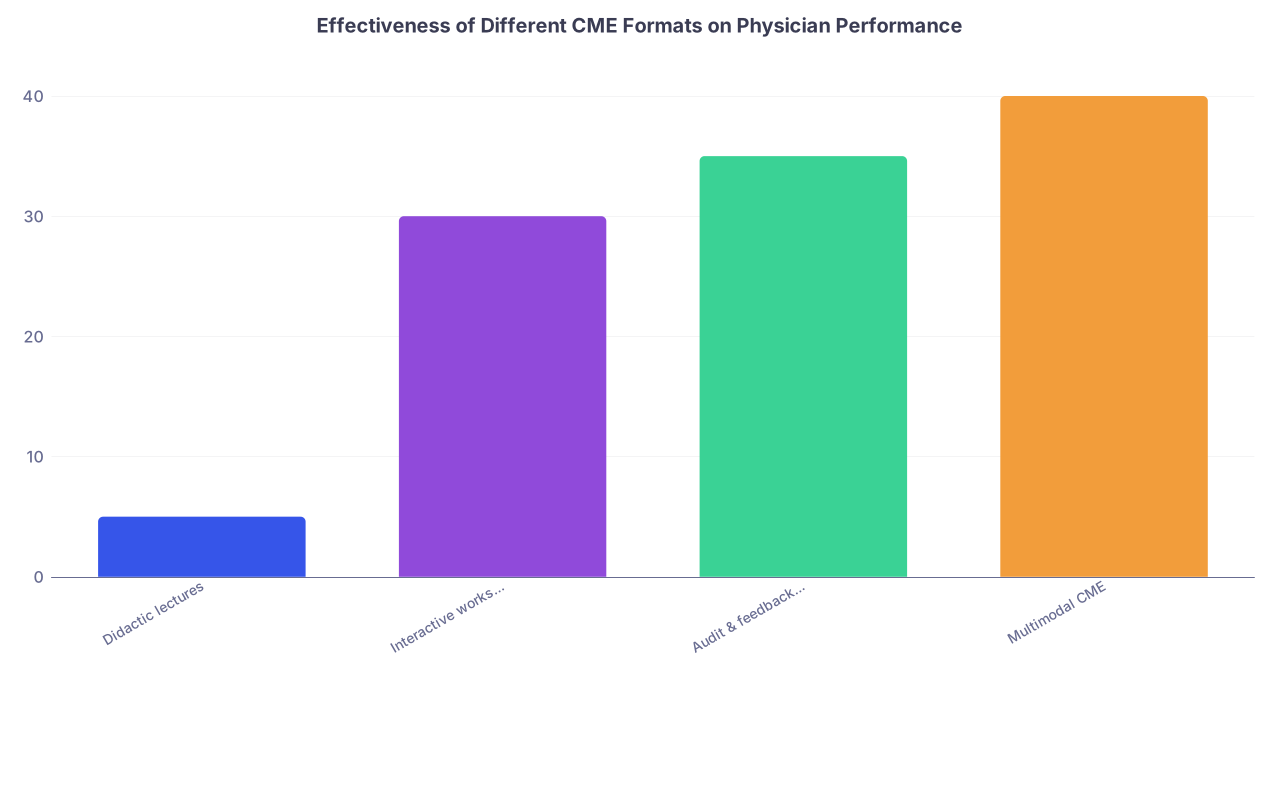
| Category | Value |
|---|---|
| Didactic lectures | 5 |
| Interactive workshops | 30 |
| Audit & feedback CME | 35 |
| Multimodal CME | 40 |
Interpret that chart loosely as “percent of studies showing meaningful performance improvement.” It matches the qualitative conclusions: format matters far more than the credit count.
Let’s get concrete.
Example: Hand Hygiene and Hospital Infections
Hospitals have been beating the “wash your hands” drum for years. Posters did nothing. Emails did nothing. But structured education plus system changes did.
Programs that combine:
- Focused CME sessions about transmission, local infection data, and proper technique.
- Real‑time feedback (observers, dashboards, unit‑level rates).
- Repeated reinforcement over months.
have produced double‑digit jumps in hand hygiene compliance and tangible drops in healthcare‑associated infections. ICU CLABSI rates down. MRSA rates down. Same staff. Same facility. Different education and structure.
Was the education itself “mandatory”? For most hospitals, yes. Staff were required to complete the training to work on the unit. And suddenly, surprisingly, outcomes moved.
Example: Prescribing and Antibiotic Stewardship
The idea that prescribing habits are impossible to change is nonsense. Several antibiotic stewardship interventions are essentially targeted, mandatory CME plus feedback.
Typical pattern:
- Baseline audit of prescribing for URI, bronchitis, UTI, etc.
- Short, focused education sessions on guidelines and local resistance patterns.
- Individual or group feedback reports comparing each clinician to peers.
- Follow‑up sessions and reminders.
What happens? In study after study, inappropriate antibiotic prescribing drops anywhere from 10–30%, sometimes more. You see fewer broad‑spectrum scripts, shorter durations, and better alignment with guidelines.
This is CME. It’s education tied to real tasks, anchored by data, with repeated engagement and mandatory participation within the institution. And, yes, it improves patient‑relevant outcomes, including resistance patterns and sometimes reduced complications from unnecessary antibiotics.
Example: Cardiovascular Risk and Diabetes Care
There are CME interventions focused on chronic disease management that show measurable changes in A1c, BP control, lipid levels, and adherence to evidence‑based therapies.
Common features:
- Case‑based sessions with real patient data from the clinicians’ own panels.
- Tools integrated into the EMR after the CME (order sets, alerts, templates).
- Performance dashboards used as part of the educational loop.
- Required participation as part of quality initiatives or MOC pathways.
Do these drag A1c from 9.5 to 6.5 instantly? Of course not. But you see statistically significant improvements in process and intermediate outcomes: more ACEi/ARB use in proteinuric diabetics, better statin use in high‑risk patients, more consistent BP control.
Again, not theoretical. Measured.
Mandatory vs Voluntary: The Subtle but Critical Difference
Here’s where the myth really starts to wobble: when participation is optional, you almost always self‑select the motivated, up‑to‑date clinicians. Of course they improve. But your system outcomes barely move, because the outliers — the ones whose practice is furthest from guidelines — often do not show up.
Mandatory CME changes the denominator.
Now you’re not just preaching to the choir. You’re dragging the back‑of‑the‑pack into the room. That matters, especially for safety and standardization.
Let’s be blunt:
- The clinician still using outdated insulin sliding scales.
- The surgeon still handing out 30 days of opioids as a default.
- The primary care doc never checking microalbumin.
They’re not coming to your optional Saturday workshop because they “love learning.” They come when there’s a stick: licensure, credentialing, payor requirements, maintenance of certification.
Mandatory CME is how you reach the most dangerous tail of the distribution.
There are studies showing that when entire departments or health systems are required to participate in outcome‑oriented CME — especially when linked to performance feedback — variation shrinks and average performance improves. That’s exactly what you want if you care about population outcomes: not perfection from a few stars, but fewer weak links.
What Actually Predicts Whether CME Improves Outcomes
If you want to know whether a “mandatory CME” requirement in your hospital or state is likely to be useful, do not ask how many hours. Ask how it’s built.
The research is remarkably consistent about the features that matter.

1. Interactivity and Case‑Based Learning
Passive lectures are mostly about making faculty feel productive. They have limited documented impact.
When CME includes:
- Real patient cases, preferably from participants’ practice.
- Opportunities to choose an approach and get immediate feedback.
- Small groups or at least active polling/discussion.
you start to see behavior change. The brain is being forced to decide, not just receive.
2. Multiple Contacts Over Time
One‑off sessions are like single doses of medication for a chronic disease. Symptomatic relief at best.
Interventions with repeated touchpoints — multiple sessions, reminders, follow‑up emails, booster activities — consistently show stronger and more durable effects on behavior and outcomes.
3. Explicit Practice Change Targets
Vague goals like “improve awareness of COPD management” produce vague results.
Good CME defines concrete behavior changes: “increase use of LAMA/LABA in GOLD B and above,” “reduce antibiotic scripts for viral URI by 25%,” “increase appropriate VTE prophylaxis in hospitalized patients.”
Then it measures them.
4. Audit and Feedback
This is the single most underutilized but powerful tool.
Show clinicians:
- Their own data.
- Compared to peers.
- Compared to guidelines or targets.
Then tie CME activities directly to closing those gaps.
When that feedback loop is formalized — and yes, often mandatory — performance and outcomes move. Without feedback, education lives in a vacuum.
5. Integration With System Changes
If the system fights the new behavior, CME loses. Always.
Programs that pair education with:
- Updated order sets.
- EMR prompts or nudges.
- New protocols and checklists.
- Support from nursing, pharmacy, and admin.
see far better results. Because you’re not relying on memory and willpower; you’re changing the environment.
Where Mandatory CME Fails (and Why People Think It Never Works)
There is a reason so many clinicians roll their eyes when they hear “mandatory CME.”
They’ve sat through:
- Hour‑long pharma‑sponsored dinners disguised as education.
- Ethics modules that read like legal CYA, completely disconnected from daily dilemmas.
- State opioid CME that’s a shallow, fear‑based rehash of the same three PowerPoint slides.
You click through. You get your certificate. Your practice does not change. Obviously.
The problem here isn’t the “mandatory” part. It’s the “garbage in, garbage out” part.
Let me be direct: if there’s no pre‑defined clinical outcome or behavior change tied to the CME, it is theater. It may keep the licensing board or hospital lawyer happy, but nobody should pretend it improves care.
The myth emerges when people generalize from that garbage to all mandatory CME. It’s like claiming “statins don’t reduce cardiovascular events” because your patients refused to take them or you prescribed them once and never checked adherence.
Badly designed CME is a waste. That’s not controversial. But it does not prove that the concept of mandatory CME is doomed.
The Real Policy Question: Reform, Not Repeal
So where does this leave licensing boards, specialty societies, hospitals, and clinicians?
The answer is not “abolish mandatory CME.” That’s a fantasy that conveniently ignores public accountability and the reality that medicine evolves faster than intuition.
The better move is more uncomfortable: stop granting credit and regulatory blessing to CME that has no plausible path to behavior or outcome change.
| CME Design Feature | Weak / Check-the-Box CME | Strong / Outcome-Oriented CME |
|---|---|---|
| Format | Passive lecture, reading | Interactive, case-based |
| Frequency | One-off session | Multiple contacts, boosters |
| Performance data used? | No | Yes, audit and feedback |
| System integration | None | EMR/order set changes |
| Measures behavior change? | Rarely | Routinely |
If you want mandatory CME to actually earn its keep, you build more of the right column and starve the left.
That means:
- Licensure bodies specifying competencies and outcomes, not just hour counts.
- Hospitals tying CME participation to QI projects with concrete metrics.
- Payers and systems aligning incentives for practices that engage in data‑driven CME.
Does that create more work upfront? Yes. Is it more effective than pretending an hour of generic slides about “professionalism” each year is protecting the public? Also yes.
For Individual Clinicians: How to Make Mandatory CME Actually Useful
You probably cannot rewrite your state’s CME rules by next renewal. But you do have more control than you think over whether mandatory hours are pure pain or at least partially productive.
A few pragmatic moves:
First, ruthlessly skip the fluff when you have a choice. If an activity doesn’t tell you in the first five minutes what specific behavior or outcome it’s targeting, downgrade its value immediately. It might be tolerable background noise, but don’t expect practice change.
Second, chase your own data. Whenever possible, pick CME that uses your numbers — your prescribing rates, your complication rates, your screening rates. Abstract webinars are forgettable; confronting your own outliers is not.
Third, look for CME that touches your tools. Anything that comes with changes to templates, order sets, or checklists is more likely to stick. You’re not just learning; you’re rewiring your environment.
Finally, treat mandatory CME as leverage. If admin wants your department at a 100% completion rate for some new requirement, you’re suddenly in a better position to demand that the content be useful, linked to your QI priorities, and tied to real metrics. Use that.

The Bottom Line: Stop Arguing About Hours, Start Arguing About Design
Mandatory CME, by itself, is neutral. It’s a container.
Fill it with poorly designed, passive, content‑heavy and outcome‑free sessions, and you do not move the needle. Fill it with interactive, data‑driven, system‑linked education, and you absolutely can change physician behavior and patient outcomes. The literature is clear on that, even if the average clinician’s lived experience is not.
So the blanket claim “mandatory CME doesn’t improve outcomes” is just wrong. What’s true is sharper and more uncomfortable:
- Most current mandatory CME is not designed to improve outcomes.
- When CME is properly designed and made universal, it does.
If you are a clinician, you’re justified in being cynical about the way CME is usually executed. But do not confuse a broken implementation for a dead concept. If anything, the evidence argues for being more demanding of CME — and of the institutions that hide behind it — not walking away from it.
Years from now, you will not remember how many hours you logged to renew your license. You will remember the handful of educational moments that actually changed how you treat people — and the systems that either made those moments mandatory or let them quietly never happen.


