

What if the free online CME you do half-asleep at 10 p.m. is actually performing as well—or better—than the stuff your hospital pays thousands of dollars for?
Let me ruin a popular myth up front: price is a terrible proxy for CME quality. There is data on this. And it does not back up the smug “you get what you pay for” line you hear from people who have never once looked at an outcomes report.
You’re in a system that likes equating cost with seriousness. Flyers for $895 conferences in resort cities. “Premier” board review courses. Subscription CME platforms that brag about how expensive they are, as if that proves anything except their marketing budget.
So let’s ask the only question that matters: does free CME actually change knowledge, behavior, or patient outcomes any less than paid CME?
The short answer: not really. And sometimes it does better.
What CME is supposed to do (not what vendors tell you)
Strip away the glossy brochures and “networking opportunities.” CME—free or paid—is supposed to do three concrete things:
- Improve knowledge / competence
- Change clinician behavior and decision-making
- Improve patient or system outcomes (yes, that’s aspirational, but it is the stated goal)
Most providers now use Moore’s framework (levels 1–7) to describe outcomes:
| Level | Focus |
|---|---|
| 1 | Participation |
| 2 | Satisfaction |
| 3 | Learning (declarative/procedural) |
| 4 | Competence (intent to change) |
| 5 | Performance (actual change) |
| 6 | Patient health |
| 7 | Community health |
Here’s the awkward truth: the majority of CME—paid or free—never gets measured beyond level 2 or 3. You did the activity, you liked the speaker, your post-test score went up. That’s it.
So the myth that “free CME is low quality” usually rests on vibes, not data:
- “The slides looked basic.”
- “It was sponsored.”
- “The interface was clunky.”
None of that correlates reliably with performance change or outcomes.
What the outcomes data actually shows about free vs paid CME
Let’s get specific. There have been multiple peer‑reviewed evaluations of free, mostly online CME programs, often funded by grants or noncommercial support.
Patterns that show up again and again:
- Knowledge gains of 20–40 percentage points from pre‑ to post‑test
- Sustained knowledge above baseline at 4–8+ weeks
- Self‑reported practice changes in 40–70% of participants
- Documented performance changes (chart review / claims / registry data) in targeted measures
Now compare that to typical outcomes claims from large, expensive, in‑person CME meetings—when they bother to measure anything beyond attendance and smile sheets.
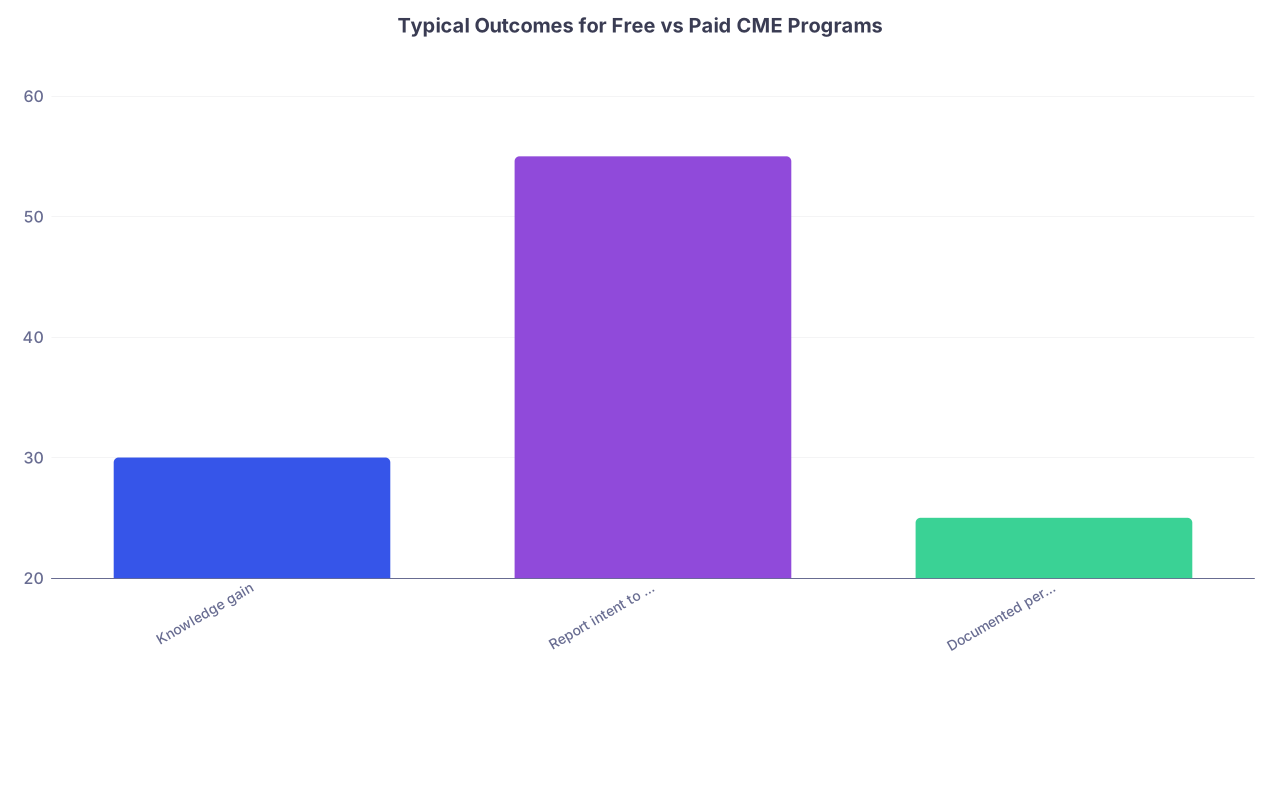
| Category | Value |
|---|---|
| Knowledge gain | 30 |
| Report intent to change | 55 |
| Documented performance change | 25 |
Before you object: that bar chart isn’t saying paid CME is worse. What I’m pointing out is there is zero evidence that paid CME has inherently superior outcomes. When you actually find head‑to‑head or comparable metrics, the differences are small or non-existent.
A few consistent findings from the literature and large provider reports:
- Free, online, case‑based CME often shows knowledge jumps of 20–35 percentage points. That’s on par with or better than many pricey live conferences.
- Performance change is driven by format and reinforcement, not cost. Repeated, interactive, case‑driven content (often free) tends to outperform one‑and‑done expensive lectures.
- Multimodal free CME (video + cases + downloadable tools) performs particularly well on self‑reported behavior change.
I’ve sat in outcomes meetings where a free, grant‑funded online program dramatically outperformed a $1,000 in‑person course on adherence to updated guidelines—same topic, similar target audience. The uncomfortable silence in the room was telling.
Where the “free = low quality” myth actually comes from
If the data doesn’t support the bias, why is it so persistent?
Because people are extrapolating from aesthetics and annoyance, not outcomes.
You’ve probably experienced at least one of these:
- A clunky web portal that looks like it was built in 2009
- A slide deck from a mediocre speaker reading bullets
- A program plastered with a pharma logo
- A 5‑question post‑test that feels insultingly easy
So you conclude: “garbage.” But here’s the twist—some of the best‑performing programs on knowledge and behavior metrics look exactly like that on the surface.
There are four main reasons the myth survives:
Status and signaling
Big-ticket conferences feel prestigious. Fly to a major city, stay at a hotel, wear a badge. That “feels” like serious education in a way that free, solitary online modules do not. Your brain equates effort and expense with value.Marketing distortion
Paid CME vendors have an obvious incentive to position “free” as lower tier. Subtle digs about “unfunded” or “industry‑driven” programs are common. Rarely do they mention that their own outcomes data, when available, looks almost identical.Confusion between production quality and educational impact
HD video, slick graphics, and polished branding matter for engagement. They do not guarantee learning transfer. A clean but simple case‑based PDF sometimes does more damage to your old habits than a cinematic lecture.Guilt and rationalization
If you or your institution spent thousands on a conference, it’s uncomfortable to confront the idea that you could’ve achieved the same learning outcomes from a free, well‑designed online activity. So the narrative becomes: “That free stuff can’t be as good.”
What actually predicts CME quality (hint: not the price tag)
If you want to separate high‑impact CME from fluff, stop looking at whether it’s free and start looking at these factors.
1. Is it anchored in real practice gaps?
Serious providers—often the same ones offering free CME—start with chart audits, registry data, or guideline‑practice gaps. For example:
- Underuse of SGLT2 inhibitors in diabetics with CKD
- Poor vaccination rates in adults with COPD
- Underdetection of familial hypercholesterolemia in primary care
When a course explicitly states the practice gap it’s targeting and cites data, your odds of it mattering go up sharply. Many free grant‑funded programs do exactly this because they have to justify impact to the funder.
Paid events, ironically, sometimes fall back on vague topics like “what’s new in cardiology” that are informational but not tightly aimed at a measurable practice gap.
2. Does it use active learning and cases?
If an activity asks you to:
- Work through patient cases
- Make decisions, then get immediate feedback
- See consequences of different choices
- Revisit similar problems in slightly different contexts
…that’s where you see durable changes. I’ve seen programs where the plain‑text, web‑1.0 case module trounced the beautifully produced lecture on every outcomes metric that matters.
Free CME has leaned hard into this—mostly because online modules are cheaper to deliver at scale than polished live events. That’s a feature, not a bug.
3. Does it measure beyond “Did you like it?”
Look for mention of outcomes like:
- Pre/post test scores with actual percentages
- Follow‑up surveys at 4–12 weeks on what changed
- Chart audits or performance data in a subset of participants
You’ll be surprised how often that deeper measurement shows up in no‑cost, grant‑funded CME versus the big paid meetings that cash your check, give you a badge, hand out a satisfaction survey, and call it a day.
A quick reality check on industry and “free = biased”
Here’s where people get twitchy. A lot of free CME is supported by educational grants from pharma or device companies. The knee‑jerk reaction: “Then it’s all biased.” That’s too simple—and in many cases, flat-out wrong.
ACCME‑accredited providers live and die by separation from commercial influence. Are there bad actors? Sure. But the rules are strict:
- Content control must be independent of the funder
- Faculty conflicts must be disclosed and managed
- Brand names and specific products are regulated in slides and materials
- Outcomes sometimes must be shared back in anonymized aggregate, forcing real measurement
You should absolutely stay skeptical. But skepticism isn’t the same as blanket dismissal. I’ve read outcomes reports from industry‑supported, free CME that showed:
- Documented improvement in prescribing guideline‑preferred generics, not just branded drugs
- Better adherence to deprescribing in older adults
- Increased use of evidence‑based non‑pharmacologic options
Bias is a risk. So is laziness in any educational design. Price does not immunize you against either.
How free CME gets such strong outcomes (when it’s done right)
There’s a simple structural advantage free CME has: it can prioritize reach and iteration over polish and revenue.
A lot of free CME programs:
- Run hundreds of thousands of learners through an activity
- Iteratively tweak content based on detailed question‑level analytics
- Attach 4–12 week follow‑ups because they’re not depending on you flying to a physical location once
That scale allows them to:
- See which questions confuse almost everyone and fix them
- Identify which cases actually change behavior and double down
- Precisely target specialties and even practice settings
Paid live events have a harder time with this. They run once a year. Same speaker, slightly tweaked slides. Outcomes beyond attendance? Rare.
Here’s a simple comparison of structural advantages:
| Feature | Free Online CME | Paid In‑Person CME |
|---|---|---|
| Scalability | Very high | Limited |
| Iterative improvement | Easy, data-driven | Slow, episodic |
| Pre/post testing | Routine | Often optional/superficial |
| Follow‑up measurement | Common in good programs | Rare |
| Cost to learner | None/low | High (fee + travel) |
The punchline: when you actually measure knowledge and behavior change, good free CME exploits its structural strengths and competes directly with (or beats) its expensive cousins.
How to pick CME that actually changes your practice
Let’s be practical. You have limited time, a credit requirement to hit, and a low tolerance for junk.
Here’s how I’d triage options—without caring about the price tag:
Look at the learning objectives and gaps
Are they concrete and practice‑linked, or just “review updates in X”?Scan for format clues
Cases, decision points, and feedback? Good. One‑way 60‑minute monologue with no interactivity? Lower expectations.Check outcomes claims
Any numbers at all—knowledge gains, performance changes, follow‑ups? If a provider can quote actual percentages, they’re at least trying.Note the scope
“We educated 40,000 clinicians and saw X change” means they had enough data to not hand‑wave.Ignore the prestige theater
Fancy location, famous keynote, high fee—none of that shows up in your patients’ vital signs.
If a free, slightly ugly web course hits 1–4 on that list and a polished, expensive conference hits only “nice hotel,” you know where your practice will actually move.
The uncomfortable truth for institutions and clinicians
Hospitals and health systems keep shelling out money for travel, registration, and branded events while simultaneously lecturing you about “value-based care.” The irony writes itself.
If institutional CME committees were brutal about outcomes data, many would:
- Shift budget from travel-heavy conferences to scalable, outcomes‑driven online programs (many of them free or low cost)
- Demand performance‑linked metrics from every paid CME provider
- Use free CME with strong outcomes as part of quality‑improvement initiatives and MOC
And you, as an individual clinician, might quietly get more practical value from:
- A series of no‑cost, case‑based online activities with documented performance impact
- A free, grant‑funded program specifically targeting metrics your institution actually tracks
- Repeated short modules instead of one massive annual event
It’s not as glamorous as a week in Scottsdale. It just works better.
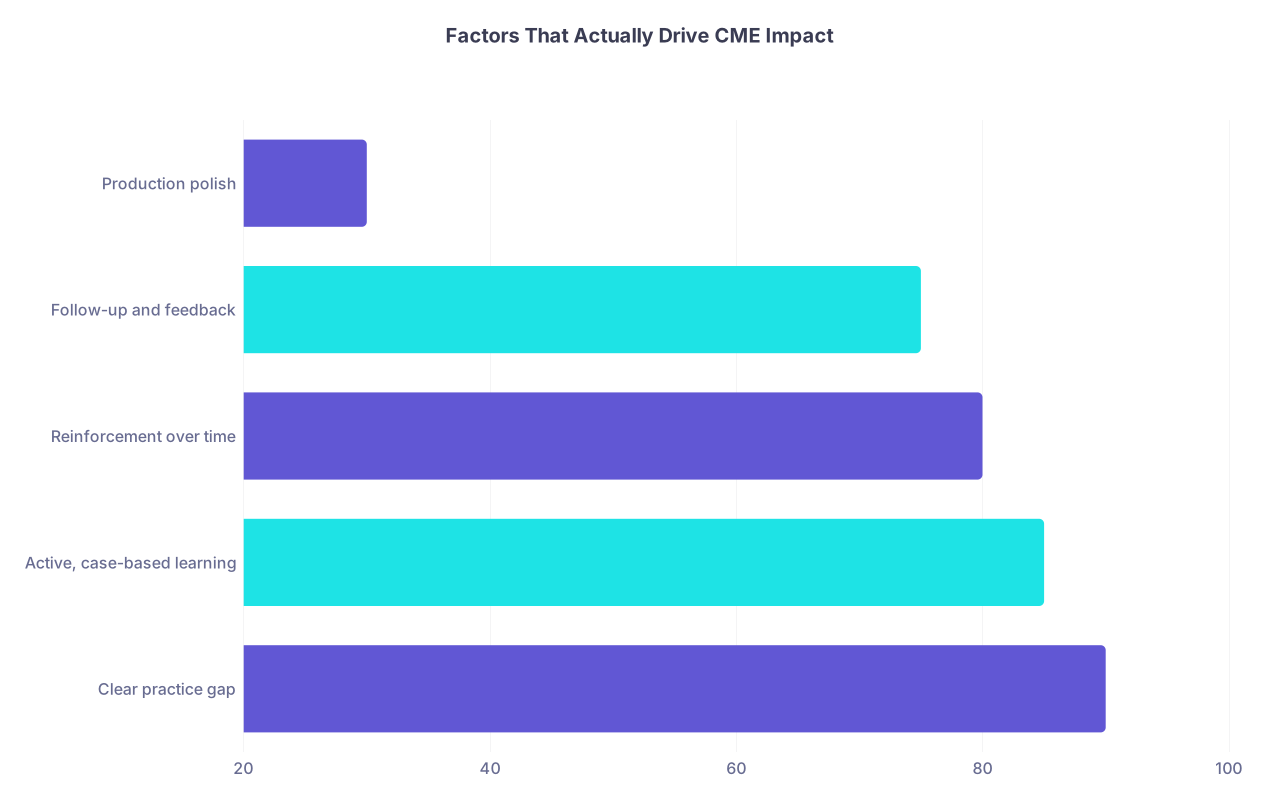
| Category | Value |
|---|---|
| Clear practice gap | 90 |
| Active, case-based learning | 85 |
| Reinforcement over time | 80 |
| Follow-up and feedback | 75 |
| Production polish | 30 |


| Step | Description |
|---|---|
| Step 1 | Need CME Credits |
| Step 2 | Skip |
| Step 3 | Lower value |
| Step 4 | Moderate value |
| Step 5 | High value pick |
| Step 6 | Topic matches practice gap |
| Step 7 | Active, case based? |
| Step 8 | Shows outcomes data? |

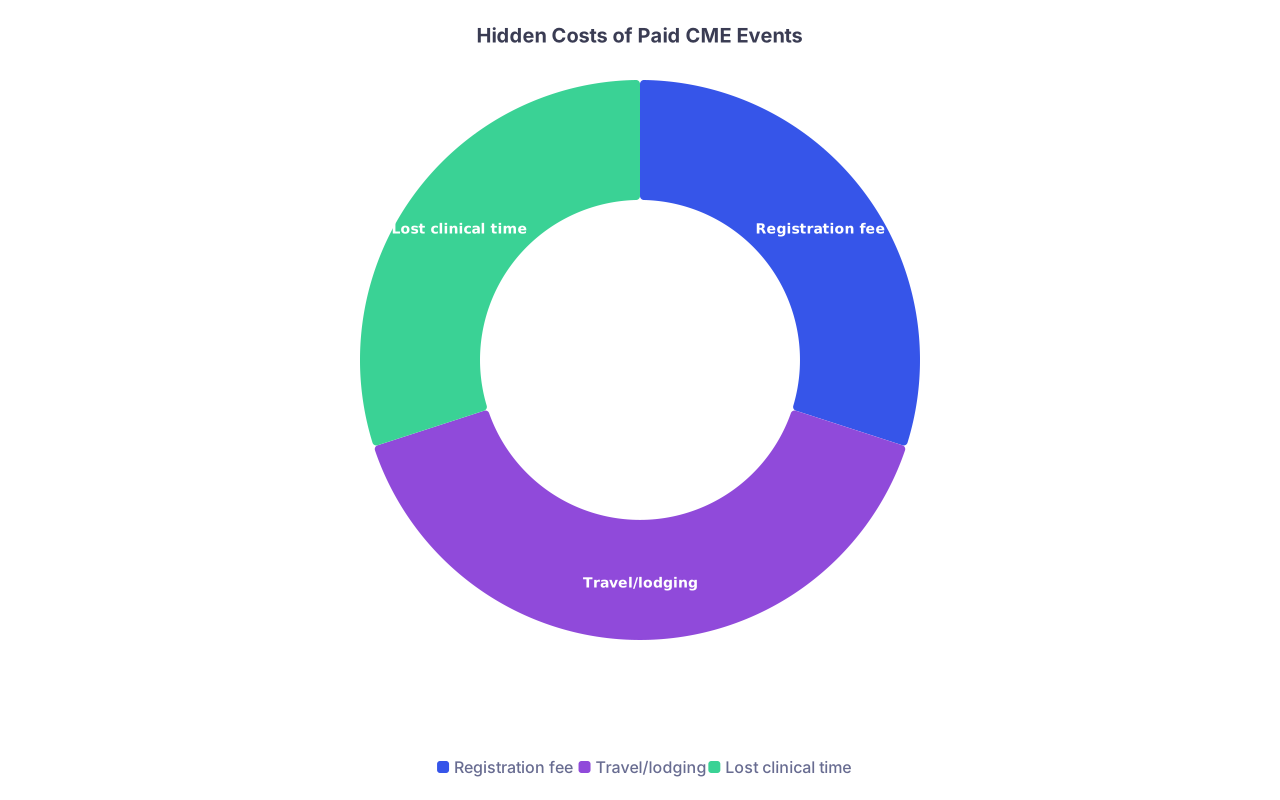
| Category | Value |
|---|---|
| Registration fee | 30 |
| Travel/lodging | 40 |
| Lost clinical time | 30 |
The bottom line
Three points and we’re done:
- There’s no solid evidence that free CME is inherently lower quality; when outcomes are measured, well‑designed free programs often match or exceed expensive CME on knowledge and behavior change.
- Format, focus on real practice gaps, interactivity, and follow‑up measurement drive educational impact—not the price printed on the brochure.
- If you stop using cost as a proxy for quality and start demanding outcomes data, a lot of “premium” CME will suddenly look mediocre—and a lot of unassuming, free CME will look like what it actually is: high‑value education hiding in plain sight.


