

62% of physicians say they doubt their most expensive CME activities actually changed their practice in any meaningful way.
That’s not from a pharma watchdog group. That’s from surveys embedded in CME outcomes research. You feel it intuitively every time you sit through a $1,500 “premium” course and walk away with two mildly useful pearls and a tote bag.
Let’s pull this apart.
The CME industry has quietly adopted the same pricing psychology as luxury hotels and business-class flights: if it costs more, it must be better. Higher ROI. Better networking. More “cutting-edge.”
The data does not back that up.
The CME Pricing Myth: More Dollars = More Value?
You’ve seen the pitch:
- “Intensive 3-day board review — $1,895”
- “Exclusive small-group procedural CME — $3,500 + travel”
- “Executive physician leadership program — $4,000”
The implied message: higher cost equals higher yield. Reality: outcomes data on CME is brutal about this.
A series of systematic reviews (including the often-cited ACCME-associated and JAMA/MedEd studies) consistently show:
- The format of CME matters more than the price.
- Interactivity, spaced learning, and feedback predict behavior change.
- Glitzy venues, big-name speakers, and “comprehensive” slide decks do not.
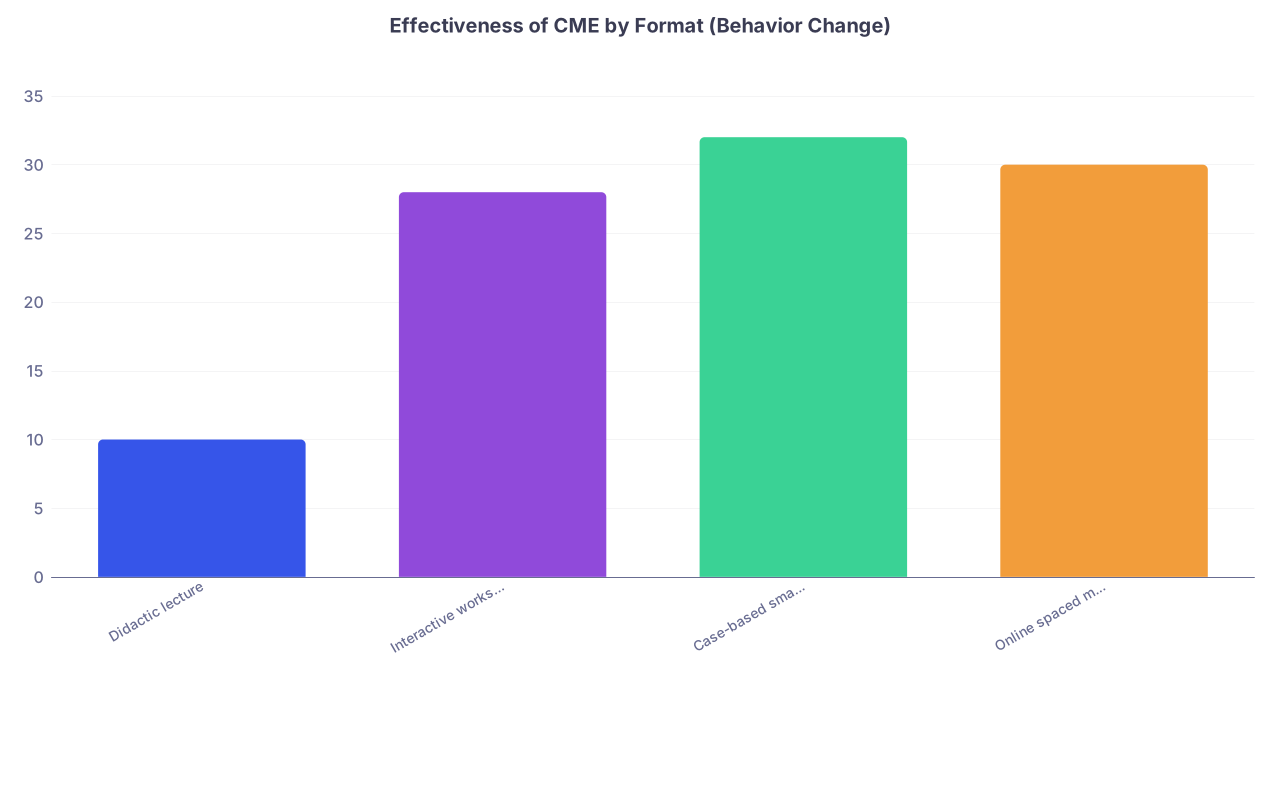
| Category | Value |
|---|---|
| Didactic lecture | 10 |
| Interactive workshop | 28 |
| Case-based small group | 32 |
| Online spaced modules | 30 |
Those numbers are representative of the relative effect sizes you see over and over in the literature. Not exact, but directionally accurate:
- Traditional lectures: marginal behavior change.
- Interactive, case-based, or spaced learning: ~2–3x more impact.
Notice what’s missing? Price. There’s zero evidence that “expensive” CME inherently lands in the effective formats category.
What You’re Actually Paying For
From looking at budgets, vendor contracts, and talking to CME coordinators, the markup on high-cost CME mostly goes to:
- Venue and AV (hotel ballrooms, resort fees, staging)
- Faculty honoraria and travel
- Marketing and branding
- Administrative overhead tied to “experience”
What doesn’t scale linearly with cost:
- Measurable practice change
- Guideline adherence
- Patient outcomes
- Even long-term knowledge retention
If a $2,000 course uses the same passive lecture format as a $300 online bundle, the ROI difference is mostly in your credit card statement and your Instagram photos from the resort.
What the Evidence Actually Says About CME ROI
Let’s define ROI like adults, not marketers.
Return on investment for CME shouldn’t be “felt inspired for a day” or “got to hear a famous cardiologist.” It should be:
- Did your clinical behavior change?
- Did patient outcomes improve?
- Did you reduce risk, errors, or unnecessary cost?
- Did it materially help your career (promotion, certification, procedural credentialing)?
Most CME studies use outcomes frameworks similar to Moore’s levels (0–7). Simplified:
- Level 1–2: Satisfaction, participation
- Level 3–4: Learning (knowledge/skills)
- Level 5–7: Behavior change, patient outcomes, system impact
Here’s the uncomfortable truth: the majority of CME—cheap or expensive—never gets beyond Level 3–4 in measured outcomes. And when researchers do look at behavior and outcomes, the big price tags don’t rescue poor design.
What Drives Real Outcomes (Spoiler: Not First-Class Flights)
Consistent findings across multiple reviews:
Interactivity
- Q&A isn’t enough. You need cases, discussion, problem-solving, audience response systems, simulations.
- Workshops and small groups outperform passive lectures, regardless of venue quality.
Repetition and Spacing
- Single one-off events are weak.
- Spaced learning, follow-up modules, and reminders perform better.
Context and Relevance
- Activities tethered to your actual clinical environment (e.g., quality-improvement-linked CME) show stronger behavior change.
- Generic “state-of-the-art update” talks are intellectually satisfying, but practice impact is often marginal.
Audit and Feedback
- CME that includes data about your own practice patterns (e.g., your antibiotic prescribing vs benchmarks) is more likely to change what you do on Monday.
None of that requires a $2,000 registration fee.

The Real Cost Structure: What Are You Actually Buying?
Let’s compare what you’re paying for, not what the brochure implies.
| Feature / Aspect | High-Cost In-Person CME | Lower-Cost / Online CME |
|---|---|---|
| Venue & catering | Premium hotel, full meals | None or minimal |
| Faculty access | Limited Q&A, maybe reception | Asynchronous, email boards |
| Format | Mostly lectures, some panels | Mixed, often modular |
| Interactivity | Variable | Often quiz/case integrated |
| Travel/lodging cost | High | Zero |
| Practice change measurement | Rare | Sometimes built-in |
Notice the column that’s blank on both: “Proven better outcomes.” Price does not guarantee that box gets checked.
You’re often paying for logistics and experience, not pedagogy.
When High-Cost CME Can Make Sense
Now the nuance. Sometimes expensive CME is absolutely worth the money. But the justification is almost never “it’s more expensive, therefore more educational.”
High-cost CME occasionally makes real sense when:
You’re buying access to a credential or skill you literally cannot get otherwise.
- Example: A specific ultrasound-guided procedure course required by your hospital for privileging.
- Surgical skills workshops with hands-on cadaver labs and supervised practice.
The course is tightly coupled to your revenue or promotion path.
- An advanced coding/billing CME that actually adds six figures to your annual billing accuracy.
- Leadership CME that is explicitly recognized by your system for advancement (e.g., necessary for a medical director role).
The format is genuinely high-yield (and rare).
- Intense, small-group case simulation with individualized feedback.
- Customized learning plans with pre-course assessment, post-course coaching, and follow-up.
In those cases, the ROI is not from “fancy conference.” It’s from a structural link between the course and your skills, privileges, or income.
The Lipstick-on-a-Pig Version
I’ve seen “premium” CME weekends where:
- 90% of the time was traditional PowerPoint lectures.
- Q&A was squeezed into 5 minutes because the schedule was overloaded.
- The most interaction was with the hotel bar staff.
- Outcomes evaluation was literally just a satisfaction survey asking, “Did you like the speaker?”
Charging $1,800 for that doesn’t turn it into high-ROI education. It just makes it a more expensive bad format.
The Hidden ROI Killers: What Most Docs Don’t Count
Physicians are surprisingly casual about the true cost of CME. They look at registration, maybe airfare, and stop there.
You should also be counting:
- Lost clinical revenue from days not seeing patients.
- Cognitive load and fatigue from travel (yes, that affects retention).
- Time away from family or other priorities.
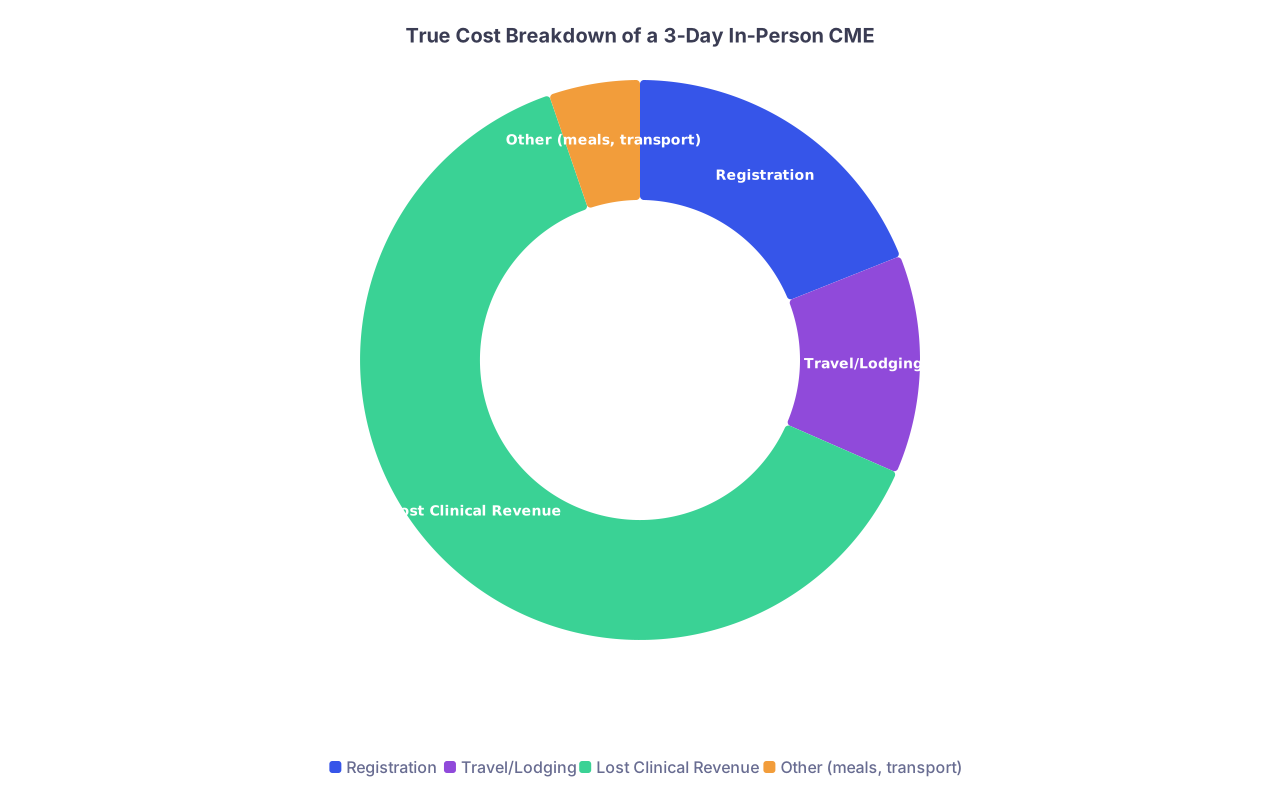
| Category | Value |
|---|---|
| Registration | 1800 |
| Travel/Lodging | 1200 |
| Lost Clinical Revenue | 6000 |
| Other (meals, transport) | 500 |
For many attending physicians, the biggest line item is not the fee. It’s the lost billable time.
That’s why a humble $399 online course you can do in evenings can crush the “ROI per hour of real life cost”—if it’s well designed.
What Data-Driven CME ROI Actually Looks Like
Let me strip this down to the core:
You get better ROI from CME that is:
- Shorter but repeated, rather than “one and done”
- Interactive and case-based, not passive and theatrical
- Embedded in your real workflows (QIP-linked, EMR prompts, local protocols)
- Measured beyond “did you like the lunch?”
Here’s a rough, reality-based comparison of ROI if you actually tracked downstream impact.
| CME Type | Direct Cost | Hidden Cost (time, travel) | Likely Practice Change | ROI Quality |
|---|---|---|---|---|
| Big-name resort conference (lecture) | High | Very high | Low | Poor |
| Small hands-on procedure workshop | High | Moderate | High | Strong |
| Online board review Qbank + modules | Moderate | Low | Moderate–High | Good |
| QI-linked, hospital-sponsored CME series | Low | Low | High | Excellent |
Notice that price alone doesn’t predict the ROI rating.
How to Judge a Course Before You Light Money on Fire
You do not need to become a CME outcomes scientist. But you do need a simple filter.
Ask these questions before you register:
What outcome level is this designed for?
- If the marketing only talks about “updates,” “staying current,” and “engaging speakers,” it’s probably Level 2–3 at best.
- If they mention practice change, QI, or patient outcomes—and show how they measure it—that’s a better sign.
What specific behavior should change for me?
- “You will be up to date on hypertension” is vague.
- “You’ll adopt X guideline-based regimen for resistant HTN and reduce unnecessary imaging” is concrete.
How interactive is this, really?
- Sitting in a ballroom watching bullet-point slides is not interactivity.
- Look for: case discussions, problem-solving sessions, breakout groups, simulations, structured peer feedback.
Is there follow-up or just a firehose weekend?
- Any pre-work? Any post-course reinforcement? Emailed cases? Follow-up webinars?
- If not, retention will fade quickly. Your brain is not special; spacing works.
Can I achieve the same learning goals cheaper?
- Could you get 80–90% of the content from:
- Clinical guidelines and review articles
- A good Qbank
- An online CME bundle
- Local grand rounds or QI projects
- Could you get 80–90% of the content from:
Ask that honestly and the hype starts to look flimsy.

| Step | Description |
|---|---|
| Step 1 | See CME Advertisement |
| Step 2 | Look for low cost, high interactivity |
| Step 3 | Consider high-cost if unique and hands-on |
| Step 4 | Find cheaper equivalent |
| Step 5 | Check for outcomes and follow up |
| Step 6 | Need specific skill or just credits |
| Step 7 | Hands-on or credential required |
The Industry Incentive Problem (Why This Myth Persists)
CME providers are not evil. But they are businesses.
Their incentives:
- Fill seats.
- Keep sponsors and hotels happy.
- Get good satisfaction scores (smiley-face surveys).
None of those necessarily push them toward designing activities with real, measured practice change. Measuring actual outcomes is harder, slower, and less marketable than glossy photos of a ballroom with blue lighting and a famous keynote.
So you get:
- Overemphasis on prestige speakers.
- Underinvestment in design that drives behavior change.
- Pricing anchored to what the market will tolerate, not what the outcomes justify.
You have to counterbalance that with your own filter, because nobody else is doing that math for you.
So, Do High-Cost CME Courses Deliver Better ROI?
Usually? No.
They deliver:
- Nicer environments.
- Better food.
- More impressive programs to show your colleagues.
- Sometimes a good networking opportunity.
They do not, by default, deliver:
- Better knowledge retention.
- Bigger practice change.
- Superior patient outcomes.
- Higher “dollars-to-impact” value.
You can absolutely find high-cost CME that’s worth the money. But that’s because of what it does, not what it costs.
If you stop equating price with quality and start asking, “What specific behavior will this change, and how will it make me better or safer on Monday?”—your CME portfolio, your bank account, and your patients will all be better off.
Years from now, you will not remember which hotel the “Advanced Update in Internal Medicine” was held in. You will remember the two or three CME decisions that actually changed how you practice—and those have very little to do with how much you paid.


