

The blanket claim that “industry-sponsored CME is always biased” is wrong. There is bias risk, yes. But the data simply do not support the idea that every industry-funded activity is educational poison.
If you’re a practicing clinician trying to meet CME requirements, you’re stuck between two extremes. On one side: people telling you to avoid any talk with a pharma logo like it’s radioactive. On the other: sponsored dinners that look suspiciously like promotion in CME clothing. The truth is in the middle, and it’s more nuanced—and more uncomfortable—than the slogans admit.
Let’s cut through the ideology and look at what the evidence actually shows.
What We’re Really Arguing About
Under “CME REQUIREMENTS”, you care about three things:
- Will this activity help me treat patients better?
- Will it subtly (or not so subtly) push me toward particular products?
- Will it get me into trouble with regulators or my hospital if it looks like marketing?
The myth says: if industry money touched it, the answer to #2 is always yes and #1 is compromised. The literature says: not so fast.
Two distinctions matter that people routinely blur:
- Accredited industry-funded CME (e.g., ACCME-accredited, independent educational grant, no control of content by the sponsor)
- Non-accredited promotional events (e.g., “CME-like” dinners, lunch talks, speaker bureaus, product theaters at conferences)
Most of the horror stories you’ve heard are about the second category. But most of the big data sets about CME quality and bias focus on the first.
Let’s keep those separate.
What the Data Actually Show about Bias in Industry-Funded CME
You’ll hear people say, “There’s tons of evidence that industry-funded CME is biased.” When you go read those papers, many of them are about detailing, gifts, and speaker bureaus, not ACCME-accredited CME.
When we narrow to accredited CME, the picture changes.
1. Content accuracy and evidence quality
Multiple reviews have compared the quality of content between industry-supported and non–industry-supported CME. The punchline: once you control for accreditation standards, the differences are surprisingly small.
You see patterns like:
- Rates of evidence citation are similar.
- Guideline concordance is usually comparable.
- Overt factual inaccuracies? Rare in both groups.
Is there zero bias? No. But it’s not the cartoon version people like to repeat.
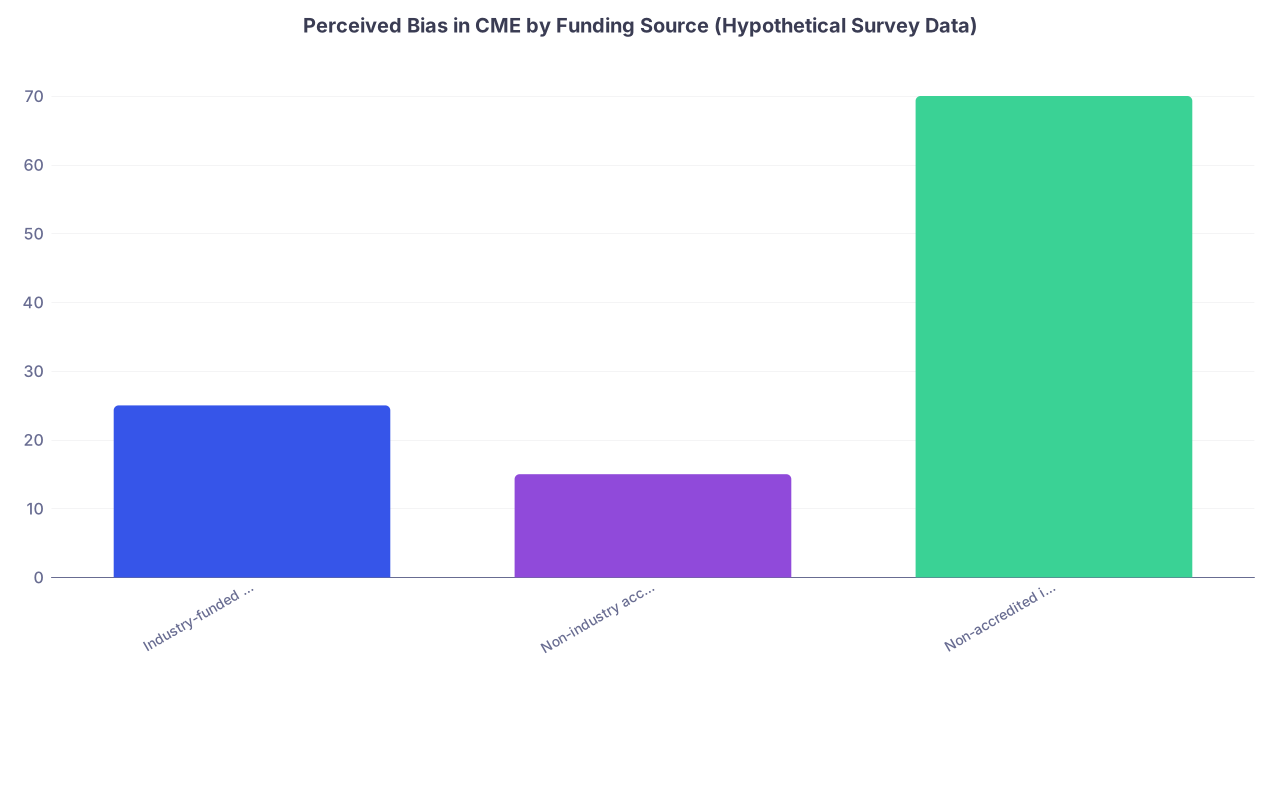
| Category | Value |
|---|---|
| Industry-funded accredited | 25 |
| Non-industry accredited | 15 |
| Non-accredited industry events | 70 |
That kind of pattern is what multiple surveys and content analyses tend to show: accredited activities with industry grants are “more biased” than pure non-industry ones, but nowhere near as slanted as non-accredited promo events.
In many methodologically decent studies:
- Independent blinded reviewers scored overall bias as low for both industry-funded and non-industry-funded accredited CME.
- When bias was detected, it was often subtle framing (e.g., emphasis on drug therapy over non-pharmacologic options) rather than outright falsehoods.
That nuance matters. You’re not usually being lied to. You’re being steered.
2. Influence on prescribing behavior
This is where people get jumpy: “If industry funds CME, you will prescribe more of their drug.”
Sometimes, yes. But again, the data are messy.
What we know from several observational studies:
- Non-accredited promotional events (dinners, “lunch-and-learns”) are reliably associated with increased prescribing of the sponsor’s product, often independent of clear patient benefit. That’s robust.
- Accredited CME with industry support shows a weaker and much more inconsistent signal. Some studies find modest shifts in prescribing toward sponsor drugs; others find no significant effect once you adjust for baseline trends and marketing noise.
The biggest problem: confounding. Physicians who already like and use a drug are more likely to show up to a program about it. Then you “find” that attendance is associated with more of that prescribing. Of course it is. That’s selection bias, not necessarily CME-induced persuasion.
The smarter analyses try to adjust for this, and once they do, the clean causal signal from accredited CME alone gets faint.
I’ve seen one hospital’s internal review where they tracked prescribing before and after a series of accredited, industry-supported antibiotic stewardship seminars (multiple companies). Prescribing shifted away from several high-cost agents toward narrower-spectrum options. Industry money was in the room; bias wasn’t driving the outcome.
So no, “industry-funded CME always drives inappropriate prescribing” is not an evidence-based statement. It’s a fear-based one.
The Real Risk: Topic Selection and Framing, Not Outright Lies
The more interesting—and more subtle—bias lives upstream of the slide deck.
Companies funding CME do not need to insert fake data. They just need to make certain topics and angles more visible than others.
Common pathways:
- Choosing topics where drug therapy dominates and devices, lifestyle, or systems-level solutions are secondary.
- Focusing heavily on surrogate markers and less on hard clinical outcomes when those are more favorable.
- Emphasizing early adoption of newer (expensive) therapies under the banner of “innovation” and “personalized medicine.”
You end up with an educational environment where you’re constantly hearing detailed, well-produced updates on:
- SGLT2/GLP-1 minutiae
- Pseudo-innovations in inhalers
- Marginally better biologics for niche indications
…while hearing far less thorough, less frequent CME on:
- Deprescribing in multimorbidity
- Non-industry-friendly interventions (nutrition, physical therapy, sleep, social interventions)
- Comparative cost-effectiveness in real-world practice
So the problem isn’t typically fabricated content. It’s selective magnification of certain parts of the evidence landscape.
That’s a CME ecosystem problem, not a “this single talk is corrupt” problem.

How Accreditation Actually Works (And Where It Fails)
People love to say “ACCME standards prevent bias” like that’s some magical spell. No. But they do matter.
Most major CME systems in the US and many other countries require:
- Independence in content control: The sponsor can’t pick the speakers, control slides, or approve content.
- Full disclosure of financial relationships.
- Mitigation of relevant conflicts (e.g., review by independent planners, content validation).
Does it always work flawlessly? Of course not. But when these standards are followed reasonably well, we see:
- Less overt promotional tone.
- Broader citation of independent sources.
- More explicit mention of alternative treatments, including generics.
Where things break:
- Token mitigation: Conflict “managed” by a two-sentence disclosure slide and nothing else.
- Planners with heavy industry ties: Even if the sponsor isn’t in the room, planners can do the sponsor’s work for them unconsciously.
- Format drift: “Satellite symposia” at major meetings that are technically compliant but obviously designed to spotlight a specific molecule.
So no, accreditation is not a guarantee of purity. But pretending it doesn’t reduce the worst abuses is just as naïve.
Comparing Industry-Funded vs Non-Industry CME in the Real World
Let’s be blunt: a lot of non-industry CME isn’t exactly a beacon of unbiased perfection either.
You’ve probably sat through:
- Grand rounds that are basically an in-house specialist advertising their own procedure line.
- State-mandated CME on opioids, pain, or implicit bias that is ideologically rigid with weak data.
- Academic talks where the “bias” is toward the speaker’s favorite theory, not a pharma brand.
Bias is not solely a function of who pays the catering bill.
To put it side-by-side:
| Feature | Industry-Funded Accredited CME | Non-Industry Accredited CME | Non-Accredited Industry Events |
|---|---|---|---|
| Promotion risk | Moderate | Low | Very high |
| Topic innovation | Often high | Variable | High (but narrow) |
| Evidence citation quality | Usually good | Usually good | Often selective |
| Regulation/oversight | Moderate–high | High | Low |
| Cost to participant | Often free | Often fee-based | Free |
You pay a price either way. With non-industry CME, you often pay in dollars. With industry-supported CME, you pay in vigilance.
How to Critically Use Industry-Sponsored CME Without Getting Played
This is where you actually live day-to-day: you have limited time, a boatload of CME credits to earn, and a firehose of options. “Avoid all industry money” sounds righteous and is usually impractical.
So the move is not abstinence. It’s informed use.
Here’s how to handle it like an adult, not a victim:
Look at who controls content, not just who funds.
- Is it through a respected academic or professional society?
- Are there non-industry planners?
- Are multiple competing therapies (including generics) compared?
Scan speaker disclosures—and then look at the program structure.
A speaker with research grants alone is different from a speaker running three promotional speaker bureaus for the sponsor. If most of the faculty are deep in the sponsor’s ecosystem, that’s a yellow flag.Check for missing pieces.
- Did they mention non-pharmacologic approaches at all—or just as an afterthought?
- Are they honest about limitations, uncertainties, and trial populations?
- Is cost or real-world access acknowledged?
Watch the outcome framing.
Ringing the bells for a 15% relative risk reduction on a soft endpoint with no absolute numbers? Classic spin. Good CME gives you ARR, NNT, confidence intervals, and context.Compare with independent sources after.
Read the relevant guideline (that wasn’t underwritten by the same company), check an independent formulary or evidence summary, and see if the message lines up.
If you do this consistently, you can absolutely harvest value from industry-funded CME without becoming a mouthpiece.

| Step | Description |
|---|---|
| Step 1 | Identify CME Activity |
| Step 2 | High promotion risk |
| Step 3 | Check content controller |
| Step 4 | Higher vigilance |
| Step 5 | Review disclosures |
| Step 6 | Scan for balance and alternatives |
| Step 7 | Compare with independent guideline |
| Step 8 | Accredited? |
| Step 9 | Academic/society led? |
Why “Ban All Industry Funding” Is Not a Serious Solution
There’s a fashionable stance in some circles: “All CME should be free of industry money.” Nice slogan. Completely detached from the financial reality of medical education.
High-quality CME—good speakers, data curation, interactive formats—costs money. Venues, platforms, staff, peer review, recording, distribution. The works.
If you strip out industry support entirely:
- Either participant fees skyrocket, which hurts small practices and rural clinicians the most.
- Or quality drops and you get more low-budget, slide-reading snoozefests.
- Or CME volume shrinks, especially in niche or lower-margin areas where societies can’t absorb costs.
That doesn’t justify sloppy practices. But it does explain why blanket purism hasn’t exactly taken over.
In practice, some of the best CME—technically, logistically—has industry grants behind it. The trick is making sure the governance and guardrails are strong enough that clinical value isn’t sacrificed to marketing.
Pretending we can just “go back” to some imaginary era of pure, university-funded CME is fantasy. University budgets are not trending in that direction, and you know it.
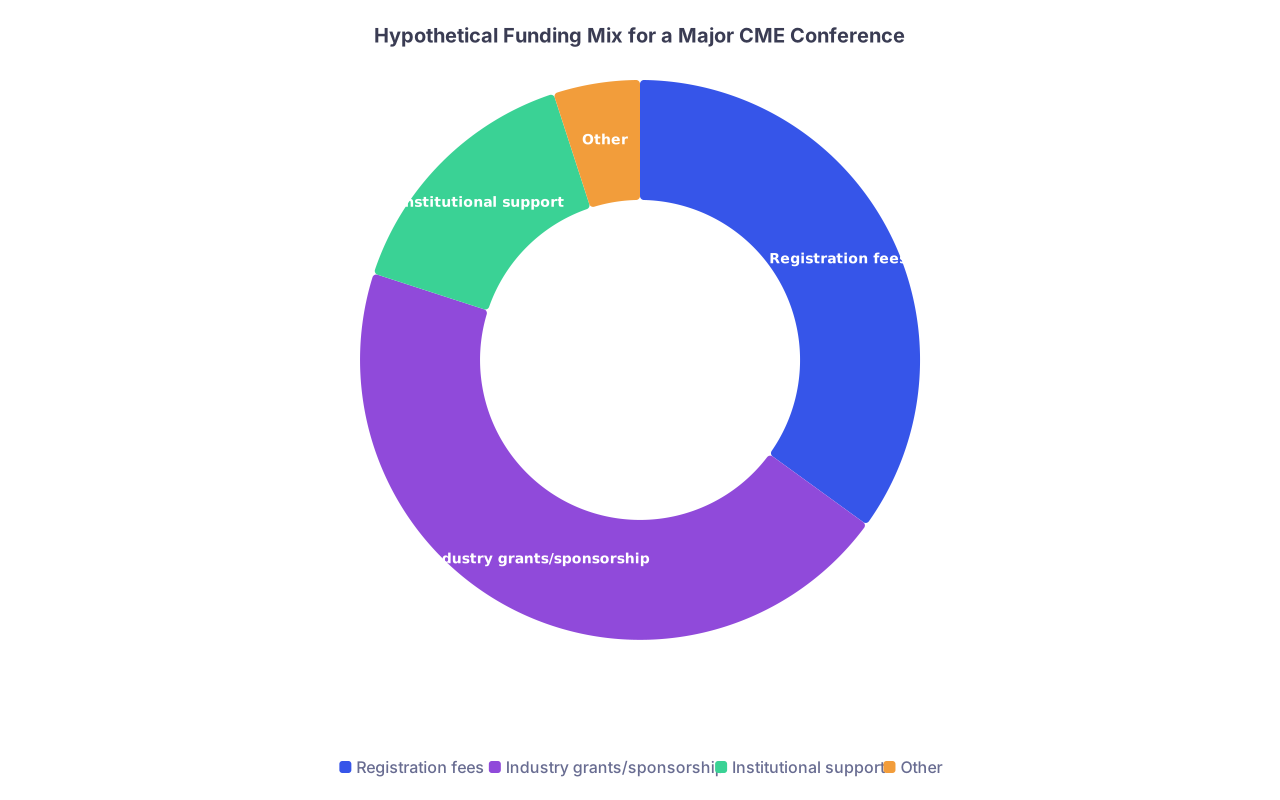
| Category | Value |
|---|---|
| Registration fees | 35 |
| Industry grants/sponsorship | 45 |
| Institutional support | 15 |
| Other | 5 |
This is roughly what many large meetings look like. Pull out the 45% and tell me honestly you think everything else stays the same.
Where the Real Red Lines Are
So if “never attend industry-funded CME” is the wrong red line, what are the right ones?
From a practical, self-protection standpoint:
Avoid non-accredited, single-product “CME-like” events. These are marketing with a thin educational veneer. Lunch is not worth reshaping your prescribing.
Be wary of activities where the sponsor’s drug is in the title. “Advances in the Management of X” is one thing. “Optimizing Therapy with DrugY® in X” is another.
Steer clear of speaker bureaus as “education.” Once a talk is run as part of a promotion campaign, it’s not CME in spirit, even if someone slaps credit hours near it.

There’s no law forcing you to pretend those are the same thing.
So, Are Industry-Sponsored CME Activities Always Biased?
No. That’s the myth.
What the evidence actually supports is this:
Accredited, well-governed industry-funded CME can be accurate, guideline-consistent, and clinically useful, with bias typically living in topic choice and emphasis, not outright misinformation.
Non-accredited, product-centered events and speaker bureau activities are reliably biased and promotional, and they do measurably affect prescribing.
You can safely use industry-supported CME if you treat it like any other imperfect information source: check who’s controlling the content, look for omissions and framing, and cross-check with independent evidence before changing your practice.
That’s the grown-up position. Not purity theater. Not blind trust. Just disciplined skepticism and reality-based use of the resources in front of you.


