

The idea that CME is just a bureaucratic box to check for licensure is wrong. And clinging to that myth is quietly making clinicians worse at their jobs.
Let me be clear: most CME as currently consumed is garbage. Death-by-slide-deck conferences. Token online modules you click through while answering messages. Sponsored dinners where the educational objective is “use more of our drug.” You’re not imagining that a lot of it feels useless.
But that’s not the same as saying CME itself is useless.
The data say something different: when CME is done correctly—planned, targeted, integrated with real practice—it changes physician behavior and improves patient outcomes. The problem isn’t that CME is a box to check. The problem is that too many physicians treat it like one.
Let’s pull this apart.
How We Got Here: The Box-Checking Mentality
I’ve heard versions of the same line in hospitals from Boston to Bakersfield:
“Yeah, I just need like 10 more Category 1s before my license renewal.”
“Just send me the link, I’ll click through it while I finish notes.”
“I’ll get my risk management credits from that malpractice webinar—I’ll put it on 1.5x.”
This isn’t laziness. It’s conditioning.
The system set this up:
State medical boards say: you must have X CME hours.
Hospitals say: you must have Y CME hours in Z topics.
Boards and MOC systems say: you must have modules A through F.
So physicians respond rationally. They hit the minimum requirement with the least disruption to their already out-of-control schedules. That is not a moral failing. That’s survival.
But it creates a distinction almost nobody talks about:
- Regulatory CME – hours you need to prove you’re “keeping up.”
- Functional CME – targeted learning that actually changes how you practice.
You can satisfy the first while totally ignoring the second. And that’s what a lot of people do.
What the Data Actually Show About CME Effectiveness
Here’s the part that cuts against the usual eye-rolling about CME.
Systematic reviews and meta-analyses (yes, actual evidence, not brochure copy) have been consistent about a few things:
- Didactic lectures alone? Almost useless for changing clinician behavior.
- Multimodal, interactive CME? Effective. Not just at knowledge, but at practice change and outcomes.
A classic example: a JAMA meta-analysis on continuing medical education found that traditional, lecture-based CME had minimal impact on clinical performance. But interactive sessions, small groups, case-based learning, and CME integrated with feedback and reminders showed moderate to large effects on both physician behavior and patient outcomes.
This pattern has been replicated across areas:
- Antibiotic stewardship
- Diabetes management
- Hypertension treatment
- Cardiac care
- Cancer screening
Whenever CME moves from “sit and absorb” to “engage, apply, and follow up,” results change.
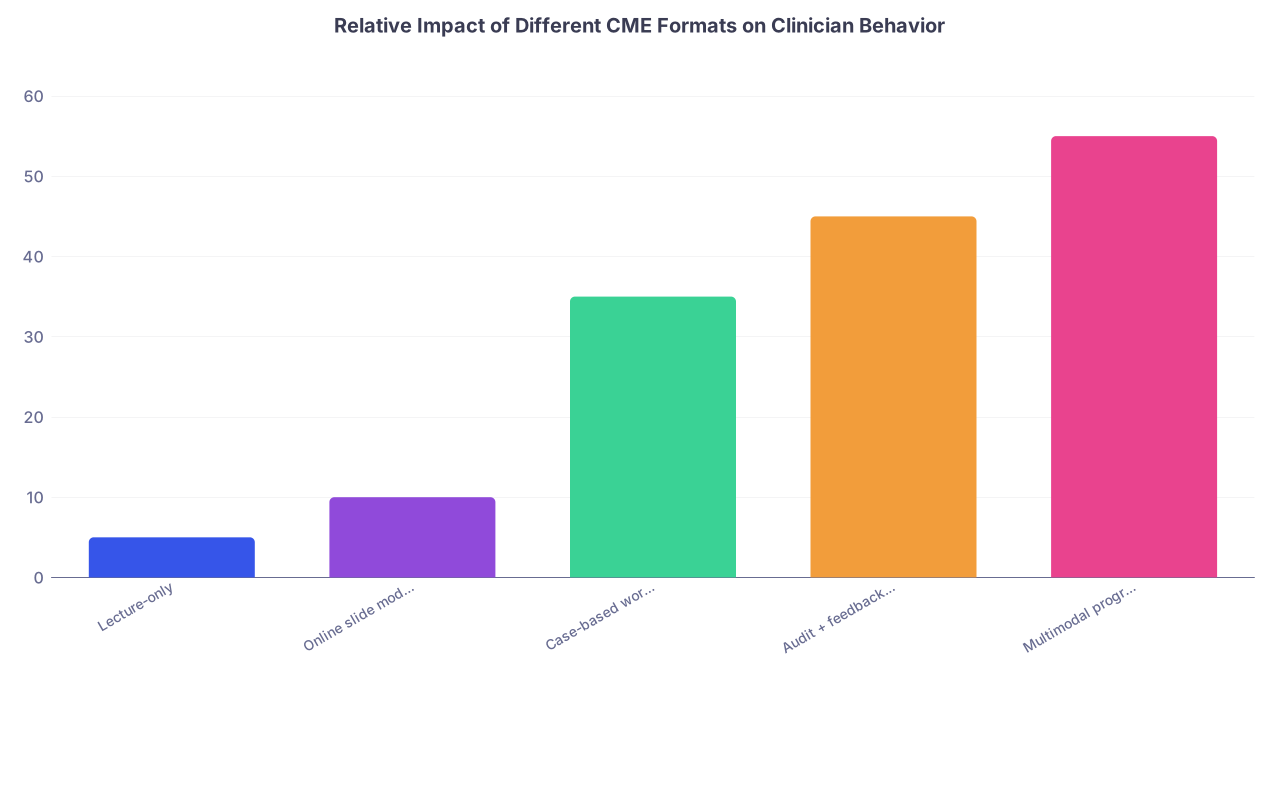
| Category | Value |
|---|---|
| Lecture-only | 5 |
| Online slide module | 10 |
| Case-based workshop | 35 |
| Audit + feedback CME | 45 |
| Multimodal program | 55 |
Interpret the rough numbers like this: lecture-only CME barely nudges practice. A multimodal program—interactive sessions, cases, reminders, audit and feedback—can radically shift how people treat patients.
So, when someone says “CME doesn’t do anything,” what they’re really saying is, “The way I usually consume CME doesn’t do anything.” Those are not the same statement.
The Real Risk: Stale Practice, Hidden in Plain Sight
The danger of the “just a box” myth isn’t philosophical; it’s clinical.
Medicine moves faster than any one of us can track. A few concrete examples:
- The 2017 ACC/AHA hypertension guidelines drastically changed thresholds and treatment targets compared with JNC 7/8. Years later, some attendings still quote 140/90 as if nothing changed. Patients pay the price.
- Opioid prescribing standards, risk mitigation strategies, and alternatives have evolved dramatically. Many people’s habits formed in a pre-crisis era don’t line up with current evidence or regulatory expectations.
- Heart failure with reduced EF changed from “ACEi + beta-blocker” to a much more complex, multi-drug foundational regimen (ARNI, SGLT2 inhibitors, MRA, etc.) over a relatively short period. Staying current by osmosis doesn’t work here.
When you believe CME is just a legal hurdle, you unconsciously treat your existing knowledge as “good enough.” That’s comfortable. It’s also wrong.
| Area | Old Norm | Newer Standard (Illustrative) |
|---|---|---|
| Hypertension | 140/90 as universal threshold | Lower thresholds, risk-based targets |
| HFrEF | ACEi + beta-blocker | ARNI, SGLT2i, MRA, more aggressive use |
| Opioid Prescribing | Short courses, loose limits | Tight monitoring, PDMP, alternatives |
| Anticoagulation in AF | Warfarin default | DOACs preferred in many patients |
I’ve watched senior clinicians get blindsided on rounds when a resident quotes a guideline they’ve never actually read. They cover it with confidence, as most good clinicians do. But the reality is simple: their practice drifted away from the evidence years ago. They just never noticed.
CME done well is one of the few structured tools you have to audit yourself before a bad outcome or a malpractice case does it for you.
The Sponsored CME Problem: Confusing “Available” with “Useful”
Let’s address the elephant in the ballroom: industry involvement.
I’ve sat in “educational symposia” where the faculty slides may as well have had the drug logo watermark. Every case mysteriously ended with the same branded solution. Attendees left with a nice dinner and a distorted sense of first-line therapy.
The evidence on industry-sponsored education is not subtle. It tends to:
- Overemphasize drug therapy over nonpharmacologic options
- Spotlight newer, more expensive agents
- Understate uncertainty and adverse effects
So yes, if most of what you count as “CME” is pharma-sponsored dinners and satellite symposia, your subconscious is right to be cynical.
But that’s exactly why treating CME as a checkbox is dangerous. When you don’t actively curate your learning, the path of least resistance is whatever’s most aggressively marketed and easiest to attend.
That’s how you end up with clinicians who have encyclopedic recall of every PCSK9 inhibitor trial but still manage type 2 diabetes like it’s 2005.
What High-Value CME Actually Looks Like
Let me flip this around. Suppose you drop the myth and accept that CME could be more than a hoop. What does useful CME look like in the real world?
Not glamorous. Not performative. Just effective.
It usually has at least three features:
- Problem-first, not credit-first
The best CME starts with, “Where are my outcomes—or my confidence—actually weak?” Not, “What course gives 10 easy credits this weekend?”
That might mean you realize your comfort with:
- GLP-1 agonists and SGLT2 inhibitors is shaky
- Palliative care conversations always feel rushed and clumsy
- New sepsis definitions and early management bundles still confuse you
You seek CME that hits that nerve. Not whatever your inbox happened to advertise this week.
- Interactive and applied
The literature is clear: passive learning doesn’t change behavior. High-yield formats include:
- Case conferences where you’re forced to choose a management plan and defend it
- Small-group workshops on, say, complex anticoagulation decisions
- Simulation (codes, airways, sepsis, obstetric emergencies)
- Programs where your own practice data are reviewed (e.g., your antibiotic prescribing, your readmission rates)
- Reinforced and looped back into your practice
One-off events bounce off your cortex and vanish. Real change often needs:
- Reminders in the EHR
- Protocols updated to match what you just learned
- Follow-up sessions that re-audit your data and show improvement—or lack of it
That kind of CME isn’t just “educational.” It’s embedded QI with credits attached.

| Step | Description |
|---|---|
| Step 1 | Regulatory Requirement |
| Step 2 | Random credits\nLectures\nSponsored talks |
| Step 3 | Minimal practice change |
| Step 4 | Targeted topics\nInteractive formats |
| Step 5 | Practice audit\nFeedback |
| Step 6 | Updated habits\nMeasurable outcomes |
| Step 7 | Approach |
Notice what’s missing here: anything about “fun conferences in nice cities.” That can be a bonus. It’s not the metric.
A Hard Truth: Your Brain Isn’t Special
A lot of seasoned clinicians lean on a quiet, unspoken assumption: “I see so much volume, I basically am doing CME every day.”
No, you’re not. You’re reinforcing your current mental model every day.
Real-time clinical work:
- Gives you pattern recognition
- Rewards speed over reflection
- Punishes uncertainty
Learning requires the opposite:
- Space to question your reflexes
- Time to review data that conflict with your current habits
- Psychological safety to admit, “I’ve been doing this wrong.”
I’ve sat in morbidity and mortality conferences where you can see the split. The clinicians who view CME as a hoop get defensive, externalize, blame the system, or dismiss guideline changes as “not realistic for my patients.” The ones who’ve invested in real continuing education are more likely to say, “This is how I’ve been doing it. Here’s where it diverges from best evidence. I need to fix that.”
Same years in practice. Very different posture toward learning.
The literature on expertise backs this up: deliberate practice—targeted effort to improve weak areas with feedback—is what moves people from competent to excellent. CME can either be the bureaucratic version of that or the real thing.
You pick.
Stop Letting Regulators Define Your Ceiling
State boards and specialty boards set floors, not ceilings. They’re telling you the minimum documentation they need to believe you haven’t completely abandoned learning.
Minimum hours. Minimum topics. Minimum proof you’re alive and vaguely engaged.
If you let that define your concept of CME, you’re accepting a learning strategy built around liability. Not around excellence, not around outcomes, not around realistic self-respect.
Here’s the pivot that separates the box-checkers from the professionals:
The box-checker asks:
“How do I get 40 hours of CME this cycle with the least pain?”
The professional asks:
“What 3–5 concrete practice gaps am I going to fix this year, and which CME activities will most efficiently help me close them?”
Same requirement. Completely different mindset.
And ironically, when you start from the second question, the hours basically take care of themselves. You overshoot the minimum almost by accident.
Where to Put Your Attention Next
If you’re reading this as a med student, resident, or early-career doc, here’s the uncomfortable reality: the training structure that currently shoves learning in your face will go away. Nobody will be forcing you to read the new sepsis guidelines or trial data once you’re out.
CME is the skeleton of what replaces it. You get to decide if that skeleton is functional or ornamental.
Watch for these tells in your own behavior:
- You pick CME events based primarily on convenience, location, or food.
- You can’t point to a single persistent change in your practice from your last year of CME.
- You rely mostly on Twitter/Medscape/UpToDate updates and tell yourself that’s “enough.”
- You shrug at new MOC or CME requirements as “just more hoops” without asking whether any of them might be pointing at real practice gaps.
If that’s you, then yes, right now CME is basically a box in your life. But that’s not inherent to CME. That’s a choice.
Three points to walk away with
The myth that CME is “just a box for licensure” is self-fulfilling. Treat it that way, and it will be useless. The evidence shows well-designed CME can meaningfully change clinician behavior and patient outcomes.
Most low-yield CME is passive, lecture-based, or industry-shaped. High-yield CME is problem-driven, interactive, and tied back to your own practice data and habits.
Boards set the minimum you must document, not the level you should aspire to. If you want to avoid becoming that attending who practices 2010 medicine in 2026, you cannot afford to keep treating CME as paperwork. It has to become one of your core tools for not falling behind.


