

You are not doomed—but you absolutely can blow this if you treat it like a normal application year.
Let me just say the quiet part out loud: competitive specialty + couples match + partner in a less competitive field is one of the most anxiety-inducing combinations in the entire Match system. And your brain is probably already doing the greatest hits:
- “What if I tank their chances?”
- “What if they tank my chances?”
- “What if we match but in different cities?”
- “What if we compromise and then I hate my career forever?”
- “What if we pick geography first and then one of us never matches?”
Yeah. I know.
Let’s walk through this like people who are legitimately scared—but still want to make rational, strategic moves.
The Hard Truth About “Mixed-Competitiveness” Couples
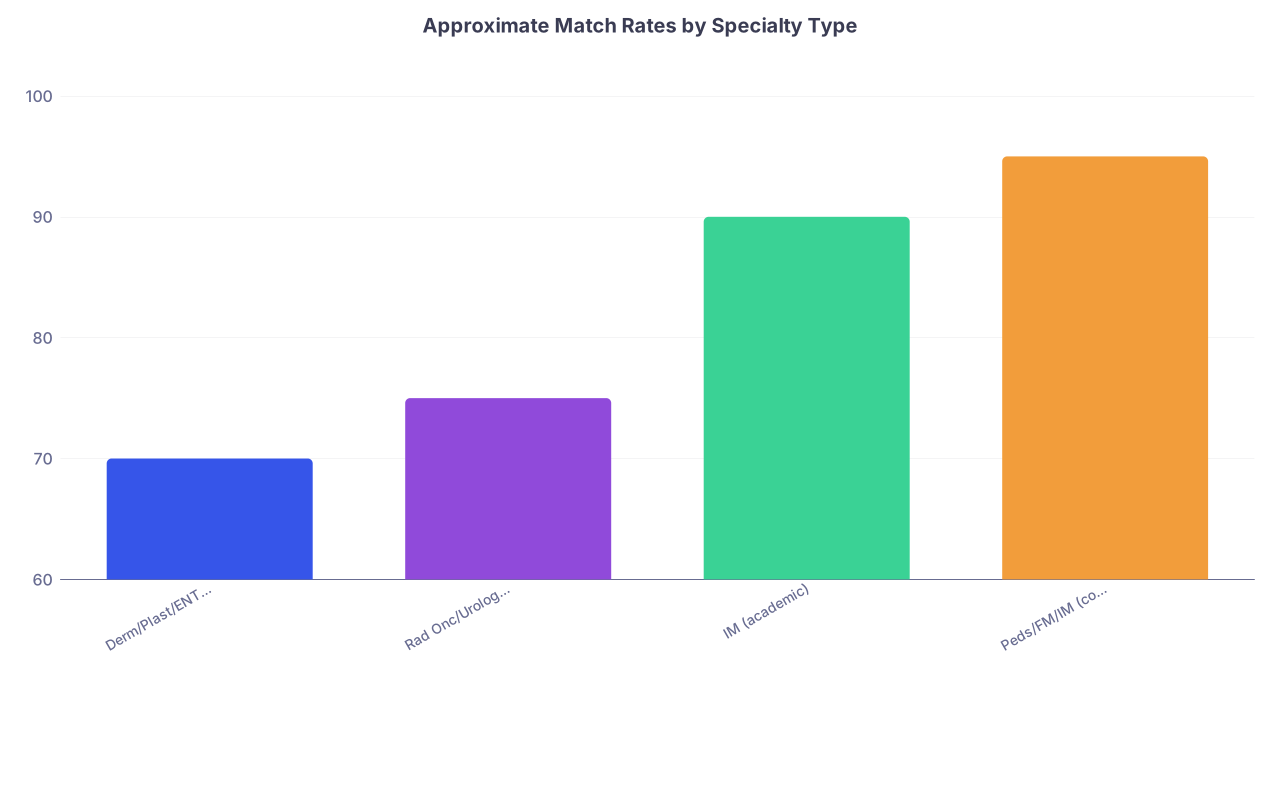
| Category | Value |
|---|---|
| Derm/Plast/ENT/Ortho | 70 |
| Rad Onc/Urology/Neurosurg | 75 |
| IM (academic) | 90 |
| Peds/FM/IM (community) | 95 |
Here’s the basic problem in your situation:
You want something like:
- Dermatology
- Orthopedic surgery
- ENT
- Plastic surgery
- Neurosurgery
- Or maybe EM/rads/IR at a really high-tier place
Your partner wants:
- Pediatrics
- Family med
- Psych
- Internal medicine (not necessarily prestigious academic)
- Or just “somewhere decent and stable”
On paper, that sounds like, “Well great, at least one of us is flexible.” But the Match doesn’t care about “vibes.” It’s math and geography.
The risk is this:
- You’re fighting for a small number of spots clustered at specific hospitals.
- Your partner’s specialty exists everywhere … but that doesn’t matter if there are no spots for you nearby.
- If you rank only the few cities where your competitive specialty is viable, your partner’s options shrink dramatically.
- If you prioritize your partner’s broader options, you may end up in places where your desired programs are ultra-competitive or virtually non-existent.
So no, you’re not doomed. But casually “hoping it works out” is reckless. You need structure.
Step 1: Decide What You’re Actually Optimizing For (Not What You Say You Are)

| Step | Description |
|---|---|
| Step 1 | Talk Honestly |
| Step 2 | Maximize Joint List Length |
| Step 3 | Broaden Geography + Backup Plans |
| Step 4 | Mixed Strategy: Jumps + Backups |
| Step 5 | Rank every city with any combo |
| Step 6 | Add prelims, TY, less competitive options |
| Step 7 | Higher risk, more targeted list |
| Step 8 | Top Priority? |
Most couples tell each other: “We’ll put the relationship first.” Then they make a rank list that clearly doesn’t do that.
You and your partner have to answer this brutally honestly:
If the Match said:
“I can guarantee you stay together, but your specialty might change or your location might be less ideal,”
would you take that deal?
Or:
“I can guarantee you the best possible outcome for your career, but your partner’s outcome and your ability to live together are less certain,”
would you take that deal?
You’re probably trying to say “both,” but the algorithm doesn’t care. Your rank list is your real priority, whether you admit it or not.
Here are the three main real-world priorities I’ve seen:
Stay together no matter what
You’re willing to:- Take less “prestigious” programs
- Add prelim/TY years to keep options open together
- Consider SOAP if needed to land in the same place
- Accept that your competitive dream specialty may come with a backup plan
One career takes priority this cycle
Usually when:- One partner is applying to an ultra-competitive specialty or super-elite programs
- The other partner feels more flexible or earlier in training (e.g., MS4 + PGY-1) You:
- Make a rank list that maximizes that partner’s odds
- Have a contingency plan for the other person (SOAP, reapply, research year, etc.)
Both careers first, relationship takes a calculated hit if it must
This is harsh but sometimes real. You:- Rank strong programs even in different cities
- Accept that some ranked pairs mean living apart for a while
You can’t build a rational couples list until you’ve picked your lane. And if you and your partner are quietly in different lanes? That’s how resentment starts.
Tonight, you two need to have that conversation. Not “what do we want ideally,” but “what are we actually willing to give up.”
Step 2: Understand How the Algorithm Actually Treats You

The couples match isn’t romantic. It’s a brute-force pairing exercise.
You and your partner don’t submit separate lists. You submit a joint list of combinations:
- (You: Program A, Them: Program X)
- (You: Program A, Them: Program Y)
- (You: Program B, Them: Program Z)
- …and so on
The algorithm goes down that list from top to bottom and asks:
“Is there a way to place both of these people at these programs simultaneously given all other applicants?”
If yes → you match there.
If no → it tries the next pair.
The scary translation if you’re the competitive one:
If you aim very high and your partner’s specialty is everywhere, the system still needs those two specific spots to be open together. You can totally be “good enough” for a single program in isolation but fail to match there as a couple because your partner can’t fit into the same hospital system in that city.
And the reverse:
Your partner might be wanted by tons of peds/FM programs, but they don’t get them because those specific combinations with you never line up.
This is why couples match stories sound so random. They’re not random. They’re just constrained by combinations, not individuals.
So what do you do with that?
You deliberately build:
- Multiple combinations in the same city/region
- Pairs that include:
- Your reach programs + their safer programs
- Your safer programs + their reach programs
- Backup options for both of you
The worst couples lists are the short, “perfect or nothing” ones. Those are the “doomed” people.
Step 3: Build a Ruthlessly Strategic Program List

Here’s where the anxiety spikes, because you start seeing how little room for error you actually have. That’s fine. Better to feel it now than in February.
You and your partner need a shared spreadsheet with at least these columns:
- City
- You: specialty + program name
- You: competitiveness (reach / realistic / safety-ish)
- Them: specialty + program name
- Them: competitiveness
- Does this city have:
- Multiple programs in your specialty?
- Multiple programs in their specialty?
- Prelim/TY years (if relevant)?
- How badly would we actually live here (1–5)?
Then you organize cities into tiers of feasibility.
| City | You (Derm) Options | Partner (Peds) Options | Couples Feasibility |
|---|---|---|---|
| Boston | 3 | 4 | High |
| Mid-size A | 1 | 3 | Medium |
| Small Town | 0 | 2 | Low |
| Big City B | 2 | 1 | Medium |
You want:
- Cities where you have more than one realistic option
(Not just: “there’s a derm program.” Is it really reachable with your stats?) - Cities where they have more than one program
- Enough cities that your total pair combinations aren’t tiny
Example of how this might work in real life:
You want ortho. Your partner wants FM.
You might:
- Seriously target regions like:
- Large academic centers with:
- Multiple ortho programs or big ortho intake
- Community FM programs in the same metro
- Large academic centers with:
- Be cautious about:
- Cities with only 1 tiny ortho program that’s insanely competitive
- Cities with only 1 FM program that may not love couples
Then, for each good city, you build multiple pairs:
- (You: Ortho Program 1, Them: FM Program A)
- (You: Ortho Program 1, Them: FM Program B)
- (You: Ortho Program 2, Them: FM Program A)
- (You: Ortho Program 2, Them: FM Program B)
Yes, it’s tedious. Yes, it’s necessary.
Step 4: Backup Strategies That Don’t Destroy Your Relationship
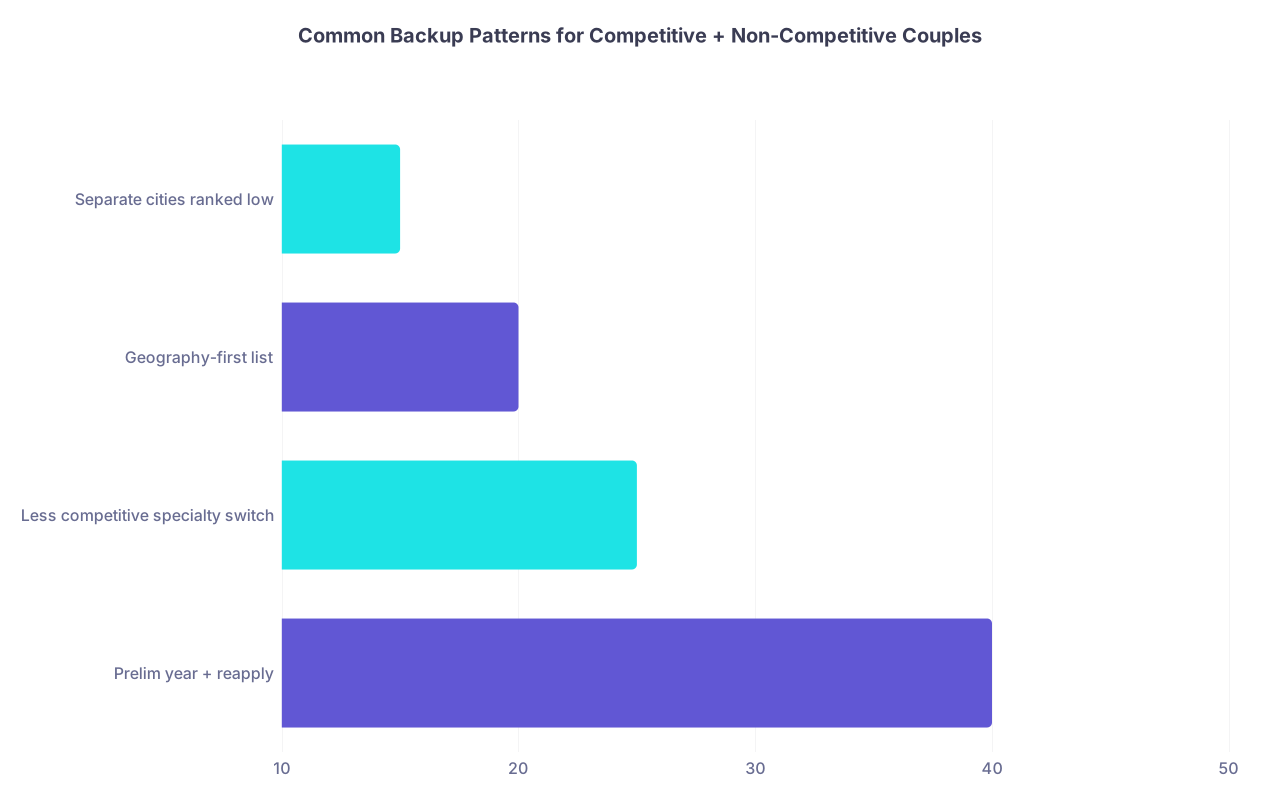
| Category | Value |
|---|---|
| Prelim year + reapply | 40 |
| Less competitive specialty switch | 25 |
| Geography-first list | 20 |
| Separate cities ranked low | 15 |
Here’s the itchy part: you must decide in advance what happens if your dream specialty doesn’t work out this cycle.
Common backup structures I’ve seen:
Prelim/TY + reapply
Good if:- You’re in a competitive field (derm, rads, gas, ophtho, etc.)
- You’re willing to do a prelim medicine or surgery year
- Your partner can match into their categorical spot in the same place This can be a great way to stay together physically while you regroup.
“Tiered” specialty plan for you
Something like:- Rank: ENT → prelim surgery + reapply → categorical gen surg Or:
- Radiology → prelim IM → categorical IM spots in same city This hurts pride. But it massively increases odds you both match somewhere together.
Relationship-first, prestige-later
You:- Emphasize programs more likely to take a chance on you as a couple
- Accept that you might end up in a less “shiny” place
- Plan to move for fellowship if you want “big name” later
Last-resort separate city pairs ranked at the bottom
Some couples do:- Top 80–90% of list: same city only
- Last 10–20%: high-value programs even if in different cities
That’s a brutally honest compromise. You’re saying:
“We will fight very hard to be together. But we won’t destroy both of our careers entirely to avoid even the possibility of distance.”
None of these are fun. But “no plan, just vibes” is much worse.
Step 5: The Conversation You’re Probably Avoiding With Your Partner

You’re probably both trying to be “supportive” and “chill” and “not pressure the other person.” That’s a recipe for vague statements and secret terror.
You need to actually ask each other:
- “On a scale of 1–10, how devastated would you be if you didn’t match into this specialty this year?”
- “On a scale of 1–10, how devastated would you be if we ended up in different cities for a year or two?”
- “What’s worse for you: being apart for a bit, or sacrificing your top specialty choice permanently?”
- “If I miss out on this specialty now, will I secretly resent you? And if you compromise for me, will you resent me?”
This is dark. Do it anyway. Better to uncover simmering fears now than in March when you’re moving.
The couples that imploded didn’t implode because of the Match. They imploded because they never said the hard parts out loud.
You Are Not Selfish for Wanting a Competitive Field (But You Are Responsible)
Let me say this clearly:
You are not a bad partner because you want derm, or ortho, or ENT, or any other competitive thing.
You are, however, responsible for:
- Being honest about how much you care about that
- Being realistic about your chances (Step/COMLEX, research, letters)
- Not gaslighting your partner into pretending it’s “no big deal”
- Doing the extra work this kind of couples match requires
The same goes for your partner. They’re not “less than” because they chose peds or FM. They are not your backup character. Their career is real. Their anxiety is real. Their desire not to be treated as “the flexible one” is real.
If both of you take each other’s careers seriously, you can absolutely build a plan where:
- You maximize realistic chances at your competitive goal
- They still land in a solid program
- You have multiple layers of backup that don’t destroy the relationship
Are you guaranteed success? No.
Are you doomed? Also no.
You’re just in a high-stakes puzzle that requires more discipline than the average couple.
What You Can Do Today (So Your Brain Will Shut Up a Little)
Here’s a concrete next step you can take tonight:
Open a shared Google Sheet with your partner and:
- List every city that realistically has:
- At least one program for you
- At least one program for them
- Color code:
- Green = multiple realistic options for both
- Yellow = realistic for one, dicey for the other
- Red = fantasy or nearly impossible
- Decide together:
- Are we willing to rank yellow cities?
- Are we willing to rank any red cities?
- Then:
Block out 1 hour this week to map at least 10–15 concrete pair combinations.
Not talk “in theory.” Actually build combinations.
You’ll still be anxious—I’m not going to lie. But you’ll move from “we’re doomed” to “ok, we’re in a tough but controllable situation.”
And that’s a much better place to be.
FAQ (Exactly the Questions You’re Probably Too Scared to Ask)
1. If I’m going for a hyper-competitive specialty and my partner is in FM/Peds, am I basically screwing them?
Not automatically, but you can screw them if you’re reckless. If you only rank elite cities with limited community options, their flexibility doesn’t help much. The way you avoid this is by:
- Including a healthy mix of mid-tier cities where your competitive field is still strong but not absurd, and where their programs are plentiful.
- Being honest about your competitiveness and not building a fantasy-only list.
If your Step scores, research, and letters are weak for your field and you still insist on all-top places, yeah—you’re endangering both of you.
2. Is it smarter to drop to a less competitive specialty just to make couples matching easier?
Sometimes yes. Sometimes absolutely not. If you’re “ortho or I will be miserable forever,” forcing yourself into IM to make this one match cycle easier might backfire long-term with resentment. But if you’re genuinely 50/50 between, say, rads and IM, and the numbers + locations look dramatically better for IM, then yes, switching can be strategic and not self-betrayal. The key question: are you truly flexible, or are you pretending to be flexible so you don’t feel guilty?
3. What if one of us doesn’t match—does the couples match make that more likely?
It can. Matching as a couple generally does slightly increase the risk that at least one of you doesn’t match, because you’re tying your outcomes together. But building a long, thoughtful list with backup combinations, prelim/TY options, and multiple cities mitigates that. The disaster scenario is the couple that ranks like 10–15 pairs, all in “dream” places, and nothing else. Don’t be them.
4. Is it a bad idea to rank some separate-city options at the bottom?
Not necessarily. For some couples, it’s a smart, brutally honest compromise:
“We’d rather be together, but if it comes down to both of us not matching versus being apart for a year, we’ll take long-distance.”
You just have to be 100% sure you both truly agree. If one of you is quietly thinking, “I’d rather scramble than be apart,” and the other is thinking, “I’d rather be apart than SOAP into something I don’t want,” that mismatch will blow up later.
5. How many programs do we need to apply to as a mixed-competitiveness couple?
More than you want to. Competitive partner usually needs to go pretty broad—often 40–60+ programs in fields like ortho, ENT, derm (depending on your stats). The less competitive partner might still need 25–40+ if geography is constrained. The main goal is to generate enough interview combinations in enough cities that your eventual rank list isn’t anemic. If you’re staring at a joint list with like 20–30 total pairs? That’s a red flag.
6. How do we protect our relationship if the Match goes badly?
You start now, not after it blows up. Name the possible bad outcomes out loud:
- “What if only one of us matches?”
- “What if we match in different cities?”
- “What if one of us has to SOAP?”
Then agree on: - How you’ll talk to each other (no blame, no ‘you ruined my life’ statements).
- What the 6–12 month plan would be in each case (reapply? research year? transfer? long-distance then aim for fellowship together?).
The couples who survive the worst outcomes aren’t luckier. They’re just the ones who had the hard discussions before everything hit the fan.
Open a blank Google Sheet right now, name it “Couples Match Strategy – [Your Names],” and list five cities where both your specialties exist. That’s your starting point. Don’t scroll more blogs until that’s done.


