

The biggest lie people tell couples in the Match is: “It’ll work out, don’t stress.”
You should stress a little. A short rank list as a couple is a risk. But it’s not as simple as “short list = you’re doomed” or “just rank more and you’re safe.” The truth is messier and way more uncomfortable.
Let’s pull that apart, because I’m guessing you’re sitting there asking:
- “We only have 8–10 programs. Is that insanely risky?”
- “Are we going to go unmatched and regret not adding more?”
- “Are we being too picky… or not picky enough?”
- “Are we screwing each other over by couples matching at all?”
You’re not alone. I’ve watched couples whisper these exact questions outside interviews, in group chats, in those awful 1 a.m. doom-scroll sessions.
Let’s talk about what “too short” actually means for a couples rank list, what’s really risky, and what’s just your brain doing its usual anxiety theater.
1. What “Too Short” Actually Means for a Couples Match
For couples, “too short” is not a fixed number. It depends on:
- Your specialties (FM + Psych ≠ Derm + Ortho)
- How competitive your apps are
- How geographically picky you are
- Whether you’re willing to separate (temporarily or by distance)
But let me be blunt: as a couple, a 5–7 line list of only “perfect, dreamy programs in one city” is high risk unless you’re both absolute rockstars in less competitive fields.
Here’s the basic math problem with couples matching:
NRMP isn’t matching two people to “a program.” It’s trying to match the pair to a combination of programs. That means:
- If you each rank 10 programs individually, the pair can theoretically rank up to 10 x 10 = 100 combinations.
- But if those 10 are all in the same city, and half of them didn’t interview both of you, your effective couples list might be much shorter.
So when you say “our list is short,” I always want to know:
- How many couples lines are on your list?
- How many total interviews did each of you get?
- How picky are your combinations? (Same hospital only? Same city? 1-hour drive max?)
Because a list with 12 thoughtful combinations can sometimes be safer than a bloated list of 40 unrealistic or geographically tiny options.
Still, there are some general ranges where anxiety is… let’s say, more justified.
| Situation | Total Couples Rank List Lines | Risk Level (Typical) |
|---|---|---|
| Both in very competitive fields | < 20 | High |
| One competitive + one mid-range | < 15 | High-ish |
| Both in primary care-ish fields | < 10 | Moderate |
| Willing to be in nearby cities | 15–25 | Often reasonable |
| Willing to separate for a year | 20+ | Risk decreases |
Is this perfect? No. Is it more helpful than “you’ll be fine”? Yes.
2. How Risky Is Your Short List, Really?
Let’s say you’re sitting there with something like:
- One partner: IM
- One partner: Psych
- 9 programs overlapped
- You’ve built maybe 10–12 couples combinations
- You’re mostly in one metro area, with a few “stretch” pairs
Here are the things that actually make this risky:
Both of you have just barely enough interviews.
If one of you has 4–5 interviews total, your floor is already shaky.Your combinations are hyper‑restricted.
Example: every line is “same hospital only,” no nearby hospitals, no willingness to commute 45–60 minutes.You’re in competitive specialties with average stats.
Think Derm + Ortho with like 6–7 interviews each and you only ranked “dream” academic centers together. Yeah, I’d be sweating, too.You didn’t use all reasonable combinations.
You crossed off “less desirable” but still acceptable pairs because they felt like settling.
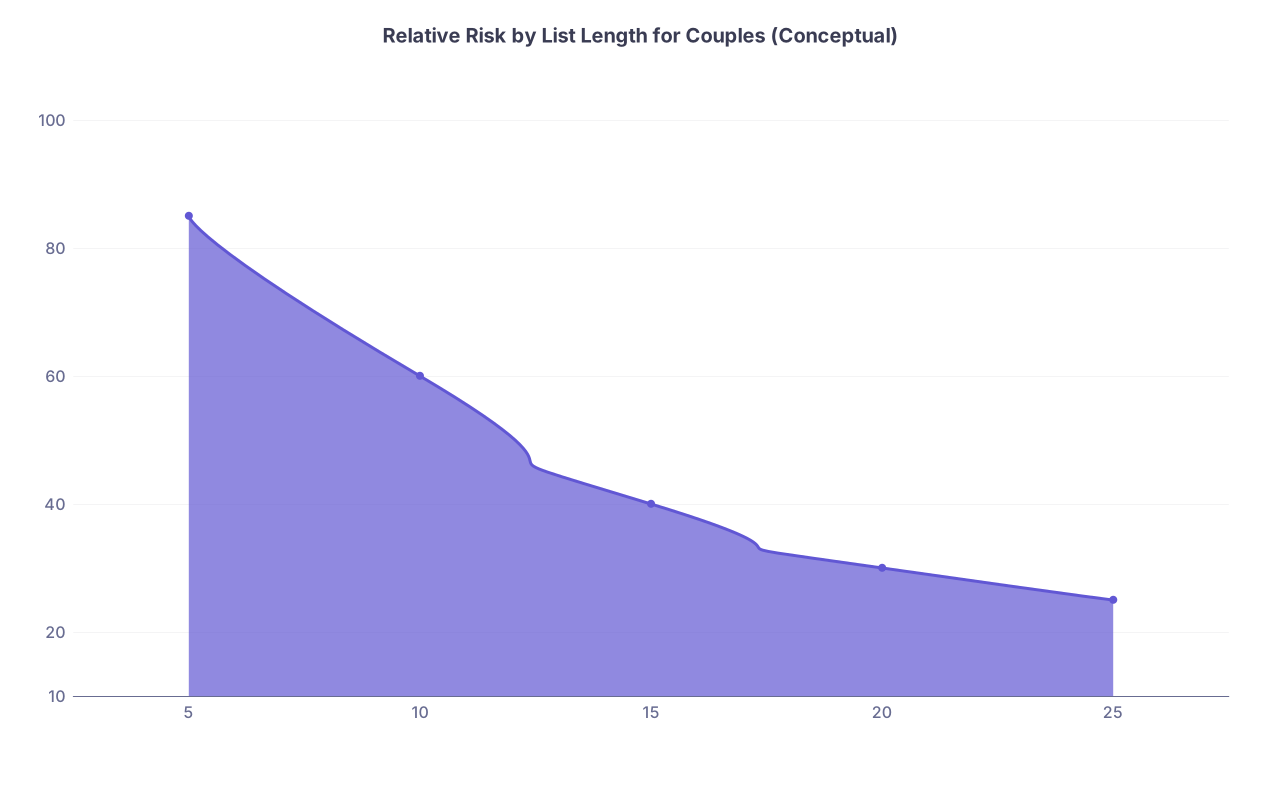
Here’s where a chart helps ground the panic a bit:
| Category | Value |
|---|---|
| 5 | 85 |
| 10 | 60 |
| 15 | 40 |
| 20 | 30 |
| 25 | 25 |
Think of that line like this: as your number of realistic couples rank lines goes up, your chance of both going completely unmatched generally goes down. It never hits zero, but it gets less terrifying.
That 5–10 range? That’s where your brain keeps screaming: “Are we about to ruin our lives?”
Sometimes that’s catastrophizing. Sometimes it’s your intuition nudging you that you cut your list too aggressively.
3. The Tradeoff No One Likes to Admit: Risk vs Misery
Here’s the part people gloss over with their “just rank more programs” advice:
Every additional combo you add can:
- Decrease your risk of not matching
- Increase your risk of matching somewhere you’ll genuinely hate
So you’re stuck between two terrible fears:
- Fear A: “We don’t match as a couple and our whole plan implodes.”
- Fear B: “We match together but at a program so awful we’re miserable for 3–7 years.”
You can’t make both of those 0%. You have to pick which fear you’re more willing to live with.
I’ve seen couples do all versions of this:
Couple 1: Ranked only 6 combos, all in one city they loved. One partner went unmatched. They scrambled/SOAPed into a prelim year and tried again. They still say they’d rather have done that than be stuck somewhere awful together.
Couple 2: Ranked 40+ combinations, including cities they’d never visited and programs they hated on interview day. They matched together… at one of the bottom “panic lines.” They spent intern year saying, “We should’ve just been a little braver and cut this place.”
Couple 3: Had about 15–18 combos. Some “dream,” some “fine,” a few “this will be rough but survivable.” They matched into a “fine but not amazing” pair. They’re tired but okay with it. No one’s thrilled, no one’s destroyed.
That third version is usually what I push people toward: Not reckless. Not perfection-or-bust. Just realistically cautious.
4. Concrete Ways to Judge If Your Rank List Is Too Short
Let’s get painfully practical. Here are questions I’d use to audit your list.
4.1. Are you both individually rank-safe?
I’d feel truly nervous if:
- One of you has fewer than ~8–10 interviews in a moderately competitive specialty
- Or fewer than ~6–7 in a less competitive one
Because couples matching does not erase the individual competitiveness problem. If one person is already on thin ice solo, the couple is on thinner ice together.
4.2. Did you use all non-terrible combinations?
Ask yourselves, line by line:
“If we landed here, would we be:
- Safe
- Able to function
- Not utterly resentful for three straight years?”
Not “Is this our dream?” Just: “Is this livable?”
Any pair that passes that bar probably deserves to be on the list, even if:
- The city is boring
- The program isn’t prestigious
- The commute is annoying
Where people slash too aggressively:
- Crossing off community programs that are solid but not glamorous
- Cutting pairs that involve a 45–60 minute commute between hospitals
- Removing “backup” cities just because they feel like giving up
You can be picky. You just can’t be picky and low-volume and in hard specialties.
5. What If We Really Don’t Want to Add More Programs?
Let’s say you’ve gone through everything, and you still end up with, say, 8–12 couples lines. And you really don’t want to add more because anything beyond that would be miserable or unsafe.
You’re basically choosing this equation:
“We are willing to accept a higher chance of not matching as a couple in exchange for not spending 3+ years somewhere that will wreck us.”
That’s not irresponsible. That’s just… a choice. A scary one, but a valid one.
If you go that route, you need to be honest about:
Your Plan B if one of you doesn’t match
- SOAP for prelim/TY
- Reapplying next year
- Long-distance temporarily
- Financial/emotional support systems
Your Plan B if you both don’t match
- Reapply as a couple next cycle
- Research year, MPH, something to strengthen your apps
- Where you’ll live, how you’ll afford life, what that year emotionally looks like
Your tolerance for uncertainty Some people would rather roll the dice on one year of chaos than lock in three years of misery.
Others would rather guarantee some match, anywhere, just to kill the uncertainty.
Neither is objectively correct. But pretending you’re not making that tradeoff is how resentment builds later.
6. Timeline Panic: Is It Too Late to Fix a Short List?
Modern panic: you’re staring at your list a few days before deadline thinking, “Is it too late to fix this?”
Short answer: If the list isn’t certified yet, you can still adjust.
Here’s what a realistic “last pass” might look like:

| Step | Description |
|---|---|
| Step 1 | Open Current Couples List |
| Step 2 | Add all livable same-city pairs |
| Step 3 | Add cross-city combos within 1 hr drive |
| Step 4 | Keep geographic limit |
| Step 5 | Keep those off the list |
| Step 6 | Review risk level & certify list |
| Step 7 | Any obvious missing combos? |
| Step 8 | Willing to commute 45-60 min? |
| Step 9 | Any programs you hated? |
Translation:
You’re not inventing new programs now. You’re just making sure you didn’t artificially shrink your safety net because you were emotionally tired after interview season.
A lot of couples build their initial list in a haze of:
- “I hated that one resident.”
- “That PD seemed cold.”
- “The city was gray.”
Then two weeks later they realize: actually, that place was… fine. And “fine” is very different from “I will be clinically depressed here.”
This is your chance to rescue those “fine” options.
7. What No One Tells You About How It Feels After Match Day
There are three emotional scenarios I see over and over:
Short list, didn’t match as a couple, but you preserved your non-negotiables.
It’s brutal at first. You’ll question everything. But I’ve watched some of these couples regroup, do a prelim, reapply, and end up somewhere better long-term. They carry scars, but often less regret.Long list, matched at a place you really didn’t want.
You’ll tell yourselves you should be grateful, because “we matched together.” But it can be suffocating to feel stuck in a setting you added out of panic at 1 a.m. three weeks before the deadline.Medium list, landed at a compromise.
Not dream. Not disaster. It’s okay. You’re together, you’re working hard, and after a year it just becomes normal life. This is probably the most common and the least dramatic, which is why no one talks about it.
You’re trying to steer toward scenario #3. The annoying middle path. The one that feels unsatisfying right now because it’s not a perfect fairytale or a bold all-or-nothing move.
That’s usually where the sane decisions live.
FAQ (Exactly 6 Questions)
1. Is fewer than 10 couples rank list lines automatically “too short”?
Not automatically, but it’s definitely in the “be very nervous and very intentional” zone. If you’re both in less competitive fields (FM, IM, Peds, Psych) and the programs are places where you were both clearly ranked-to-match, 8–10 lines can be okay. If either of you is in a competitive specialty, <10 lines is usually a real risk, not just anxiety.
2. Should we add programs we actively disliked just to make the list longer?
Usually, no. If you truly felt unsafe, disrespected, or deeply miserable at an interview, putting that place on the list “just to have more lines” can backfire badly. You don’t want to wake up on Match Day realizing you ranked your way into three years of dread. Add programs that are neutral-to-okay, not ones that made your gut scream “absolutely not.”
3. What if one of us is much stronger on paper than the other—does that change how long our list should be?
Yes, and this is the part no one likes to say out loud. The weaker application often drives the risk. If one person would be rank-safe as a solo applicant and the other is borderline (few interviews, weaker scores, red flags), the couple as a unit is more fragile. In that case, it’s smarter to err on a slightly longer list with more “fine but not amazing” options so the weaker side doesn’t drag both into the unmatched zone.
4. Is it safer to uncouple our rank lists if we’re really anxious about not matching?
It might be safer statistically, but emotionally and practically it can be rough. Uncoupling usually makes sense only if: (1) you’re in very different competitiveness levels, and (2) you’re both okay with long-distance and maybe living in totally separate cities for 3–7 years. If the idea of living apart feels worse than the idea of taking a less-than-ideal city together, you probably shouldn’t decouple just for marginal statistical gain.
5. We have a short list in one city we love. Should we expand to other cities just to reduce risk?
Ask yourselves one harsh question: “If we matched in that other city we’ve never wanted to live in, would we regret adding it more than we’d regret going unmatched and trying again?” If your honest answer is “I’d rather reapply than live there,” then don’t add it. If your answer is “It wouldn’t be ideal, but we’d survive,” yeah, it probably belongs on the list as a backup line.
6. How do we know when to stop tweaking the rank list and just hit certify?
When all of these are true:
- Every program still on the list is at least livable for both of you
- You’ve added all reasonable combinations (including nearby hospitals and commutable cities) that meet your minimum standards
- Anything you’re leaving off now is something you’d sincerely resent matching to
At that point, further tweaking is just anxiety cosplay. You’re not increasing safety; you’re just feeding the worry monster. Hit certify, walk away, and accept that some level of risk is baked into this whole process.
Key points to walk away with:
- A short list as a couple can be a real risk, especially in competitive specialties or with very narrow geography—but it’s not automatically reckless if it reflects your true limits.
- Don’t add programs you’d genuinely hate just to feel “safer”; add all the places that are realistically livable, even if they’re not exciting.
- You’re choosing a tradeoff—more lines vs more potential misery—and the “reasonable middle” is usually a medium-length list of honest, livable options, not a perfect fantasy or a panic-filled spreadsheet.


