

It’s 11:47 p.m. You’re on the couch with your partner, both pretending to “review programs,” but really you’re just staring at the same spreadsheet you’ve reopened 17 times.
Their side: 260+, AOA, strong letters, away rotations at name-brand places.
Your side: decent but not stellar scores, that one ugly clerkship eval, fewer interviews so far, and this pit in your stomach that whispers the same thing over and over:
“I’m the weak link. I’m going to screw this up for both of us.”
You can’t say it out loud because you don’t want to make them feel bad. But it’s there when an invite comes for them and not you. It’s there when your advisor says, “Well, couples match is… complicated.” It’s there when someone jokingly says, “Hope you don’t get dragged to a bad program,” and you think: I am the drag.
Let’s talk about that. Honestly. Not with fake reassurance, but with how this actually plays out and what you can do without destroying your sanity or your relationship.
First: Are You Actually “Dragging Them Down”?
Let me be blunt: maybe. But not in the melodramatic way your anxiety is telling you.
Couples matching does change both of your odds. For both of you.
It doesn’t work like: “Strong partner gets their dream, weaker partner rides their coattails.” The algorithm doesn’t reward the “better” applicant and punish the “worse” one. It treats you as a unit. You either match as a pair at a linked combination, or you don’t. That can help or hurt.
Here’s what actually happens, statistically, most of the time:
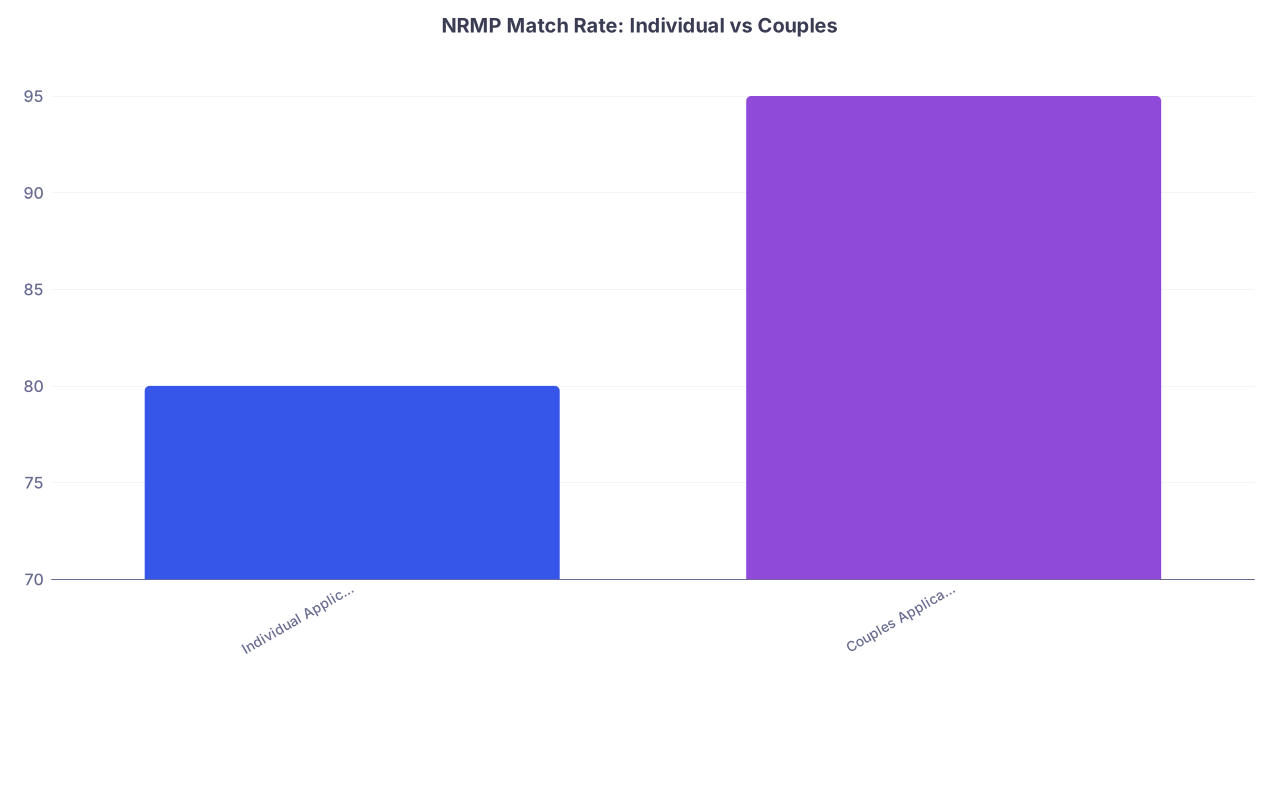
| Category | Value |
|---|---|
| Individual Applicants | 80 |
| Couples Applicants | 95 |
Rough numbers over the last several years: individual seniors match around 80+%, couples around mid- to high-90s. So purely by “will we both match somewhere,” couples are actually safer.
The trade-off is this: the stronger partner is more likely to give up some reach. The weaker partner is more likely to match “up” a little. You both bend toward the middle.
So are you “dragging them down”? In the sense that their final outcome might not be as shiny as if they applied completely solo to only top programs? Yeah, maybe. That’s the reality.
But here’s the piece your anxiety keeps skipping:
They’re also choosing that trade-off. Consciously. Because they want to match with you.
If they wanted the absolute best prestige outcome, they wouldn’t couples match with someone they view as “dead weight.” The fact that you’re in this together at all means they prioritize being with you over having the fanciest name on their badge.
You feeling guilty about that doesn’t make you noble. It just makes you miserable. And honestly, it’s probably stressing them out more than your application ever could.
How Couples Match Actually Handles “Unequal” Partners
Let’s strip away the feelings for a second and talk mechanics, because your brain is probably filling in the blanks with horror stories.
In couples match, you don’t submit one list. You submit a paired list of combinations:
- Your program A + Their program X
- Your program A + Their program Y
- Your program B + Their program X
- Your program C + Their program Z
… and so on
The algorithm goes down that stacked list in order of your preferences as a pair and tries to match both of you with a valid combo.
Here’s what that means for you as “the weaker” one:
If they have more interviews and at stronger places, a lot of those combos will involve them at great programs and you at solid-but-less-flashy ones. That’s fine. Very common.
Programs don’t see “Oh, this person is dragging their partner.” They see two separate applicants at their own programs. Your partner’s program doesn’t care about you. Your program doesn’t care about them. The link only matters at the algorithm stage.
Being “weaker” doesn’t make your partner’s app look worse. There isn’t a box that says “partner’s Step score.” It’s not a two-for-one discount pack.
What does change:
- You will both likely rank some places your partner wouldn’t touch if they were alone.
- They will probably not rank as many All-Star programs as they would solo.
- You will probably rank a wider range of programs than you’d choose alone.
So is there a trade-off? Yes. Is it automatic doom? No. It’s a rebalancing. I’ve watched this play out more times than I can count, and the outcome that destroys people isn’t usually the match. It’s the constant guilt and resentment built up along the way.
The Guilt Spiral: “What If They Secretly Resent Me?”
Let’s say the quiet part. You’re not just worried about the match. You’re worried that five years from now they’ll be on a night shift saying, “I could’ve been at [Prestige Hospital] if it weren’t for you.”
This is what keeps people up at night.
Here’s the hard truth: if your partner is the type of person who would weaponize that against you later, the problem is not the couples match. It’s the relationship.
Most healthy couples I’ve watched through this:
- Have at least one blunt conversation like, “You know you’re stronger on paper, right?”
- Hear the other person say, “Yeah, but I’d rather be together than optimize my ego.”
- Believe them. Even if their anxiety (like yours) flares up now and then.
If you keep that conversation internal, your brain just spins out scenarios:
- “What if they only said yes to couples match because they felt bad for me?”
- “What if their advisor told them not to but they didn’t tell me?”
- “What if they match at my level and regret it forever?”
You know how you fix those? You actually ask. Plainly. Something like:
“Can we talk about something uncomfortable? I’m really scared that my application is limiting your options, and I’m terrified you’ll regret couples matching with me. I need to know how you’re really thinking about this.”
Yes, your voice will shake. Yes, you’ll want to backpedal and say “never mind.” Don’t.
I’ve heard versions of the replies:
- “I know my app is stronger. I’m okay with where that puts us. I want to do this together.”
- “I’ve already made peace with maybe not going to my top-top dream place. That’s my choice.”
- “Honestly, I’d be more miserable crushing it alone somewhere without you.”
If their answer is: “Yeah I’m not sure,” that sucks to hear. But it’s still better than walking into the match year on a foundation of unspoken fear.
Strategic Reality: What You Can Actually Do About Being “Weaker”
Let’s shift from vibes to tactics. You can’t magically become a 260 or erase a failed shelf. But you’re not powerless.
Think like this: your job is not to become your partner. Your job is to increase the number of realistic, rankable combinations for the pair.
That means:
You apply and interview broadly.
Not because you’re bad, but because range helps the couple. You want:- Academic programs
- Community programs
- Different cities/regions
- A few true safeties that you could see yourself at without hating everything
Your partner’s shiny interviews are great, but if you have 10 solid mid-tier-ish places that are geographically near their high-tier places, suddenly you have lots of viable combos.
You do the ugly-but-necessary spreadsheet. Together.
Rough version:Simple Couples Match Combination Grid Your City / Tier Their City / Tier Status Your Top City Their Top City Reach Your Top City Their Mid City Realistic Your Mid City Their Top City Realistic Your Safety City Their Mid City Safety Your Safety City Their Safety City Nuclear fallback Not Pinterest-cute. Just a realistic map of: “Okay, if I get an interview here and you have one there, that’s another box we can rank.”
You shore up whatever’s actually fixable.
If your Step is your weak point but letters are strong, emphasize the hell out of your narrative, your fit, your reliability. If your evals had some dings, own them and show growth. The difference between “weaker” and “noncompetitive” is often how you present yourself.You have an honest Plan B conversation.
A real one. Not the “haha we’ll live in a van” joke.- Are you both okay ranking a combination where one person is at a clearly “worse” program nearby, just to be together?
- Is there a line you won’t cross? (e.g., certain cities, malignant reputations, family obligations)
- What if one of you has to scramble/SOAP? Does the other still go where they matched, or are you considering unconventional solutions later (re-applying, transfers, etc.)?
Is that a fun talk? No. But not talking about it is worse.
The Quiet Fear: “What If I Don’t Match and They Do?”
This is the nightmare scenario in your head: they’re opening an email that says “Congratulations,” and you’re opening… nothing.
Here’s how the system actually works with couples:
- The algorithm is trying to match you both together in one of your ranked combinations.
- If you couples match correctly (and don’t suddenly un-couple late), you either match as a unit or not at all.
- “They match, I don’t” is not a typical direct outcome from the algorithm for an intact couples pair.
Where it gets messy is if:
- Someone drops out of couples last-minute, or
- Someone’s application is actually catastrophic (major professionalism issue, not just “lower scores”)
Is it impossible for one to end up with a spot and the other be scrambling? No. I’ve seen weird things in SOAP and post-Match shuffles. But for a normal, reasonably put-together pair, the bigger risk is:
- You both match, but in a less-ideal location or program tier than one of you had dreamed of.
That’s… not fun. But it’s survivable. Lots of excellent careers start in very un-Instagrammable programs.
And again, the biggest damage I’ve seen couples take isn’t “we matched in a mid-tier city instead of a top coastal program.” It’s “we spent a whole year with one of us secretly convinced they were ruining the other person’s life.”
What Programs Actually Think About Couples
You’re probably imagining PDs in a dark room saying:
“Ugh, couples. Now we have to deal with someone’s weaker partner.”
Reality is more boring.
Your program sees you. Their program sees them. Unless you’re applying to the same program or same hospital, nobody’s running a detailed joint analysis of “partner quality.”
Most PDs I’ve heard basically fall into three camps:
- Neutral: “Okay, they’re couples matching. Fine.”
- Mildly positive: “Couples can be more stable, more likely to stay.”
- Mildly negative but practical: “This complicates rank lists slightly, but whatever.”
The one place you might feel the “weaker” status is if you both apply to the same program/department and your partner is clearly above their usual bar and you’re at or slightly below. Then yes, you may not both get ranked highly there.
But that’s not unique to you being “worse.” That’s… just matching.
If you’re worried PDs are sitting there going, “Wow, look at this 230. They’re going to ruin their 260-partner’s career,” they’re not. They’re too busy trying to fill their own class with functional human beings who will show up to work.
Protecting Your Relationship While Your Brain Is Melting
The worst thing about being the “weaker” applicant isn’t the data. It’s the shame.
You might notice yourself:
- Downplaying your anxiety because you “don’t want to add to their stress”
- Overcompensating by pushing them toward their dream programs even when it hurts you
- Saying “I’m fine with anywhere” when you’re very much not fine with everywhere
- Snapping or shutting down every time their phone dings with a new invite
You can’t control your Step score now. You can control how honest you’re willing to be with the person you’re supposedly building a life with.
Things that help:
- Explicit permission on both sides to be sad/jealous/afraid without it being personal
- Ground rules like: “When one of us gets an invite and the other doesn’t, how do we share that?”
- Agreeing on when to talk about match (e.g., 30-minute updates in the evening instead of all-day constant buzzing)
- Letting each other be annoying humans about this sometimes without making it a referendum on the relationship
You’re allowed to feel jealous that they have more interviews. That doesn’t mean you’re not happy for them. You’re allowed to feel scared that you’re limiting them. That doesn’t mean you actually are in the catastrophic way your brain is painting it.
Quick Reality Check Before Your Brain Runs Away Again
Let me pull this together before your anxiety looks for a new angle.
- Yes, your partner’s “ceiling” might come down a bit because of you. That’s part of couples match, and it’s something they are choosing too.
- No, you are probably not ruinously dragging them down into oblivion. You’re one half of a unit trying to maximize joint options, and statistically, couples match is safer overall.
- The real danger here isn’t algorithm math. It’s resentment, silence, and secret guilt poisoning what could be an actually okay outcome.
If you do nothing else after reading this, do these two things:
- Have one painfully honest conversation with your partner about your fear of dragging them down.
- Sit down together and map out your realistic and safety combinations so your brain has concrete facts instead of vague panic.
You’re not the “problem child.” You’re one person with one file in a deeply flawed but functional system, trying to make it work with someone you care about. That’s not selfish. That’s exactly what the couples match is for.


