

Last night you were pricing out apartments in three different cities and imagining your new life together. Tonight you’re lying awake wondering if you’ll even end up in the same state because your partner still “isn’t totally sure” about their specialty. And the Match clock keeps ticking whether you two are ready or not.
That whiplash? Completely normal. Terrifying, but normal.
The Specific Nightmare of Couples Matching When One of You Is Undecided
Let me name the thing you’re actually scared of, because I know your brain is already going there:
- What if they change their mind in January and blow up our rank list?
- What if their indecision drags my application down?
- What if we don’t match because they couldn’t commit?
- What if I compromise now and resent them for years?
This is the stuff no one really talks about on Reddit. Everyone posts their “We matched together!” photos. Almost no one posts, “We almost killed each other in October because one of us was still deciding between EM, IM, and anesthesia.”
But I’ve seen it. A lot.
The truth: one partner being unsure about specialty doesn’t doom your Couples Match. But it does change how you need to plan, talk, and rank. And it absolutely affects your stress level if you don’t get intentional about it.
Let’s break it down before your brain talks you into catastrophizing every scenario.
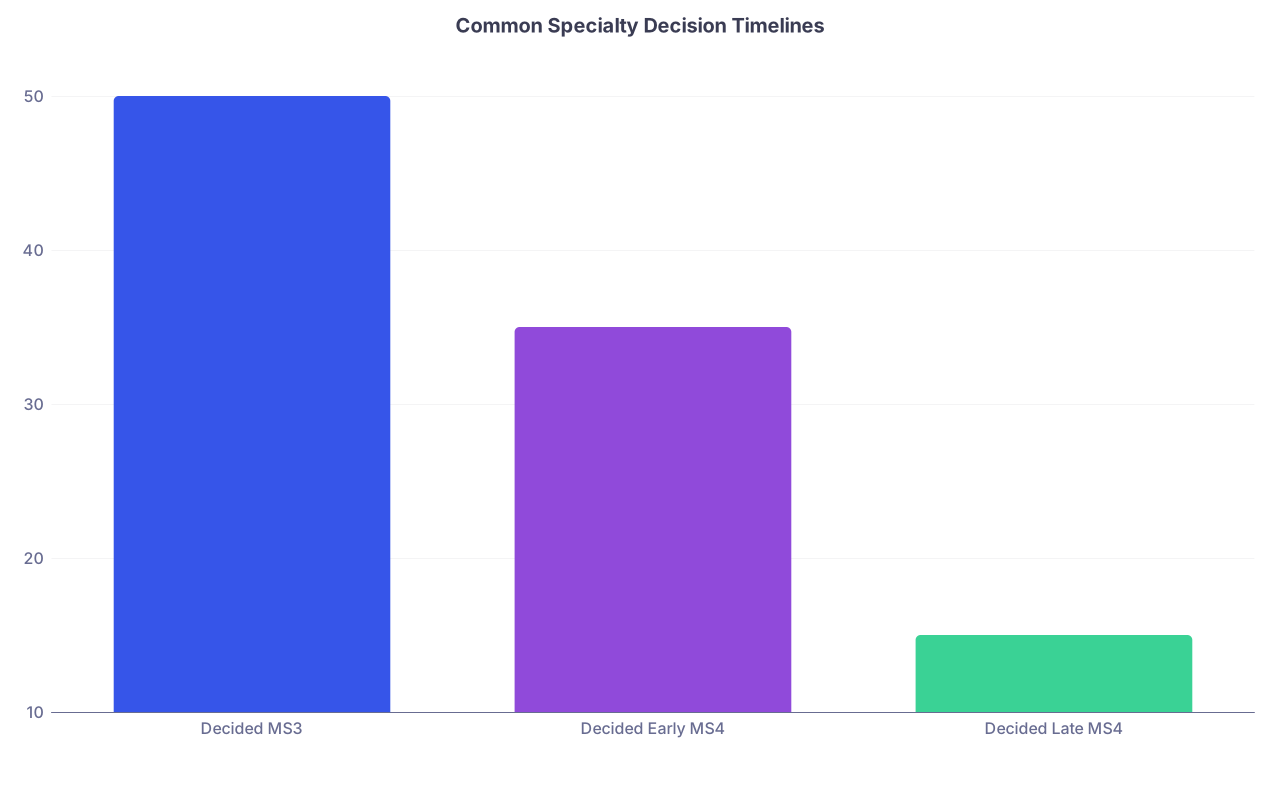
| Category | Value |
|---|---|
| Decided MS3 | 50 |
| Decided Early MS4 | 35 |
| Decided Late MS4 | 15 |
Step One: Get Honest About What “Unsure” Actually Means
“Unsure” covers about 10 different realities. You need to know which one you’re dealing with.
There’s a huge difference between:
- “I’m 90% sure I want internal medicine but still deciding between hospitalist vs cards vs heme/onc later.”
- “It’s between IM and FM and I could see myself happy in both.”
- “It’s between psych and EM and I’m applying to both and seeing what interviews I get.”
- “I have no idea, I hate everything, I just want this to be over.”
Those are not the same level of risk to your Couple’s Match.
So instead of letting “I’m not sure yet” sit there like a bomb in the middle of your relationship, force some clarity:
Ask them (calmly, not at midnight):
- “What are your top two specialties, realistically, right now?”
- “If you had to pick today and never change, what would you choose?”
- “What’s actually holding you back from deciding? Fear, lack of exposure, letters, lifestyle, money?”
- “Is there any specialty that’s 100% off the table?”
You’re not trying to bully them into choosing. You’re trying to figure out whether you’re dealing with fine-tuning or full-blown indecision.
If they can say something like: “Honestly it’s 70% IM, 30% FM” — that’s workable. If they say: “I don’t know, I hate thinking about it, can we talk later?” — that’s a red flag for your planning timeline, not for their worth as a person.
The silent, avoidant indecision is what wrecks Couples Match planning. Not the uncertainty itself.
Step Two: Separate Emotional Panic From Practical Risk
Your brain is probably running worst-case simulations on loop:
- “We’re doomed.”
- “PDs will see right through this.”
- “No program will want someone who’s undecided.”
- “My partner is going to ruin this for both of us.”
Let’s be blunt: those thoughts are feelings dressed up as facts.
From a practical standpoint, there are only a few actual risks when one partner is still unsure:
- They spread themselves too thin applying to multiple specialties, tanking their chances in all of them.
- You build a couples rank list that’s chaotic, inconsistent, and too short.
- They decide late to completely change specialty, after applications or interviews, and your whole strategy collapses.
Everything else? Manageable.
I’ve seen couples where one partner applied to IM only kind of sure, then fell in love with nephrology halfway through interview season. Did it make things smoother? No. Did it destroy their Couples Match? Also no. They still matched together into a solid IM program because their application was coherent even if their long-term plan was evolving.
The real danger is not uncertainty. It’s denial and procrastination. Your job is to drag this into the light early enough to plan around it.

| Step | Description |
|---|---|
| Step 1 | Partner Unsure About Specialty |
| Step 2 | Fine-tuning Choice Within Same Field |
| Step 3 | Choosing Between Related Fields |
| Step 4 | Choosing Between Very Different Fields |
| Step 5 | Low Risk to Couples Match |
| Step 6 | Moderate Risk, Needs Strategy |
| Step 7 | High Risk, Needs Backup Plan |
| Step 8 | Type of Uncertainty |
Step Three: Anchor Around What Is Decided
You might feel like everything’s floating, but it isn’t.
Even if they’re still choosing between specialties, there are usually some fixed points you can grab onto:
- Geographic priorities (family, partner’s job, cost of living)
- Dealbreakers (no rural programs, no programs with malignant reputation)
- Lifestyle boundaries (no 100+ hour/week surgical lifestyles, or no night-heavy specialties)
- Academic vs community preference
Sit down and agree on these things as if they were both decided. Because those constraints don’t magically change if they pick IM vs FM or EM vs anesthesia.
Once those anchors are set, you can start building a program universe that works for either of their likely choices and for you.
If your partner is torn between EM and IM, you’re looking for cities with:
- At least one solid EM program
- At least one solid IM program
- Ideally multiple of each so your couples list isn’t paper-thin
Suddenly you’re not planning against a void. You’re planning against a narrowed, realistic set of possibilities, based on what’s already known.
Step Four: Decide on an Actual Application Strategy (Not Just Vibes)
Here’s where couples fall apart: they stay in anxiety mode and never convert it into an actual strategy.
If your partner is undecided, they basically have three real options:
- Pick one specialty and commit for this cycle.
Scary. Cleaner. Best odds overall. - Apply to two specialties with a primary and a true backup.
Slightly messy. Requires discipline. Still workable. - Apply half-heartedly to two totally incompatible specialties and hope for the best.
This is the disaster scenario.
You two need to talk about which path you’re taking — explicitly. Not implied. Not assumed.
You don’t want to discover in December that you thought EM was the main plan and they thought it was “just seeing how interviews feel” and IM was the real plan.
If they’re going dual-application, the key questions are:
- Which specialty is the priority for couples ranking?
- Are you both okay living in a location where only one of those fields has strong programs?
- Are you mentally and financially prepared for them to match into their “backup” yet live with it long-term?
Because let me be harsh for a moment: backup specialties aren’t ethically disposable. Programs don’t want to be someone’s afterthought. If your partner is going to use a field as a backup, they should be genuinely willing to train and work in it.
Not wildly in love maybe. But at least, “I can see a real future here without resenting everyone around me.”

Step Five: Protect Your Application While Still Being a Team
Here’s the part no one wants to say out loud: you’re allowed to care about your own future too.
Being understanding of their uncertainty doesn’t mean:
- Letting them dictate everything
- Sacrificing all your preferences and goals
- Downplaying how this is affecting your mental health
You actually need two parallel tracks:
Track A: Your personal application strategy.
You should still be:- Applying broadly enough for your competitiveness
- Targeting programs that fit your career goals
- Getting your letters, Step scores, and experiences lined up cleanly
Track B: The couples overlay on top of that.
Once you know your individual interview universe and their interview universe, then you start building couples lists that maximize overlap without completely destroying what’s good for either of you.
You do not have to torch your own trajectory just because they’re late to decide. Compromise? Yes. Self-obliteration? No.
I’ve seen relationships get poisoned quietly because one partner swallowed all their preferences to “be supportive” during couples matching, then sat on low-grade resentment for years. That’s not noble. That’s a time bomb.
So have the hard conversation now:
- “Here’s my non-negotiable list for my own career.”
- “Here are the things I’m actually flexible on for us.”
Make them do the same.
Step Six: Build Rank Lists That Assume Imperfect Certainty
Perfection is off the table. You’re trying to do damage control, not engineer the flawless outcome.
When you eventually build your couples rank list, here’s how to structure it when one partner had initial uncertainty:
Top portion of the list:
Programs that:- Fit both of you reasonably well
- Are in locations you can both tolerate (not just one person’s dream)
- Don’t hinge on a fantasy scenario (like, “I’ll magically fall in love with surgery even though I hate the OR”)
Middle portion:
Programs where one of you is taking a bigger career compromise, but the relationship/location tradeoff makes sense — and you’ve explicitly agreed that you’re okay with that.Bottom portion (but still on the list):
“We’d rather be together almost anywhere than risk being apart” zone. Only put programs here if you really mean that. Not because you feel guilty or pressured.
And yes, you should talk about the painfully awkward question:
“If the Match algorithm puts us together in a location/specialty that’s bad for one of us but ‘okay’ for the other… are we actually okay with that?”
Because couples rank lists can absolutely prioritize “together” over “good fit” if you build them that way. The algorithm doesn’t care about your internal doubts.
| Uncertainty Type | Couples Match Risk | Notes |
|---|---|---|
| One field, subspecialty undecided | Low | Doesn’t affect Match |
| Two related fields (IM vs FM) | Low-Moderate | Geography more important |
| Two moderately related fields (IM vs EM) | Moderate | Needs careful program selection |
| Two very different fields (Ortho vs Psych) | High | Limited overlap, more compromise |
| No clear direction at start of apps | Very High | Consider delaying or committing to one |
Step Seven: Decide What Happens If They Still Can’t Decide
This is the nightmare scenario you’re quietly worried about: it’s crunch time, ERAS is open, and they’re still not truly decided.
You actually have more than two options (match together vs break up). You can:
Delay their application a year
Brutal to say. Sometimes the smartest option. If their uncertainty is absolute and they’re about to halfway-apply to three specialties, it may be kinder to your future selves to hit pause.Commit together to one of their top options
You both say, “Okay, it’s EM. We’re doing EM + [your specialty]. No more waffling, we accept the tradeoffs.” Then move forward like it’s decided, because it is.Agree that this year, you won’t couples match
Painful. But better than forcing a rushed decision they’ll regret while dragging your application with it. You can still aim for the same cities without technically linking.
None of these are pretty. But pretending you have unlimited time, when you don’t, is worse.
How to Stay Sane While All This Is Happening
Let’s be honest: even with the best planning, this still sucks emotionally. Being the “more decided” partner can feel unfair. Like you have to be the rock while also quietly panicking.
A few sanity checks:
- You’re not crazy for feeling scared or resentful sometimes.
- Their uncertainty isn’t a moral failing.
- Your need for stability is not unreasonable.
- This is a specific, high-stress phase. It will end.
Find at least one person outside the relationship (friend, mentor, therapist) who you can be 100% unfiltered with. Say the ugly version out loud somewhere else, so you don’t unload all of it on your partner.
And please don’t make big, permanent relationship decisions in October at 1 a.m. during ERAS season. You’re both in fight-or-flight. Hold the big calls for March–April, when the outcome is clearer and your nervous system isn’t on fire.

What This Actually Comes Down To
Underneath all the logistics, this is a test of how you two handle:
- Uncertainty
- Mismatched timelines
- Compromise vs self-respect
- Making big decisions without perfect information
Those skills matter way beyond residency. Kids, jobs, relocations, illness — all of it is the same muscle.
So no, one of you being unsure about specialty doesn’t mean you’re doomed as a couple or as applicants.
It means you’re getting an early, brutal crash course in real-life decision-making together. Uncomfortable. Not fatal.
FAQs
1. Should we even couples match if my partner is still undecided about specialty?
If they’re completely undecided (as in, no realistic top 1–2 specialties by the time ERAS opens), I’d question couples matching this cycle at all. But if they can narrow down to one primary and maybe one realistic backup, you can still couples match as long as you:
- Build a strategy around those specific fields
- Prioritize locations with programs for both
- Accept that your rank list will involve more compromise and backup scenarios
The worst combo is full indecision + couples match + no hard conversations. That’s when people get burned.
2. Is it selfish to push my partner to just pick something?
It depends how you’re doing it. Saying, “This is stressing me out, and we need a decision by X so we can build a real plan” is not selfish. That’s reality. Saying, “Pick whatever lets us be in my dream city or I’m out” is.
You’re allowed to have boundaries around timelines. You’re not allowed to treat their entire career as a prop in yours. There’s a middle ground where you respect their process but also protect yourself from being dragged into chaos.
3. What if they change their mind after we submit our rank list?
Then you’re in damage-control mode, not optimization mode. You can’t change the list after the deadline. You basically have three choices if this happens before Match Day:
- Accept that they may end up in a specialty they’ve cooled on and plan for possible future transition (fellowship, second residency, etc.).
- Agree that if the match outcome is truly misaligned, you’ll revisit location/specialty later on as a team.
- If it’s a total dealbreaker and fundamental mismatch, you may have to consider decoupling future plans — but that’s an emotional/relationship decision, not an NRMP one.
Honestly, this is why you want the “could I live with this specialty long-term?” conversation before you lock in the rank list.
4. Will programs see it as a red flag if my partner applied to multiple specialties?
Programs care more about coherence than about purity. If your partner applied to IM and FM with strong, believable reasons and appropriate letters for each, that’s not automatically a red flag. If they applied to neurosurgery, pediatrics, and radiology with generic personal statements and random letters, that looks confused and unserious.
So yes, mixed applications can be a problem — but they don’t have to be if your partner’s narrative is thoughtful and their application materials are specialty-specific. The couples aspect doesn’t change that much; PDs mostly evaluate you as individuals.
5. What if I’m starting to resent them for not deciding — does that mean the relationship is doomed?
No. It means you’re under insane pressure and your brain is looking for someone to blame. Very common. What matters is what you do with that resentment.
If you bury it, fake being fine, and then explode after Match — that’s more dangerous than saying, “I’m starting to feel resentful and scared, and I need us to talk about this openly.” The couples who survive this aren’t the ones who never feel resentment. They’re the ones who drag it into the light, admit it, and work around it instead of pretending it isn’t there.
Key points to keep in your head when it all feels like too much:
- Uncertainty about specialty doesn’t automatically doom your Couples Match; silence and avoidance do.
- You’re allowed to protect your own career and mental health while still being a supportive partner.
- The goal isn’t a perfect plan — it’s an honest one you both actually understand and can live with.


