

What if couples match helps us now… but quietly ruins my career 10 years from now?
This is the part no one really answers honestly, right?
Everyone talks about “prioritizing your relationship” and “it’s just three to seven years,” but the voice in your head is like:
“Yeah, cool, but am I trading away fellowship options? Academic jobs? Competitive subspecialties? Am I going to be that attending who says, ‘I could’ve gone farther… but I couples matched’?”
Let’s pull that fear out into the open and actually beat it up a little.
The core fear: Am I locking myself into a second‑tier career?
Here’s the nightmare version most of us secretly run in our heads:
You couples match. To make it work:
- You rank fewer programs.
- You sacrifice a “reach” place you love for one that will take both of you.
- One of you picks a solid-but-not-elite academic program; the other ends up at a more community-heavy place or mid‑tier program.
Fast forward 8–10 years in your imagination:
- Your PDs don’t gush over you the way they do over “homegrown” Ivy people.
- You apply to a competitive fellowship and feel like your program name is a handicap.
- You’re on faculty somewhere thinking, “If I’d just gone to that top‑tier residency instead of couples matching, would I be at a better institution? Doing cooler cases? On bigger grants?”
That’s the anxiety script. I’ve heard versions of it from a ridiculous number of MS4s.
Now the honest part: yes, couples match can shape your career path. Sometimes in ways that are limiting in the short term.
But “shaping” is not the same as “ruining.”
Where couples match actually changes the game
Let me be blunt: couples match is not free.
You’re not crazy or dramatic for worrying about trade‑offs. There are trade‑offs.
Here’s where they usually show up.
1. Number and type of programs you apply to
When you couples match, everything becomes a Venn diagram: places that like you, places that like your partner, and places that are okay with couples. That overlap is smaller than either list alone.
You may:
- Drop some super‑reach programs that don’t make sense for your partner
- Apply more broadly geographically instead of just “prestige clusters”
- Include programs you probably wouldn’t even glance at if you were single
Does this sometimes mean ending up at a less “name brand” spot than you might solo? Yes.
Does that automatically mean long‑term damage? No. It just means the path to the same destination might be a little less linear and a little more work on the back end.
2. Specialty + location combinations
The real friction points happen when one of these is true:
- Both of you are in competitive specialties (Derm + Ortho, ENT + Ortho, Rad Onc + anything)
- One person’s specialty is extremely location‑limited (Neurosurg, Ophtho in some regions)
- One partner is dead‑set on a tiny geographic area with few programs
Those scenarios can absolutely push one person toward:
- A slightly less competitive program
- A different tier of academic center
- Or, rarely, reconsidering specialty
The key word there is “slightly.” In reality, most couples do not go from “Harvard or bust” to “tiny random program with zero resources.” They shift from, say, “top 5 academic” to “strong mid‑tier academic” or “big community with academic affiliation.”
That’s not the death of a career. That’s a different launch pad.
What matters for your career way more than the program name
Here’s the not‑sexy truth people don’t like: long‑term, your output matters more than your zip code.
I’ve seen people from very average programs get into:
- Big‑name fellowships
- Elite academic jobs
- National leadership roles
Because they did the stuff that actually moves the needle.
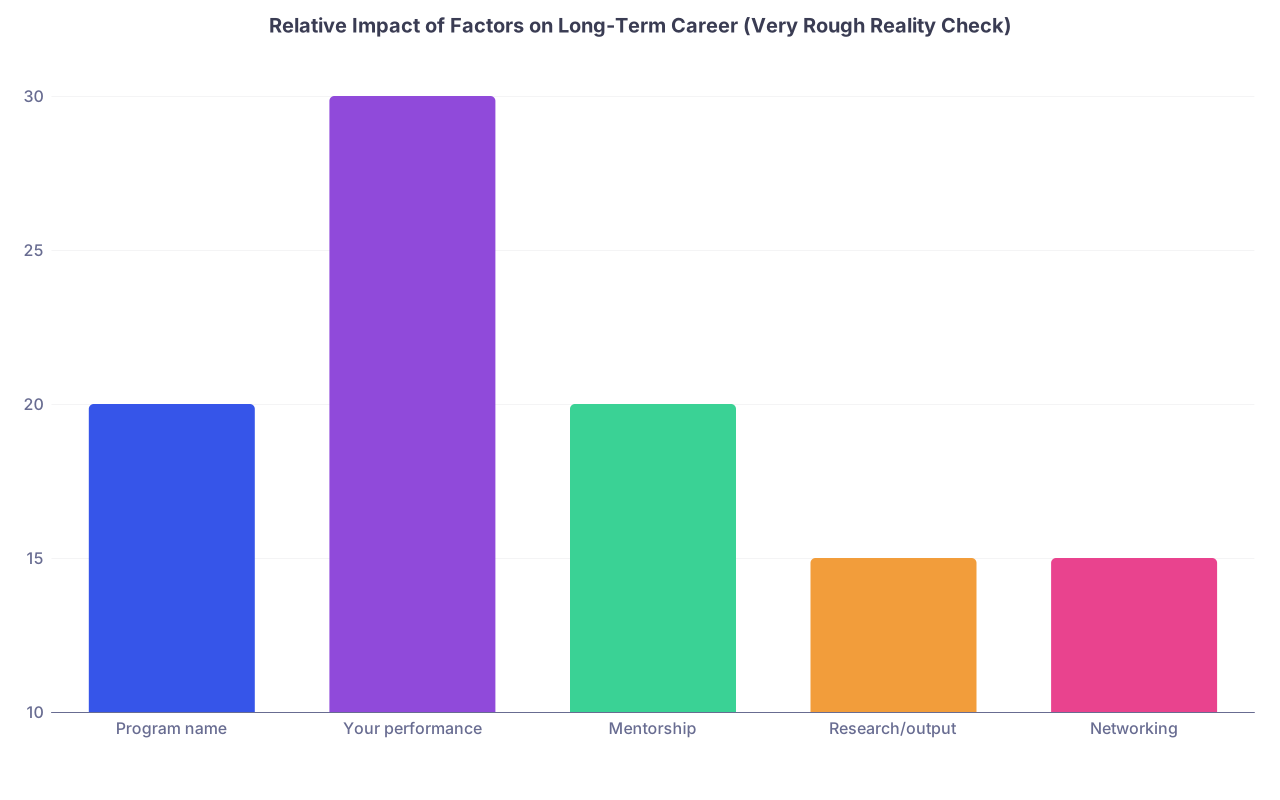
| Category | Value |
|---|---|
| Program name | 20 |
| Your performance | 30 |
| Mentorship | 20 |
| Research/output | 15 |
| Networking | 15 |
Is this exact? No. But the pattern is real.
You don’t build a career on a logo. You build it on:
- How hard you work once you’re there
- How proactive you are in finding mentors
- How early you get involved in projects, leadership, teaching
- How you show up on wards, in clinic, in the OR
A slightly “lower‑tier” program with phenomenal mentors who actually care about you will do more for your career than a “top‑5” place where you’re anonymous and miserable and your relationship is falling apart.
And couples match often forces you to think hard about fit, support, and real life. Not just prestige.
Where couples match can pinch your long‑term options
Let’s not sugarcoat. There are ways couples match can make things harder.
1. Hyper‑competitive fellowships if you’re starting from a weaker platform
If you want:
- Derm → Mohs at an ultra‑elite program
- IM → Cards/GI at the top 3–5 fellowships
- Gen Surg → Ortho/Plastics style competitiveness in some fellowships
And you match into a residency that:
- Has very little research
- Has limited subspecialty exposure
- Has no track record of sending people to those fellowships
Then yes, you could be climbing a steeper hill. Not impossible. Just steeper.
The question you have to ask is brutal but honest:
“Is it this exact top‑3 fellowship that matters, or is it doing this type of work that matters? And am I willing to buy the maybe‑1% chance of that exact fellowship with a 40% chance my relationship falls apart?”
Most people, when they drop the ego and the noise, pick the relationship and the type of career, not the line on the CV.
2. Narrow geographic paths for fellowship or jobs
If your couple is like: “We must stay in Boston/NYC/SoCal forever,” then yes, couples match can concentrate you in saturated markets where both residency and fellowship and jobs are more competitive.
You might:
- Take a less ideal fellowship because it’s local
- Pass on strong but distant opportunities
- Spend longer as adjunct/part‑time/locums while waiting for the “right” job to open
But that’s not really a couples match problem. That’s a geography problem. Single people stuck in one city for family reasons have the same issue.
Reality check: What actually happens to couples 5–10 years out
Let me give you the pattern I’ve seen over and over.
Scenario 1: “We compromised a bit, and it was fine”
Two internal med people. Or peds + FM. Or EM + Anesth. Reasonably flexible.
They:
- Match at solid mid‑tier academic or a pair of solid community programs in the same city
- Do well
- Match into fellowships they’re happy with, maybe not ultra‑elite but definitely good
- End up in jobs that fit their actual life, not their med‑student fantasy
Ten years later, what they mostly talk about is: “I’m glad we were in the same city. I’m glad we weren’t doing long distance with 80‑hour weeks.” Not “I could’ve been at UCSF GI.”
Scenario 2: “We made a big sacrifice… and it stung for a while”
Sometimes one partner really does take a bigger hit. Think:
- One gives up Derm for IM
- One goes from ortho to gen surg
- Or one matches “below where they could’ve” to be near the other
Those people can have a harder time emotionally at first. There’s sometimes some resentment. Some “what ifs.”
But. Many of them:
- Find subspecialties or niches they never considered
- Build strong CVs anyway (because they’re sharp and driven)
- End up with careers that look different than their M4 fantasy, but are still very good
The only true long‑term disasters I’ve seen are when:
- The sacrifice was massive and
- The couple wasn’t actually stable and
- The person never really processed or owned their choice
That’s the person 15 years later still saying, “I threw away my dream for you.” That’s not a couples match failure so much as a communication and honesty failure at the start.
Scenario 3: “We didn’t couples match. We tried to go ‘all out’ solo.”
There’s also the flip side no one advertises.
I’ve seen people refuse to couples match because “I don’t want to limit my career” and then:
- Match on opposite coasts
- Survive on FaceTime and Southwest flights
- One person burns out or cheats or breaks emotionally
- Relationship ends halfway through PGY‑2
And then you’re left with a “better” program, no partner, and the realization that your life doesn’t magically feel worth it just because the hospital logo is fancy.
But sure. Technically, their “long‑term career potential” is preserved.
How to protect your future career while couples matching
You’re not powerless here. There are ways to stack the deck so this doesn’t box you in.
1. Be strategic about “floor,” not just “ceiling”
You and your partner need to define, clearly, your minimums. As in:
- “I need a program with at least X type of fellowship on site or strong track record of sending people there”
- “I need some established research in my area of interest, not just vague ‘research opportunities’”
- “I need a place where >1 resident per year goes into fellowship, not zero”
Then build your rank list backwards from that floor, not from the shiniest name.
| Factor | Partner A (IM) | Partner B (Peds) |
|---|---|---|
| Fellowship exposure | Cards & GI on-site | NICU & PICU on-site |
| Research | At least 1 active mentor | At least 1 active mentor |
| Program type | Academic or hybrid | Academic or hybrid |
| City size | > 250k population | > 250k population |
You’re trying to avoid dead‑end programs. Not chase unicorns.
2. Front‑load your hustle in residency
If you’re worried your program isn’t as big‑name as you hoped, you don’t get to be passive.
First year in, you:
- Meet program leadership early
- Tell them your fellowship or career goals clearly
- Ask who the “go‑to” faculty are in that field
- Start showing up to their clinics, conferences, research meetings
Residents from “meh” programs who do this routinely end up with glowing letters and surprisingly good fellowships.
3. Use your relationship as a stabilizer, not a distraction
Honestly, one underrated part of couples match: you have someone at home who gets it. If you treat that like a resource instead of an anchor, you actually might perform better.
Less emotional volatility. Less isolation. Less spiraling alone at 2 a.m. after a bad code.
That stability shows up in your performance. That performance shows up in your letters and evaluations. That shows up in your fellowship applications and job interviews.
You can absolutely turn “I couples matched” into a subtle competitive advantage, because you weren’t falling apart behind the scenes.
So… can couples match hurt my long‑term career?
Yes. If:
- You blindly rank any place that will take you both
- You ignore program quality, mentorship, or track record
- One of you makes a massive sacrifice you secretly resent
- You then coast through residency assuming “it’ll work out”
But the more honest version:
Couples match shifts the probabilities and shapes the path. It can lower the odds of a tiny set of ultra‑specific, ultra‑prestige outcomes. It does not condemn you to a second‑rate career unless you treat it like a one‑way trap and stop doing the things that actually build a career.
Most attendings 10–15 years out are not walking around saying, “Couples match ruined my life.” They’re too busy dealing with:
- RVUs
- Kids
- Call schedules
- Admin nonsense
- And trying to remember the last time they slept 8 hours
What will stick with you is whether you felt alone and miserable during the hardest training years of your life, or whether you had someone in your corner who understood exactly why you came home at 10 p.m. and cried over a consult.

| Step | Description |
|---|---|
| Step 1 | Couples Match Decision |
| Step 2 | Solid programs for both |
| Step 3 | Weak fit or dead-end |
| Step 4 | Good mentorship & performance |
| Step 5 | Limited support & growth |
| Step 6 | Strong fellowship/job options |
| Step 7 | Slower path, but still possible |
| Step 8 | Strategic? |
And for what it’s worth: programs know couples match is a thing. Fellowship directors know. Hiring committees know. Nobody is sitting there in 2035 squinting at your CV going, “Hmm, I see you couples matched, so we’re going to hold that against you.”
They care: Are you good? Are you reliable? Do you get along with humans?
Everything else is noise.

Quick reality snapshot: logo vs life
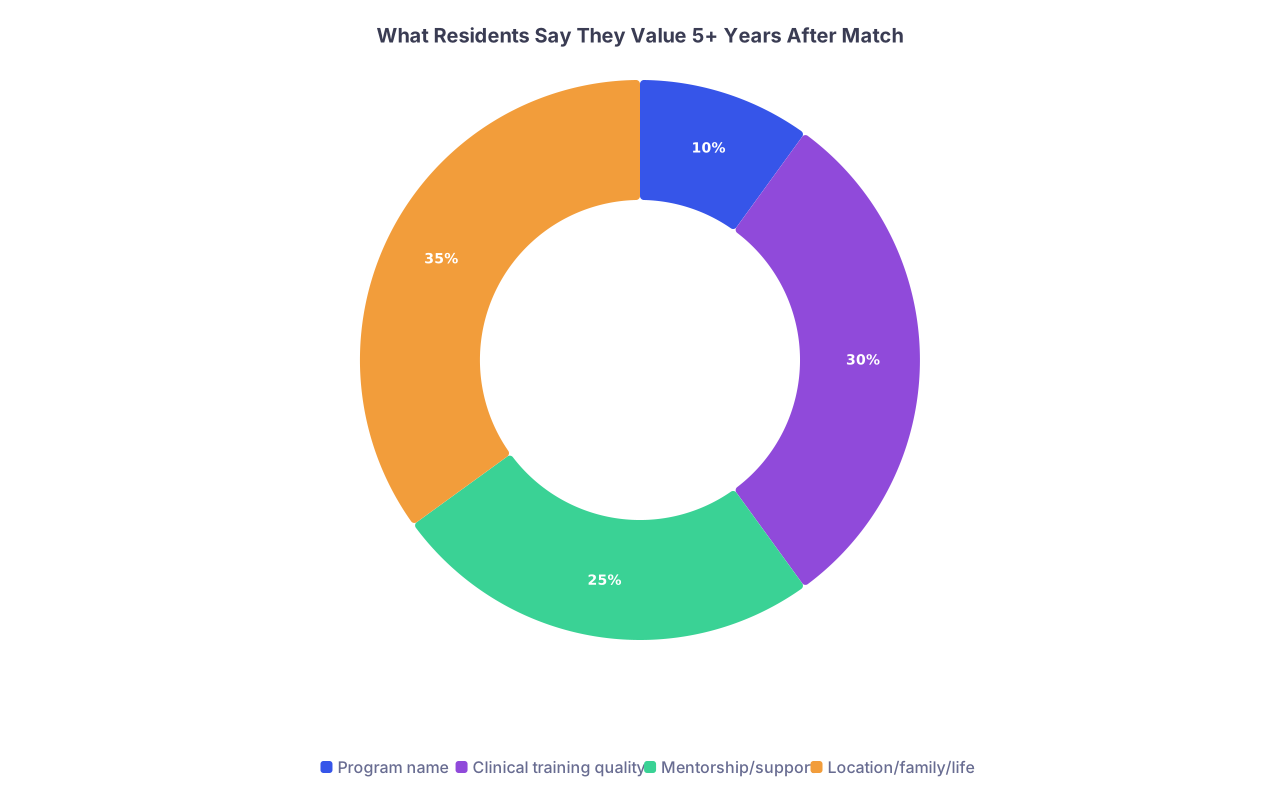
| Category | Value |
|---|---|
| Program name | 10 |
| Clinical training quality | 30 |
| Mentorship/support | 25 |
| Location/family/life | 35 |
Ask people 5–10 years out what mattered more:
The name on their badge? Or:
- How competent they feel
- Whether they burned out
- Whether their relationship survived
- Whether they actually like their day‑to‑day life
The answers are depressingly consistent. Most of the stuff we obsess about as MS4s collapses down to a very short list of real priorities.
Couples match forces you to confront that list sooner.

Years from now, you won’t remember every program you cut from your rank list. You’ll remember who was sitting next to you when the Match email opened—and how you two handled everything that came after.
FAQ (Exactly 5 Questions)
1. If I couples match into a mid‑tier IM program, can I still get a competitive fellowship like Cards or GI?
Yes, absolutely. Residents from mid‑tier programs match into competitive fellowships every single year. What you’ll need to do is be intentional:
- Get involved with cards/GI faculty early
- Do research or QI with them
- Crush your rotations and electives in that field
- Go to conferences, present posters if you can
Fellowship PDs care most about: letters, performance, and evidence you actually want and understand the field. A mid‑tier program with great mentorship can beat a top‑tier place where you’re invisible.
2. Will fellowship directors judge me for couples matching in residency?
No. They might not even know unless you mention it. And even if they do know, they won’t care in the way you think. What they look at is:
- Your evaluations
- Your letters
- Your research/output
- Your personal statement and interview
If couples match comes up, it’s usually in a neutral or even positive light: it shows you can balance life, relationships, and demanding training. No one is marking you down 10 points because you chose not to be miserable and alone.
3. What if my partner’s specialty is way more competitive than mine? Am I doomed to carry the compromise?
Not automatically. But both of you need to be brutally honest. Often the person in the less competitive field actually has more flexibility geographically and program‑wise, which is both a curse and a weird advantage. The goal isn’t “you sacrifice everything, they sacrifice nothing.” The goal is: both of you give a little.
You protect a basic floor for your own training (no dead‑end program, no toxic mess) and accept that maybe you won’t get your absolute dream location or shiniest logo. And they accept that maybe they won’t only rank the absolute top‑tier ultra‑competitive places.
4. Could couples match hurt me later if we break up during residency?
It can make things logistically messier, but not career‑ending. If you’re already in the same program, you finish there. If you’re in the same city but different programs, you keep training where you are. Programs do not punish you for a breakup.
The regret usually isn’t career‑related. It’s emotional: “Did I compromise for someone I didn’t end up with?” That’s why you don’t couples match with someone you’re half‑sure about. If you’d be at peace with your rank list even if something happened, you’re on safer ground.
5. Is it ever reasonable to decide not to couples match to protect a specific career goal?
Yes. If you have a very narrow, very competitive goal—like neurosurg at a tiny number of programs or Derm where your stats are borderline—and you and your partner both agree that this absolute career target matters more than location together, it can be rational to apply separately.
But that has to be a joint, eyes‑wide‑open decision. Not one person unilaterally declaring, “My career matters more than where we end up.” You’re weighing two real risks: giving up a highly specific career shot vs. putting your relationship through long‑distance residency. Neither is fake. You just have to decide which regret you’re more able to live with.
Years down the line, what’ll matter is not that you out‑optimized every variable, but that you can look back and say, “Given what I knew then, I made a choice that lined up with my values—and I owned it.”


