

It’s January. The two of you are hunched over a laptop, staring at your half-finished couples rank list. Your spreadsheet is full of combos like “Program A IM + Program B EM – Chicago” and “Program C Peds + Program D FM – Houston.” Your stomach is already in knots.
Your mom has made it very clear she “could never live in that kind of city.” Your partner’s dad sent a three-paragraph text about crime rates. Someone actually said, “Why would you throw your lives away moving there?”
And now you’re sitting there thinking:
If our families hate every realistic city we can match in… what the hell are we supposed to do?
Let me say the thing you’re too scared to say out loud:
You’re not just worried they’ll be disappointed. You’re scared they’ll be mad. Or hurt. Or less involved in your future kids’ lives. You’re scared you’ll pick a city to make them happy and then destroy your own careers. Or you’ll pick the city you need for training and ruin your relationship with your family.
So yeah. No matter what you choose, it feels like you’re betraying someone.
Let’s untangle this in a way that’s actually useful. Not fluffy “follow your dreams” nonsense. Real tradeoffs. Real worst-case scenarios. And what people actually do.
First: You’re Not Crazy. This Is a Real Conflict.
A lot of people will shrug and say, “Just pick what’s best for your career, they’ll get over it.” That’s… simplistic. And usually said by people whose parents quietly support them.
Here’s what’s really going on:
Couples match multiplies the constraints.
You’re not one person trying to match in a geographic region. You’re two people, in two specialties, trying to line up programs that:- Will even rank couples
- Have compatible interview seasons
- Have enough spots
- Are in cities that can support you both
That already narrows things brutally. Then you add “must be near family” on top of that? The list shrinks to dust.
Residency is not portable.
This isn’t undergrad where you can just transfer after a year if you hate it. You match, you’re basically there for 3–7 years unless something really extreme happens.Family is not a small “lifestyle preference.”
The people saying “just go wherever” often:- Don’t have close ties
- Or have families that can afford to visit a lot
- Or aren’t dealing with dependent parents / siblings / complicated dynamics
If you do depend on your family emotionally, financially, or for childcare, living far away is not a trivial decision.
Your fear is about regret.
You’re terrified of:- Looking back and thinking, “We sabotaged our careers to keep everyone else comfortable.”
- Or the opposite: “We chose careers over family and they were never the same with us.”
You’re not being dramatic. You’re stuck between competing “right” answers.
Reality Check: What Actually Matters in Residency
Let me be a little blunt: there’s a hierarchy of needs here. Not Instagram-quote hierarchy. Survival hierarchy.
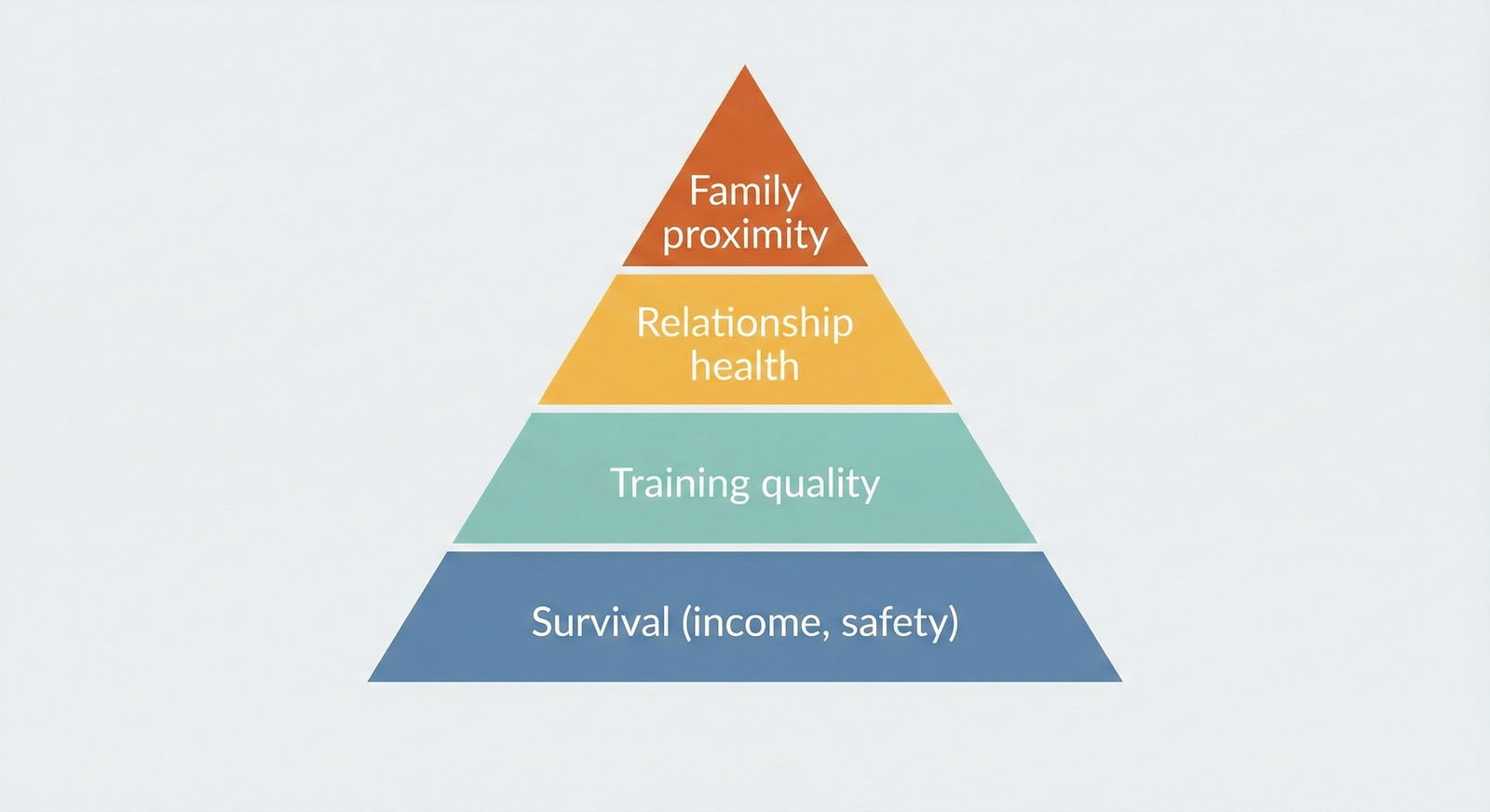
From the bottom up:
You need a job. Matching somewhere is better than not matching. That sounds harsh, but scrambling (SOAP) or reapplying is way more destabilizing to your life and family than moving to a city they don’t love.
You need decent training. Not necessarily “top 10 program” training. Just:
- Enough volume
- Not malignant
- Reasonable support
- Board pass rates that don’t make you sweat
Why? Because if residency goes badly, you’ll be more burned out, more depressed, more resentful. None of that helps your relationship with your family.
You need your relationship intact. You’re literally couples matching. If you bend your entire list around pleasing families but end up:
- Doing long distance
- Or one of you at a clearly worse program
- Or constantly resentful that will bleed into everything else in your life.
Then comes family proximity / family approval. Important. Very. But still above the foundation. If you flip that pyramid upside down, it collapses. People try this. It doesn’t go well.
So when your family says, “Why don’t you just rank places closer to home?” and those places are:
- Not couples friendly
- Historically super competitive for your specialty
- Or have only one program that interviewed just one of you
…they’re effectively saying, “Reshape reality to match my anxiety.” And you can’t. You’re already in reality.
“But What If They’re Right? What If We Hate Those Cities Too?”
This is the part no one likes to admit:
Sometimes your family is saying out loud what you secretly feel too.
You might be thinking:
- “I never pictured myself in the South / Midwest / [insert region].”
- “I’m scared of the crime stats I doomscrolled last night.”
- “I don’t know anyone there. I’m scared of being completely alone.”
Here’s the unromantic truth about residency cities: they are containers, not final destinations.
Do people stay where they train? Sometimes.
Do a lot of people leave immediately after PGY-3 or PGY-5? Yes. Constantly.
I’ve seen:
- Someone do IM in Detroit, then move to Seattle for fellowship and stay there.
- A couple do EM + Psych in New York, then run to North Carolina to raise kids near her family.
- A surgery resident spend 7 miserable-ish years in the same cold city, finish, then move to be 10 minutes from her parents and never leave.
Residency cities are like rented apartments. You don’t have to love them enough to die there. You need to tolerate them for a defined period while you build something that gives you options later.
That’s how you need to think about this:
Which city gives us the best future leverage? Even if it’s not our dream place right now.
How to Handle Family Who Hate Your Rank List Cities
Let’s talk practical scripts, because vague advice won’t help you when your mom is saying “absolutely not” over FaceTime.
Step 1: Get clear with each other before you talk to them
You and your partner need to know:
- What’s non-negotiable (e.g., not separating, not ranking programs we’d be miserable in just for geography)
- What’s flexible (e.g., maybe we’d consider a smaller city if the programs are solid)
- Your realistic best-case and backup scenarios
Have that brutally honest, slightly painful conversation with each other first. Not in front of your parents. Not with them on speaker.
Step 2: Stop asking your family for permission
Ask for input. Not approval.
You can literally say: “We love you and want you involved, but we can’t run this by committee. We’ll absolutely listen to your concerns, but the final ranking has to be ours, based on where we can both actually match and train safely.”
If they push: “We’re happy to explain our reasoning, but we’re not asking you to vote on our rank list. This is our career foundation. We need to own it.”
That sounds harsh. But if you don’t set that line now, residency will steamroll you. And them.
Common Worst-Case Scenarios (And What Actually Happens)
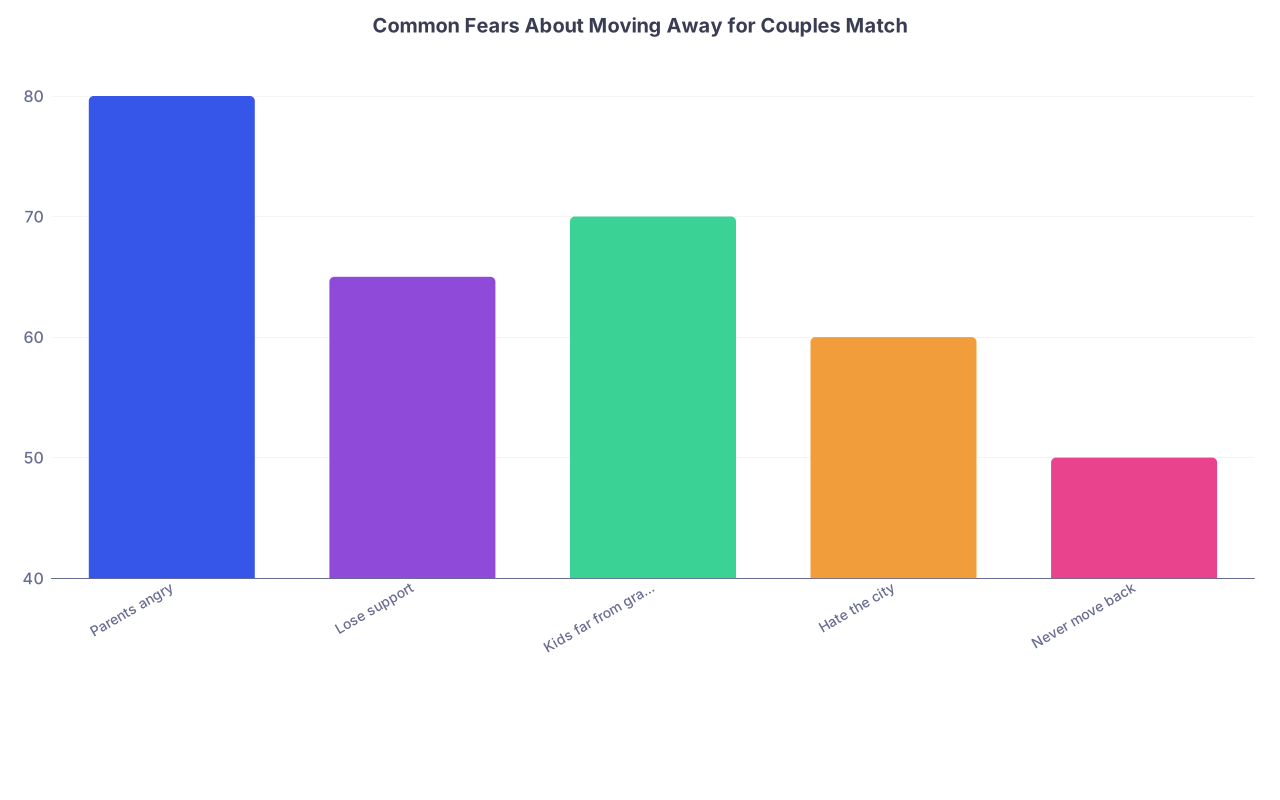
Your brain is probably catastrophizing. Mine would be too. Let’s drag those fears into the light.
| Category | Value |
|---|---|
| Parents angry | 80 |
| Lose support | 65 |
| Kids far from grandparents | 70 |
| Hate the city | 60 |
| Never move back | 50 |
Fear #1: “My parents will never forgive me if we move to X city.”
What usually happens:
- There’s a big emotional blow-up when you first tell them
- A few weeks later, they’re asking when they can visit and what neighborhoods you’re looking at
- They complain… but they still show up on FaceTime and holidays
The outliers:
- If you have extremely controlling parents, they may weaponize guilt longer
- That’s less about the city and more about long-standing family dynamics
You cannot fix decades of family dynamics with your rank list. If their love is conditional on you choosing a ZIP code they like, that’s not a residency problem. That’s a boundaries problem.
Fear #2: “We’ll lose all our child care help and be drowning.”
You might. At least for residency years. That’s real.
I’ve seen couples:
- Delay having kids until late residency or fellowship
- Budget for paid child care knowing they won’t have grandparents nearby
- Bring parents to stay for 1–3 months when a new baby arrives
- Move back closer to family once training ends, even if it means taking “less prestigious” jobs
None of these are perfect. All of them are more realistic than “we’ll have grandparents on-call 24/7 during residency and still have awesome careers in our ideal cities.”
Fear #3: “We’ll be completely isolated and hate every minute.”
Early residency often feels isolating no matter where you are. Even near family. Because:
- Your hours are brutal
- You’re exhausted
- Your social energy is gone
But you still find:
- Co-residents who become your default family
- One decent coffee shop / park / restaurant that becomes your spot
- A routine that makes the city at least livable
You don’t need the city to be your soulmate. Just not your enemy.
A Simple Framework for Building Your Rank List When Family Hates Your Options
Let me give you something concrete. Not “listen to your heart” nonsense.
Use this hierarchy when deciding between city options with your partner:
| Priority Level | What It Covers |
|---|---|
| 1 | Both of you match in same city/region |
| 2 | Programs are non-toxic and solid |
| 3 | Future career flexibility (fellowship/jobs) |
| 4 | Cost of living / safety |
| 5 | Proximity to family / their preferences |
Read that again. Family proximity is on the list. It’s just not at the top.
Then, for each city combination you’re considering, ask:
- Can we both realistically match here with the interviews we have?
- Are these programs survivable and not malignant?
- Will training here keep doors open later?
- Can we afford to live here, and do we feel basically safe?
- Between the options that meet 1–4, which are best (or least bad) for family proximity?
If you invert that and start with, “Which cities will our parents accept?” you’ll end up rank ordering fantasies, not actual options.
How to Explain Your Decision to Family Without Sounding Like You’re Dismissing Them
You’re scared they’ll think, “They don’t care about us.” That’s what hurts most.
So when you talk to them, you want this combo:
- Firm on the facts
- Soft on the feelings
Something like:
“Couples match is very different from regular match. We don’t just pick a city and go. Programs have to want both of us, and that severely limits where we can realistically end up.
We built our list by:
- First making sure we prioritize actually matching together
- Then choosing programs where we can both get solid training and stay safe
- Then, within that, putting cities closer to family higher where it made sense
We didn’t ignore you. We started with reality, then did our best to honor everyone within that. We also know residency is temporary. Where we train isn’t necessarily where we’ll raise kids long term. We’re playing the long game so in 5–10 years we have more freedom about where we live.”
You’re not asking them to feel great immediately. You’re asking them to understand that this is a constrained decision, not a rejection of them.
When You Might Actually Need to Adjust for Family
There are a few scenarios where I do think family location can legitimately move higher on the priority list:
- A parent or sibling with serious health issues who depends on you
- You or your partner having major mental health struggles where being completely away from all support would be dangerous
- Shared childcare with another sibling that’s tightly coordinated
- Immigrant families where you are a primary translator/advocate and stepping away causes actual harm
Even then, you have to ask:
“Can we hold this responsibility and survive residency in this location, as this specialty, as a couple?”
Sometimes the answer is yes → you cluster your list geographically, maybe accept slightly less ideal programs.
Sometimes the answer is no → you acknowledge you’re one person, not an entire care system, and you do what you can from where you are.
The Quiet Truth: Everyone Thinks Their Situation Is the Exception
“I know, I know, career first… but our family situation is different.”
I’ve heard that sentence in every version:
- “We’re so close to my mom. She’ll be devastated.”
- “My dad is very traditional. He doesn’t believe in kids moving that far.”
- “We’re the only grandkids. They’ve been planning to help raise them.”
Almost everyone feels like the one who can’t possibly move away from home without destroying something sacred.
And yet:
Every year, thousands of residents move to cities their families would never have picked. There’s crying. There’s guilt. There are passive-aggressive comments. There’s logistical chaos.
Then there are:
- Group texts with baby photos
- Long-weekend visits
- Grandparents learning Zoom
- And later, sometimes, moves back closer to home once training is done
Your situation feels unique because it’s yours. Your pain is specific. But the pattern? It’s very, very common.
Final Thought
Years from now, you won’t remember every agonizing argument about “NYC vs Houston vs staying close to home.” You’ll remember whether you and your partner had each other’s backs when nothing felt simple.
You’re not choosing between “career” and “family.” You’re choosing the version of short-term pain that sets you up for less regret down the line.
You can love your family and still disappoint them with this decision. Both can be true. And if you handle this honestly, with boundaries and warmth, there’s a very good chance they’ll still show up for you—just from a different airport.


