

What if the person you literally built your entire rank list around suddenly says, “I don’t think I want to couples match anymore”?
Yeah. That.
The “oh my god did I just ruin my whole application year for nothing?” feeling. The “am I going to end up alone in a random city while they get their dream program?” spiral. The “do they not see a future with me?” terror.
I’m going to say the thing your brain is already screaming: this is not a small problem. It’s not you overreacting. This is a big deal. But it’s not automatically the end of your relationship, your career, or your match.
Let me walk through what’s actually going on here, what options you realistically have, and give you specific scripts so you don’t have to invent sentences while you’re shaking.
First: What’s (Probably) Actually Happening vs. What Your Brain Thinks
Your brain’s version:
“They don’t love me enough.”
“They’re planning an exit.”
“I’m going to match nowhere and ruin my career because I tried to be with someone who doesn’t even want me.”
The more boring and more common reality:
They’re freaking out about control, risk, or regret.
Couples match raises the stakes. It feels like:
- “If I couples match, I might not get my top programs.”
- “What if we break up and I’m stuck in a place I only ranked for them?”
- “What if I tank their match chances?”
- “What if we both go unmatched because of this?”
Those are not small fears. And honestly? They’re not stupid. I’ve heard plenty of versions of:
“My boyfriend said, ‘I don’t want you to resent me if you don’t get your dream program because of me.’”
It sounds like rejection. It’s often actually guilt and panic wearing rejection’s clothes.
But. You still have to deal with the actual fact: they’re talking about backing out of something you’d already emotionally (maybe logistically) committed to. That affects your whole future.
So let’s get concrete about your choices.
Your Real Options (Not the TikTok Version)
Let me simplify what you’re looking at. There are only a few actual structures this can take.
| Option | Main Tradeoff |
|---|---|
| Stay in couples match as planned | More coordination, higher emotional stakes |
| Modify couples strategy (looser tie) | Some flexibility, some togetherness |
| Both apply individually but “aligned” | No formal couples match, still coordinated ranks |
| Fully separate applications | Maximum autonomy, minimum certainty about location |
1. Stay in the Couples Match As Planned
This is the “wait, don’t burn it down yet” option.
Use this if:
- Their doubts are more about fear than total refusal.
- They’re saying things like “I’m scared we’ll both go unmatched” not “I don’t see us long-term.”
What this can look like in practice:
- You revisit your program list together.
- You make sure each of you still has programs you’d be okay with even if the relationship ended (ugly to say, necessary to do).
- You talk openly about worst cases: “What if we break up after we match—would you still be okay at that program?”
This is where honest, slightly brutal clarity actually lowers anxiety long-term.
2. Modify the Couples Strategy (Looser Tie)
Couples match doesn’t have to mean “we must be at the exact same hospital no matter what.”
You can:
- Rank “same city, different programs” pairings high.
- Include “my stronger program / their okay program” combos and vice versa.
- Have some “I’d rather match alone here than not match at all” entries later in the list.
This can help a partner who’s freaking out about being “dragged down” or “dragging you down.”
You can literally say:
“We can structure our list so neither of us sacrifices everything. You can still go strong after your top places; I just want some structured overlap so we’re not gambling our whole relationship.”
We’ll get to a script for that.
3. Apply Individually but Aligned
This is “no official couples match, but we still try to end up nearby.”
You:
- Apply separately (no couples code).
- Try to get interviews in overlapping regions.
- Build rank lists that favor the same cities or same general area.
- Accept that there’s no algorithmic pressure keeping you together—just probability.
When this makes sense:
- Your partner is adamantly against couples matching.
- You still want to try to be in the same city if possible.
- You’d each rather protect your individual match chances than tie them formally.
This does increase the risk of ending up in different places. That’s just reality.
4. Fully Separate Applications
This is the emergency exit.
You:
- Do not couples match.
- Do not strategically try to line things up.
- You each rank as if the other person doesn’t exist.
This is appropriate if:
- They’re clearly saying they don’t want to factor the relationship into their match.
- You’re starting to feel like your career is being held hostage by someone who won’t commit to any shared plan.
- You’re already half out the door mentally.
Harsh? Yeah. But pretending you’re on the same team when you’re not is worse.
Before You Decide: Questions You Have to Ask Each Other
You can’t pick a real option if you’re dancing around what’s actually going on. So yes, you’re going to have to ask the scary questions.
Not all at once. But honestly and clearly.
Key things you need to understand:
Is this about us or about the match?
- “Are you worried about our relationship long-term, or mostly about match risk and program options?”
What are they actually afraid of?
- “What outcome feels like the worst case for you right now?”
Are they open to modifying the plan instead of scrapping it?
- “Would you consider a couples list that still allows you to rank your top places high, with some joint options after that?”
If you ended up long-distance, what then?
- “If we match apart, do you see yourself wanting to do distance with a plan to reunite after residency? Or do you feel like that wouldn’t be realistic for you?”
If they can’t or won’t answer these, that’s its own answer.
Actual Scripts: How to Talk About This Without Imploding
You said “options and scripts,” so let’s do the scripts.
Script 1: Opening the Conversation Without Sounding Accusatory
Use something like this when they’ve hinted they don’t want to couples match anymore, and you’re trying not to implode.
“Hey, I’ve been thinking about what you said about not being sure about couples matching anymore. It honestly scared me, and I don’t want to guess what you’re thinking.
Can we set aside some time to really talk through what’s making you hesitate? I want us both to be honest—even if it’s uncomfortable—because this affects both our careers and our relationship.”
You’re not begging. You’re not attacking. You’re naming your fear and asking for clarity.
Script 2: If You Want to Stay in the Couples Match but Adjust It
“I hear that you’re worried about limiting your options or hurting your match chances. That makes sense.
What if we look at this less like ‘we must be at the exact same program’ and more like ‘we give ourselves a structured chance to be together without sacrificing everything’?
We can build a rank list where:
– You still rank your top programs highly.
– I still have places that are good for me independently.
– We include a mix of same-program and same-city options.I’m not asking you to throw away your dreams. I’m asking if there’s a version of this where we both feel like we’re protecting our careers and our relationship.”
You’re reframing it as “both/and,” not “you vs me.”
Script 3: If You’re Worried They’re Actually Backing Out of the Relationship
Sometimes “I don’t want to couples match” is actually “I don’t see us long-term,” but packaged safely.
You can call this gently:
“I need to ask something kind of blunt because I don’t want to misinterpret this.
When you say you don’t want to couples match, is that mostly about fear of the process and risk? Or is it that you’re not sure you see us being together long-term?
I can handle an honest answer. I just don’t want to keep making life decisions based on assumptions that aren’t true for you anymore.”
Yes, this is terrifying. It’s also better than silently rearranging your entire future around someone who’s already halfway out.
Script 4: If You Decide You Can’t Risk Couples Matching Anymore
If you’ve thought it through and realized: “I can’t keep begging someone to tie their future to mine,” here’s a way to set a boundary without blowing up:
“I’ve been thinking a lot about what you said about not wanting to couples match. I can see how much stress it’s causing you, and I don’t want you to feel trapped or resentful.
At the same time, I can’t build my entire match strategy around someone who isn’t sure they want to commit to any shared plan. That doesn’t feel safe for me either.
I think the healthiest thing might be for us to apply separately and make decisions that are right for each of us individually. If we still end up in the same place or close by, amazing. If not, we’ll have to be honest about what that means for us.
This isn’t me giving up on us. It’s me refusing to gamble my career on a plan you’re not actually on board with.”
It’s sad. It’s also sane.
What Happens to Your Match Chances in Each Scenario?
Your anxious brain wants numbers. Fair.
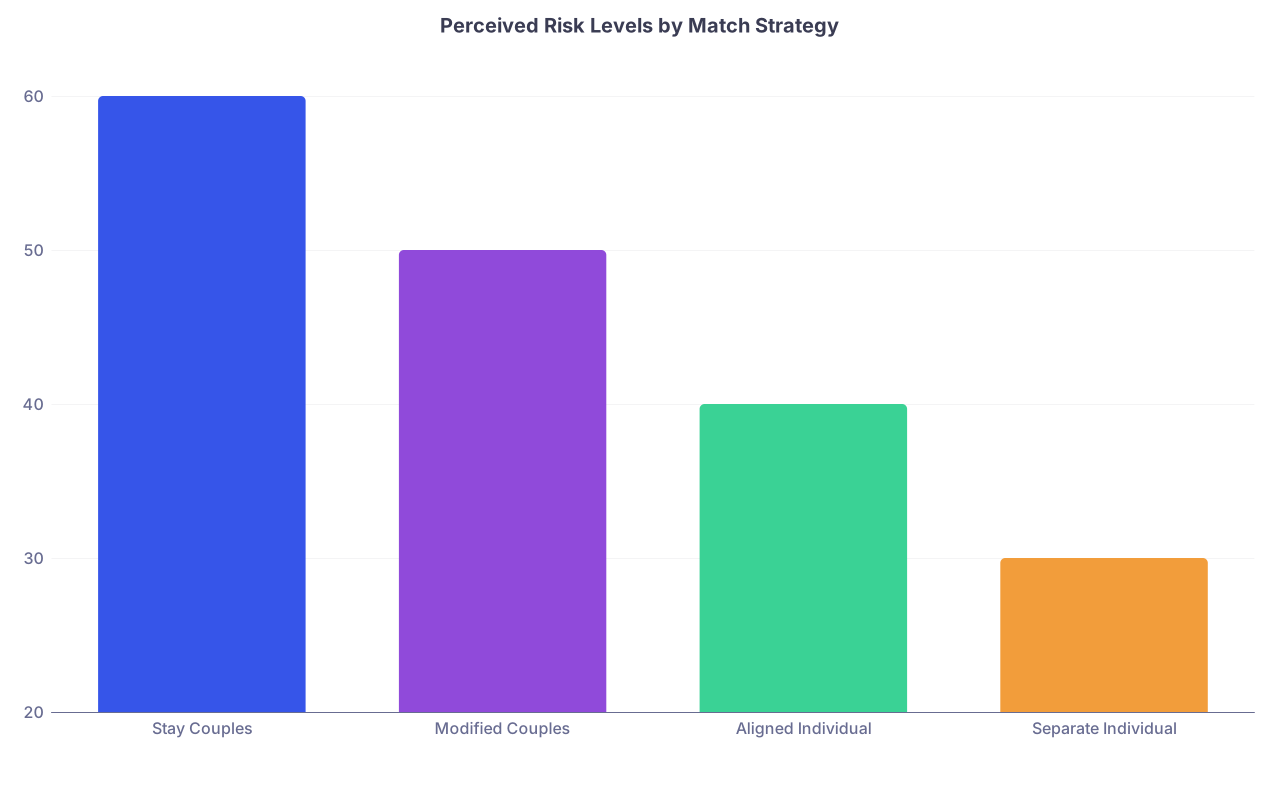
No, there’s no exact algorithm that says “if partner panics in October, you’re doomed.” But here’s the general reality:
| Category | Value |
|---|---|
| Stay Couples | 60 |
| Modified Couples | 50 |
| Aligned Individual | 40 |
| Separate Individual | 30 |
Interpretation (loosely):
- Staying tightly couples matched can increase the chance of not getting your absolute top individual program, but it doesn’t automatically tank your match. It just narrows combos.
- Modifying couples strategy (flexible rank list) usually balances risk decently.
- Aligned but individual gives each person most autonomy, less structural protection for the relationship.
- Fully separate maximizes career autonomy, minimizes built-in protection for being together.
What I’ve actually seen:
- Couples who talk early and build realistic rank lists do fine.
- Couples that avoid the hard conversations until February have way more drama and regret.
- People who stay in couples match because they’re terrified of a breakup they already feel coming… usually end up resenting someone. Sometimes themselves.
If You End Up in Different Cities: Are You Automatically Over?
No. But also… you’re not automatically fine.
I’ve seen all versions:
- Two people 3 hours apart who see each other every other weekend and end up engaged.
- Two people in “same city, opposite sides of the county, both in malignant programs” who implode in 6 months.
- A couple across the country who break up 2 weeks into intern year because they’re both drowning.
The real question is: are both of you willing to treat distance as a miserable season you work through, or as an opening to slowly drift?
You don’t need a perfect plan, but you do need:
- A shared understanding of “we’re doing distance with the goal of being back in the same city when possible.”
- Some vision of how that could realistically happen (fellowship, job search, transfers—yeah, they’re hard, but people make it work).
How to Stop the Constant Spiral in Your Head (Not Fix, Just Turn Down the Volume)
You’re not going to think your way out of anxiety on this one. But you can stop feeding it caffeine.
Three practical things:
Separate relationship question from match question in your head
Literally label them on paper: “Us” and “Match.”
Ask: “If I take residency out of it for 5 minutes, do I still want to be with this person long-term?” and “If I take this relationship out of it, where would I want to train?”
You need both answers.Have a deadline for this decision
Not “we’ll kind of keep talking.”
“By [specific date], we will decide: stay couples / modified couples / aligned individual / separate.”
Endless limbo is worse than a painful decision.Tell one trusted person the unfiltered version
Not the “we’re working through it” sanitized take.
The “I’m terrified they’re using match as a soft breakup tool” version.
You need someone who can say, “Yeah, this is messed up,” or “No, you’re skipping 8 steps with your catastrophizing.”
FAQs
1. What if they swear they still love me but absolutely refuse to couples match?
Then believe them on the “love,” but also believe them on the refusal.
You can love someone and still not be willing to tie your career options to theirs. That’s not automatically a character flaw; it’s a boundary. Your job is to decide if you can live with that boundary and not resent them later.
If you can’t, you’re not wrong. You’re just incompatible on a major life decision.
2. Are we doomed if we don’t couples match but try to end up in the same city?
Not doomed. But you do need to treat “same city” as something you strategize about, not just vaguely hope for.
That means:
- Agreeing on preferred regions.
- Being realistic about the competitiveness of your specialties.
- Accepting that you might have to prioritize “same city, mid-tier” over “different cities, dream programs” if being together is truly the top value.
If one of you says that’s the priority and then ranks like it isn’t, that’s the real problem.
3. Could we couples match and still break up without everything being ruined?
Yes. And it happens.
People break up during residency even when they matched together. The key is whether you’d still be okay training where you matched even if the relationship ended.
That’s why I always tell people: don’t rank any program you’d be miserable at alone. It sounds cold now. It feels like protection later.
4. What if I already said I’d couples match, and now I’m the one doubting?
You’re allowed to change your mind. You’re not allowed to blindside them in February.
If your doubts are about:
- Match risk
- Program quality
- Fairness to them
You can talk about modifying strategy.
If your doubts are about:
- Not seeing them long-term
- Feeling trapped
- Secretly hoping you end up in different cities
You owe them the truth. Not the softened “I’m just worried about match risk” version. The real one. Because they’re building a future around you, and they deserve informed consent.
Core things to remember:
- Their fear of couples matching is not automatic proof they don’t love you—but it is data you need to take seriously.
- You have real options: full couples, modified couples, aligned individuals, or fully separate. None are perfect. All are survivable.
- The worst outcome isn’t matching apart. It’s letting someone else’s ambivalence drag your career and sanity into a black hole because you were too scared to have the hard conversation.


