

The fear of long‑distance ruins more couples than the Match ever will.
Let me say that again, because it’s the thing no one puts on those cheery NRMP brochures: the fear of long‑distance can quietly wreck you long before rank lists are due.
You’re staring at your odds, running spreadsheets, hearing horror stories:
“What if we couples match and still end up across the country?”
“What if we don’t couples match and that somehow causes us to split?”
“What if my partner doesn’t match at all because of me?”
You’re not crazy. This stuff is brutal. I’ve watched people cry on the floor over a rank list. I’ve watched couples resent each other for years because of how they did (or didn’t) couples match.
So let’s walk through the real question you’re asking:
If our chances of landing in the same city seem slim… is couples matching still worth it, or are we just signing up to be miserable and long‑distance anyway?
First, what “slim chances” actually means (and what it doesn’t)
Most of us catastrophize based on vibes, not math. You hear “competitive specialty” and your brain jumps to: “We’re doomed, we’ll be 3,000 miles apart, we should just break up now and save time.”
Pause. Strip the drama for a second.
There are really three ingredients in “chances look slim”:
- One or both of you are in competitive fields (derm, ortho, ENT, ophtho, plastics, neurosurg, rad onc, sometimes EM or rads depending on the year).
- One partner’s app is clearly weaker on paper (lower Step 2, fewer interviews, red flags, visa issues).
- Your geographic overlap is tiny (you’re both dead‑set on 1–2 cities, or one of you has family/health constraints).
If you’ve got all three, yeah, it’s rough. But “rough” is not the same as “impossible” or “guaranteed long‑distance.” And this is where people make bad decisions out of fear.
Let me put a bit of reality in front of you:
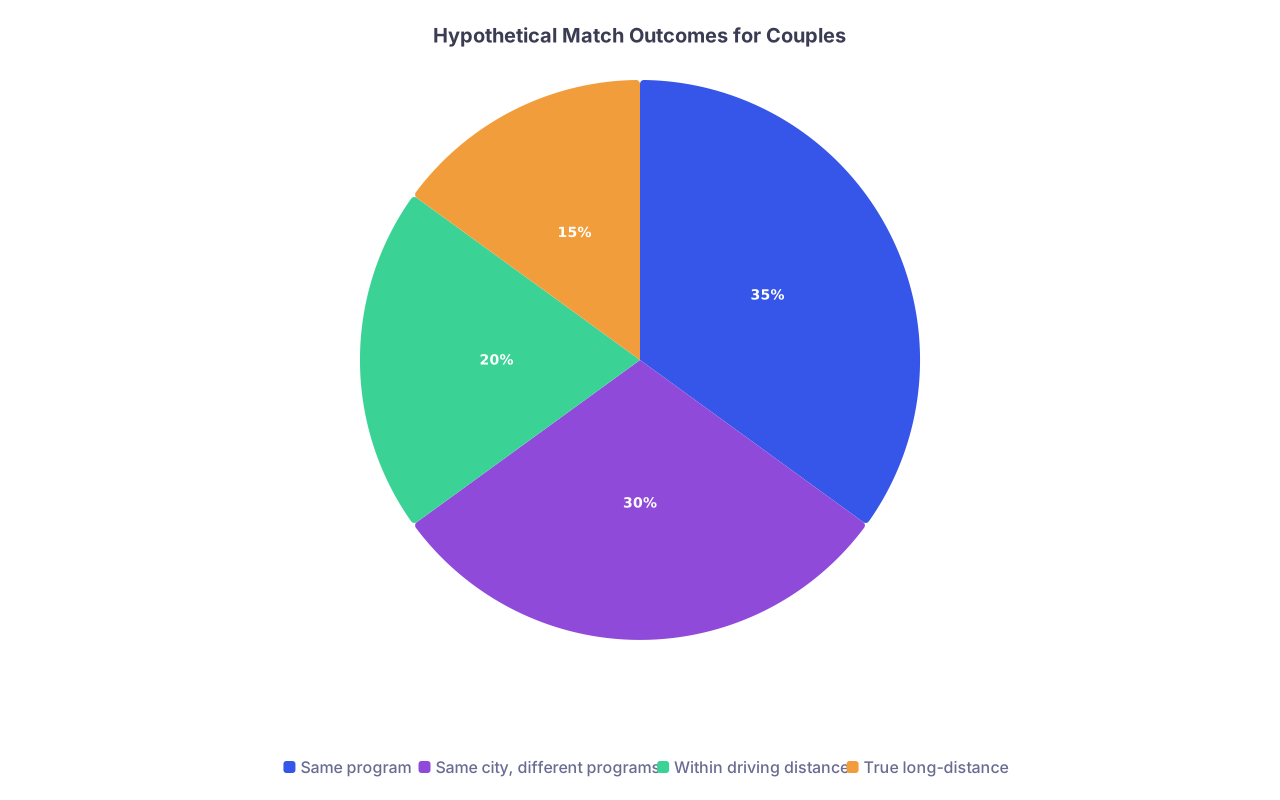
| Category | Value |
|---|---|
| Same program | 35 |
| Same city, different programs | 30 |
| Within driving distance | 20 |
| True long-distance | 15 |
Those aren’t official NRMP numbers; they’re a decent reflection of what I’ve seen anecdotally across several classes: most couples don’t end up in fairy‑tale “same program” situations, but true nightmare long‑distance for all 3+ years is not the default outcome.
The bigger problem? People assume:
- “If we couples match, programs will hate us and we’ll both get tanked.”
- “If we don’t couples match, we’ll magically end up in the same city anyway.”
Both of those are fantasies. Just in opposite directions.
What couples match actually does to your chances
Couples matching isn’t a love spell. It’s a constraint on an algorithm. That’s it.
The algorithm’s job becomes:
“Find a pair of positions that match your combined rank list preferences.”
So yes, your options narrow. That’s the honest part. Some programs that might have taken you individually won’t work out as a pair.
But here’s what gets twisted in people’s heads:
- Programs are used to couples. They don’t sit in conferences snarling, “Ugh, a couples match, hard pass.” Most have matched multiple couples before.
- The “risk” for programs is not nearly as gigantic as students think. They’re not promising anything except maybe a bit of coordination and goodwill.
- You are not “doomed” the moment you toggle “couples.” It just means your rank lists are tied.
Where it does get dangerous is when your pair is wildly unbalanced and no one wants to admit it.
Think: one partner with 250+ Step 2 and 20 interviews in a competitive specialty, the other with 5 interviews and borderline scores in IM/FM. If that strong partner only ranks “sexy coastal programs” to stay geographically close to the weaker partner’s single desirable city, yes, you might both go down together.
But that’s not because couples match is “bad.” That’s because you built a rank list based on protecting each other’s feelings, not on reality.
You can work with the algorithm if you’re brutally honest and willing to do some things that feel… icky but necessary.
The real question: what’s worse for you—structured risk or chaos?
You have two main paths:
Couples match with conservative, reality‑based rank lists, accepting some sacrifice in individual “prestige” or perfect fit to increase the odds you’re together or at least within driving distance.
Apply separately, cross your fingers, and accept there is zero built‑in pressure on the algorithm to keep you even remotely close.
And here’s the trap: when people say, “Our chances of matching together are slim,” they often compare:
- Best‑case separate match (“maybe we both end up in the same city somehow”)
vs. - Worst‑case couples match (“we both don’t match or end up in awful programs and hate each other forever”).
That’s not honest.
The real comparison is:
- Worst‑case separate match: one of you matches somewhere great, the other ends up across the country or doesn’t match at all, and the relationship starts absorbing all the blame.
vs. - Worst‑case couples match: you both end up in a less competitive or less desirable city/program than you’d like, but still employed and with some level of proximity.
Neither is pretty. But they’re different flavors of pain.
Some people would rather preserve their individual career ceiling even if it means a serious risk of true long‑distance or breakup. That’s not selfish; it’s just a different calculus.
Other people know themselves well enough to say, “I’ll be more destroyed by my relationship imploding than by doing IM in a smaller city.”
You have to decide which disaster you’re more willing to risk. Not which fantasy outcome you like better.
Concrete things that change “slim chances” into “reasonable gamble”
Let’s talk strategy instead of just fear.
If you’re going to couples match despite feeling like underdogs, there are a few levers you absolutely must pull. This is where I see people screw up.
1. Be honest about whose career is more constrained
Someone always has less wiggle room. Could be:
- The derm applicant with 15 derm interviews and very few prelim options.
- The partner who needs to be near a specific hospital for health or disability care.
- The IMG who has a limited list of visa‑friendly places.
You can’t pretend both of you have the same flexibility if you don’t. Decide whose constraints must be prioritized to avoid total disaster.
Then build around that person.
| Scenario | Who Gets Priority | Why |
|---|---|---|
| Derm + IM | Derm partner | Far fewer spots, harder to rematch |
| IMG + US MD | IMG partner | Visa limits, fewer interviews |
| Major health issue + healthy partner | Partner with health issue | Access to specific care essential |
| Single-income couple + partner with dependents | Higher earner | Financial stability for family |
If neither of you is willing to say out loud whose constraints matter more, you’ll build a mushy, unfocused rank list that pleases no one and protects nothing.
2. Expand geography more than your pride wants
“I only want East Coast.”
“I could never live in the Midwest.”
“We need to be near a major airport and mountains and water.”
Okay. Then accept your odds are worse. You can’t have boutique preferences and also panic about slim chances.
The couples I’ve seen pull off what looked impossible all did one thing: they blew up their geographic ego. They added places they’d previously sworn they’d never touch.
If being together is truly the priority, your rank list should look a little ugly to your med school friends. That’s the price.
3. Accept that one of you might “take the hit”
Here’s a harsh truth: in most hard couples matches, one person sacrifices more.
A strong anesthesia applicant ends up at a solid but not “top‑tier” Midwest program because that’s where their FM partner got love.
Or a peds applicant ends up in a mid‑size city away from her dream coastal home because her partner’s ortho options were clustered inland.
It sucks. You’ll stare at other people’s Instagram stories from fancy coastal residencies and feel that sting.
But I’ve watched those same people five years later, with stable relationships, decent fellowship matches, and actual lives. Many of them would tell you: “I’m annoyed at where I trained, but I’m glad I didn’t blow up my relationship over it.”
You’re allowed to be bitter and still think it was the right choice.
When you probably shouldn’t couples match
Let me be blunt: couples matching is not always the noble, romantic thing. Sometimes it’s a bad idea.
You probably shouldn’t couples match if:
- The relationship is already rocky, full of ultimatums, or on/off. Adding the stress of joint rank lists will not magically fix trust issues.
- One partner is deeply ambivalent about medicine and talking about quitting, changing paths, or taking a year off.
- You fundamentally disagree about priorities: one of you clearly values prestige and career trajectory above all, the other clearly values location/relationship—and neither is budging.
In those cases, forcing a couples match can turn into mutual sabotage. You both compromise, you both end up disappointed, and you still might not make it as a couple.
Better to own the truth: “We’re each going to rank for ourselves, and if we end up close, amazing. If not, we reassess then.”
That’s not failure. That’s honesty.
When couples match still makes sense even if odds look bad
There are also situations where couples matching is still the better bet, even when your spreadsheet looks ugly:
- You absolutely know you cannot emotionally survive 3+ years of true long‑distance. You’ve done it before and it nearly broke you.
- You don’t have strong, rigid career goals tied to ultra‑competitive programs or cities. You care more about being okay together than about a brand‑name hospital.
- One or both of you already has some risk in the application (low Step 2, failed exam, few interviews), and you’d rather both end up in “safe but okay” places instead of rolling solo dice and risking one person scrambling or going unmatched.
For some couples, shared mediocrity is better than solo excellence and solo ruin. Brutal way to phrase it, but true.
If that sentence makes you recoil, maybe that’s your answer: you might be someone who would resent that trade‑off forever.
A simple sanity check: the 3 questions I’d make you answer
If we were sitting in a study room right now and you asked, “Should we still couples match?” I’d ask you these three things and not let you dodge:
If we end up together in a non‑prestigious, mid‑tier city that neither of you loves, but both in solid, safe programs—will you look back and say, “We made the right call,” or, “I ruined my career for this”?
If you match separately and end up 1,000+ miles apart for three years, how likely is it—honestly—that this relationship survives? Not the fairytale version. The one where you’re both working 60–80 hours a week, sleeping post‑call, and traveling costs time and money you don’t have.
Which loss would you grieve longer: not getting your dream program, or losing this relationship because of the Match?
Your answers are your answer. Not mine. Not Reddit’s. Not your attending’s.
You’re allowed to be scared—and still choose
Let me validate the horrible thought you probably haven’t said out loud:
“What if the way we choose to match is the specific reason we break up?”
Yeah. That’s possible. I’ve seen it.
I’ve seen couples blame each other for rank lists, for cities, for “I could’ve gone to X if it wasn’t for you.” I’ve also seen couples blow apart because they didn’t couples match and one person ended up feeling like the other chose prestige over them.
There is no zero‑risk path here. That’s the part no one can sugarcoat.
What you can do is:
- Get sickeningly honest with each other about priorities.
- Talk through worst‑case outcomes in advance, not at 7 a.m. on Match Day when you’re both shaking.
- Decide which pain you’re more willing to carry.
And then you choose. Fully, not halfway. If you couples match, you don’t spend three years saying, “Well, you made us do this.” You both own it. If you don’t couples match, you don’t keep secretly resenting the other person for “not fighting harder.”
You will still be scared. That doesn’t mean you made the wrong call. It just means you’re human and this process is designed to make you feel like everything is on the line—because honestly, a lot of it is.
FAQs
1. Are we “wasting” our chances by couples matching if one of us is much stronger?
Not automatically. But you do need a ruthless strategy. The stronger partner will almost certainly need to rank a mix of high‑tier, mid‑tier, and “safe but decent” programs in regions where the weaker partner got interviews. If the stronger partner only ranks reach programs trying to “have it all,” you’re right, you’ll waste the safety net. The waste comes from denial, not from clicking the couples button.
2. What if we couples match and still end up long‑distance—was it all pointless?
No. Couples matching can still nudge you from “opposite coasts” to “same state but 2–3 hours apart” or “short flight instead of cross‑country ordeal,” depending on how you build your list. Even if you don’t land in the same city, there’s often less chaos than two totally independent matches. It’s not all‑or‑nothing same‑hospital vs. disaster.
3. Does couples matching hurt our chances of matching at all?
It can if you build an unrealistic rank list that doesn’t include enough combinations, safety programs, or geographic flexibility. The algorithm isn’t punishing you for being a couple; it’s just following your constraints. If you only give it fantasy scenarios, it will happily give you… nothing. You protect yourselves by giving the algorithm lots of “good enough” pairings beneath the dream ones.
4. Should we still couples match if we’d “be okay” with long‑distance for one year?
Yes, and that actually gives you more power. You can rank some combinations where one of you is at a 1‑year prelim or transitional year nearby or within a short flight, with the plan to re‑apply together later. That flexibility often improves your odds overall, because you don’t force every pairing to be perfect from Day 1.
5. What if our advisors disagree—some say couples match, some say don’t?
Welcome to medicine: three attendings, five opinions. Listen for why they’re saying it, not just the conclusion. Is one fixated on prestige? Is another more relationship‑oriented? Filter their advice through your own answers to those three sanity‑check questions. If an advisor’s priorities don’t match yours, their conclusion shouldn’t either.
6. How do we know if we’re choosing couples match out of love or out of fear?
Ask yourselves this: if residency weren’t a factor—no Match, no algorithm—would you still be planning a shared future in the same city, making big life decisions together? If yes, you’re probably acting out of genuine commitment, even if fear is loud. If the relationship only feels “serious” in the context of the Match, and you’re mostly terrified of being alone, that’s more fear than foundation. And no algorithm can fix that.
Key takeaways:
You’re not overreacting—this decision is genuinely high‑stakes. Couples matching with “slim chances” isn’t automatically wrong, but it only works if you’re brutally honest about priorities and willing to sacrifice ego and geography. There’s no risk‑free option—only the version of risk you and your partner are most willing to live with, and hopefully, grow through together.


