

You’re not crazy: this is the nightmare scenario couples think about and then immediately try not to think about.
The fear you’re too scared to say out loud
Let’s just say it plainly: you’re terrified that Monday morning will come, that email will hit your inbox, and:
You: “We did it. I matched.” Partner: “I didn’t.”
Or the other way around.
And then what? Are you a terrible person if you feel relieved you matched? Are you a terrible partner if you feel jealous and resentful? Are you about to blow up your relationship because of an algorithm and some PD you’ve never met?
This is the stuff that actually keeps couples match people up at 2:30 a.m., refreshing NRMP emails that aren’t coming any faster no matter how many times you stare at them.
You’re not alone in this. I’ve watched couples go through:
- One matches, one doesn’t
- Both match, but 1,000+ miles apart
- One SOAPs into something they didn’t want, one lands their dream
- Both SOAP, one gets nothing
So let me walk through what actually happens if only one of you matches on Monday, what options you realistically have, and how to not destroy yourselves (or each other) in the process.
Because no one explains this part. They just tell you to “trust the process” and “rank programs honestly.” Okay. And then what?
Monday: Match Status Day – the emotional whiplash
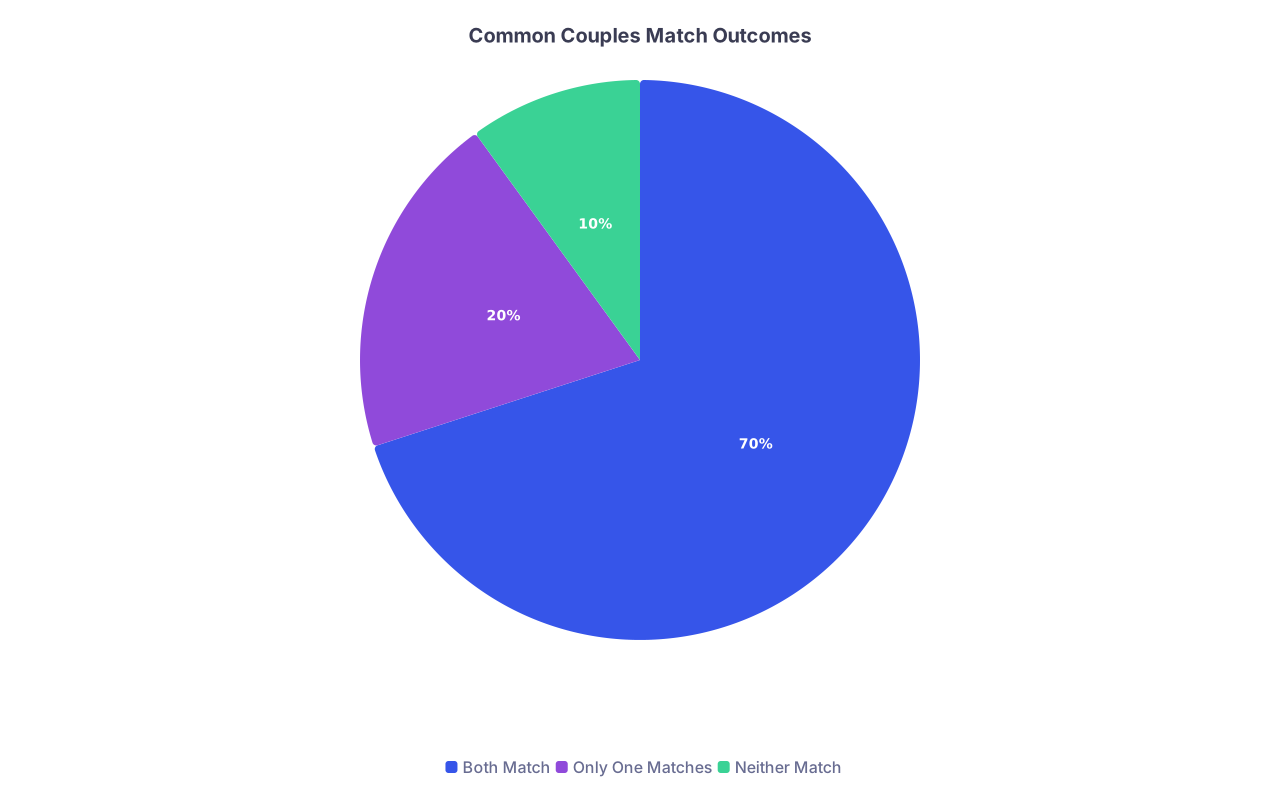
| Category | Value |
|---|---|
| Both Match | 70 |
| Only One Matches | 20 |
| Neither Match | 10 |
On Monday at 10 a.m. Eastern, you both open the same portal.
Three main possibilities exist for a couples match pair:
- Both of you match
- Neither of you match
- One of you matches, one doesn’t
You’re here for scenario 3. The one no one wants to say out loud.
Here’s the brutally practical version of what that looks like:
- The person who matched is locked in. That spot is real. It’s done.
- The person who didn’t match gets the “you are eligible for SOAP” message.
- As a couple, you have maybe 24–48 hours to go from stunned, crying on the floor, to rational decision-making with spreadsheets open.
And the emotional part is not some minor footnote. It drives the decisions. I’ve seen:
- The matched partner trying to say, “We can withdraw, I’ll reapply with you,” while secretly panicking about losing that hard-won spot.
- The unmatched partner saying, “Just go, I’ll figure it out,” and then spiraling at night because they feel abandoned, behind, and “less than.”
- Both people too scared to admit what they actually want.
You’re going to feel pressure to make some grand, romantic, self-sacrificing gesture. Ignore that instinct for a second. You need a clear head and a plan, not a movie moment.
What actually happens to the unmatched partner

| Step | Description |
|---|---|
| Step 1 | Unmatched on Monday |
| Step 2 | Eligible for SOAP |
| Step 3 | Get list of unfilled positions |
| Step 4 | Apply via ERAS |
| Step 5 | Interview Mon-Thu |
| Step 6 | SOAP Offers Rounds |
| Step 7 | Accept Offer |
| Step 8 | No Offer |
If only one of you matches, the unmatched partner immediately shifts into SOAP survival mode.
Here’s the SOAP reality, stripped of the sugarcoating:
- You find out you’re unmatched Monday morning
- You get access to the list of unfilled positions
- You rapidly tailor and submit ERAS applications (you can’t just shotgun everything; there are caps)
- You interview—often virtual, short, rushed—from Monday–Thursday
- There are multiple offer rounds; you may get an offer, or nothing at all
And this whole time, your partner—who did match—is sitting there feeling guilty for having “good news” while you’re trying not to fall apart on Zoom.
This is where the couples match fantasy of “it’s us against the world” smashes into the logistics of an NRMP algorithm and SOAP chaos.
So the question becomes: how do you make choices in SOAP that don’t wreck both your careers and your relationship?
The hard decision: do you still prioritize being together?
Let me be blunt: there’s no “right” answer here, but there are some common traps couples fall into.
Trap 1: The martyr move
Matched partner says, “I’ll give up my spot. We’ll both reapply next year. We’ll go through this again together.”
It sounds noble. It also might be reckless.
Because here’s the part people skip: reapplying isn’t guaranteed success. Programs may wonder why you gave up a spot. You’re another year older, maybe with a gap, maybe no strong new accomplishments.
You need to actually look at:
- The specialty and competitiveness of the matched position
- Your Step scores / COMLEX / class rank
- Program reputation and training quality
- Your realistic chances of getting any better situation next year
Sometimes sacrificing a solid categorical IM or FM spot so you can “reapply together” is just… a bad idea. For both of you.
Trap 2: The “we’ll just long-distance and it’ll be fine” fantasy
The other extreme: “You SOAP wherever; I’ll go to my program; we’ll figure it out. It’s just a few years.”
Could you do long-distance? Yes. People do. But residency long-distance isn’t undergrad long-distance.
You’re exhausted, on call, on nights, working weekends, trying to pre-round and keep track of labs. You’re charting at midnight. You miss texts. You forget to call. Not because you don’t care—because you’re drowning.
A 2-hour drive is one thing. A 4-hour flight with two post-call schedules is another. Be honest about that. Not aspirational-honest. Real-honest.
Trap 3: Avoiding the real conversation until it’s too late
The biggest mistake? Waiting until after you’re already in SOAP panic mode to discuss:
- Would either of you ever give up a spot?
- How far apart is truly too far?
- Would one of you change specialties to be closer geographically?
- Is there a “primary career” for a year or two, with the understanding it rebalances later?
These shouldn’t be invented in crisis. They should be clarified before Monday. Even if it makes you both anxious. Especially because it makes you both anxious.
Strategy when only one of you matches: what are your options?

Let’s say it’s happened. One match. One SOAP.
Here’s what you’re actually choosing between, not in fantasy-land but in real life:
Option 1: Keep the matched spot, unmatched partner SOAPs as close as possible
This is the most common and, frankly, often the most rational.
You both:
- Identify programs in SOAP within a realistic radius (you define that—same city, 1–2 hours driving, same state, etc.)
- Unmatched partner focuses SOAP applications on those first, then broadens out if needed
- You accept that PGY1 might be “we see each other on some weekends and post-call days,” not nightly dinners and cozy Netflix
This option preserves:
- A guaranteed spot for one of you
- A chance at a geographically workable solution
- At least one stable income and visa pathway (if that applies)
Yes, it hurts that you’re not automatically together. But it avoids the nuclear option of burning the matched spot.
Option 2: Keep the matched spot; unmatched partner either doesn’t SOAP or doesn’t get a spot, and re-applies next year
This one is brutal emotionally.
- One partner starts residency this year
- The other spends a year doing research, prelim work, MPH, or something to strengthen their application
- You deal with the reality that your timelines are now permanently staggered (you won’t finish training the same year)
This works best when:
- The unmatched partner has a realistic shot to significantly improve their app
- The specialty isn’t insanely competitive, or they’re willing to pivot
- Both of you can tolerate “one of us is moving forward, one is stuck” without resentment eating you alive
But this absolutely needs explicit talking about power dynamics, income, and emotional fallout. Otherwise it festers.
Option 3: Matched partner gives up the spot (very rare, very high-risk)
I have seen this. I have also seen it go badly.
Possible reasons couples consider this:
- The matched spot is prelim or in a specialty/location that the matched partner already dislikes
- The relationship is a higher priority than any single match outcome
- They believe both of them will match next year into something better
My honest take: this is only remotely reasonable if:
- The matched spot is truly poor fit (program with toxic rep, wrong specialty, or location you both hate)
- Both of you are objectively competitive applicants
- You’re both fully aligned and not guilted into it
And even then, it’s still a big gamble.
How to talk about all this without torching your relationship
This is the part everyone underestimates.
People think the danger is “the algorithm breaks us up.” Usually it’s not. It’s the way you talk (or don’t talk) to each other under stress that does the real damage.
Some ground rules that might save you:
No forced self-sacrifice.
“I’ll give up my spot” should never be accepted on the spot. You sleep on that. You talk it through logically. You maybe talk to mentors or advisors.You’re both allowed to have feelings that contradict your ideals.
You can be relieved you matched and still devastated for your partner. You can be proud of them and still feel jealous. That doesn’t make you a bad person. It makes you a human.Be concrete, not vague.
Don’t say “I’ll go wherever you go.” Say, “I’m willing to be within X hours, but not cross-country,” or “I’ll switch from derm to IM if we’re still apart in a year.” Vague promises feel romantic now and resentful later.Agree in advance who gets the final call on certain decisions.
Example: “If you SOAP into anything within 2 hours of my matched program, we commit to that.” Or, “If I match and you don’t, we agree I’m keeping my spot, and we’ll build from there.”
It feels cold to talk like this. But clarity here is actually mercy.
What programs actually think (and what they don’t care about)
| Priority | How Much They Care |
|---|---|
| Your exam scores | High |
| Your fit with specialty | High |
| Your couples match story | Low |
| Your relationship status | Almost zero |
| Your geographic preferences | Moderate |
Programs are not sitting around thinking, “Aw, but their partner matched 800 miles away, maybe we should help them out.” They’re filling holes. Fast.
During SOAP, PDs care about:
- “Can this person function on day one?”
- “Are they committed to this specialty?”
- “Do they have any huge red flags?”
They do not care that your partner matched across the country. That’s not cruelty; that’s them being in survival mode too.
So in SOAP personal communications or emails, don’t waste time selling the love story. Focus on competence, commitment, and why you’re a good fit for that unfilled spot.
Your couple story might matter if you’re both already in the same region and trying to coordinate between programs later for a swap or PGY2 change. But in SOAP? It’s background noise.
Planning before Monday so you’re not making decisions in shock
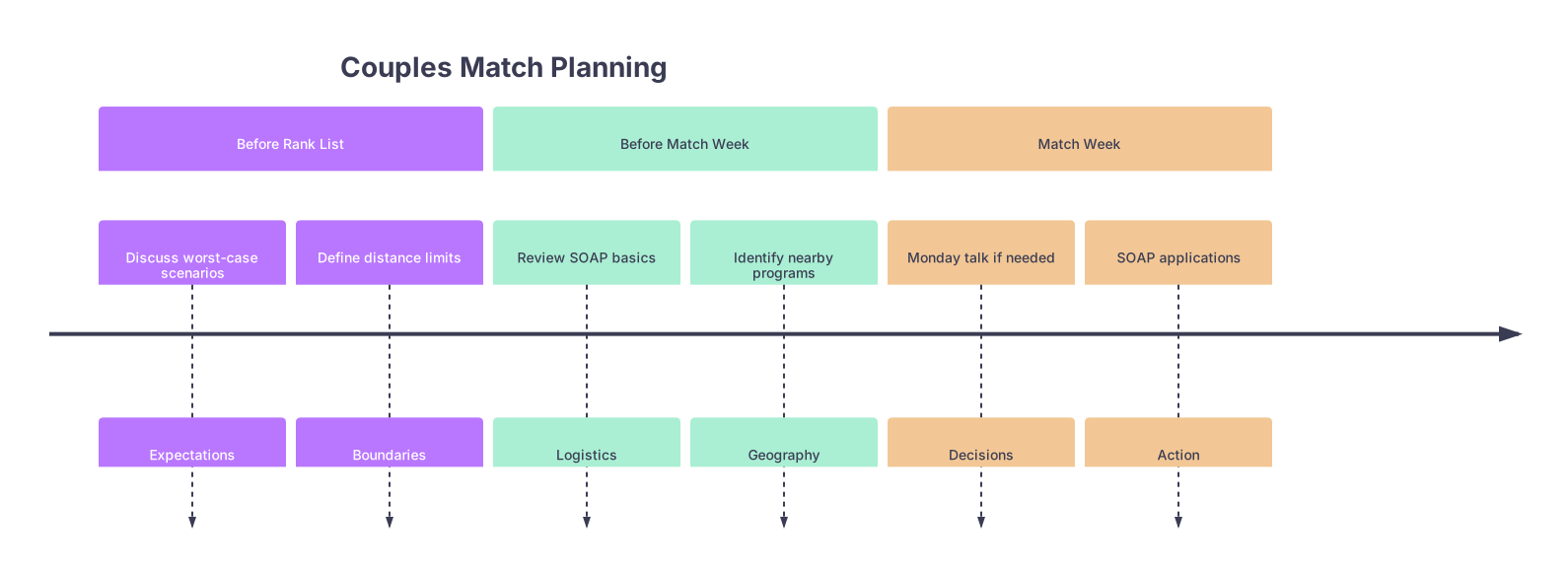
| Period | Event |
|---|---|
| Before Rank List - Discuss worst-case scenarios | Expectations |
| Before Rank List - Define distance limits | Boundaries |
| Before Match Week - Review SOAP basics | Logistics |
| Before Match Week - Identify nearby programs | Geography |
| Match Week - Monday talk if needed | Decisions |
| Match Week - SOAP applications | Action |
You’re reading this before the SOAP storm hits (or maybe in the middle of it, in which case: deep breath). Either way, here are the conversations that need to happen now, not after the email:
- “If only one of us matches, do we agree that person keeps their spot?”
- “How far apart is too far for us? Be specific.”
- “If one of us needs to reapply next year, what does that year look like financially and emotionally?”
- “Is there any situation where giving up a spot is on the table? If yes, what exactly would that look like?”
If you force yourselves to answer these while you’re relatively calm, you’re less likely to blow everything up on Monday out of panic, guilt, or adrenaline.
And yes, these conversations feel awful. You will both want to say, “Let’s just wait and see.” That’s fear talking. Have the uncomfortable talk anyway.
If you’re the one who matches

You’re going to feel like you’re not allowed to be happy. Like your joy is somehow disrespectful.
You are allowed to be proud of yourself. You are allowed to feel relief. You’ve worked for this. You also need to be emotionally available for a partner whose world just imploded.
What helps:
- Don’t immediately start talking about your new city, new apartment, your co-residents. Give your partner space.
- Tell them clearly: “I’m not leaving you behind. We’re going to figure this out together.”
- Let other people celebrate you—parents, classmates—so your partner doesn’t feel alone or pressured to “fake happy” for you.
Guilt won’t fix anything. Showing up consistently will.
If you’re the one who doesn’t match

You will go straight to: “I’m the weak link. I’m dragging us down. They’d be better off without me.”
That voice is lying to you.
Plenty of strong applicants don’t match. Bad luck, geographic constraints, couples ranking, overreaching on programs—it’s not some moral judgment on your worth as a doctor or as a partner.
You have one job that first day: stabilize enough to act. Not to make lifelong decisions about your career and your relationship in one emotional meltdown.
- Cry. Absolutely.
- Then start SOAP prep. Reach out to advisors. Let your partner support you instead of pushing them away because you feel ashamed.
You are not “less than” because a computer said “no match.” It just means your road is messier than you planned.
FAQ (exactly 4 questions)
1. Should my partner give up their matched spot if I don’t match on Monday?
Usually, no. That sounds romantic and loyal, but it can be a terrible career move for both of you. A guaranteed spot in a decent program is gold. Only consider giving it up if the spot is truly a bad fit and you both have strong odds of matching better next year. Even then, sleep on it, talk to advisors, and check your motivations. Don’t make that decision out of panic or guilt.
2. Can we still stay together if our programs end up far apart?
Yes, people do it. But residency long-distance is hard and not Instagram-cute. You’ll miss calls, holidays, even each other’s crises because of schedules. The relationship can survive, but only if you’re both brutally honest about your limits, actively plan visits around rotations, and don’t treat long-distance as some temporary inconvenience that will magically fix itself. It’s work. On top of the hardest work you’ve ever done.
3. Will not matching ruin my chances forever, especially as part of a couple?
No, it doesn’t have to. It makes the path bumpier, but I’ve seen plenty of people not match, SOAP into a prelim year or take a research year, and then land solid categorical spots later—sometimes even ending up closer to their partner than they expected. You’ll need a coherent story, stronger letters, and maybe flexibility on specialty or location, but “unmatched once” is not a career death sentence.
4. What should we decide before Match Week to be ready for this scenario?
You should both be clear on three things: whether a matched partner ever gives up a spot (and under what specific conditions), how far apart is too far for you (define in hours/regions, not vibes), and what the unmatched year would look like if one of you has to reapply (finances, living situation, career-building). If you lock those in ahead of time, you’re far less likely to panic-implode your relationship or your careers when that Monday email hits.
If you remember nothing else:
- One of you matching and one not is a crisis, not a verdict on your worth or your relationship.
- Keeping the matched spot while the other SOAPs or re-applies is usually the most stable path, even if it feels emotionally messy.
- The hard, uncomfortable conversations you have before Monday are what protect both your careers and your relationship when everything feels like it’s falling apart.


