

It’s late August of your fourth year. You’re on a sub‑I. Your partner is on an away rotation at a big military medical center. You just got an NRMP token email. They’re talking about uploading documents to MODS/GMO preferences/Military Match whatever. You both stare at the calendar and realize: you’re not in the same system. At all.
One of you is going through the military match (Army/Navy/Air Force). The other is going through the civilian NRMP match. You still want to end up in the same city. Or at least within a drivable radius. But there’s no official “couples match” between DoD and NRMP.
Here’s the reality: nobody is coming to coordinate this for you. You have to build the plan yourself.
Let me walk you through exactly how to think about it, what to do each month, and where people commonly screw this up.
Step 1: Get brutally clear on constraints (not wishes)
Before you do any spreadsheets or couples “vision board” nonsense, you need to understand the hard rules of each system. Not what you want. What the systems allow.
Military side: what’s actually fixed
If your partner is military match, their side has the earlier, binding decisions.
Typical pattern (varies a bit by branch/year, but close enough):
- Rank list due: late October–early November
- Match results: mid‑December (for GME vs GMO/flight surgery, and usually location if direct to residency)
By the time you’re building your final NRMP rank list in February, their fate is already sealed somewhere:
- They’re either:
- Going straight to residency at a specific MTF (e.g., San Antonio, Walter Reed, Portsmouth, Tripler), or
- Going to a GMO/flight surgeon billet and may or may not know the exact location yet.
On the military side, the big non‑negotiables:
- They cannot “couples match” with you officially.
- They cannot change their match after December because your NRMP plan changed.
- They have limited control over geographic location compared to you.
Accept this now: your NRMP strategy must flex around their result, not the other way around.
NRMP side: what’s actually fixed
On your side:
- ERAS opens: June
- Applications sent: September
- Interviews: Oct–Jan
- Rank list due: late February
- Match Day: mid‑March
Key point: you will know their military match result before you submit your final NRMP rank list. But not before you apply and interview.
So the order of operations is:
- You both build lists of possible cities based on where the military has programs/billets.
- You apply/interview broadly with those in mind.
- Military match results in December → location (or at least region) becomes real.
- You then sculpt your NRMP rank list around that December reality.
If you keep that logic in your head, everything else gets easier.
Step 2: Map the actual geography that matters
Vague goals like “We’d like to be in the same state” are useless. You need a map with named cities, facilities, and realistic commute distances.
Sit down one evening. Open Google Maps. List out the likely military locations and their nearby civilian residency hubs.
1. Identify realistic military locations for your partner
If they’re going straight into residency via military GME, likely hubs (branch dependent) look like:
- San Antonio (SAMMC)
- Washington, DC area (Walter Reed, Fort Belvoir, etc.)
- Portsmouth/Norfolk, VA
- San Diego, CA
- Honolulu (Tripler)
- Tacoma/Seattle (Madigan)
- Maybe smaller sites depending on specialty/branch
If they’re going GMO/Flight Surgeon, locations are more scattered. But you can often estimate: coastal bases, large Army posts, Air Force flight wings, etc.
Have them ask their military GME advisor directly:
- “For my specialty or GMO track, what are the top 5 most likely bases/MTFs I could end up at?”
If that advisor answers, “It depends,” push: “Where did people go last year from our school?” Names and places, not vibes.
2. Look up civilian residencies within 60–90 minutes of each
Now cross‑reference with NRMP programs.
Example: if partner might match to Walter Reed (Bethesda, MD):
- Civilian IM/EM/whatever programs within 60–75 minutes:
- Washington Hospital Center
- Georgetown
- GW
- University of Maryland
- Some community programs in Maryland and Northern Virginia
Write that down.
Do this for each likely military city. You should end with something like:
| Military Hub | Nearby Civilian Cities | Rough Commute Radius |
|---|---|---|
| San Antonio (SAMMC) | San Antonio | 30–45 min |
| Walter Reed (DC area) | DC, Baltimore, Northern VA | 30–75 min |
| Portsmouth, VA | Norfolk, Virginia Beach | 20–45 min |
| San Diego, CA | San Diego | 20–60 min |
| Hawaii (Tripler) | Honolulu | 20–40 min |
If you’re thinking “We’ll just do long distance if we have to,” fine. But still do this exercise. Because you might be able to make it work if you’re deliberate now, instead of panicking in December.
Step 3: Design your NRMP application strategy around clusters, not dream names
Here’s where people mess up: the civilian partner builds an application list like a typical solo applicant. Famous programs. Random scatter. Zero geographic clustering around military hubs.
That’s how you end up matched at University of Colorado while your partner is at Portsmouth.
You need to think in clusters:
- Cluster = a metro area or commuting region where:
- There’s a military base/MTF where your partner might end up
- AND there are 2–6 civilian programs in your specialty nearby
Example cluster: San Antonio
- Military: SAMMC
- Civilian possibilities for you: UT Health San Antonio, Methodist, Baptist, etc. (depending on specialty)
Make 3–5 core clusters where overlap is decent, then sprinkle in some true individual “reach” or “backup” programs elsewhere.
Application planning rule of thumb
- 60–70% of your applications in 3–5 overlapping clusters tied to military hubs
- 30–40% in standalone locations you genuinely like (in case co‑location fails)
For competitive specialties, you’ll still need to apply broadly. That’s fine. Just don’t be random. Weight applications where you actually have a shot of living together.
Step 4: Month‑by‑month game plan
Let me lay this out as a rough timeline. Adjust by year/branch, but the logic stays.
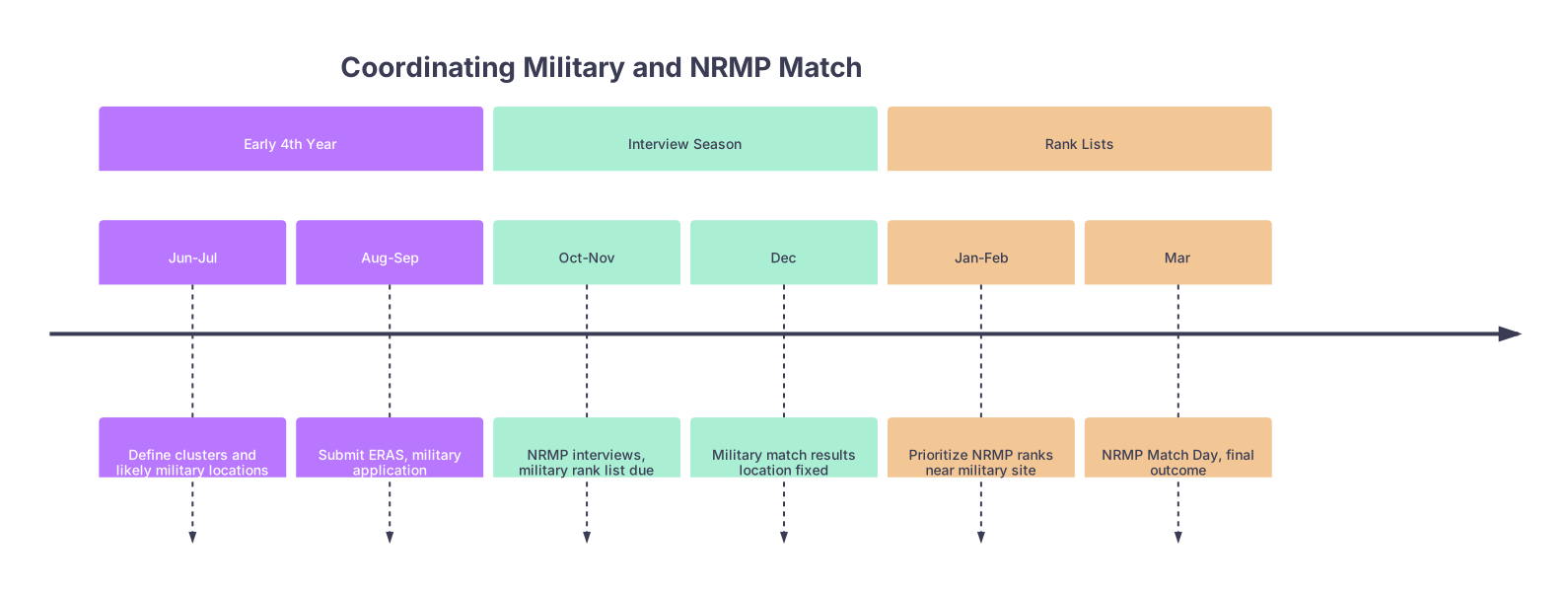
| Period | Event |
|---|---|
| Early 4th Year - Jun-Jul | Define clusters and likely military locations |
| Early 4th Year - Aug-Sep | Submit ERAS, military application |
| Interview Season - Oct-Nov | NRMP interviews, military rank list due |
| Interview Season - Dec | Military match results location fixed |
| Rank Lists - Jan-Feb | Prioritize NRMP ranks near military site |
| Rank Lists - Mar | NRMP Match Day, final outcome |
June–July (early MS4)
- Military partner:
- Confirm branch deadlines and whether they’re applying GME vs GMO.
- Talk to GME advisor about realistic locations.
- Civilian partner:
- Build NRMP program list around clusters (using the map exercise).
- Make sure you’re not applying to just two programs near each military hub. You want depth.
September–November
- You both apply in your respective systems.
- You attend NRMP interviews.
- They finalize their military rank list.
Tactical move: as you interview, tell programs the truth (strategically):
- “My partner is an Army/Navy/Air Force medical student applying through the military match and will likely end up in X/Y/Z. That’s a big part of why I’m very interested in this region.”
Most PDs will appreciate the honesty. Some will actually bump you up if they think you’re likely to stay. Programs love residents who have reasons to stay tied to the area.
December: Military match hits
This is the big pivot point.
Your partner now knows:
- Residency vs GMO/flight surgeon
- Location (for direct‑to‑residency or often for GMO, or at least the base/region)
Once that email comes in, you say: “Okay, the center of gravity is now [City/Base].”
Your tasks in the next week:
- List every NRMP program you interviewed at within ~1.5 hours of that base.
- Reality check competitiveness: which programs actually liked you (based on vibes, emails, interview feel, etc.)
- Draft a location‑weighted rank order list.
Step 5: Building your NRMP rank list after the military result
This is where you have to be honest with yourselves about priorities.
There are three main strategies I see work. Pick one and admit it to yourselves.
Strategy A: “We must be together” (Proximity > Program Prestige)
You rank programs near your partner’s base at the very top, even if they’re not your fanciest interviews.
Example clarity:
- Partner matches San Diego (Navy).
- Your favorite interview overall was University of Michigan.
- But you agree being in the same city matters more than program brand.
Your rank list might start with:
- UC San Diego
- Scripps Mercy
- [Any other San Diego‑adjacent programs]
4+. Other programs you liked elsewhere in decreasing preference
You accept the trade‑off: geographic stability over name prestige. That’s a valid, adult choice.
Strategy B: “Program quality first, but we’ll try for proximity”
You say: “I’m willing to be at some distance for a clearly better training environment, but I still weight proximity.”
Example:
- Top‑tier program elsewhere you loved
- Best program near partner’s base
- Second‑best near partner’s base
- Second‑tier non‑local you still like
5+. Rest
You might end up 2–3 hours away but still drivable on weekends. Not ideal, but tolerable. This is a middle‑ground strategy.
Strategy C: “We’ll do distance if needed” (Career > Co‑location)
You prioritize your best‑fit program list almost completely by your own career goals. Proximity is nice, but not a major driver.
This is reasonable when:
- Your specialty is very competitive and you can’t afford to down‑rank stronger programs.
- Your partner’s assignment is temporary (e.g., 2–3 year GMO tour) and your training is 4–7 years.
- You both agree long‑term career trajectory is more important than 3–4 years of geography.
None of these are wrong. What’s wrong is pretending you’re Strategy A but making a Strategy C rank list. Then acting surprised.
- “We’re going to build a rank list that puts being together above everything else.”
or - “We’re ok doing distance if it means you get the best program you earned.”
Say it aloud. Then build the rank list that matches that statement.
Step 6: Communication with programs (when and how to use it)
You can’t game the algorithm. But you can communicate like a grown adult.
When to reach out
After the military match in December:
- If your partner is locked into City X and you interviewed at programs there:
- You can send a short, specific email to your top 1–3 programs in that area.
Something like:
Dear Dr. [PD],
I wanted to share an update that’s important to my residency decision. My partner is an [Army/Navy/Air Force] medical student who just matched to [specific base/hospital] in [City]. Because of that, I’m especially interested in training in this region to keep our family together.
I enjoyed my interview day at [Program Name], especially [specific detail]. Your program is my top choice in the area, and I would be thrilled to train there.
Sincerely,
[Name, AAMC ID]
Do not spam 15 programs with “you’re my top choice.” Pick 1–3 where you’re genuinely serious.
What not to do
- Don’t lie about rank intentions. Word gets around. PDs are not dumb.
- Don’t bad‑mouth the military, complain about not having control, or overshare about dissatisfaction. Keep it professional.
- Don’t try to pressure them: “If you rank me highly, I’ll guarantee to stay here with my partner.” The algorithm doesn’t care about emotional deals.
Programs can’t officially “couples match” you with a military partner, but some PDs will quietly give extra weight to someone clearly anchored to the region.
Step 7: Special cases and tricky variables
Case 1: Military partner is doing GMO first, residency later
This is messier.
If they’re going to GMO/flight surgeon billets for 2–3 years:
- Their first assignment might not line up nicely with your PGY‑1–PGY‑3 training.
- Their eventual residency match (later military GME or civilian deferral) becomes another roll of the dice.
How to approach it:
- Treat your residency choice as the stable anchor.
- Prioritize your best reasonably proximal program cluster, knowing they may need to move or do some distance for part of the time.
- If their GMO assignment location is known before February, you can still weight region a bit. But don’t over‑sacrifice if it’s a short tour.
Case 2: Different specialties with wildly different competitiveness
If one of you is applying something like:
- Derm, ortho, plastics, ENT, urology (very competitive)
and the other is in a more flexible specialty (FM, IM, peds, psych), you should not pretend you have equal leverage.
Usually, the more flexible specialty should:
- Be more location‑heavy in their application strategy
- Apply to more programs in each critical cluster
- Have more willingness to prioritize proximity in the rank list
If both of you are in hyper‑competitive fields, accept that co‑location may not happen. In that case, deliberately talk about long‑distance logistics: flights, call schedules, time zones, cost.
Case 3: One of you is open to civilian or military deferment
Some years, the military offers:
- Civilian deferments (you do residency in NRMP, still in uniform)
- Civilian sponsored slots (they pay, you train at a specific civilian site)
If your military partner might go that route:
- Ask early how those deferments are decided.
- Understand if they can target specific cities/programs or if it’s centrally assigned.
- Realize those decisions also often precede your NRMP rank deadline.
Deferment can simplify things if you both end up in NRMP—then you can couples match like any other pair. But never assume deferment will happen. Use it as a bonus option, not the core plan.
Visual: How much should you weight proximity?
Here’s a rough mental model of how some couples weight location vs. program:
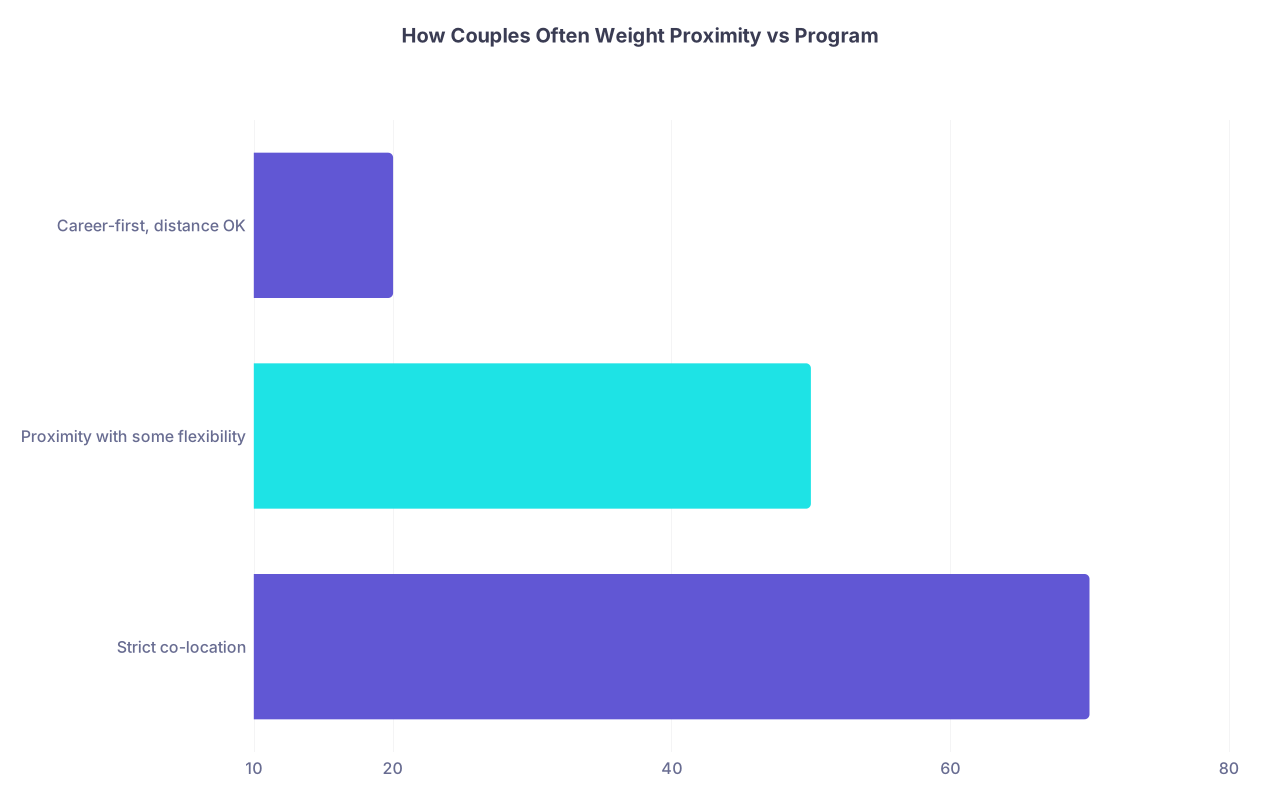
| Category | Value |
|---|---|
| Strict co-location | 70 |
| Proximity with some flexibility | 50 |
| Career-first, distance OK | 20 |
This isn’t scientific. Just a reminder: most dual‑match couples I’ve seen land somewhere in the middle. They care about being near each other, but not at “I’ll go anywhere no matter how bad” levels.
Step 8: Emotional and practical prep for worst‑case scenarios
Let’s be blunt: even with perfect planning, you might not end up in the same city. Or state.
That’s not a failure of planning. That’s just two rigid systems that don’t talk to each other.
If you want to stay sane:
Talk about the worst case before it happens:
- “If I end up in Boston and you’re in San Antonio, what’s our plan?”
- “How often can we realistically see each other with our call schedules?”
- “What’s our time horizon? Is this a 3‑year problem or a 7‑year problem?”
Set a review point:
- “We’ll reevaluate geography when one of us finishes residency or when your GMO tour ends.”
Don’t catastrophize:
- A few years of distance is hard. But it’s not a guarantee your relationship implodes. I’ve seen plenty of couples white‑knuckle through it and come out fine. The ones who implode usually never talked about expectations, money, or timeline.
Quick sanity check: Are you doing the basics right?
By January, you should be able to say “yes” to most of these:
- We’ve identified 3–5 realistic military hubs and the nearby civilian programs.
- My NRMP applications were weighted toward at least 2–3 of those hubs.
- We talked explicitly about whether proximity or program prestige matters more.
- Once the military match hit, I reshaped my rank list with that location in mind.
- We have a specific plan (not vibes) for how to handle it if we don’t end up together.
If you can’t say yes to most of that, you’re not coordinating a dual system. You’re winging it.

FAQs
1. Should the NRMP partner delay rank list certification until the very last day?
Yes, within reason. You should absolutely wait until after the military match result and any final information from your partner’s side. But do not cut it so close that a website glitch or forgotten login destroys your plan. Rank early, update late if needed, and certify at least a day or two before the deadline.
2. Is it worth telling every program about my military‑match partner?
No. Tell programs where the information actually matters:
- Programs in the city/region where your partner is likely (or confirmed) to be.
- Programs that explicitly asked about geographic ties or family considerations.
For places you’re not realistically going to rank high even with co‑location, it’s noise. Focus your communication where it might change how they perceive your likelihood to come.
3. What if my partner doesn’t know their GMO assignment location before my rank list is due?
Then you treat your own residency as the stable piece. Rank programs in cities where:
- You’d be okay training regardless of their exact base.
- There’s at least a chance of being within flight distance or overnight‑drive distance from likely GMO hubs.
Do not wreck your training plans for a location they might not even get. Instead, choose strong programs in reasonably well‑connected cities (major airports, etc.) so visits are doable.
4. Can we appeal or change the military assignment if my NRMP match is far away?
Very unlikely. The military does not care about the NRMP algorithm. Once your partner has orders or a GME slot, backtracking is rare and takes serious justification unrelated to “my partner matched in Denver.” Assume their location is carved in stone once December hits and build your NRMP strategy around that, not around some theoretical exception.
5. Is there any way to truly “couples match” between military and NRMP?
Formally, no. The systems do not coordinate rank lists. The closest you get is:
- You cluster your NRMP applications/interviews around likely military hubs.
- After the military match, you heavily prioritize programs near your partner’s assigned location.
- You communicate clearly with those programs about your situation, hoping they value your geographic commitment.
That’s it. Everything else is rumor or wishful thinking. Your power here is in smart targeting and brutally honest priority setting—not in secret back doors.
Bottom line
- The military match result is your fixed point. You bend the NRMP strategy around it, not the other way around.
- If you’re serious about staying together, you don’t apply or rank like a solo applicant. You build clusters around military hubs and make your rank list match your stated priorities.
- You won’t control everything, but you can avoid the dumb outcomes. Map the options, talk honestly, and align your actions with what you say matters most.


