
Using the Same CV for All Programs: Why That Strategy Backfires
What do you think it looks like on the other side when your CV says you’re “passionate about academic medicine” and you just applied to 40 community programs with no academic track?
I’ll tell you: it looks lazy. Or worse, dishonest.
Let me be blunt. Using the exact same CV for every residency program is one of the quietest but most damaging mistakes applicants make. It feels efficient. It feels “standardized.” It is neither. It’s a red flag for programs that are actively trying to filter out generic applicants.
You’re not applying to college anymore. Residency programs know exactly what they offer, what they don’t, and what kind of resident actually thrives there. When your CV doesn’t reflect that, you get mentally sorted into the “mass mailer” pile—whether they say that out loud or not.
Let’s break down where people screw this up and how to fix it without destroying your sanity.
The Core Mistake: Confusing “Same Template” With “Same CV”
You absolutely should use:
- The same core structure
- The same baseline content
- The same professional formatting
You should not use:
- The same unprioritized bullet order
- The same section emphasis
- The same wording of interests and goals
Programs don’t all want the same profile. Pretending they do is how you look mismatched, even when you’re actually a good fit.
Here’s the problem: residency applications are read fast. No one is diving deep into your CV line by line on first pass. They’re scanning.
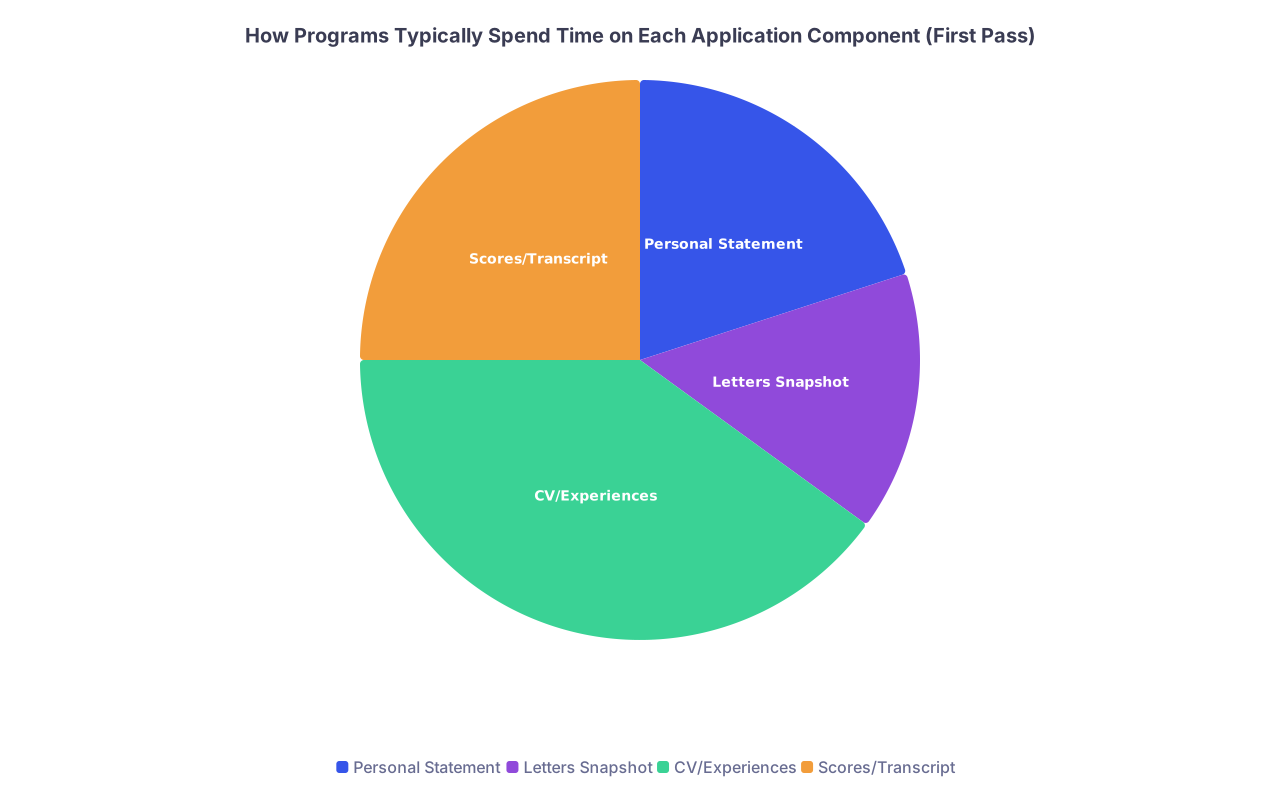
| Category | Value |
|---|---|
| Personal Statement | 20 |
| Letters Snapshot | 15 |
| CV/Experiences | 40 |
| Scores/Transcript | 25 |
What that means:
- If your CV doesn’t immediately surface what matches that program, they won’t go hunting for it.
- If the first things they see look generic or misaligned, they move on.
The mistake isn’t “having one master CV.” The mistake is copy-pasting that master version everywhere with zero adjustment.
How a One-Size-Fits-All CV Quietly Screams “Bad Fit”
I’ve seen this over and over: applicants with solid experiences who look weak on paper because they refused to prioritize for the program in front of them.
Here’s how a generic CV backfires in very specific ways.
1. Misaligned Priorities in Your Experience Order
Programs make assumptions based on what you put first.
- Applying to a research-heavy academic IM program?
- Research buried on page 2 after a long list of volunteer items = you’re not serious about academics.
- Applying to a hands-on community EM program?
- Page 1 loaded with lab work, basic science, and one lonely clinical experience at the bottom = you’re probably going to leave for a fellowship track.
You might have all the right experiences. But if you list them in a way that doesn’t match the program’s identity, they see a mismatch.
Do not just list everything chronologically because “that’s neutral.” It’s not neutral. It’s lazy.
You should be:
- Reordering sections
- Reordering bullets within big experiences
- Bringing certain roles up from the depths
Not lying. Not inventing. Just prioritizing.
2. Tone-Deaf “Career Goals” and Interests
This one gets people rejected faster than they think.
Imagine this:
- You apply to a small community program with no formal research infrastructure.
- Your CV highlights:
- “Long-term goal: become a physician-scientist leading an NIH-funded lab”
- “Primary interest: translational oncology research”
- “Looking for: strong research mentorship and protected time”
What they hear: “I will be unhappy here and I will complain.”
Flip it:
- You apply to a major academic program with multiple fellowships and T32 grants.
- Your CV focuses on:
- Local health fairs
- Church clinic volunteering
- Zero mention of research despite multiple projects listed in ERAS
What they hear: “This applicant wants a service-heavy community job. They’ll be miserable in our research culture.”
Your mistake? Not who you are. Just copy-pasting the same vague career line into every version:
“I am interested in a career combining clinical care, teaching, and research.”
That sentence is in so many CVs it might as well be a stock image.
If a program director can’t tell from your CV whether you genuinely fit their environment, you just made their decision easy. Out.
3. Overstuffed, Underfocused Experience Lists
Using one CV for all programs encourages a hoarding mentality:
“If I include everything I’ve ever done, something will stick.”
That’s how you end up with:
- 12 tiny leadership positions no one cares about
- 9 undifferentiated volunteer roles that look the same
- 6 “research experiences” that are really just you pipetting for a summer
You’re making programs do the work of figuring out what actually matters. They won’t.
What they think when they see an overstuffed, generic CV:
- Either you don’t understand what matters for this specialty
- Or you’re trying to inflate weak core experiences with fluff
- Or both
A targeted CV doesn’t mean shorter. It means cleaner:
- Consolidated roles
- Highlighted impact
- Less “committee member,” more “what you actually did”
4. Ignoring Program Type: Academic vs Community vs Hybrid
This is where using the same CV everywhere really burns you.
Different program types are effectively selecting for different types of residents.
| Program Type | What They Look For First | Big Red Flag on Generic CV |
|---|---|---|
| Research-heavy academic | Publications, abstracts, research continuity | No research emphasis, vague “interest” only |
| Community | Clinical exposure, service, teamwork | CV dominated by lab work and theory |
| Hybrid | Balanced clinical + academic signals | Overweight on one side with no nuance |
If your CV looks exactly the same for:
- University of Michigan (heavy academics)
- A busy county safety-net program
- A small community hospital without fellowships
…then it looks “right” for exactly none of them.
You don’t have to rebuild your CV structure each time. But you do need three general versions at minimum:
- Academic-leaning
- Community-leaning
- Balanced/hybrid
Then you fine-tune within those.
The Parts of Your CV You Absolutely Should Customize
Let’s be practical. You’re not rewriting your entire life story for 60 programs. That’s nonsense.
But if you’re not adjusting these pieces, you’re leaving easy points on the table.
1. Section Order
This is the simplest, most high-yield change—and almost no one bothers.
If you’re applying to:
Academically-heavy programs:
- Education
- Research / Scholarly Activity
- Clinical Experience
- Teaching / Leadership
- Service / Volunteer
Community-heavy programs:
- Clinical Experience
- Service / Volunteer
- Teaching / Leadership
- Education
- Research / Scholarly Activity
You’re not changing facts. Just what they see first.
2. Bullet Point Focus
This is where smart applicants quietly win.
Take the same experience and watch how it can hurt or help you depending on emphasis.
Original, generic bullet:
- “Assisted with data collection and chart review for a retrospective study on heart failure admissions.”
Now, adjusted:
- For academic program:
- “Led data collection and analysis for retrospective study on heart failure admissions; co-authored abstract accepted to regional cardiology conference.”
- For community program:
- “Reviewed charts for heart failure admissions to identify care gaps; collaborated with residents to propose workflow changes for discharge counseling.”
Same job. Different story.
What you should be editing:
- First bullet on major entries
- Any bullet that’s just task-list fluff
- Any line that can be reframed in either academic or clinical-impact terms
If you’re sending the generic version to everyone, you’re choosing to be forgettable.
3. “Interests” or “Career Goals” Line
If your CV includes a short “Interests” or “Career Goals” section and you’re not tailoring it—stop. You’re sabotaging yourself.
Bad examples I see constantly:
- “Interested in hospital medicine, research, and teaching.”
- “Open to a variety of practice settings including academic and community.”
- “Undecided about subspecialty but interested in everything.”
These say nothing. They’re wallpaper.
Better approach:
- For strong academic program:
- “Career goal: Academic hospitalist with focus on medical education and quality improvement.”
- For community-based program:
- “Career goal: Community-based internist with emphasis on longitudinal patient care and underserved populations.”
- For hybrid:
- “Career goal: Clinician-educator with a mix of inpatient care, resident teaching, and community outreach.”
You might actually be open to multiple paths. Fine. But the version of your CV they see should reflect the path that makes sense for them.

“But I Don’t Have Time to Customize 50 CVs” – Yes, You Do
Here’s where people melt down and give up. They imagine writing 50 unique CVs, one for each program.
That’s not the move. That’s overkill and unsustainable during interview season.
Do this instead.
Step 1: Build a Strong, Complete Master CV
This is your everything document:
- Every role
- Every bullet
- Every date
- Maximum detail
You won’t send this version anywhere. It’s your source.
Step 2: Create 3–4 Targeted Base Versions
Group programs loosely:
- Heavy academic/research
- Community-focused
- Hybrid university-affiliated community
- Special niche (e.g., rural track, global health track) if relevant
For each:
- Reorder sections
- Reorder experiences
- Tune bullets and “career goals” language
Now you’ve got 3–4 “working CVs.”
Step 3: Light-touch Tweaks for Specific Programs
This is where the time burden is actually small but the impact is big.
For a given program:
- Scan their website for what they brag about:
- Research? Community service? Trauma? Rural? Global health? DEI?
- Adjust:
- 1–2 bullets to highlight alignment
- Interest line to reflect their strengths
- Maybe bring one related experience higher in the list
This is 5–10 minutes per program once your base versions are clean. You can absolutely do that.

| Step | Description |
|---|---|
| Step 1 | Build master CV |
| Step 2 | Create academic version |
| Step 3 | Create community version |
| Step 4 | Create hybrid version |
| Step 5 | Review program website |
| Step 6 | Adjust section order |
| Step 7 | Edit 1 to 2 bullets |
| Step 8 | Align career goals line |
| Step 9 | Final check and submit |
Hidden Red Flags That Show Up Only When You Reuse CVs
Once you start tailoring, you’ll notice problems your generic CV was hiding.
1. Contradictory Narratives
Example: your personal statement for a community program screams:
- “I want to serve underserved populations”
- “My goal is to practice full-scope outpatient medicine”
But your CV—the same one you sent to an R1 program—leads with:
- Bench research
- Basic science publications
- No real longitudinal clinic experiences
That disconnect is deadly. It looks like you’re telling each program whatever you think they want to hear.
Customizing your CV forces your application to be internally consistent.
2. Fake-Sounding “Passions”
If you claim:
- “Strong interest in medical education”
…and your CV has:
- Zero teaching roles
- No tutoring
- No TA position
- No curriculum involvement
Programs notice. They might not say it, but they do.
Tailoring your CV for education-heavy programs means:
- Digging up:
- Peer teaching
- USMLE tutoring
- Small group facilitation
- Orientation leader roles
- Elevating those higher
If you literally have nothing to support the “passion,” then stop saying it. Or go get the experience before you apply.
3. Overuse of Copy-Paste Phrases
When you use the same CV everywhere, you stop seeing how repetitive you sound:
- “Worked closely with residents and attendings”
- “Passionate about improving patient care”
- “I learned the importance of teamwork and communication”
Those phrases are white noise to any program director.
Once you start editing for specific program types, you naturally:
- Cut repetition
- Replace fluff with specifics
- Sound like a real person instead of a template

How to Improve Your Residency CV Without Lying or Overhyping
A lot of people hear “tailor your CV” and somehow translate that to “exaggerate.” That’s how you end up in painful interview moments:
- “So tell me about this ‘leadership role’ you listed here.”
- “What was your specific contribution to this project?”
- “You wrote that you ‘led’ the initiative—walk me through that.”
If your heart races when you think about those questions, you’ve already pushed too far.
Here’s the safer, smarter way to improve your CV for residency.
1. Change Emphasis, Not Facts
Examples:
- From:
- “Assisted with patient care tasks on the inpatient medicine service.”
- To academic:
- “Actively participated in daily rounds and contributed to literature reviews for complex inpatient cases.”
- To community:
- “Helped coordinate discharges and follow-up plans for complex patients transitioning back to the community.”
Same job. Different lens.
2. Use Outcome-Oriented Language Where You Actually Have Outcomes
Strong:
- “Co-authored abstract accepted to national conference.”
- “Clinic implemented new follow-up protocol we developed; no-show rate dropped over 6 months.”
Weak (and borderline dishonest if overblown):
- “Significantly improved patient care” with nothing concrete
- “Led major QI initiative” when you just attended meetings
If you hesitate when you imagine a PD asking “How exactly?” then dial it back.
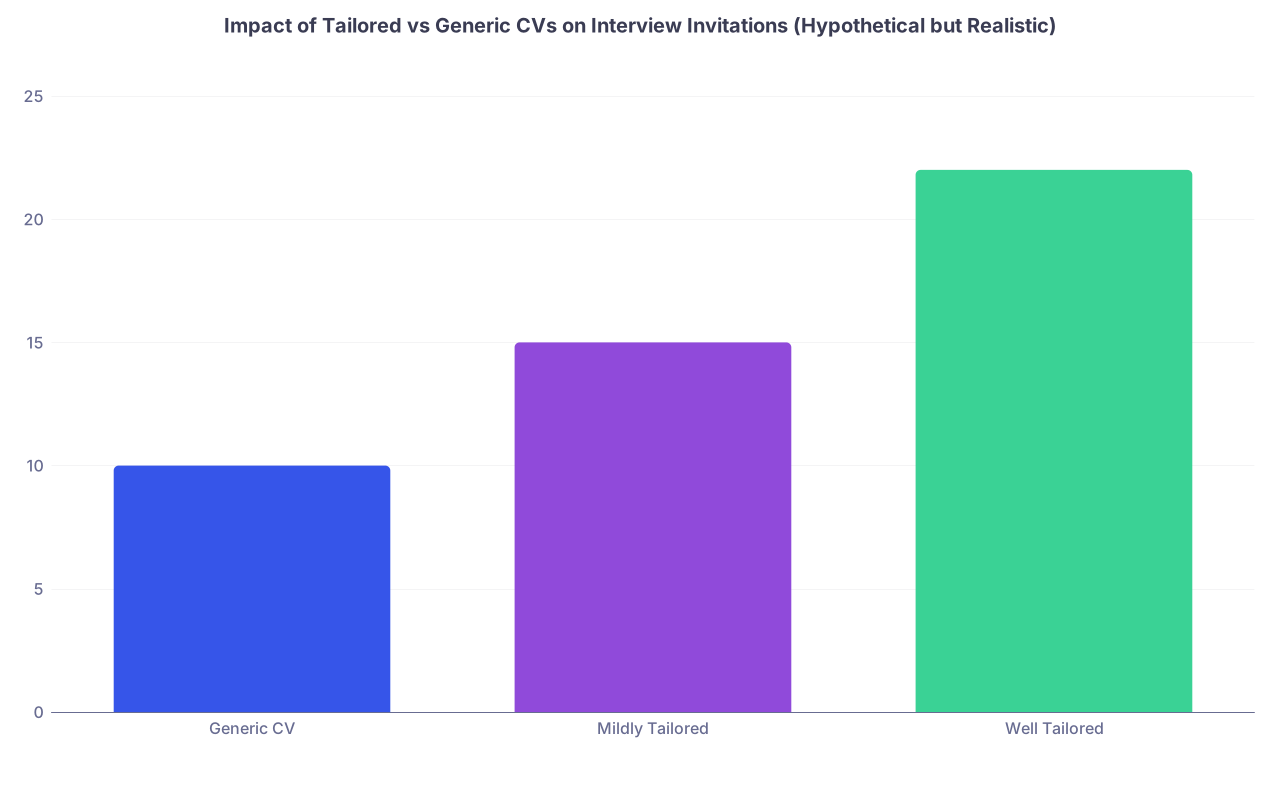
| Category | Value |
|---|---|
| Generic CV | 10 |
| Mildly Tailored | 15 |
| Well Tailored | 22 |
Even in a rough, hypothetical scenario like this, the advantage is obvious. People who tailor get more interviews. Period.
The Bottom Line: Stop Treating Your CV Like a Static Document
If you remember nothing else, remember this:
Programs are trying to answer one question fast:
“Can this person succeed and be happy here?”
A single, catch-all CV tells them:
- “I didn’t think carefully about what you actually are.”
- “I’m applying broadly; you’re just one of many.”
- “You do the work of figuring out whether I fit.”
That’s not how you stand out in a crowded match year.
Key points:
- Using the exact same CV for all programs makes you look generic, misaligned, and sometimes dishonest—even when you’re not.
- You don’t need 50 CVs; you need a strong master version plus 3–4 targeted variants, with light tweaks per program.
- Tailor emphasis, order, and wording to signal real fit for each program type—without changing facts or inflating your role.
Stop broadcasting noise. Make your CV say, clearly and quickly, “I belong in a program like yours.” That’s how you avoid the silent rejection pile.