The worst mistake a DO applicant makes in interview season is acting like this is “just like MDs, but slightly harder.” It is not. As a DO in the ACGME game, your interview season has different pressure points, different risks, and far less room for sloppy timing.
I am going to walk you month by month, then week by week through the key stretch: roughly September through February. At each point: what you should send, say, schedule, and track if you want a realistic shot at ACGME success as a DO.
Big-Picture Timeline: Your ACGME Interview Season as a DO
Before we zoom into months, anchor the whole arc.
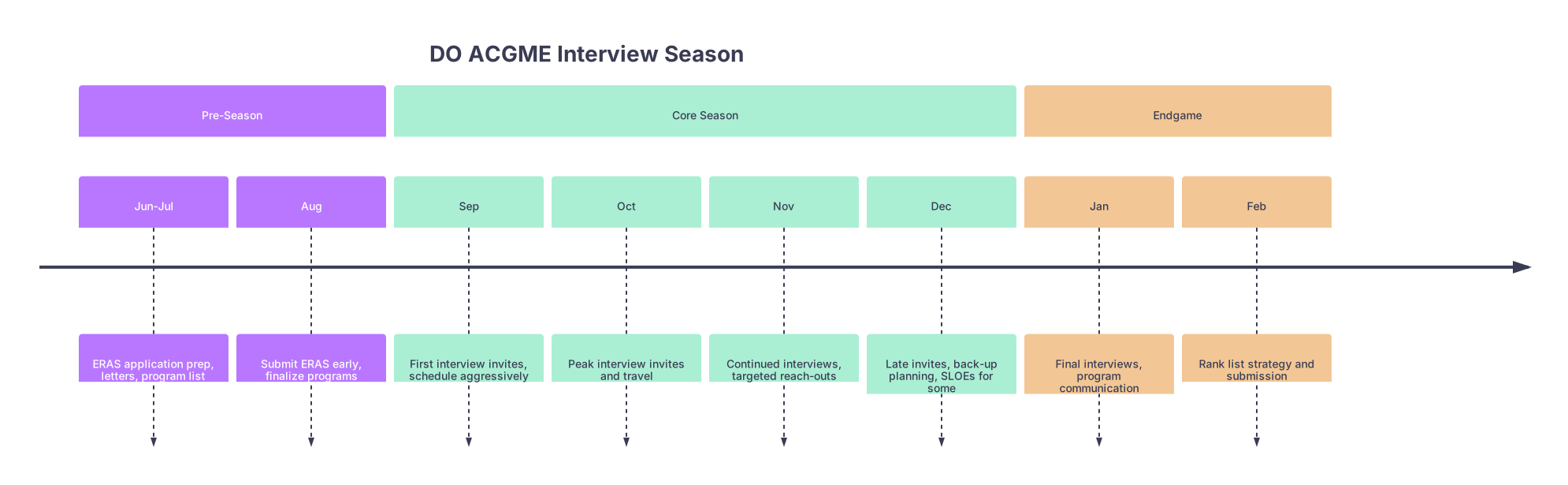
| Period | Event |
|---|---|
| Pre-Season - Jun-Jul | ERAS application prep, letters, program list |
| Pre-Season - Aug | Submit ERAS early, finalize programs |
| Core Season - Sep | First interview invites, schedule aggressively |
| Core Season - Oct | Peak interview invites and travel |
| Core Season - Nov | Continued interviews, targeted reach-outs |
| Core Season - Dec | Late invites, back-up planning, SLOEs for some |
| Endgame - Jan | Final interviews, program communication |
| Endgame - Feb | Rank list strategy and submission |
As a DO, you are usually:
- Competing for fewer “DO-friendly” ACGME spots than MDs assume exist.
- Over-screened on COMLEX–USMLE conversions, school name, and “fit.”
- Hurt badly by late responses, vague emails, and unstructured scheduling.
So you cannot drift through this. You need a calendar.
August: Pre-Season Positioning (Before Invites Hit)
By August 1, you should already be acting like interviews start tomorrow.
At this point you should:
Have ERAS 95% complete
- Personal statement finalized for your primary specialty.
- A second tailored statement prepped if you are dual-applying (for example, FM + IM).
- All experiences edited down to clear, specific impact statements. No vague “helped with patient care” nonsense.
Know your numbers and your lane
Build a simple reality-check table for yourself:
| Metric | Green Zone | Yellow Zone | Red Flag |
|---|---|---|---|
| COMLEX Level 1 | ≥ 600 or 520+ USMLE step | 520–599 or USMLE ~220–229 | < 500 or no USMLE |
| COMLEX Level 2 | ≥ 620 or strong upward | 550–619 | < 540 or big downward |
| Research (for IM/Neuro) | ≥ 1 pub / strong project | Poster / case reports | None |
| Letters (specialty) | ≥ 2 strong specialty docs | 1 good, others generic | No specialty letter |
| School | Strong DO reputation | Average DO, neutral reputation | New/unknown DO school |
If you are yellow/red in multiple rows, you must:
- Apply more broadly and earlier.
- Include more DO-friendly community programs.
- Stop fantasizing about matching only at 3 “dream” academic centers.
Lock logistics
- Update your voicemail: full name, professional, no music, no jokes.
- Create a dedicated email label/folder for residency communications.
- Shared calendar (Google, Outlook) set up with color-coding for:
- Interview invites
- Waitlists
- Second looks / open houses
Prepare scheduling infrastructure
When invites hit, you will have hours—sometimes minutes—to respond. Pre-write:
- A “yes to interview” email template.
- A “date conflict, can we do X/Y?” template.
- A short professional signature with:
- Full name, degree
- Medical school and expected graduation date
- Phone number
You do not want to be writing from scratch at 11:13 pm about the last remaining December 7 slot.
September: The First Wave – Instant Response Mode
By early September, ACGME invites start trickling out, especially in fields like EM, IM, FM, psych.
At this point you should:
Early September (Weeks 1–2)
Submit ERAS as early as possible (if not already)
Late DO applicants get crushed. Aim for ERAS submission day 1 or very close.Turn on notifications
- Phone push notifications for email.
- Desktop alerts if you are on rotations with computer access.
- Define “protected response windows” with your attending if possible:
- “Dr. Smith, I’m applying this year; may I briefly step out if I get a time-sensitive interview email? I’ll keep it under 2 minutes.”
Yes, that conversation is slightly awkward. Yes, you should do it.
First-batch invites: respond within 1–2 hours
Programs often send 10–20 invites for 10 spots, expecting some declines.Your rule:
- Accept immediately if:
- You would seriously consider ranking them
- The date is logistically manageable
- Do not try to “hold” multiple dates while you decide. That game backfires.
- Accept immediately if:
Mid–Late September (Weeks 3–4)
- Track your numbers weekly
Create a simple sheet:
- Programs applied
- Invites received
- Rejections
- No response
Then review:
- If by late September you have zero invites in a less competitive specialty (FM, psych) with average scores → your application is not landing.
- If in something like derm, ortho, ENT and you have 0–1 invites, that is unsurprising. You likely knew that going in.
Send targeted interest emails (carefully)
Around the third to fourth week, for high-priority, DO-friendly programs where you have heard nothing:Keep it short:
- 3–4 sentences:
- Who you are (DO, school, key numbers if they are decent)
- Why that program specifically (location, training focus, osteopathic recognition)
- 1 concrete tie: rotation, family, research connection, mentor
- A polite reiteration of interest in interviewing
- 3–4 sentences:
Do not send mass, generic “checking on status” emails. Those read desperate instantly.
- Start interview prep in parallel
You do not wait until you have 10 invites to practice.
By end of September you should have:
- A 60–90 second “tell me about yourself” answer, practiced out loud.
- 3 clinical stories ready:
- A time you handled a difficult patient/family.
- A time you received hard feedback and actually changed.
- A moment that confirmed your interest in this specialty.
October: Peak Interview Season – Prioritize Like a Surgeon
October is where DO applicants either consolidate momentum or slowly bleed out opportunities.
At this point you should:
Early October (Weeks 1–2)
- Aggressively triage invites
Your calendar will start colliding. You cannot attend everything.
Rank every program in three buckets as invites arrive:
- Tier 1: Would be thrilled to match here.
- Tier 2: Solid, realistic options.
- Tier 3: Only if you are worried about not matching.
Your rule:
- Never decline Tier 1 or 2 for a Tier 3.
- If a Tier 1 invite conflicts with a Tier 3 you already scheduled → politely cancel the Tier 3 and free that slot early.
- Cluster geography when possible
If you have:- Two Midwest programs offering dates in a similar window → pick consecutive days.
- East and West coast interviews in the same week → re-negotiate one.
This is not about being cheap; it is about arriving rested and not half-deranged from travel.
- Tighten your DO-specific talking points
Many ACGME programs will not ask about osteopathic training directly, but they absolutely notice it. Have clear, confident answers to:
- “Why did you choose a DO school?”
- “How do you see OMT fitting into your future practice?” (Even if the real answer is “rarely,” say it like an adult, not apologetically.)
- “How has your DO training shaped the way you approach patients?”
You are not there to convert anyone. You are there to sound competent and grounded.
Mid–Late October (Weeks 3–4)
- Fine-tune interview skills with real reps
By your third or fourth interview, you should not still be rambling for 4 minutes when asked, “Tell me about yourself.”
Pay attention to:
- Whether you hit your key themes:
- Work ethic with examples
- Capacity for feedback
- Team orientation
- Patient-centered behavior rooted in osteopathic philosophy (if that genuinely matches you)
- Whether you are answering the question actually asked. Many applicants just recite pre-planned scripts.
- Monitor the invite curve
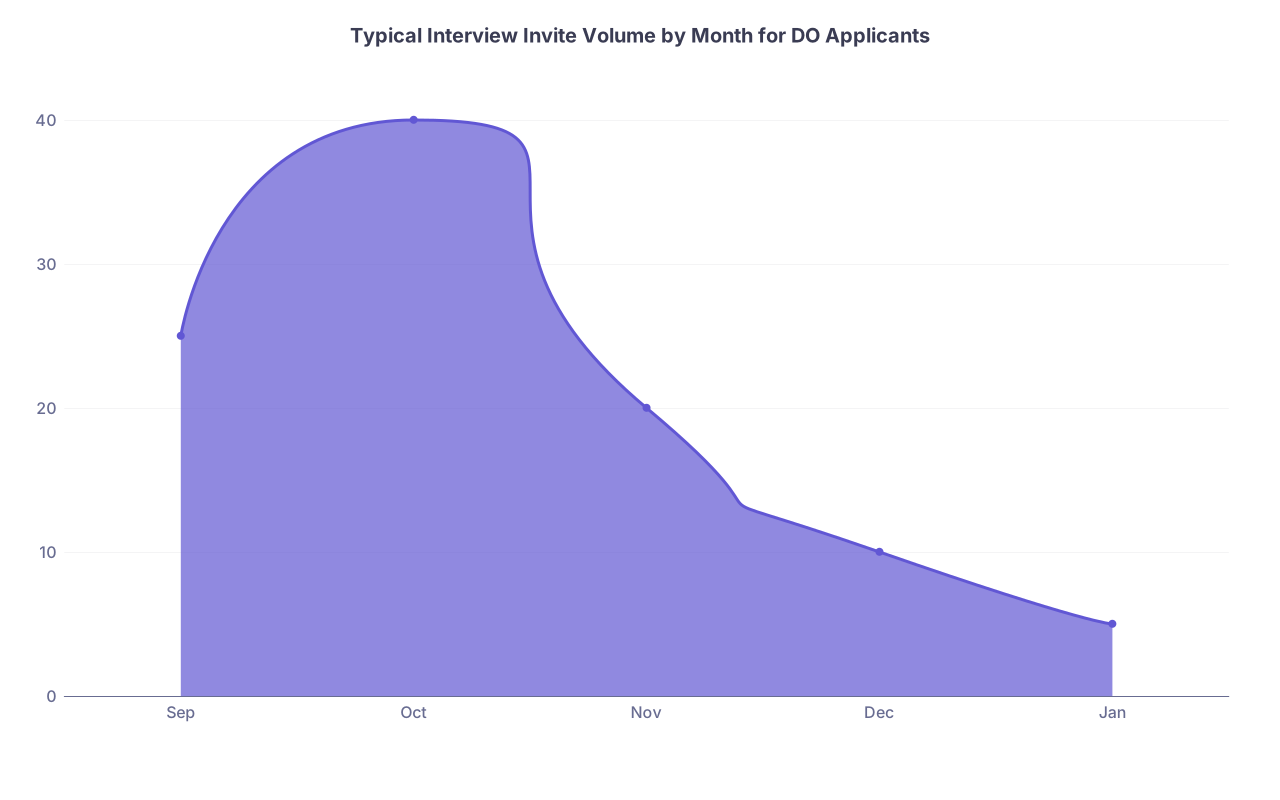
| Category | Value |
|---|---|
| Sep | 25 |
| Oct | 40 |
| Nov | 20 |
| Dec | 10 |
| Jan | 5 |
If by late October:
- You have 0–2 interviews in FM, IM, or psych with average or better scores → you must widen your net (more community programs, more DO-heavy regions).
- You have 5–7 interviews in a moderately competitive field → you keep going but start accepting almost every reasonable invite.
- You have 10+ interviews with a strong distribution → you focus on quality, not hoarding more.
- Check in with your dean’s office / advisor
A five-minute honest conversation:- “I have X invites in Y specialty. Does this align with past DO match data from our school?”
- If they seem nervous, take it seriously. Schools track this stuff.
November: Second Wave Invites and Course Correction
November feels quieter but it is critical for DOs. This is when well-written interest emails and smart scheduling actually move the needle.
At this point you should:
Early November (Weeks 1–2)
- Reassess your list specialty by specialty
Look at each:
- Number of interviews.
- Program type (university vs community).
- Geographic spread.
If your numbers are low:
- Add more programs (yes, this late). Especially:
- Smaller community hospitals.
- Programs with clear history of DO residents.
- Regions less saturated with MD-heavy schools (Midwest, some South, some non-coastal areas).
- Strategic, not spammy, letters of interest
For a handful (not 30) of high-priority programs where you are a good fit on paper but have no invite:
Target those where:
- DOs are on the resident roster.
- Your Step/COMLEX fits or exceeds their published averages.
- You have a concrete tie to location or program features.
Email structure:
- Subject: “Continued interest – [Your Name], DO applicant”
- 4–6 sentences:
- 1 sentence: Who you are, current hospital / school.
- 1–2 sentences: Why them specifically (sub-I there, mentor connection, curriculum feature).
- 1 sentence: Any update (new publication, recent rotation evaluation, improved score).
- 1 sentence: Clear interest in interviewing if slots become available.
This is not begging. It is concise professionalism.
Mid–Late November (Weeks 3–4)
- Use early interviews to refine your rank tiers
By late November you should know:
- Which programs felt like a genuine fit.
- Which ones looked good on paper but had toxic resident dynamics or disorganized leadership.
Take notes the same day after each interview. Three bullets:
- Pros
- Cons
- Gut feeling (yes / maybe / no)
You will not remember details in February without this.
- Prepare for late-season invites
Some DO-friendly and smaller ACGME programs send invites into late November and December, especially after they see early no-shows.
Stay flexible:
- Do not block your entire December with non-essential travel.
- Keep at least one or two days most weeks that you can free quickly if an invite drops.
December: Late Invites, Reality Check, and Backup Work
December can be surprisingly busy for DO applicants. It is also the month where you must confront your actual odds.
At this point you should:
Early December (Weeks 1–2)
- Respond fast to late invites
Many December invites are from:- Programs that expanded interview days.
- Spots opened due to cancellations.
- Smaller hospitals finalizing their lists.
They often fill within hours. Your “reflex accept” muscle still needs to work.
- Evaluate your total interview count honestly
Rough, very general benchmarks for DOs in ACGME (varies by specialty and your profile):
FM / IM / Psych / Peds:
- 8–10+ interviews → generally competitive for matching.
- 5–7 → possible but riskier.
- ≤4 → concerning; you need strong backup thinking.
EM, Anesthesia, General Surgery:
- 10–12+ → safer ground.
- 6–9 → borderline.
- ≤5 → very high risk.
Highly competitive specialties (ortho, derm, ENT):
- If you are DO without a very strong research / rotation story, expect much higher risk even with interviews.
If your numbers are low, you do not just “hope December is good to me.” You:
- Consider dual applying if you have not already and deadlines allow.
- Add more prelim / transitional / categorical backup where appropriate.
- Have a direct discussion with an advisor about SOAP strategy as insurance.
- Tune your “why this program” answers
DOs get filtered harder on “fit.” Show that you actually paid attention:
- Reference specific experiences: “I spoke with Dr. X about your resident-run clinic and…”
- Mention osteopathic aspects where relevant, especially for programs with Osteopathic Recognition:
- “Your dedicated OMT clinic is something I could see myself actively participating in and possibly helping to expand.”
Mid–Late December (Weeks 3–4)
- Prepare for holiday slowdowns
Communication dips around the last 2 weeks of December. Do not panic.
Use this lull to:
- Tighten your program notes.
- Update your CV with final publications or presentations.
- Get rest. You are not impressive if you show up in January interviews burned out and bitter.
- If you are seriously short on interviews, build a hard backup plan
This is where painful realism pays off.
Questions to answer, in writing:
- If I do not match in March, what is my immediate plan?
- Research year?
- Preliminary year + reapply?
- Family medicine backup in SOAP?
- Who are 2–3 mentors willing to support that plan?
You hope not to use it. You still build it.
January: The Final Push and Program Communication
January is about finishing strong and positioning yourself intelligently for the rank list.
At this point you should:
Early January (Weeks 1–2)
- Keep interview performance sharp
Late interviews count every bit as much as early ones.
Do a brief reset:
- Rehearse your core stories again.
- Fix any weak answers that kept tripping you up in December.
- Update your examples with fresh clinical rotations if they are better.
- Craft targeted post-interview communications
You will hear a lot of bad advice here. The reasonable middle ground:
For programs you are truly considering ranking highly:
- Send a concise thank-you within 24–48 hours.
- Reference something specific from the day.
- Reaffirm your interest without games like “I will definitely rank you #1” (unless you are absolutely sure and the specialty culture accepts that language).
For your absolute top program:
- Many applicants send a clear “You are my #1” email in late January or early February. Do that only once. And mean it.
Be aware: some programs explicitly tell you they do not want post-interview communication. Respect that.
Mid–Late January (Weeks 3–4)
- Build your rank list framework early
Start sketching tiers before the official rank system even opens.
Sort programs roughly into:
- Group A: Would be happy to train here.
- Group B: Acceptable but not ideal.
- Group C: Only if absolutely necessary.
Factors that matter more than DOs sometimes admit:
- Resident morale and how they talk when attendings are not around.
- Program stability (recent PD turnover is a red flag unless clearly handled).
- How DOs have historically fared there (are DO residents thriving or just surviving?).
- Double-check any program-specific instructions
Some ACGME programs for DO-heavy specialties may:- Ask for updated transcripts or exam scores.
- Request additional letters or forms.
Do not be the applicant who misses an easy checkbox in January.
February: Rank List Decisions and Quiet Nerves
By February you are mostly done with travel. This month is about strategic ranking and not sabotaging yourself with emotion.
At this point you should:
Early February (Weeks 1–2)
- Finalize your rank list logically, not emotionally
Simple rule: rank in order of where you would actually want to go, assuming all offered you a spot.
Do not:
- Rank a “prestige” program higher if you genuinely liked a community DO-friendly place better.
- Drop a solid program low because one interviewer was mildly awkward.
As a DO, you especially should prioritize:
- Programs with a track record of supporting DO residents.
- Places where you felt respected, not “tolerated.”
- Training environments where you will actually learn, not just survive.
- Stop trying to game the algorithm
The NRMP algorithm is applicant-favorable. You hurt yourself by:- Trying to predict who will rank you highly.
- Moving a program you loved lower because you are “not sure” they liked you.
Rank purely by your preference. Full stop.
Mid–Late February (Weeks 3–4)
- Submit the rank list early, then leave it alone
- Aim to certify your list several days before the deadline.
- Double-check:
- Program names and codes.
- That categorical vs prelim tracks are correct.
- No accidental omissions.
Once submitted, resist the temptation to recertify every 24 hours based on random anxiety. That usually makes lists worse.
- Mentally shift to post-Match scenarios
Quietly prepare for both outcomes:- If you match: transitions to intern year, housing, financial planning.
- If you do not: SOAP logistics, contacts, and what you will tell your support system.
You will handle it better if you have already thought through the first 72 hours of each scenario.
The Short Version: What Matters Most for a DO in ACGME Interview Season
Boiling it down:
Timing and responsiveness beat wishful thinking.
Early application, rapid invite responses, and month-specific adjustments matter more for DOs in ACGME than for many MD peers.Strategic breadth protects you.
You cannot rely on a tiny, prestige-heavy list as a DO. Broader applications, DO-friendly programs, and realistic interview count targets are non-negotiable.Clear, grounded communication wins.
From your first email in September to your final thank-you in January, you need concise, professional, DO-confident messaging—no apologies, no defensiveness, just competence.
Follow that cadence month by month and you stop being a passive “DO applicant in a tough year” and start acting like what programs actually want: a future colleague who knows how to plan, adapt, and execute.