
The fact that you’re hesitating means your instincts are working.
Choosing a Caribbean MD over a US DO in 2026 is almost always the wrong risk to take.
Not “maybe.” Not “it depends on your learning style.” The data is brutally lopsided. But you do have a real decision to make, and it’s not trivial: you’re balancing prestige perception, match odds, debt, and your actual life 10 years from now.
Let’s walk this like I would with a student sitting in my office with both acceptance letters on the table.
Step 1: Be Honest About the Actual Question You’re Asking
You’re not really asking “MD vs DO.”
You’re asking:
“Is it ever rational to turn down a US DO seat for a Caribbean MD acceptance?”
In 2024–2026 reality: almost never. The only time Caribbean makes sense is when you have no US option and are consciously accepting much higher odds of never practicing as a US physician.
You, however, do have a US option.
So your real decision is:
- Safer, less sexy: US DO (lower prestige in public perception, but higher probability of practicing in the US)
vs - Risky, shinier letters: Caribbean MD (classic “feels more like a shortcut,” but with brutal filter points later)
Once you see it that way, the framework becomes clearer. Let’s break it down by the things that will actually matter: board scores, match odds, specialty choice, location, and money.
Step 2: Understand How Match Risk Really Works
You don’t care about med school for its own sake. You care about getting through med school into residency.
Think of it as two funnels: one for US DO, one for Caribbean MD.
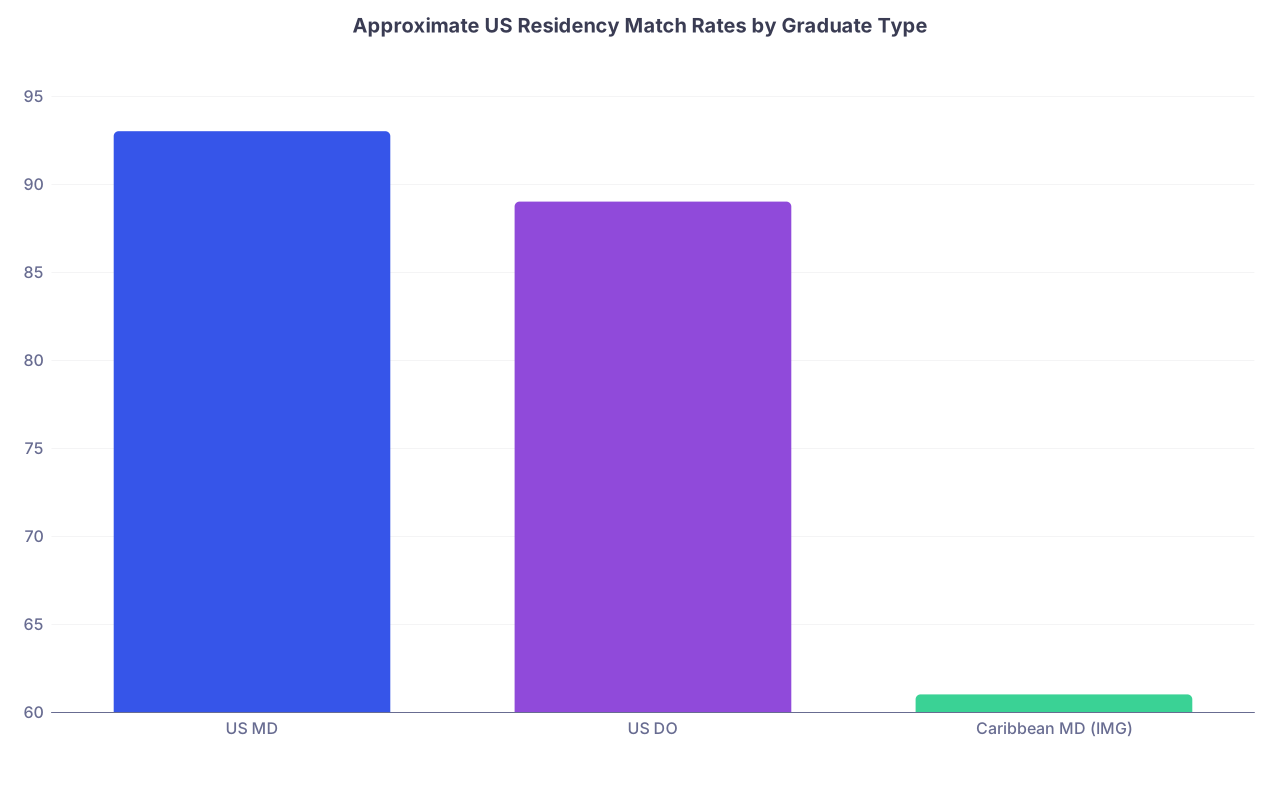
| Category | Value |
|---|---|
| US MD | 93 |
| US DO | 89 |
| Caribbean MD (IMG) | 61 |
Numbers vary slightly by year and cohort, but the pattern is stable:
- US MD: mid-90% match
- US DO: upper-80s/low-90s when applying smartly
- Caribbean (IMG): often in the 50–65% range overall
And here’s the part most applicants don’t internalize:
Caribbean schools “solve” their match numbers by failing, dismissing, or academically withdrawing large chunks of each incoming class before Step/Level exams and before graduation. I have seen classes that started with 300+ and graduated under 100. So the survivors look “okay” statistically, but a lot of their classmates quietly disappear.
US DO schools do not play that same game at nearly that scale.
In practical terms:
- At a US DO, if you show up, pass your classes, study competently, and avoid disasters, you have a strong chance of ending up in some residency.
- At a Caribbean MD, even if you work hard, the structural obstacles (attrition, clinical placements, visa issues for some, IMG bias) make your path objectively riskier.
If your goal is “I want to be a US physician, even if not in my dream specialty,” the safer vehicle is US DO by a wide margin.
Step 3: How Different Are MD vs DO Letters in Real Life?
Here’s the part that trips people: your parents, random nurses, or that one attending who trained in the 1980s might still talk like DOs are “second tier.” That’s outdated in most contexts.
Reality in 2026:
- DOs are fully licensed physicians in all 50 states.
- DOs match into every major specialty, including competitive ones, though with slightly lower rates in the hyper-competitive fields.
- Most patients do not care. Some don’t even know the difference.
What actually matters:
- Where you trained (strong program vs weak)
- Your board scores and clinical performance
- Letters of recommendation
- Your specialty and networking
MD vs DO can give you an edge in certain ultra-competitive niches (derm, plastics, some surgical subspecialties), but the Caribbean MD label is not the same as US MD. Programs do not treat them equivalently.
A US DO is usually viewed more favorably than a Caribbean MD for residency. Yes, even though one says MD.
So if your brain is doing this:
“MD sounds better than DO, so Caribbean MD must be better than US DO.”
That logic is wrong. Programs do not line them up that way.
If I had to crudely rank perceived strength for residency doors:
US MD > US DO > Non-Caribbean IMG MD > Caribbean MD
That’s the reality you’re stepping into.
Step 4: Compare the Risk Profile Like an Adult, Not a Dreamer
Blunt version:
- US DO = lower prestige, much lower risk, more predictable debt, better support systems
- Caribbean MD = higher surface prestige (to laypeople), drastically higher risk of never practicing, often worse support, often higher effective debt
Let’s walk through the four big risk buckets.
1. Academic & Exam Risk
US DO:
- You’ll be surrounded by classmates who generally had similar or slightly better metrics than you.
- Schools are structured to get as many students as possible to pass COMLEX (and often USMLE as well) because their accreditation depends on it.
- You’ll have in-house advising, remediation, board prep resources, and generally more structured support.
Caribbean MD:
- Admission standards are much looser. Translation: your cohort will be highly variable, and teaching may be geared to “weed out” at scale.
- Heavy front-loaded basic sciences, often with large lecture halls and less individualized support.
- If you struggle early, there’s much less safety net. I’ve seen schools basically tell students, “Maybe medicine isn’t for you” after one bad term.
- Your entire outcome hinges on crushing USMLE as an IMG. No cushion.
2. Clinical Rotation Risk
US DO:
- Clinical rotations are usually pre-arranged within a network of US hospitals. You may have to travel, but it’s built into the system.
- Evaluations count for residency, but you’re not fighting IMG stigma just to be there.
Caribbean MD:
- Many rotations are in community hospitals or clinics that affiliate with multiple Caribbean schools.
- Spots can be limited. Students sometimes get delayed waiting for rotation slots, which delays graduation, which costs money.
- You’re often with other IMGs only, not integrated with US MD/DO students. That matters for networking and letters.
3. Match Risk by Specialty
Here’s the piece people underestimate: as a Caribbean grad, your realistic target specialty range shrinks.
US DO:
- Very good odds at: IM, FM, Peds, Psych, many EM programs, some Anesthesia, some OB/GYN, some Gen Surg, etc.
- With excellent boards + research + networking, DOs match into derm, ophtho, ortho, radiology, etc. It’s hard, but possible.
Caribbean MD:
- Most match success is clustered in: IM, FM, occasionally peds and psych.
- Surgical specialties and lifestyle specialties (derm, ophtho, plastics, ortho, ENT, radiology, anesthesia) are extremely difficult to enter. Not “impossible,” but think lottery odds.
If you’re saying “I don’t care, I just want to be any kind of doctor,” then maybe this sounds acceptable. But people change. The MS1 who “just wants to help people” sometimes becomes the MS3 who loves ortho. Your future self will be furious if your earlier self burned those options prematurely.
4. Financial Risk
US DO:
- Expensive, yes. But more predictable.
- You’re eligible for US federal loans, income-driven repayment, PSLF if you work in qualifying jobs later.
- Higher match odds mean higher probability you can actually pay the loans back as a physician.
Caribbean MD:
- Often very high tuition plus cost-of-living abroad plus flights plus expensive US clinical rotations.
- If you don’t match or wash out, you’re stuck with six-figure debt and no physician income.
- Private loans or weird financing arrangements may be involved, depending on the school.
If you’re going to take on $250k–$400k+ of debt, do it with the odds on your side, not against you.
Step 5: The Only Fair Reasons Someone Might Still Consider Caribbean MD
Let me be fair. There are a few scenarios where Caribbean MD can be rational. But they’re narrow.
You have no US MD or DO acceptance.
- You’ve applied multiple cycles, improved your app, still nothing.
- You’ve worked in healthcare for years; you’re older and fully understand the risk.
- You are genuinely okay with likely ending up in IM/FM only, and possibly not matching at all.
- Your alternative is giving up medicine entirely.
You’re already accepted, deep into the pipeline, and transferring is unrealistic.
- Different situation from you. This is damage control, not initial decision-making.
That’s it. Notice what’s not on this list: “But MD sounds cooler.”
In your case, you already have a US DO seat. So those edge-case justifications do not apply.
Step 6: How to Compare Specific Schools, Not Just Categories
If you still feel torn, do this like an adult making a business decision.
Make a simple table. Not vibes. Not gossip. Actual numbers and policies.
| Category | US DO School (You) | Caribbean MD School (You) |
|---|---|---|
| 4-year COMLEX/USMLE Pass % | ||
| Overall Match Rate | ||
| # of US Residency Matches | ||
| Avg. Debt at Graduation | ||
| Attrition / Dismissal Rate | ||
| Guaranteed US Rotations? | ||
| Federal Loans Eligible? |
Then start calling and emailing:
- Ask each school: “What percentage of your incoming class graduates on time?”
- “Of those who start, how many match into any US residency within 1–2 years of graduation?”
- “Where are your core clinical rotations? Are they guaranteed? In what cities?”
- “Do you publish full match lists for the last 3 years?” (Then actually read them.)
You’ll notice a pattern: US DO schools usually can and will answer clearly. Caribbean schools often answer in vague marketing-speak, or they cherry-pick the best outcomes.
If a school cannot give you clear match and attrition data, that’s your answer. You don’t voluntarily blindfold yourself before walking into a minefield.
Step 7: The Emotional Traps You Need to Call Out
You’re not just weighing data; you’re fighting ego, family pressure, and fear of missing out. Let’s name the traps.
The Letters Trap
“I’ve always dreamed of ‘MD’ after my name.”
Reality: MD vs DO will matter far less to you in 10 years than whether you actually matched and like your specialty. Being a happy DO hospitalist beats being a non-matched Caribbean MD grad working some random job to pay off impossible loans.The Speed Trap
“Caribbean starts sooner; I don’t want to wait another year.”
You’re tempted to start “right now” rather than reapply or accept the DO offer that starts later. Don’t sacrifice 40 years of career for 12 months of impatience.The Overconfidence Trap
“Those stats apply to other people. I’ll be in the top 10%.”
Every Caribbean student thinks that on day one. Half won’t even make it to step exams. The match is full of “smart, hardworking, motivated” people who still don’t match because the system is stacked against IMGs.The Family/Friend Flex Trap
“My family back home will respect ‘MD’ more.”
Your family will respect you more if you’re a practicing physician who isn’t financially crushed and bitter. If they need a three-letter word to validate you, that’s their insecurity, not your obligation.
Step 8: A Simple Decision Path You Can Actually Follow
Here’s the flow I’d use if you were sitting across from me.

| Step | Description |
|---|---|
| Step 1 | Accepted to US DO and Caribbean MD |
| Step 2 | Re-evaluate goals entirely |
| Step 3 | Choose US DO |
| Step 4 | Caribbean MD is last-resort option |
| Step 5 | Goal: Practice in US? |
| Step 6 | Willing to accept high non-match risk? |
| Step 7 | Already exhausted all US options? |
In your current scenario:
- You want to practice in the US.
- You already have a US DO seat.
- You’re asking because you are worried about risk.
Follow your own concern to the logical outcome. Take the lower-risk route that still gets you where you want to go.
Step 9: If You Pick US DO, How to Maximize Your Upside
Let’s assume you make the rational choice: you accept the US DO seat.
Here’s how you turn that into the best possible career instead of always wondering “what if”:
Commit fully to being excellent. Not “I settled for DO,” but “I’m going to be top 10–25% here.”
Plan early for boards: COMLEX + likely USMLE Step 2 if you’re aiming for competitive specialties or certain regions.
Use your DO network. DO schools often have strong connections with community programs and former grads now in leadership. Find them.
Be smart about specialty choice.
- If you end up wanting something very competitive: you’ll need strong scores, research, early mentorship, and realistic backup plans.
- If you’re happy with IM/FM/Peds/Psych: your odds of matching somewhere you can live with are very good.
Stop apologizing for your path. Patients really don’t care. Colleagues care more about whether you show up, do good work, and are not a disaster on call.
Step 10: If You Ignore This and Choose Caribbean MD Anyway
I won’t sugarcoat it: I think that’s a bad call for someone who already has a US DO seat.
But if you’re going to do it regardless, at least go in eyes wide open:
- Pick the Caribbean school with the strongest and clearest published match list into US residencies.
- Confirm clinical rotations are guaranteed and mostly in the US.
- Treat USMLE Step 1 and Step 2 as life-or-death exams, because for your career, they are.
- Save aggressively before matriculating. You’ll have extra costs people don’t tell you about.
- Understand that if you end up in IM/FM in a less desirable location, that’s actually a good outcome statistically for Caribbean grads.
If that all sounds heavy, it’s because it is.
The Bottom Line
If you’ve been accepted to both a Caribbean MD program and a US DO school, here’s the hard truth:
- A US DO seat is significantly safer for becoming a practicing US physician, even if the letters feel less shiny right now.
- Caribbean MD comes with massively higher match and financial risk, and the “MD” letters do not compensate for that in residency directors’ eyes.
- If your real goal is “I want to doctor in the US,” you take the path with the highest probability of getting you there: the US DO offer on your table.