It’s March. Your partner just opened their email and matched into a residency in City X. Big, shiny academic medical center. Mostly MD residencies. Maybe one small community program with a DO here or there.
You’re a DO student, maybe OMS-II or OMS-III, and you’re doing the math in your head. You want to be in the same city. You want a decent residency. You’re also very aware that “mostly MD programs” often translates to “more Step 2 obsessed, less DO-friendly by default.”
This is where a lot of DO students panic. You don’t need to panic. But you do need a plan. Early. Aggressive. And brutally realistic.
Here’s how you play this.
Step 1: Get Clear on What You’re Up Against
First thing: stop thinking “my partner matched here, so I’ll just also match there.” That’s not how this works.
You’re dealing with:
- A geographically constrained application (you’re essentially “city-locked”).
- A city that is likely dominated by one or two big-name MD institutions.
- Program leadership that may or may not regularly take DOs.
- Increasing Step 2 weight, decreasing patience for weak board scores.
You don’t get to be average now. You need a strategy that compensates for two things you can’t change:
- You’re DO in a predominantly MD ecosystem.
- You’re tied to a specific area.
So your question is not “Can I match?” It’s “What do I need to look like on paper and in person so an MD-heavy region has no excuse to filter me out?”
Let’s map that out.
Step 2: Do a Hard, Honest Self-Assessment
Brutal honesty here. Before you even think about game plans and signals and love letters to PDs, you need to know what you’re working with.
Look at:
- COMLEX Level 1 and 2 (or expected performance if early)
- Step 1/2 status (taken, not taken, scores)
- Class rank or quartile
- Clinical evaluation patterns (strong? average? any red flags?)
- Research and publications
- Specialty target (this matters a lot)
If you’re preclinical (premed/OMS-I/II), your job is different: you’re trying not to paint yourself into a corner that makes this impossible later. I’ll get to that.
But first, understand the competitiveness landscape.
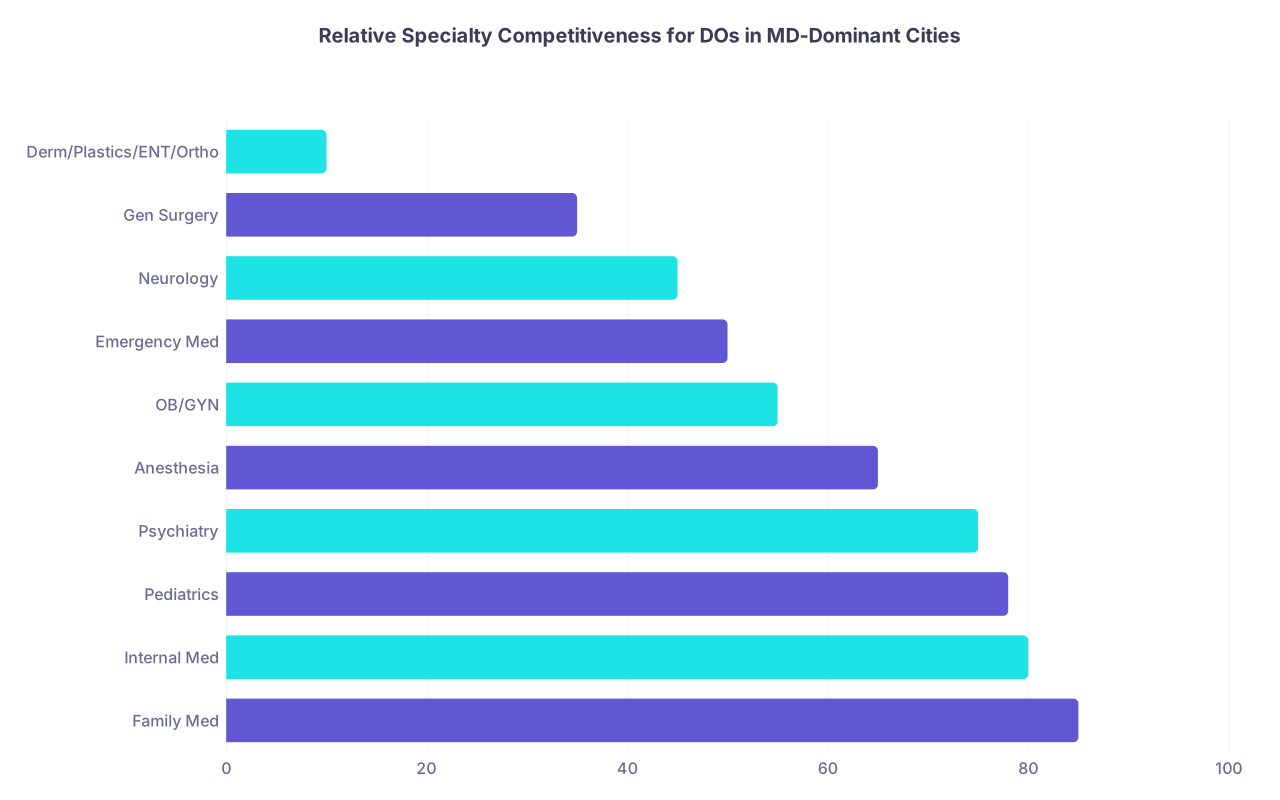
| Category | Value |
|---|---|
| Family Med | 85 |
| Internal Med | 80 |
| Pediatrics | 78 |
| Psychiatry | 75 |
| Anesthesia | 65 |
| OB/GYN | 55 |
| Emergency Med | 50 |
| Neurology | 45 |
| Gen Surgery | 35 |
| Derm/Plastics/ENT/Ortho | 10 |
Those numbers aren’t real percentages; they’re relative “achievability” scores I’d assign in an MD-heavy city for a typical DO student with solid but not stellar stats. You can still crack harder fields, but it stops being a location-first decision and becomes a numbers-game plus luck.
Key reality checks:
- If you’re aiming for derm, plastics, ENT, ortho, neurosurgery in an MD-dominated city and you’re a DO with average scores: your odds are low. Very low.
- If you’re aiming for IM, FM, peds, psych, or even anesthesia with good Step 2 and clinical performance: being a DO is not a deal-breaker, but geography plus DO status will stress your application.
You don’t have to give up your dream specialty right now, but you do need two columns in your brain:
- “Ideal” specialty.
- “City-stable and realistic” specialty.
You’ll come back to those later.
Step 3: Preclinical Years (Premed / OMS-I / OMS-II): Set Up Your Future Self
If you’re not yet in clinicals, your game is pure setup.
1. Choose Your Med School and Rotations Wisely (Premeds Pay Attention)
If you’re still premed:
- Prefer DO schools with established rotation networks in the region where your partner tends to match (if they’re already in MD school, ask where their home program sends residents/fellows).
- Look for DO schools whose students have matched historically into that city or that program system. Not vibes. Data.
You want to see: “Our grads have matched at XYZ Medical Center (Internal Medicine, Pediatrics, Psychiatry, etc.).” That tells you they at least know your school exists.
2. Plan to Take USMLE Step 2 (and likely Step 1 if still an option)
If you’re in OMS-I/II:
- Plan as if you will apply to MD programs. Because you probably will.
- If you still have the option: strongly consider taking Step 1, but recognize most filters are now Step 2-based. Some academic MD programs in city-heavy regions still like seeing a Step 1 pass; a few quietly use it as an initial screen even if they swear they don’t.
- Non-negotiable: take Step 2. And don’t just pass. Aim to crush it.
MD-heavy cities have filters. Some PDs won’t know what to do with COMLEX alone. Taking USMLE doesn’t guarantee love, but skipping it often guarantees an auto-discard.
3. Start Early Research Tied to That City or System
If your partner already knows their likely geographic targets (e.g., they’re at an MD school where grads cluster into Houston, Boston, Chicago, etc.):
- Ask around your DO school: any faculty with collaborative projects or co-authorships with that city’s academic centers?
- Get involved in projects where the PI has national connections or is known in that specialty. Name recognition matters more than students want to admit.
If you’re very early, your goal is simple: by OMS-III, you want some combination of:
- 1–2 posters
- Maybe a pub or two (case reports acceptable)
- Preferably tied to your target specialty
Step 4: OMS-III – Clinical Year and Rotation Strategy Around One City
This is where DO students either set themselves up beautifully or wreck their odds.
Your partner has matched or is about to. The city is now known. Here’s the play.
1. Map Every Program in That City and Region
You should have a spreadsheet. Not in your head. On your laptop.
| Program Name | Specialty | Takes DOs Historically? | Requires Step 2? | Affiliated with Partner's Hospital? |
|---|---|---|---|---|
| City Academic Med Center | Internal Med | Rarely | Yes | Same System |
| Metro Community Hospital | Family Med | Frequently | Preferred | No |
| Regional Children’s Hospital | Pediatrics | Sometimes | Yes | Same City |
| County Hospital | Psychiatry | Frequently | Yes | No |
| Suburban Medical Center | IM/Peds | Occasionally | Yes | No |
You fill this in for every relevant specialty and nearby city within commuting distance (maybe 30–60 minutes).
You need columns like:
- DO friendly? (look at past match lists, resident bios)
- Requires USMLE? (explicit or “strongly preferred”)
- Academic vs community
- Does it have a track record with your DO school? Any alumni?
This becomes command central.
2. Tell Your School Early You Need Rotations in/near That City
If your school does not have existing core rotations in that city, you’ll need:
- Away rotations (auditions) at target programs.
- Possibly some elective rotations at community hospitals in or near that metro.
You tell your clinical education office something like:
“My partner has matched into residency in [City]. I need to prioritize rotations in that region both for personal reasons and because I plan to apply to those programs. Can we map out sites within [X distance] and start paperwork early?”
You want to be the student they remember as organized and early, not the one begging for a last-minute switch in May.
Step 5: Step 2 and COMLEX Level 2 – You Do Not Get to Be Mediocre
If you’re locked to a city with mostly MD programs, Step 2 is now your currency.
You need:
- Step 2 CK at or above the median for the specialty you’re targeting, ideally slightly higher if DO.
- COMLEX Level 2 pass with a solid margin. Some programs don’t care, some do. Either way, you cannot afford a failure.
I’ve seen this play out:
- DO student, solid clinical evals, average COMLEX, no Step 2 yet by early fall → MD-dominant programs quietly pass.
- DO student with strong Step 2 number, some research, and good letters → suddenly “DO” becomes a footnote, not a barrier.
If you’re deciding on timing: in your situation, earlier Step 2 is generally better, as long as you’re ready. Many academic programs in MD-dense cities want scores in hand before offering interviews. Taking it in July-August of OMS-IV is often ideal.
Step 6: Specialty-Specific Reality Checks in an MD-Dominant City
You’re not just asking, “Can a DO match here?” You’re asking, “Can a DO match here in this specialty, this year, with my stats?”
If You’re Targeting a More Competitive Specialty (Anesthesia, EM, OB/GYN, Neuro, Gen Surg)
You must:
- Have Step 2 done and strong.
- Do at least one audition rotation in that city or at that hospital system, ideally two.
- Get at least one, preferably two high-impact letters from MD faculty in that field, ideally at your target programs or known institutions.
You also need a backup mentality:
- You may rank programs in that city only in your main specialty and accept the risk of not matching there.
- Or you may dual-apply (e.g., anesthesia + IM, EM + IM, OB/GYN + FM/IM) to maximize staying with your partner.
You can love a specialty and still be strategic. Being “all or nothing” when you’re geographically locked and DO in an MD-heavy market can be career suicide.
If You’re Targeting IM, FM, Peds, Psych
Better odds. But not automatic.
Do this:
- Identify which programs in that city have current DO residents.
- Try to rotate at those programs or at least in that system.
- Make yourself visible: pre-round like crazy, ask smart questions, be the student who residents fight to work with again.
Your “pitch” is basically: “I’m here, I’m committed to this city long-term because of my partner, and I function well on the team.” PDs love stability and team players more than they love random brilliance.
Step 7: Play the Couples Angle Without Being Annoying
You’re not in the NRMP Couples Match, but you are functionally coupled. You need to communicate that without sounding manipulative.
Places it matters:
- ERAS personal statement (one line, not a sob story).
- Email to program coordinator/PD when applying.
- In interviews when they ask about geographic preference.
Example language in ERAS PS or secondary questions:
“My partner will be starting residency at [Hospital/City] this year, and I’m strongly committed to training in this region long-term. I’m looking for a program where I can build a career and a life alongside them.”
Not:
“I must match in [City] because my partner is there and long-distance would be very hard for us.”
(True, maybe, but PDs don’t care about the drama. They care about risk and fit.)
You’re signaling:
- You’re more likely to rank them highly.
- You’re more likely to stay if there’s a fellowship or job.
- You’re not applying broadly just for prestige; this location actually matters.
Step 8: Use Away Rotations Like Weapons, Not Souvenirs
In an MD-heavy city, your most powerful lever as a DO is how you perform in front of them.
Strategy:
- Prioritize away rotations at:
- Programs that have historically taken DOs.
- Programs in your partner’s exact hospital system or direct affiliates.
- Schedule them:
- Early enough to generate letters (July–September ideal).
- With Step 1/2 scores already available (so you’re not an unknown entity).
On those rotations:
- Be so clinically solid that residents talk about you to leadership. I’ve seen DO students get ranked highly because someone said: “That student was the best rotator we had all year.”
- Build two specific relationships: one senior resident and one attending. Those are the people who write letters and nudge PDs.
If your school limits away rotations, prioritize your city over prestige. A no-name community program in your partner’s city where you can shine is better than a flashy away across the country you’ll never rank highly.
Step 9: Communication Strategy With Programs
You’re going to need to be slightly more assertive than your MD classmates who apply nationwide.
Timeline approach:
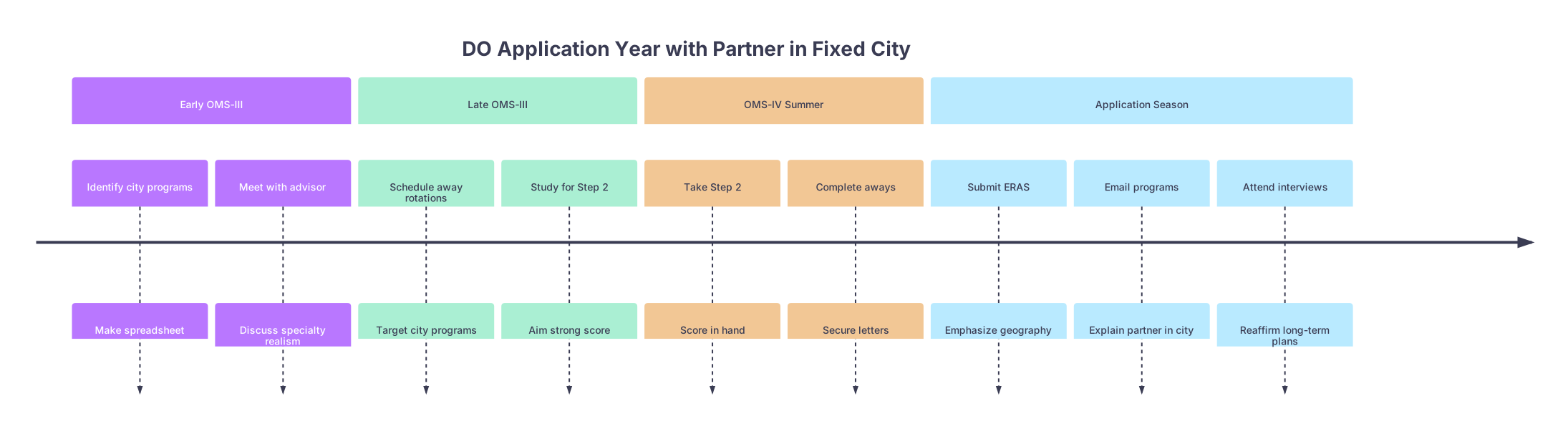
| Period | Event |
|---|---|
| Early OMS-III - Identify city programs | Make spreadsheet |
| Early OMS-III - Meet with advisor | Discuss specialty realism |
| Late OMS-III - Schedule away rotations | Target city programs |
| Late OMS-III - Study for Step 2 | Aim strong score |
| OMS-IV Summer - Take Step 2 | Score in hand |
| OMS-IV Summer - Complete aways | Secure letters |
| Application Season - Submit ERAS | Emphasize geography |
| Application Season - Email programs | Explain partner in city |
| Application Season - Attend interviews | Reaffirm long-term plans |
Specific moves:
- Late summer/fall: short, targeted, professional emails to PC/PD:
- Introduce yourself (name, DO school, specialty).
- Mention Step 2 score if strong.
- One sentence about your partner being in residency in that city.
- Express genuine interest in their specific program.
Something like:
Dear Dr. [Name],
My name is [Name], a fourth-year osteopathic medical student at [School], applying to [Specialty]. My partner will be starting [Specialty or “Internal Medicine”] residency at [Hospital] in [City] this year, and I’m very committed to training in this region.
I’ve submitted my ERAS application to [Program Name] and am particularly interested in your emphasis on [X – something specific, not generic fluff]. I would be grateful for consideration for an interview.
Sincerely,
[Name], OMS-IV
This won’t magically generate interviews, but I’ve watched it be the difference between “forgotten DO” and “oh, that’s the partner-of-our-new-intern candidate.”
Step 10: Prepare for the Worst-Case and Best-Case Scenarios
You need contingency planning. Because sometimes the numbers and geography simply don’t line up.
Best-Case
- You get multiple interviews in your partner’s city.
- You match into your top choice in that city.
- You two survive residency together in a 600 sq ft apartment.
Mid-Case
- You don’t match in the exact hospital but match within 45–60 min commute.
- One of you drives, you make it work, and life is slightly annoying but manageable.
Worst-Case
- You don’t match in that city.
- You match somewhere else or end up SOAPing into something away from them.
You can’t control the match completely, but you can control how likely each scenario is:
- Widen your radius: include every reasonable program within ~60 minutes.
- Consider less competitive specialties if being in the same city is your top life priority.
- Decide in advance: is same city more important than preferred specialty? There is no universal right answer. But pretending you don’t have to choose is how people end up blindsided.
Step 11: If You’re Still Premed and Just Dating Someone in Med School
Different situation, same principles.
You don’t know if you’ll still be together by their match day. People don’t love to hear that, but I’ve seen it enough times.
Smart approach:
- Don’t pick a DO school solely because it’s near their MD school, unless you’re in a long-term, stable situation and have had the “we’re doing this” conversation.
- If you do anticipate trying to end up geographically aligned later, then:
- Favor DO schools with broad rotation networks and a track record of grads in large academic cities.
- Train yourself from day one to be Step-competitive (good test habits, early content review, etc.).
- Stay flexible on specialty. The more rigid you are, the harder geographic matching becomes.
FAQ (Exactly 5 Questions)
1. Do I absolutely need to take USMLE Step 2 as a DO if I’m targeting an MD-dominant city?
If you’re serious about MD programs in that city, yes. Most academic MD programs and many community ones are much more comfortable comparing applicants on Step 2 than COMLEX alone. Some will consider COMLEX-only DOs, but your odds drop. In a geography-constrained situation, you can’t afford that handicap.
2. How many away rotations should I do in my partner’s city?
If possible, 1–2 targeted aways in that city’s programs or hospital systems is ideal. One in your top-choice program (or system), and another in a backup program that’s DO-friendly or known to take DOs. If your school limits aways, prioritize your partner’s city over big-name places across the country.
3. Should I change my specialty choice just to be in the same city as my partner?
That’s a personal decision, but you should at least be honest about the trade-off. If you’re a DO aiming for a very competitive specialty in an MD-heavy city, your odds may be low. If being geographically together is your top life priority, moving to a slightly less competitive specialty can dramatically increase the chance you match nearby. No one else can decide that for you—but pretending the trade-off doesn’t exist is naive.
4. How do I find out if programs in my partner’s city actually take DOs?
Look at: program websites’ resident lists, residency explorer, FREIDA, your school’s match list, and ask upperclassmen or recent grads. If a program has zero DO residents in the last few years, that’s a red flag. One or two DOs here and there is better. Multiple DOs per class is your sweet spot.
5. If I don’t match in my partner’s city, should I SOAP into anything nearby or try again next year?
If staying together geographically is critical and there’s a SOAP option within reasonable distance, most couples take it, even if it’s a backup specialty or program. If you’re deeply committed to a specific specialty and willing to do long-distance another year, you might consider reapplying after a research year. But that’s risky. When you’re DO + geographically constrained, “I’ll just try again” often doesn’t play out the way people imagine.
Key Takeaways
- Being a DO in a mostly MD city with a partner already matched there is not impossible—but it’s not forgiving. You must be deliberate about Step 2, rotations, and program targeting.
- Use your partner’s location as a strategic advantage: signal stability, rotate in that system, and build genuine relationships. Geography can be a selling point if you frame it correctly.
- Decide early how you’ll balance three things: specialty competitiveness, your geographic constraint, and your actual stats. You can’t maximize all three. Pick your priorities consciously instead of letting the Match decide for you.