
The way most students retake COMLEX Level 1 is wrong. They just “study harder” with the same scattered resources and somehow expect a different score.
You need structure. You need a limited, deliberate resource stack. And you need a timetable that tells you exactly what to do every day for 8–10 weeks.
This is that plan.
Step 1: Diagnose Why You Failed (Or Underperformed)
Before you touch another question bank, you need a post‑mortem. Otherwise you are guessing.
Here is the blunt truth: most repeat failures come from one of five patterns:
- Too few questions and weak review
- Too many resources, not enough depth
- No real spaced repetition
- OMM treated as an afterthought
- Poor timing / test-taking strategy under pressure
You must figure out which ones describe you.
Concrete diagnostic steps
Write down your previous performance
- Test date, score (or “Fail” + performance profile bands)
- How many total questions completed and reviewed (UWorld, COMBANK, TrueLearn, etc.)
- Which resources you actually used (not what you intended)
- Days per week and hours per day you truly studied (be honest)
Use your NBOME score report
- List every content area as: High / Borderline / Low.
- Do the same for OPP / OMM vs biomedical systems.
- Circle:
- Any system you scored “Low” or “Borderline”
- Any domain that surprises you (e.g., you thought you were strong in cardio but were Low)
Self‑audit your habits Ask yourself, and write brief answers:
- How many blocks per day did I consistently do?
- Did I review every question thoroughly?
- Did I have Anki or any systematic repetition?
- Did I consistently do OMM questions or only “near the end”?
- Did I practice full‑length timed blocks or tests?
If your answers sound like:
- “I did about 40–50% of a question bank”
- “I read a lot but did not do that many questions”
- “I mostly reviewed explanations when I got something wrong”
…then we already know the main problem: insufficient quality reps with feedback.
You are going to fix that.
Step 2: Build a Tight Resource Stack (Not a Pile)
Retakers do not need more resources. They need fewer, used correctly.
Here is the core stack I recommend for a COMLEX Level 1 second attempt:
| Category | Primary Resource | Backup / Supplement |
|---|---|---|
| Main Qbank | TrueLearn COMLEX or COMBANK | UWorld (selected blocks) |
| OMM | Savarese “Green Book” | OMM question sets in qbank |
| Concept Review | Boards & Beyond or Sketchy | First Aid/COMBANK notes |
| Spaced Repetition | Anki (light, targeted deck) | Self-made flashcards |
1. Question Bank (Non‑negotiable backbone)
Primary:
- TrueLearn COMLEX Level 1 or COMBANK
These are written in COMLEX style, including OMM and weird NBOME wording.
Optional secondary:
- UWorld Step 1 (if you did not thoroughly complete it before, and only for deeper path/physio/pharm understanding)
- If your previous issue was test style and OMM → prioritize TrueLearn/COMBANK.
- If your knowledge base was very weak in core sciences → add 20–40 UWorld questions/day fixed around weak systems.
But do not run 3–4 question banks at once. You will not finish them properly.
2. OMM / OPP Resources
You must treat OMM as free points. Because it is.
Core:
- Savarese OMT Review (“Green Book”) – read cover to cover at least twice.
- OMM sections and filters in your COMLEX‑specific Qbank.
Key domains:
- Sympathetic / parasympathetic levels
- Chapman’s points
- Viscerosomatic reflex levels
- Counterstrain tender points (especially high-yield regions)
- Fryette’s principles
- Sacrum / innominate dysfunction patterns
- Lymphatic techniques and indications
You will build OMM into your daily routine, not as an afterthought weekend cram.
3. Video / Conceptual Support
Use video only to repair weak conceptual foundations, not as your main job.
Good options:
- Boards & Beyond – strongest for physiology and mechanisms.
- Sketchy – for micro and pharm if you like visual mnemonics.
- Osmosis / Pathoma – targeted sections only if you already own them and know they helped you.
Limit: No more than 1.5–2 hours of video per day on average. If you are watching 4–6 hours of video daily, you are not training for the exam. You are consuming passive content.
4. Spaced Repetition
You do not need an insane Anki regimen, but you need some systematic recall.
Options:
- A curated COMLEX/Step 1 deck (Lightyear, AnKing variants), but pruned down to:
- Your current weak systems
- OMM facts
- Pharm mechanisms and high-yield details
- OR your own daily flashcards created from:
- Missed questions
- “I will forget this” moments in Savarese or explanations
Rule: Never let cards exceed 45–60 minutes per day. Spaced repetition must support questions, not replace them.
Step 3: 8–10 Week Structured Study Plan
Assuming you have at least 8 dedicated weeks before retest. If you have 10, even better. If you have only 6, you will condense this but keep the same structure.
High-level weekly structure
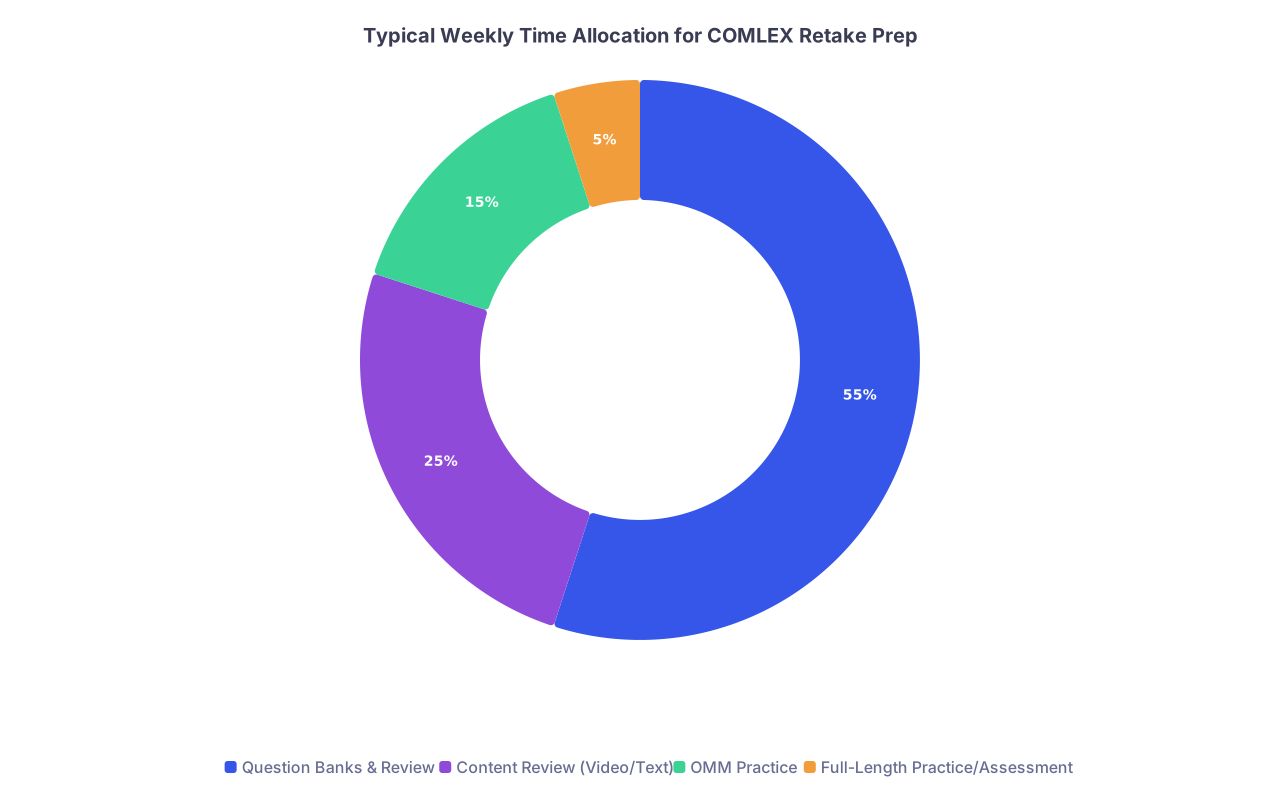
| Category | Value |
|---|---|
| Question Banks & Review | 55 |
| Content Review (Video/Text) | 25 |
| OMM Practice | 15 |
| Full-Length Practice/Assessment | 5 |
Rough percentages:
- 50–60%: Qbank questions + deep review
- 20–25%: Content review (video/text) specifically targeted at misses
- 10–15%: OMM (reading + OMM questions)
- 5–10%: Full‑length practice exams and debrief
Daily structure (template)
On study days (6 days/week):
- Morning (3–4 hours)
- 2 timed blocks of 40 questions (COMLEX‑style qbank)
- Short break between blocks
- Midday (2–3 hours)
- Detailed review of those 80 questions
- Add 5–10 new flashcards from explanations
- Afternoon (2–3 hours)
- Targeted content review based on misses (video/text)
- 30–60 minutes of OMM: Savarese reading or OMM‑only question set
- Evening (0.5–1 hour, optional)
- Light Anki / flashcard review
One day per week:
- Lighter question load (maybe 40–60 questions)
- More focus on:
- OMM consolidation
- Reviewing notes
- Mental reset
Phase breakdown: Weeks 1–10
I will assume 10 weeks; you can compress proportionally.
Weeks 1–3: Reset and Rebuild Foundation
Goals:
- Reacclimate to question volume.
- Identify precise weak systems and patterns.
- Start systematic OMM coverage.
Plan:
- 60–80 COMLEX‑style questions/day, 6 days per week.
- After the first week, add 1–2 small blocks of UWorld/day if you need deeper understanding.
- Read 10–15 pages/day of Savarese.
- 45–60 minutes of Anki focused on:
- Pharm
- Micro
- OMM autonomics/Chapman’s
By the end of Week 3:
- You should have completed:
- 1/3–1/2 of your primary COMLEX qbank.
- First pass of major OMM chapters started (vertebral levels, Chapman’s, sacrum, innominate).
Weeks 4–6: High-Intensity Question Phase
Goals:
- Finish or nearly finish your primary COMLEX qbank.
- Push question volume and timed block stamina.
- Start building exam‑day rhythm.
Plan:
- 80–120 questions/day, 6 days per week.
- At least 1 block/day must be strictly timed and in “exam conditions”:
- No pauses.
- Same start time as your planned exam if possible.
- Continue Savarese, aiming to finish 1 full read by end of Week 5.
- OMM strategy:
- 1 dedicated OMM block (20–30 questions) at least 3 days per week.
- Schedule one full-length practice exam around Week 5:
- NBOME practice exam if available, or a long custom block day (e.g., 4 x 50 questions).
After that practice test:
- Do a ruthless review:
- Classify misses: content gap vs careless vs misread vs time pressure.
- Identify 2–3 systems and 1–2 OMM topics that are still weak.
Weeks 7–8: Targeted Repair and Second Pass
Goals:
- Attack remaining weak areas.
- Finish any leftover qbank questions.
- Increase OMM accuracy and speed.
Plan:
- 60–80 qbank questions/day, but more focused:
- Use tutor mode or custom blocks by system/topic for targeted remediation.
- Second pass through Savarese (faster this time, focusing on:
- The tables.
- Side‑by‑side comparisons.
- High-yield lists.)
- Another full-length simulation at the end of Week 8:
- Timed.
- Same length structure as exam day if you can approximate it.
If scores are still borderline:
- You adjust intensity, not resources.
- Narrow content review to only your worst-performing systems.
Weeks 9–10: Polishing and Exam Readiness
Goals:
- Solidify recall.
- Sharpen test-taking mechanics.
- Avoid burnout in the final week.
Plan:
- Week 9:
- 60–80 questions/day, mostly mixed blocks, timed.
- Heavy OMM emphasis (every day some OMM).
- Rapid Savarese skim (3–4 days max).
- Week 10:
- 40–60 questions/day at most, more review than new learning.
- Last 3 days:
- 1–2 short blocks/day.
- OMM flashcards, tables, and summary notes.
- Sleep discipline, hydration, physical activity.
48 hours before exam:
- No new content.
- Light question review only.
- Savarese tables and quick facts.
- Confirm logistics: test center, timing, food, what you will wear, etc.
Step 4: OMM: Turn a Liability into Easy Points
Most students fail COMLEX with weak OMM that could have been boosted by 10–20 scaled points with a few weeks of serious work. I have watched students move from “I hate OMM” to “I crush OMM questions” with one simple rule:
Treat OMM like pharmacology. Pure, brute-force, pattern‑driven memorization plus some conceptual anchors.
How to systematically conquer OMM
Sympathetic / Parasympathetic levels
- Make yourself a one‑page sheet of:
- Organ → spinal level.
- Parasympathetic innervation (vagus vs pelvic splanchnic).
- Review this sheet daily for 2–3 weeks.
- Quiz yourself: “Appendix? T10–T12, right side, vagus?”
- Make yourself a one‑page sheet of:
Chapman’s points
- Start with:
- Heart, lungs, GI, thyroid, bladder, prostate/uterus.
- Use visual diagrams, not just text.
- Add only the ones that truly show up often.
- Make 10–20 flashcards for the most commonly tested.
- Start with:
Fryette’s principles / vertebral diagnoses
- Get comfortable reading DO exam question stems:
- “T5 is rotated right and sidebent left” → Type I or II?
- “Flexed, rotated right, sidebent right” → what does that mean?
- You should be able to:
- Name the dysfunction pattern quickly.
- Know what direct and indirect treatments would look like.
- Get comfortable reading DO exam question stems:
Sacrum and innominates
- This is where many people just guess.
- Do 50–100 dedicated sacrum/innominate questions.
- For every question, draw the sacrum and innominate movement on paper.
- Build a 1–2 page summary for:
- Forward vs backward torsions.
- Unilateral flexions/extensions.
- Innominate rotations and shears.
Lymphatics and respiratory / rib mechanics
- Know:
- When to use lymphatic treatments (post‑infection, edema, post‑MI).
- Which ribs move around which axis (pump handle vs bucket handle).
- This is pattern recognition. Not rocket science.
- Know:
Use Savarese + qbank OMM filters + your own 1–2 page summary sheets. That combination is far stronger than reading 3 different OMM textbooks.
Step 5: Question Review: Where Most Retakers Waste Time
You do not learn much from only seeing if you were “right or wrong.” You learn from dissecting why.
Here is the review protocol I push on students who need to jump a full performance band:
For each missed or guessed question:
Identify root cause:
- Did not know the fact.
- Knew it but misread.
- Got tricked by COMLEX wording.
- Ran out of time and rushed.
Write a 1–2 line takeaway in a notebook or digital document:
- “NSAIDs in pregnancy risk premature PDA closure.”
- “Chapman’s point for appendix = tip of 12th rib, right.”
Link to system or topic:
- Cardio → Pharm → Pregnancy contraindications.
- OMM → Chapman’s → GI.
For high‑yield or recurring misses:
- Make 1 flashcard.
- Do not make a flashcard for every single wrong question. Only the patterns that keep reappearing.
That is it. No 5‑paragraph essays for each question. Just:
- Cause.
- Takeaway.
- Category.
- Occasional flashcard.
You will start to see your own “greatest hits” of stupidity. Everyone has them. Fix those and your score climbs quickly.
Step 6: Full-Length Practice and Score Targets
You cannot go into a retake blind. You need at least 2 true simulations.
How many and when
- Practice Exam 1: End of Week 4 or 5.
- Practice Exam 2: End of Week 7 or 8.
- Optional Light Simulation: Shorter block set in Week 9 if anxiety is still high.
You ask: “What score do I need?” NBOME practice scores are not perfect predictors, but they give a direction.
Rule of thumb for a retake:
- Aim for consistent performance at or slightly above passing threshold with margin.
- More important: Your worst block on a simulated exam should be just around passing, not far below.
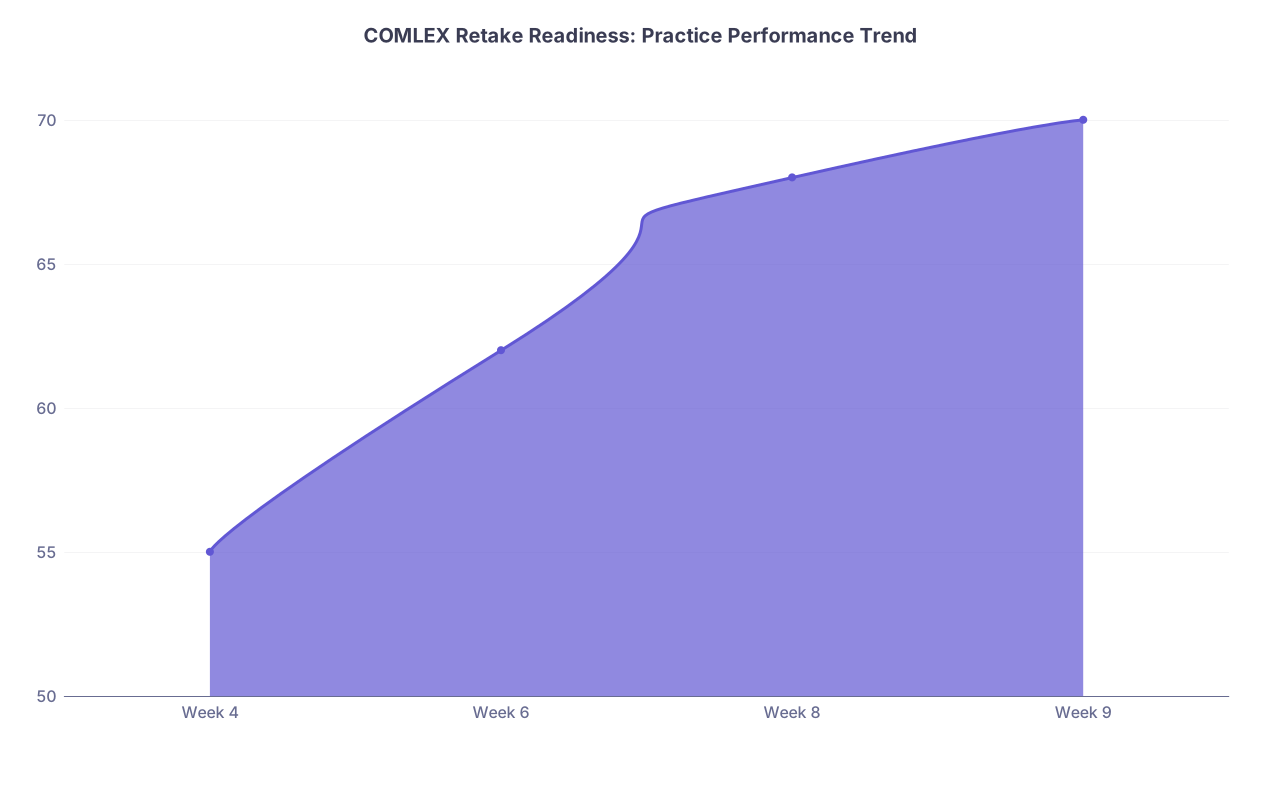
| Category | Value |
|---|---|
| Week 4 | 55 |
| Week 6 | 62 |
| Week 8 | 68 |
| Week 9 | 70 |
If your simulated performance:
- Trends upward 10–15 percentage points from first to second practice exam → you are on track.
- Stalls or drops → you adjust:
- Fewer new questions.
- More focused review.
- Possibly push exam date, if allowed.
Step 7: Time Management and Test-Day Strategy
You failed or underperformed once. You cannot walk in with the same timing mistakes.
Block pacing
COMLEX blocks are long and often wordy. If you tend to finish late or rush last 10 questions, use this:
- Divide block into quarters:
- At 25% of time used → at least 25% of questions done.
- At 50% → at least 50% done.
- At 75% → at least 75% done.
- If behind:
- Speed up slightly.
- Make faster choices on easier questions.
- Mark truly confusing ones for return, but do not leave 10–15 blanks for the end.
Flagging questions
Do not flag everything that is not 100%. You will drown.
Flag only:
- Questions where you actively eliminated nothing or only 1 answer.
- OMM questions where drawing a diagram might fix it later but you are too slow right now.
Realistically, you should have:
- 5–10 flagged questions per block.
- Time to revisit 3–7 of them.
Stress and reset protocol
You will have at least one moment on exam day where you think, “This is going terribly.” It is almost never as bad as it feels, but panic will kill your performance.
Use a simple reset:
- When anxiety spikes:
- Sit back.
- Close eyes for 10–15 seconds.
- Inhale for 4 seconds → hold for 4 → exhale for 6.
- Remind yourself: “I have trained for this. One question at a time.”
- Then attack the next question only. Not the entire exam.
Step 8: Balancing Life, Rotations, and a Retake
Most retakers are not in a perfect “dedicated” bubble. You may be:
- On rotations.
- Dealing with shame, pressure from school, financial stress.
Here is what I have seen work for students on rotations:
Minimum baseline while on a standard clinical rotation:
- Weekdays:
- 40–60 questions/day after rotation (timed if possible).
- 30–45 minutes review + quick Anki.
- Weekends:
- 2 heavy days of:
- 80–100 questions.
- 2–3 hours review.
- 1–2 hours content/OMM.
- 2 heavy days of:
Communicate with your attending or clerkship coordinator early if your retake is time‑sensitive. Some will be flexible with schedules if they understand that your licensing exam is at stake.
Step 9: When You Should Consider Delaying the Retake
There is a dangerous myth that “earlier is always better.” For a retake, that is sometimes wrong.
Consider delaying if:
- Your first practice exam (week 4–5) is extremely low and your second does not show real improvement.
- You cannot realistically get at least 6–8 weeks of solid studying (because of life events or brutal rotations).
- Your mental health is in a place where you are barely functioning.
Delaying is not failure. Repeating a failure is.
Step 10: Mental Framing – How to Study Without Shame
You already took a hit. A fail or a borderline score feels like a public scarlet letter in medical school culture. I have watched that shame do more damage than the score itself.
You need to reframe this second attempt as:
- A skills problem, not a self‑worth problem.
- A training block, not a trial of your right to be a physician.
Practical ways to protect your head:
- Limit “score talk” with classmates. They are not taking this exam for you.
- Have 1–2 people who know the full story and support you (advisor, trusted friend, partner).
- Set performance goals that are about behaviors, not just scores:
- “I will complete 80 questions and review them thoroughly today.”
- “I will finish Savarese by the end of this week.”
You fix the process. The score follows.
Final Key Points
- Tight resources, not many resources. One primary COMLEX qbank, Savarese, targeted videos, and light Anki. That is enough if you use them hard and well.
- Questions + OMM every day. High‑volume, well‑reviewed questions and daily OMM work turn the exam from chaos into patterns you recognize.
- Practice like it is the real thing. Timed blocks, full‑length simulations, and a clear test‑day pacing plan matter as much as raw knowledge on a second attempt.