
The way most residents “plan” electives for fellowship is backwards. They chase prestige names and random away rotations, then wonder why their application looks generic and their letters sound the same.
You are not trying to collect badges. You are trying to build a coherent, layered narrative that screams: “This person already functions like a junior fellow in our subspecialty.”
Let me break this down specifically.
1. The Core Idea: Stacking, Not Sampling
Electives for fellowship are not a tasting menu. They are a scaffold.
You want every major experience to do at least two things simultaneously:
- push your clinical skills toward how that subspecialty actually works, and
- provide concrete, story-level evidence that you fit that world.
Think of three vertical “stacks” you are building during residency:
- Clinical stack – how you see patients, solve problems, and tolerate complexity in that niche.
- Academic stack – your research, QI, teaching, and “thinking” identity in that niche.
- Relational stack – the attendings and fellows who will advocate for you when people close the door and ask, “Do you actually know this applicant?”
Poor strategy: scattered electives that look fun but have no through-line.
Advanced strategy: multiple linked experiences that create visible depth in one subspecialty.
Example from a PGY‑2 aiming for cardiology fellowship:
- Elective 1: General cardiology consults at home institution (PGY‑2 early).
- Elective 2: Advanced heart failure / transplant inpatient (same division, different faculty).
- Elective 3: Cardiac ICU or mixed CCU/MICU month with strong cardiology presence.
- Elective 4: Cardiology-focused research elective with the same PI you met on elective 1 or 2.
- “Bonus”: One carefully chosen away rotation at a fellowship program that is actually within reach for you.
That is a stack. There is a progression, recurring faces, and an obvious narrative.
2. Timeline: When to Pull the Trigger on Which Electives
You do not have unlimited time. You also cannot fix everything in PGY‑3 spring if you ignored structure until then.
Let’s map what a realistic elective strategy looks like in a 3-year IM or peds program. Adjust the months, but keep the sequence logic.
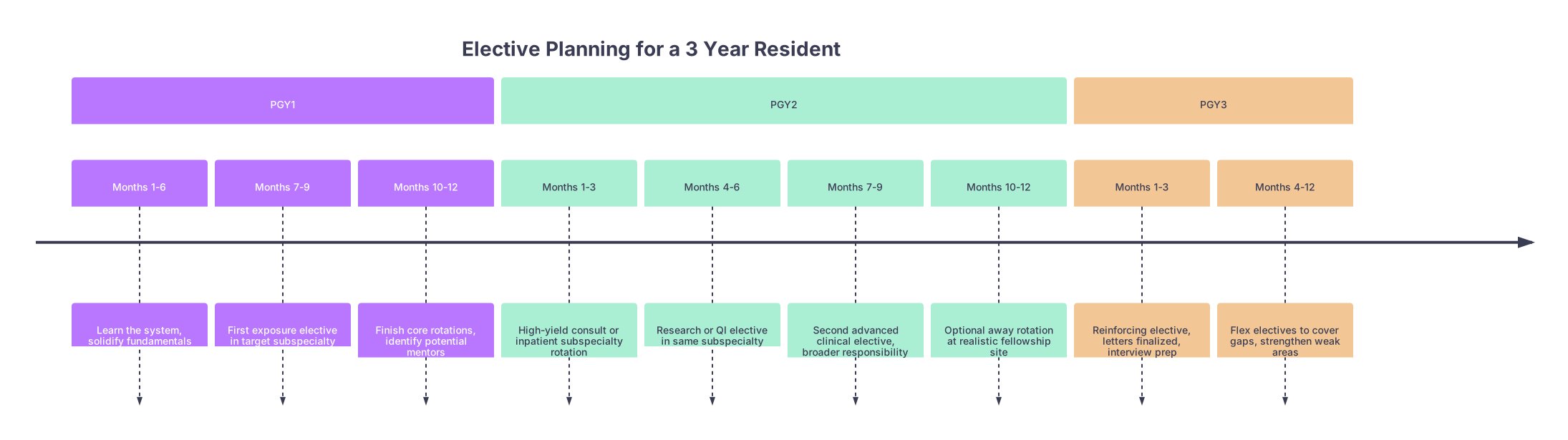
| Period | Event |
|---|---|
| PGY1 - Months 1-6 | Learn the system, solidify fundamentals |
| PGY1 - Months 7-9 | First exposure elective in target subspecialty |
| PGY1 - Months 10-12 | Finish core rotations, identify potential mentors |
| PGY2 - Months 1-3 | High-yield consult or inpatient subspecialty rotation |
| PGY2 - Months 4-6 | Research or QI elective in same subspecialty |
| PGY2 - Months 7-9 | Second advanced clinical elective, broader responsibility |
| PGY2 - Months 10-12 | Optional away rotation at realistic fellowship site |
| PGY3 - Months 1-3 | Reinforcing elective, letters finalized, interview prep |
| PGY3 - Months 4-12 | Flex electives to cover gaps, strengthen weak areas |
PGY‑1: Stop Sampling, Start Signaling
You do not need 3 subspecialty electives as an intern. But you should not pretend you are “undecided” if you are not.
Aim to:
- Do 1 targeted elective in your likely fellowship area late PGY‑1.
- Identify 1–2 attendings you would not mind tethering your next two years to.
- Observe the culture: Do you actually like the way these people practice and talk?
Concrete PGY‑1 play:
- IM resident thinking heme/onc: one malignant hematology or inpatient oncology month, not a random “cancer center float” that is mostly scut.
- Peds resident thinking NICU: one proper NICU elective where you manage vents and TPN, not a “newborn nursery” vacation.
PGY‑1 is for deciding “yes, this lane is worth stacking.”
PGY‑2: Heavy Lift Year – Build the Stack
PGY‑2 is where you commit. This is when fellowship PDs start noticing you if your home division is plugged in.
Your PGY‑2 goals:
- 2–3 electives directly in your target subspecialty.
- 1–2 electives that are adjacent but obviously relevant (MICU for pulm/crit, ID for heme/onc BMT, nephro for rheum, etc.).
- At least one research/QI or “academic” elective with a future letter writer.
You want your name said at division meetings in PGY‑2. When I sat in those meetings, we knew by spring who was “one of ours.”
PGY‑3: Consolidate, Not Discover
By early PGY‑3, the application is launching. Your electives now are mainly for:
- Reinforcing your role in the subspecialty team.
- Showing leadership/near-fellow level functioning.
- Getting one last strong evaluation/letter if needed.
- Plugging holes (e.g., procedural experience, outpatient exposure).
If you are just doing your first real subspecialty elective in PGY‑3 before applications, you are lagging, and your strategy needs triage, not refinement.
3. The Four Elective “Types” You Should Intentionally Stack
Electives that help your fellowship application usually fall into four buckets. You want representation from all four, with emphasis depending on your profile.

1. Core Clinical Electives in Your Target Subspecialty
This is non-negotiable. You need multiple months that clearly say: “I have lived in this world.”
Examples:
- Cardiology: general consults, inpatient cardiology, CCU, advanced HF.
- GI: GI consults, liver consults, inpatient GI, endoscopy unit (if residents can meaningfully participate).
- Heme/Onc: inpatient oncology, malignant heme, BMT, outpatient infusion center clinics.
- Pulm/CCM: MICU with strong pulm presence, pulm consults, sleep, transplant/advanced lung.
The advanced move: sequence them so your responsibility level clearly escalates.
Month 1: you are the “extra” resident.
Month 2: you are de facto primary resident or “mini fellow” on consults.
Month 3: you are precepting juniors and acting like a fellow when staffing.
You want at least one attending evaluation that says some version of:
“Functioned at or near the level of an early fellow on this rotation.”
That line moves applications.
2. Adjacent Electives that Amplify Subspecialty Credibility
This is where most residents waste opportunity. They pick random “easy” electives instead of strategically supportive ones.
Examples of smart adjacency:
- Pulm/CCM target: MICU, anesthesia or airway elective, echo/POCUS, ID.
- Cardiology target: MICU, nephrology (cardiorenal), vascular medicine, EM (if you are doing lots of chest pain / ACS workups).
- Heme/Onc target: Palliative care, ID, transfusion medicine, bone marrow transplant, hospitalist oncology service.
- GI target: hepatology, transplant surgery, radiology with focus on abdominal imaging.
Your goal: show that your thinking has the complexity and cross-system awareness that the subspecialty requires. A pulm/crit applicant who never set foot in an ICU looks unserious.
3. Research/QI/Academic Electives
One vague “research month” with no output does not help you. A coherent, mentor-linked stack does.
Ideal pattern:
- Late PGY‑1 or early PGY‑2: short research elective to join an existing project, learn the workflow, and get your name on something.
- Mid PGY‑2: second elective to push the project to abstract submission or manuscript draft.
- Early PGY‑3: brief protected time to finalize a paper, abstract, or presentation, ideally before ERAS submission.
You want at least one tangible deliverable per 1–2 months of “research elective” on your CV. Anything less looks like padding.
For competitive fields (cards, GI, heme/onc, pulm/crit), an applicant with 2–3 subspecialty-linked outputs (poster + manuscript or 2–3 abstracts) plus strong clinical letters often beats someone with 10 unrelated case reports.
4. Relationship‑Building / Away Rotations
Away rotations are overused and misused. They are not magic. But when done at the right place, at the right time, with the right performance, they can be a tiebreaker.
Two strategic reasons to do an away:
- Your home program has weak presence or limited breadth in the subspecialty.
- You are a realistic candidate for a specific outside fellowship and want them to see you at your best.
Do not:
- Use an away to “make up for” mediocre Step scores or weak home letters. People see through that.
- Go to a clearly out‑of‑reach “dream” institution and then act shocked when they are polite but uninterested.
Plan away rotations for late PGY‑2 or very early PGY‑3 so evaluations hit in time for letters and ERAS.
| Scenario | Away Rotation Recommended? |
|---|---|
| Strong subspecialty at home, realistic shot at home fellowship | Usually No |
| Weak or no subspecialty fellowship at home | Yes, 1–2 away at realistic targets |
| Switching subspecialty late (e.g., from cards to pulm) | Yes, if timed early enough |
| Aiming for ultra‑elite program without matching stats | Only if your home PD strongly backs you |
4. Matching Electives to Your Fellowship “Profile Type”
Not all applicants need the same stack. You have to be honest about which profile you are running.
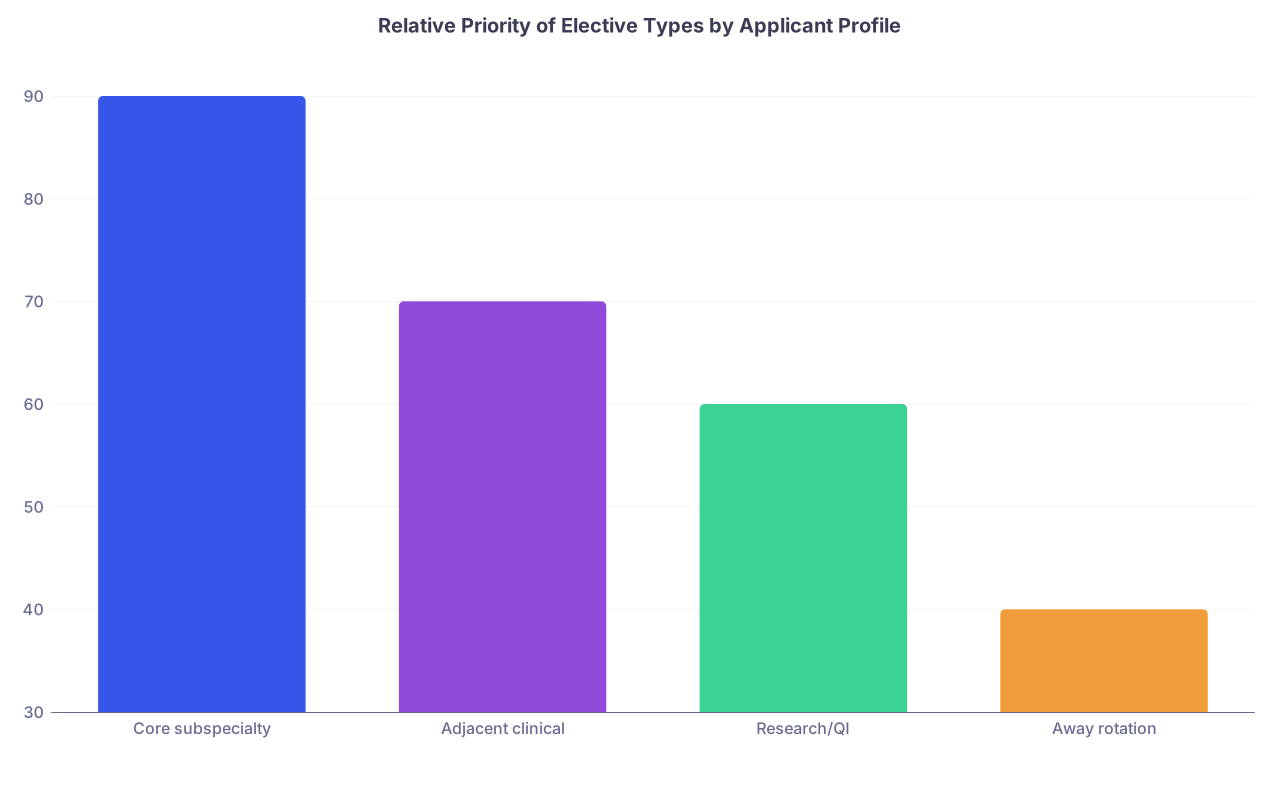
| Category | Value |
|---|---|
| Core subspecialty | 90 |
| Adjacent clinical | 70 |
| Research/QI | 60 |
| Away rotation | 40 |
Let me give you four common archetypes I see and exactly how I advise them.
Profile A: The Clinical Workhorse, Light on Research
You crush the wards, get great comments, but you have one weak poster and minimal scholarly work.
Elective stack priority:
- Multiple high-intensity subspecialty clinical electives where your work ethic and reliability are obvious.
- One tightly scoped, feasible research or QI elective with a PI who understands your timeline and will help you get at least an abstract.
- A reinforcing elective with the same division to lock in letters that emphasize your “already a fellow” clinical performance.
What you must avoid: a 3‑month “research elective” with no concrete deliverables. That backfires.
Profile B: The Research‑Heavy, Clinically Average Resident
You have 5–10 publications, maybe a PhD or MPH, but are “fine” on the wards, not stellar.
Your risk: programs worry you want a postdoc in disguise and will struggle with high-acuity service.
Elective stack priority:
- High-yield subspecialty consult and ICU-type electives that show you can manage acutely ill patients in that domain.
- One research elective that is clearly tied to clinically relevant questions (not just basic science in a silo).
- Avoid too many research elective months on your schedule; you already have the CV to prove productivity.
You want at least one attending letter saying, essentially, “Yes, they are a serious scientist, but they function solidly on busy clinical services.”
Profile C: The Late Decider
You spent PGY‑1–2 “exploring” and decide on fellowship target mid PGY‑2.
You are behind, but not doomed.
Emergency plan:
- Immediately schedule 2 subspecialty electives late PGY‑2 and early PGY‑3, preferably with different attendings in the same division.
- Slot in a short, tightly scoped research or QI project where your main aim is an abstract or presentation, not a 3‑year dataset.
- If home program is weak, one away rotation at a realistic program where your PD has connections.
Your narrative is “I came to this later, but I ramped up fast and every month for the last year has been in this lane.”
Profile D: The Non‑Traditional / Off‑Cycle / Switching Applicant
You are switching subspecialties (e.g., from general IM to cards after thinking about hospitalist work), or coming from a community program with thin subspecialty exposure.
Here, relationships are everything.
Elective stack:
- Maximum exposure months in target subspecialty at your current institution, even if it means negotiating schedule changes.
- One or two away rotations at places that are genuinely in your match range.
- A research or QI elective that shows you understand the questions that matter in that subspecialty now, not five years ago.
Your letters and direct performance on subspecialty services will matter more than Step scores.
5. How to Behave on These Electives So They Actually Convert
Stacking only works if you convert elective time into advocacy. The quiet, technically competent resident who never declares any interest gets mediocre “nice to work with” letters.
On subspecialty electives, your job is not just to see patients. It is to audition.
Signal Your Intent – Explicitly, Not Vaguely
By day 2–3 of a subspecialty elective, your attendings should know:
- You are strongly considering fellowship in their field.
- What stage you are at (PGY‑2 starting to explore vs PGY‑3 applying this cycle).
- That you are open to research projects / longitudinal clinic time if they see a fit.
I have watched residents miss letters because they never said they were fellowship-bound. Faculty assumed they were just filling a schedule hole.
Ask for Progressive Responsibility
On your second or third month in a given subspecialty, you should be asking:
- “Can I take a first pass at the consult plan before we go in?”
- “Would you be comfortable with me calling the referring team to discuss the plan?”
- “Could I precept the intern’s presentation before we staff with you?”
Those are the behaviors that get comments like, “Acts like a junior fellow” written in your evaluation.
Attach Yourself to Projects that Can Finish
On a research/QI elective:
- Do not agree to a massive retrospective chart review that clearly will not end before graduation.
- Aim for something where your role is surgical: figure data extraction for 80 patients, run the preliminary analysis, draft results section.
Tell the PI up front: “I have X months and my goal is to help push something to abstract or manuscript by [month]. If that is unrealistic for this project, could we identify a smaller piece I can own?”
That kind of clarity is rare. And faculty respond to it.
6. Choosing Between Conflicting “Good” Electives
You will hit schedule conflicts. MICU vs subspecialty consults. Research elective vs prime away slot.
Here is how I triage when I advise residents.
| Preference Question | Choose This If... |
|---|---|
| ICU vs subspecialty consult | You lack high-acuity cases or are weak clinically |
| Research vs subspecialty elective | Your portfolio has no subspecialty-linked output at all |
| Away vs home subspecialty month | You have strong home relationships and need external exposure |
| Transplant/advanced vs basic service | You already did a basic month and need complexity |
General rules:
- Before PGY‑2 spring: favor breadth within your target subspecialty and adjacent rotations (ICU, ID, nephro).
- PGY‑2 spring to PGY‑3 early: favor depth in your subspecialty and relationship‑dense electives where letters are likely.
- After ERAS submission: fill gaps (e.g., if you got feedback about weak outpatient exposure, add clinic-heavy electives).
When two options are truly equal on paper, choose the one with the stronger, more invested faculty who already know and like you. That is usually the right answer.
7. What PDs and Selection Committees Actually See on Your Transcript
Most residents overestimate how carefully people read their elective list. No one is parsing every line for hours.
They are scanning for patterns.
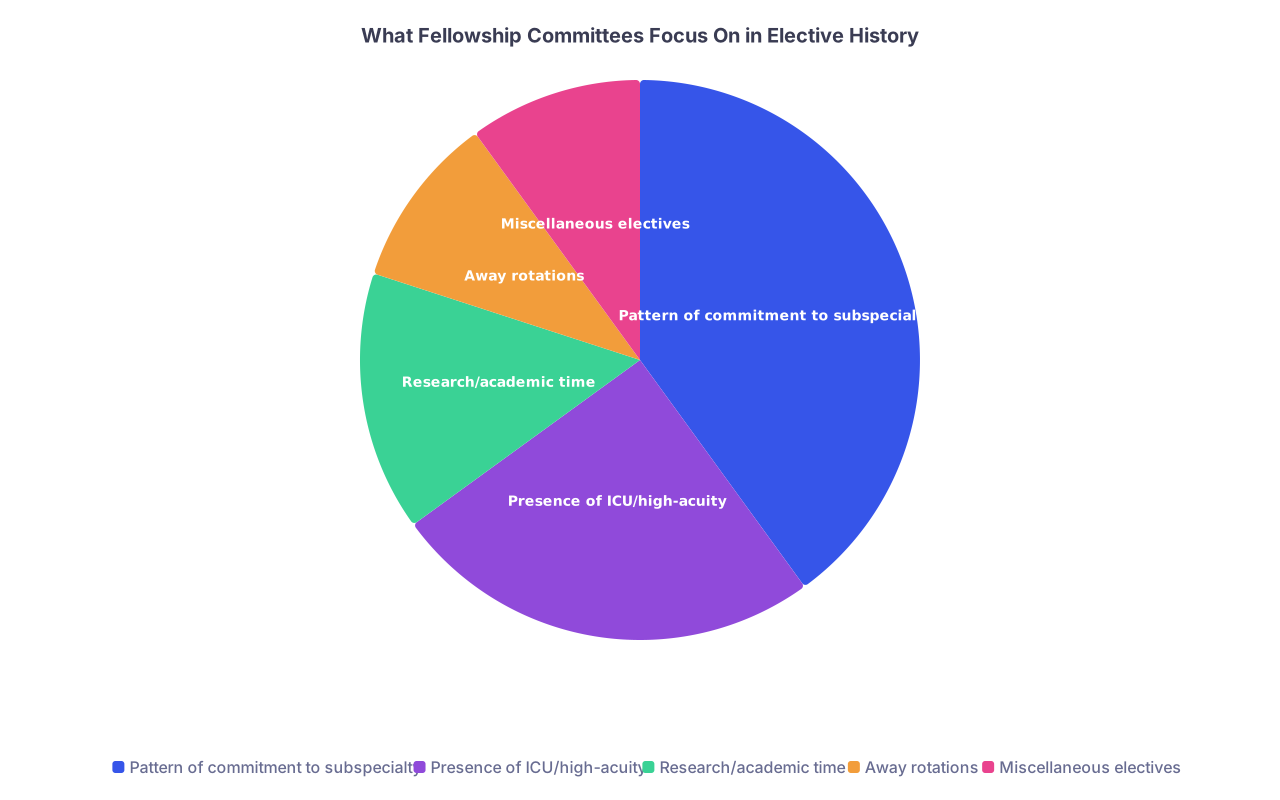
| Category | Value |
|---|---|
| Pattern of commitment to subspecialty | 40 |
| Presence of ICU/high-acuity | 25 |
| Research/academic time | 15 |
| Away rotations | 10 |
| Miscellaneous electives | 10 |
When I have sat in those rooms, the questions sound like:
- “How many months has this person actually done in [our field]?”
- “Have they touched high-acuity patients that look like what we see?”
- “Is any of their research actually relevant to us?”
- “Do we know anyone who knows them well?”
No one cares that you did “Medical Spanish” if you have no subspecialty depth and weak ICU exposure. Harsh, but true.
Your job: engineer your elective history so that a lazy, 30‑second scan creates a clear picture:
- 3–4 months in target subspecialty
- 2–3 months of relevant ICU/adjoining fields
- 1–2 months of research/QI in the same subspecialty
- Maybe 1 away at a logical partner institution
That is what a “stacked” elective pattern looks like to a committee.
8. A Concrete Example: Two Residents, Same Stats, Different Elective Strategy
Let me sketch this out so you see the difference on paper.
Both residents: IM, mid‑tier academic program, Step 1 P/F, Step 2 = 244, mid‑pack class rank. Both want GI.
Resident 1 (Random Electives):
PGY‑1: one GI consults elective.
PGY‑2: “Hospitalist elective,” Dermatology, Palliative care, one ICU.
PGY‑3: GI clinic elective, Medical education elective, “research month” with no listed outputs.
Resident 2 (Stacked Electives):
PGY‑1: GI consults (late year).
PGY‑2: Hepatology consults, MICU, GI inpatient service, research elective with GI attending (abstract submitted to DDW).
PGY‑3: Advanced GI inpatient + outpatient combined month, second research week to finalize manuscript, one away GI rotation at realistic fellowship program.
Same scores. Same program tier. On paper, one looks like a GI‑bound resident who prepared seriously. The other looks undecided and somewhat aimless.
I would bet heavily on Resident 2 in most GI fellowship applicant pools.
9. How to Recover if You Think You “Wasted” Electives Already
You are PGY‑2 or early PGY‑3 reading this and realizing your elective history is chaos. Fine. You cannot fix the past. You can still repair the story.
Steps:
- Map your completed electives and mark anything that is tangentially related to your target subspecialty. You may already have more relevance than you think (e.g., ID for heme/onc, nephro for rheum, palliative for heme/onc).
- From now until ERAS submission, make every remaining elective either:
- Direct subspecialty,
- Adjacent high-yield (ICU, ID, transplant), or
- Research/QI with a subspecialty mentor.
- Identify 1–2 attendings who could plausibly write strong letters and book electives with them specifically. Tell them your timeline and goals.
- Ask your PD or APD to help rewrite your narrative: “I explored broadly early, then committed hard once I found my fit, as you can see from the last X months of electives, research, and letters.”
A late but coherent pivot is still far better than continued randomness.
10. Final Moves: Turn the Stack into a Fellowship Narrative
Electives do not exist in isolation. You have to make them speak in your application.
Use your:
- Personal statement: to clearly articulate how specific elective experiences led you to this subspecialty and shaped your working style.
- CV: to group experiences so the subspecialty screeners can see the stack at a glance (subspecialty clinical, subspecialty research, subspecialty teaching).
- Letters: to echo the same story—clinical growth, subspecialty fit, and team function.
When a reviewer reads your file, the internal monologue you want is:
- “They have already done our kind of work.”
- “Our colleagues know and like them.”
- “They demonstrated growth and ownership over a couple of years, not just one good month.”
That is what stacking experiences for subspecialty fit actually achieves.
11. A Sample High‑Yield Stack by Subspecialty
To close the loop, here are lean, realistic stacks for a few common fellowships, assuming you have about 8–10 elective months total across residency. These are not rigid recipes, but you will see the pattern.
| Fellowship Target | High-Yield Electives (Abbreviated) |
|---|---|
| Cardiology | 2–3 cards (consults/inpatient/CCU), 1–2 MICU, 1 nephro, 1 cards research |
| GI | 2–3 GI/hepatology, 1–2 MICU, 1 ID, 1 GI research, ±1 away |
| Heme/Onc | 2–3 heme/onc/BMT, 1 ID, 1 palliative, 1 heme/onc research |
| Pulm/CCM | 2 MICU, 1–2 pulm consults, 1 sleep or transplant, 1 research |
| ID | 2 ID (inpt/consults), 1 MICU, 1 heme/onc or transplant, 1 ID research |
You will notice the pattern: core subspecialty, adjacent high-acuity, cross‑discipline exposure that that field constantly interacts with, and at least one academic slot.
Round it out with your mandatory rotations and a small number of genuinely restorative electives so you do not burn out completely, and you will have something powerful to show.
Key points:
- Electives should be stacked vertically toward one subspecialty, not scattered across whatever looks interesting on AMION.
- A powerful stack always includes: multiple core subspecialty months, adjacent high‑acuity/related rotations, and at least one realistic research/QI block with output.
- Behavior on those electives—declaring intent, taking responsibility, and finishing projects—is what converts stacked time into letters and a fellowship identity that programs actually believe.