
You are on night float. Again. It is 2:37 a.m., your senior is suturing a lac in room 12, and you are staring at yet another ACS chest pain admission. You can manage the bread-and-butter stuff in your sleep now. But somewhere between the third troponin check and the sixteenth note, a thought keeps resurfacing:
“If I want cards / heme-onc / critical care / GI (insert your dream fellowship), what exactly am I doing right now that convinces them I am more than ‘a solid resident’?”
That gap—between “good resident” and “obvious future fellow”—is where micro-expertise lives.
Not “I’m the best overall resident.” Not “I did a research year.” I mean something sharper:
- The resident the program director spontaneously mentions when a specific subspecialty topic comes up.
- The person the fellows ping at 6 p.m. when they need someone reliable who understands a focused area deeply.
- The name that appears in a targeted niche on abstracts, QI projects, and teaching sessions, all consistent with one story.
Let me break down how to build that. Intentionally. While still surviving residency.
1. What Micro-Expertise Actually Is (And What It Is Not)
Micro-expertise is a deliberately narrow, clinically relevant domain in which you have:
- Above-average knowledge for your training level
- A visible track record of doing work in that space
- A clear narrative linking that niche to your target fellowship
It is “I am the resident who knows transplant infections cold,” not “I like infectious diseases.”
Examples that actually read as signal, not noise:
- Pulm/CC: “Mechanically ventilated ARDS patients and ICU sedation strategies.”
- Cards: “Cardio-oncology – management of LV dysfunction in patients on cardiotoxic chemo.”
- GI: “IBD care coordination and biologic monitoring in young adults.”
- Heme/Onc: “Thrombosis risk and anticoagulation in cancer patients with central lines.”
- Endocrine: “Inpatient glycemic management and perioperative insulin protocols.”
- Nephrology: “AKI in cirrhotics and hepatorenal physiology.”
- ID: “Antimicrobial stewardship in high-risk hematology/oncology populations.”
What it is not:
- “I am passionate about research.” Everyone says this.
- “I love teaching.” Great. That is table stakes.
- “I like critical care, procedures, and pathophysiology.” That is the IM version of “I like long walks on the beach.”
Micro-expertise makes your name come up in specific contexts: “Run this by Patel; she’s been doing all the QI on inpatient insulin safety,” or “Ask Chen, he just presented on VTE in pancreatic cancer patients.”
Fellowship committees notice those patterns. They see a throughline. Most residents never bother to create one.
2. Choosing Your Micro-Expertise: Narrow, Boring, and Powerful
You cannot be “the advanced heart failure person” as a PGY-2. That is too broad and too senior. You want a slice of the pie that is:
- Clinically common enough to touch often
- Narrow enough to actually master in residency
- Aligned with your target fellowship
- Mappable to real projects (QI, research, teaching)
Here is how to choose, step by step.
Step 1: Start from the fellowship, not from the buzzword
Let us say you want cards. Most residents default to “I like EKGs and cath.” Useless. Instead, look for a choke point:
- Where do generalists and subspecialists constantly miscommunicate?
- Where are the consults repetitive?
- Where does everyone complain, “We do this badly”?
For example in cards:
- Perioperative management of antiplatelets and anticoagulants.
- HF readmission risk and discharge planning.
- Cardiotoxic chemo and LV function monitoring.
That is fertile ground.
Heme-onc? You might focus on:
- Neutropenic sepsis pathways.
- Transfusion thresholds and practices in specific populations.
- Anticoagulation in malignancy and catheter-related thrombosis.
Critical care?
- Ventilator liberation and spontaneous breathing trial protocols.
- Sedation/analgesia regimens and delirium prevention.
- Management of shock in sepsis vs cardiogenic shock in your unit.
Step 2: Reality-check against your institution
You have to build this niche where the patients and attendings actually are.
Look for:
- Existing clinics or services: Cardio-onc, IBD clinic, transplant service, ECMO, LVAD, sickle cell clinic, cystic fibrosis, etc.
- Faculty already doing work in that niche: look at publications, abstracts, or the division website.
- Existing QI initiatives: ask your chief residents or QI director what projects are floundering.
| Specialty | Strong Micro-Expertise Topic | Weak / Overbroad Topic |
|---|---|---|
| Cardiology | Cardiotoxic chemotherapy and LV dysfunction | General “cardiac imaging” |
| GI | Inpatient management of acute severe ulcerative colitis | “GI bleeding” in general |
| Heme-Onc | Cancer-associated thrombosis and anticoagulation | “Leukemia” as a whole |
| Pulm/CC | Ventilator weaning protocols in post-op patients | “ICU care” |
| Endocrine | Inpatient insulin safety and DKA protocol adherence | “Diabetes” |
If your hospital has no cardio-onc service, building a “cardio-onc” identity will be painful and largely theoretical. Pivot to an intersection that does exist where you work. You are not writing a fantasy CV; you are building something real.
Step 3: Pick something that touches your actual life
You need daily or weekly contact with this niche. Choosing “ECMO physiology” when your center runs ECMO on six patients per year, none on your call months, is performative.
Pick something that invades your usual rotations:
- Inpatient glycemic control – every medical service.
- Anticoagulation and VTE prophylaxis – every service, every day.
- Ventilator weaning – if you have any ICU block.
- Palliative care integration in advanced HF or malignancy – constant on cards/onc.
You want reps. Lots of them.
3. The Three Pillars: Clinical, Scholarly, Visible
Building micro-expertise is not just reading a few reviews. It is a 3-legged stool:
- Clinical habits that are obviously different (and better) than your peers
- Scholarly output (QI / research / guidelines / teaching) that creates artifacts
- Visible leadership roles that make your name the default association
Let us walk through each.
4. Clinical Micro-Expertise: Changing How You Practice, Daily
Fellows and PDs can smell “CV padding” when your day-to-day practice looks generic. Your micro-expertise has to show up on the wards.
Take “inpatient insulin management” as the niche example for someone eyeing endocrine or hospitalist-with-endo-focus.
Three concrete moves:
Build a personal mini-playbook.
On your phone or in a small notebook, keep:- Standard basal-bolus starting regimens you like, by BMI and renal function
- Correction scales you understand
- Triggers for endo consult vs managing yourself
- How you adjust for steroids, TPN, NPO status
You should reach the point where other residents see you quickly stabilize messy sugars consistently.
Own the details during rounds.
This is not about showing off. It is about consistently asking and acting on specific questions:- “She has been NPO since midnight, but the basal insulin is unchanged – should we adjust?”
- “The last three glucoses were >250 on this regimen; I recommend increasing basal by 20%.”
- “We are discharging him on prednisone; let us adjust his regimen and give specific instructions.”
If you pick another niche, the behavior is analogous. For VTE: you are the one clarifying indication, duration, dosing with renal function, and documenting the plan clearly.
Educate laterally.
When interns and students ask, “Wait, how did you decide that?” you give a 60-second, reference-backed answer.Not “because I like it this way,” but, “There is data that tighter inpatient glycemic control within X–Y range reduces infections without increasing hypoglycemia; our institution’s protocol is based on this. Here is how I apply it.”
Repeat this over months, across rotations. Attendings notice. Fellows notice. Chiefs notice. This creates a real reputation.
5. Scholarly Micro-Expertise: Turning Reps into Output
If you stop at “good clinician,” that helps you locally, but fellowship programs across the country will never see it. You need artifacts.
The key is not to juggle five disconnected projects. You want a stack around one niche.
Let us stay with the insulin example for a resident aiming for endocrine or CC/hospitalist:
-
- Question: “Are we adhering to institutional DKA/HHS protocols? What are our rates of hypoglycemia with the current insulin order sets?”
- Methods: Audit 50–100 recent admissions; measure time to protocol initiation, protocol deviations, hypoglycemia episodes.
- Intervention: Create a simplified order set reminder, an EHR best-practice alert, or a pocket card; remeasure.
Education Product
- Design a 20-minute noon conference: “Avoiding insulin disasters on night float.”
- Build a one-page visual algorithm and circulate it.
- Offer to do a short teaching session for incoming interns each July.
Research / Abstract
- From the QI data, extract something analyzable: “Reduced hypoglycemia events after implementation of a standardized insulin checklist on Medicine services.”
- Submit to your institutional research day; then an endocrine, hospital medicine, or quality conference.
Writing
- Co-author a short review or clinical vignette: “Recurrent DKA in a patient with X complicating factor” in a resident-focused journal.
- Or write a short, focused review with an attending: “Practical inpatient insulin strategies for internal medicine trainees.”
The point is alignment: every line on your CV about insulin / inpatient glycemic control is saying the same thing in a slightly different language.
Someone applying for cardio-onc might instead do:
- QI around echo ordering appropriateness before anthracycline cycles
- A small retrospective study on LVEF trends in patients receiving specific regimens
- A teaching session for residents on “Cardiotoxic chemo: when to worry and what to do”
- A case report on myocarditis after checkpoint inhibitor therapy
Same architecture. Different vertical.
Here is the mistake I see all the time: residents scatter.
- One heart failure abstract
- One ICU sedation QI project
- One random case report in rheum
- A teaching session on transfusion thresholds
Nothing wrong with any of those individually, but they do not add up to: “This person is on a trajectory to be a leader in X.”
You want that feeling when a PD skims your CV and thinks: “Okay, this is the glycemic control person,” or “This is clearly the cancer-associated thrombosis person.”
6. Visibility: Make Your Micro-Expertise Unavoidable Locally
Inside your residency program, many equally competent residents will never be described as “the ____ person” because they assume quality speaks for itself. It does not.
You need visible roles that naturally tie to your niche.
For each example niche, here is what visibility can look like.
Cardio-Onc / Cardiotoxicity
- Volunteer to be the primary resident following patients on the cardio-onc service during your cards rotation.
- Offer to give a 10–15 minute teaching talk during oncology morning conference: “Managing anthracycline-related LV decline.”
- Ask to attend the cardio-onc multidisciplinary meeting (if it exists) during an elective and actually show up, prepared.
VTE / Anticoagulation in Cancer
- Co-lead a small workgroup revising your VTE prophylaxis order sets on oncology floors.
- Become the go-to person for “What do we do with this platelet count / GI bleed / new PE?”—not because you opine loudly, but because you bring guidelines and clarity.
- Present a monthly “VTE case of the month” at resident report or tumor board.
ICU Ventilator Weaning
- During ICU rotations, take responsibility for running through all vent settings and liberation readiness systematically on rounds.
- Propose a simple SBT checklist and present early data to your ICU director.
- Tag along to multidisciplinary rounds with RTs; learn their language and advocate for consistent practice.
You are not chasing titles like “committee co-chair” (which mean nothing if you never did anything). You want actual behavior + modest leadership roles that give you a microphone.
The pattern is:
Repeat exposure → improved practice → small leadership → broader teaching.
At that point, not only do letters of recommendation have content (“She led the X project, she is our go-to…”) but multiple independent people—fellows, attendings, chiefs—can honestly back up the same story.
7. Integrating Micro-Expertise into Your Fellowship Story
Fellowship applications live and die on coherence. Programs do not want someone who “might be into anything.” They want someone with enough differentiation that they can imagine as a future colleague.
Your micro-expertise gives you a spine for:
- Your personal statement
- Your ERAS CV structure
- How your letters read
- What you say on interview day
Personal statement
Instead of the generic “I became interested in cardiology during…” structure, you anchor in your niche:
- Open with a brief, concrete case that intersects your niche (the HF patient readmitted three times because his chemo protocols and HF clinic follow-up were misaligned).
- Show how repeated exposure to that specific type of case led you to ask targeted questions.
- Describe 2–3 specific steps you took: QI, teaching, a research project—all in that micro-domain.
- Then connect this to why you need cardiology fellowship and where you see yourself contributing (e.g., building better systems for cardio-onc collaboration).
Now you sound like someone with direction, not just “someone who likes the heart.”
Letters of recommendation
A strong letter that matches your micro-expertise often reads like this:
“On our inpatient oncology service, Dr. X became the de facto expert in cancer-associated thrombosis management. She led a QI initiative that cut our time to therapeutic anticoagulation from 48 to 24 hours for new VTEs. Fellows and other residents frequently sought her input on complex cases.”
This is not magic. You engineered it.
You:
- Did the QI
- Presented the data
- Consistently practiced at a higher level in that narrow domain
- Gave a teaching session
Your letter writer is just accurately describing what everyone already knows.
Interview day
You are going to get some version of:
- “Tell me about your scholarly work.”
- “What do you see yourself doing in 5–10 years?”
- “How do you see your work here aligning with your interests?”
You answer almost all of that through the micro-expertise lens:
- “Most of what I have done has centered on inpatient glycemic control and DKA management. Our hospital had frequent protocol deviations; that led me to…”
- “Long term, I see myself as an endocrinologist with a focus on hospital-based diabetes management and system-level safety. I want to build protocols and training structures that prevent the DKA and hypoglycemia complications I see now in residency.”
- “At your institution, I’m very interested in working with Dr. Y, given their work on inpatient diabetes outcomes.”
The beauty is you are not manufacturing a pitch. You are just describing the pattern you have been building for 2–3 years.
8. Time and Bandwidth: How to Do This Without Imploding
Let me be blunt: You cannot build micro-expertise in five directions without burning out or becoming mediocre at all of them. You choose one. Maybe two if they are tightly related.
Here are realistic constraints and workarounds.
PGY-1: Observation and scouting, not empire building
Intern year is not the time to lock in a hyperspecific niche in the first week. You:
- Pay attention to what truly grabs your curiosity even when you are exhausted.
- Notice where attendings/fellows complain about gaps.
- See which rotations offer repeated, meaningful exposure.
You might keep a running list on your phone:
- “Things I might want as a niche: periop anticoagulation, ventilator weaning, IBD flares, neutropenic fever.”
By mid-year to late PGY-1, you probably have 1–2 recurrent themes.
PGY-2: Commit and build the base
You pick the niche. This is the key decision.
Then:
- Early PGY-2: identify 1–2 faculty mentors tied to that area; schedule a 20–30 minute meeting with each.
- Co-design one QI or small research project that is doable in 6–12 months.
- Start modifying your day-to-day practice in line with that niche, as we discussed.
- Offer a small-group teaching session on something narrow within that niche.
This is your heaviest build year.
PGY-3: Consolidate and broadcast
For those applying as PGY-2 (e.g., most IM subspecialties):
- Your early PGY-2 work must already be taking shape by the time apps go out in summer.
- Abstracts can be submitted late PGY-2 / early PGY-3 but should be at least in progress when you apply.
- Teaching and visible roles should be clearly established.
For PGY-3 applicants (e.g., some surgical subspecialties, anesthesia critical care, etc.):
- PGY-2: heavy lift on starting the niche.
- PGY-3: focus on getting work accepted, polishing your teaching portfolio, and lining up letters that emphasize the micro-expertise.
9. How Programs Actually Interpret This (Behind Closed Doors)
Behind the scenes, fellowship selection meetings often sound like this:
- “She is strong. Seems like a generalist. Good resident.”
- “He clearly wants cards, but I do not see a thread tying anything together.”
- “This one has done a lot with HF readmissions and transitions of care. We could plug him right into our outcomes work.”
They are trying to answer:
- Is this person reliable clinically?
- Are they serious about this field? Or will they drift?
- Can we imagine them becoming ‘our’ future academic/productive colleague?
- Do they bring something slightly distinct to the cohort?
Micro-expertise answers #2–4 in one shot.
It says:
- “Yes, they are serious. Look at the 3–4 years of consistent behavior around this one area.”
- “Yes, we can picture them building work on top of this foundation here.”
- “Yes, they bring a unique but clinically relevant micro-focus.”
If you do this right, you move out of the undifferentiated middle category—“solid resident, generic interest”—into “we remember this one.”
10. Common Pitfalls That Kill Your Signal
I have watched residents sabotage themselves in very predictable ways.
Too broad.
“Critical care + palliative + heme-onc + nephro” all equally “my passion.” Fellowship committees tune that out.Too theoretical.
Your micro-expertise lives entirely in review articles you read on your day off, but your colleagues never see it. No QI, no change in practice, no teaching. Invisible.Too intermittent.
A burst of energy for two months, then nothing. Projects abandoned. No follow-through. PDs see that on your CV timeline.No mentor alignment.
You pick a niche with zero local faculty support. You spin your wheels. Your letters become vague because no one really saw you do this at scale.CV clutter.
You bury the niche in a forest of unrelated padding. Ten micro-projects, all in different directions, none substantial. Better to have 3–4 tightly connected outputs.
Avoid those and you are already ahead of most of your co-residents.
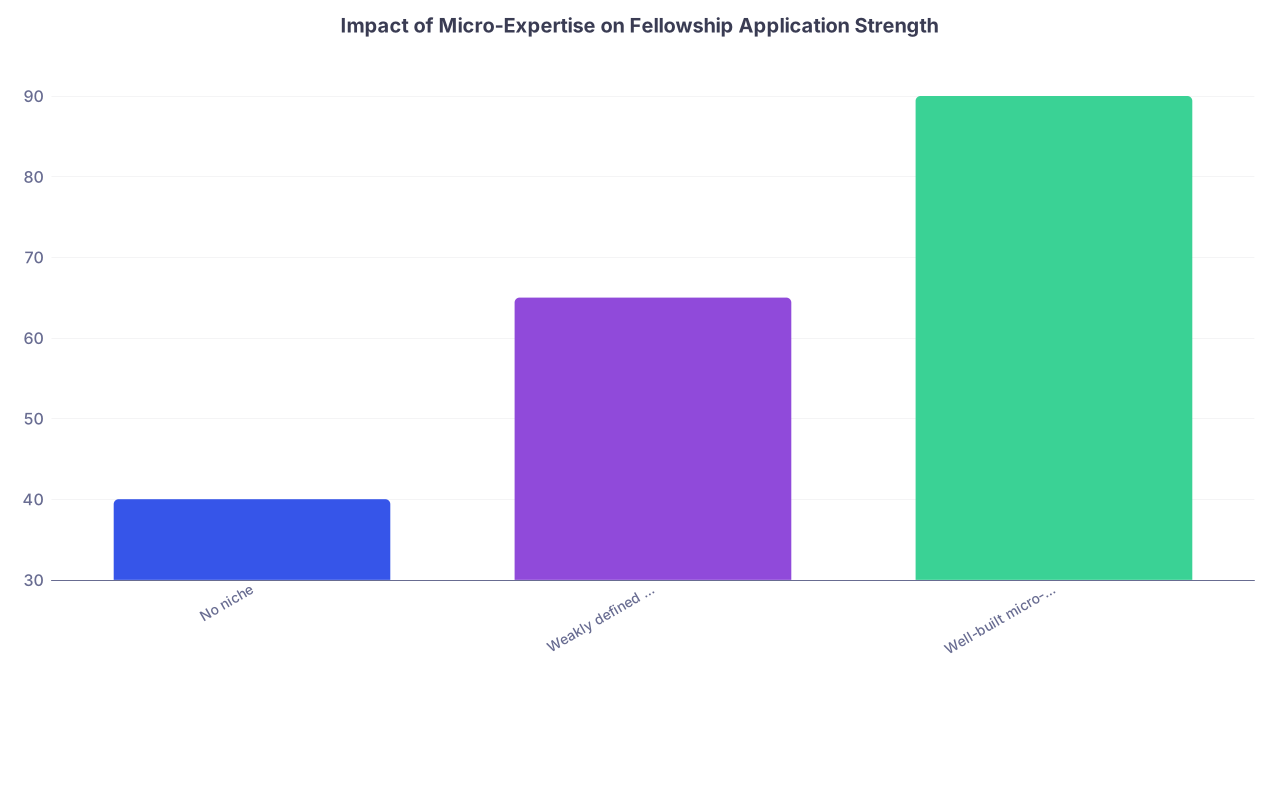
| Category | Value |
|---|---|
| No niche | 40 |
| Weakly defined niche | 65 |
| Well-built micro-expertise | 90 |
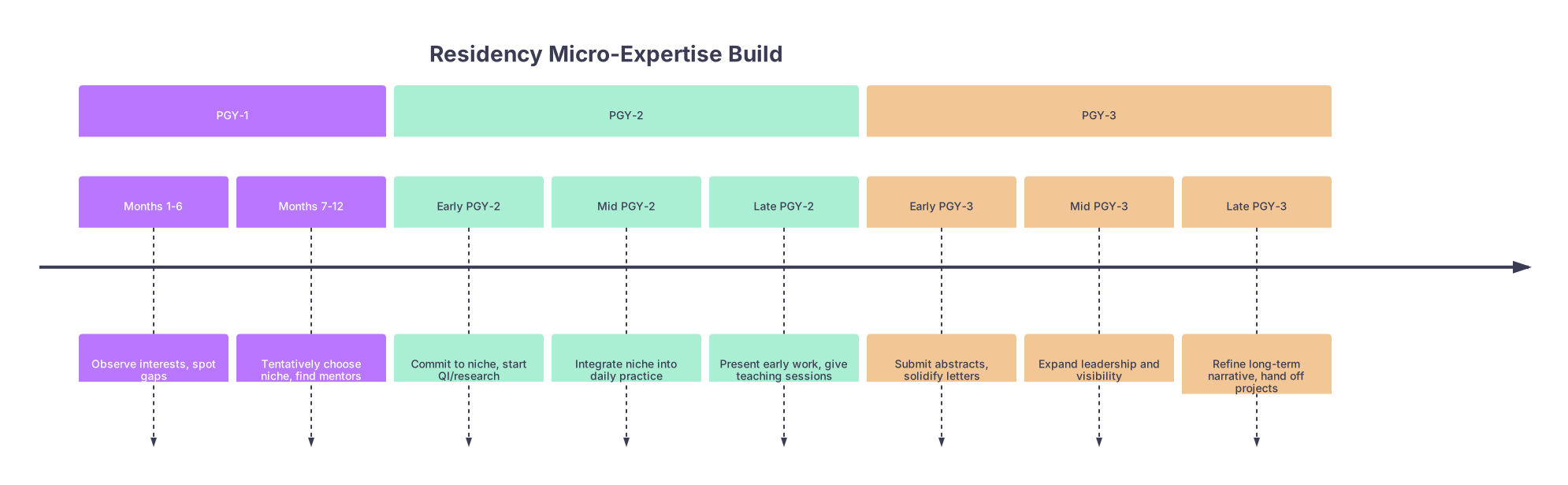
| Period | Event |
|---|---|
| PGY-1 - Months 1-6 | Observe interests, spot gaps |
| PGY-1 - Months 7-12 | Tentatively choose niche, find mentors |
| PGY-2 - Early PGY-2 | Commit to niche, start QI/research |
| PGY-2 - Mid PGY-2 | Integrate niche into daily practice |
| PGY-2 - Late PGY-2 | Present early work, give teaching sessions |
| PGY-3 - Early PGY-3 | Submit abstracts, solidify letters |
| PGY-3 - Mid PGY-3 | Expand leadership and visibility |
| PGY-3 - Late PGY-3 | Refine long-term narrative, hand off projects |
11. Putting It All Together: A Concrete Example
Let me stitch an end-to-end example so you see how this looks when it works.
Resident: PGY-2 in Internal Medicine, aiming for Pulm/CC
Micro-expertise: Ventilator weaning and sedation strategies in the MICU
PGY-1:
- Notices that vent weaning is inconsistent. Some attendings aggressively trial, others keep patients sedated and ventilated “until tomorrow.”
- Sees RTs frustrated by unclear plans.
- Jots down idea: “ICU vent liberation protocols – could be my thing.”
Early PGY-2:
- Meets with ICU director and a Pulm/CC faculty member known for QI.
- Project: Audit time from eligibility for SBT to actual SBT. Measure days on vent and ICU LOS.
- Starts personally taking charge of discussing vent settings and SBT readiness on rounds.
Mid PGY-2:
- Data show significant delays. Implements a simple checklist embedded in pre-rounding and a standardized ICU note template with a dedicated “weaning plan” section.
- Presents a short in-service to residents and RTs.
- Delivers a noon conference: “Avoiding unnecessary vent days – practical strategies for residents.”
Late PGY-2:
- Repeats the audit; sees reduction in median vent days and improved documentation.
- Submits abstract to ATS or SCCM.
- Gets faculty to co-author a short article in a QI or pulmonary journal.
Early PGY-3 (application time):
- CV shows: one major QI project, one abstract submitted/accepted, one education initiative, all on vent weaning/sedation.
- Letters from ICU director and Pulm/CC attending explicitly describe resident as “the driving force behind our vent liberation work” and “the resident we trust most with complex vent patients.”
- Personal statement opens with a story of a patient stuck on the vent for days due to unclear goals, tying that to system-level changes he helped implement.
On interview day, when asked about his interests, he does not say, “I like critical care.” He says, “Most of my work has focused on how we liberate patients from mechanical ventilation. At my institution, I led a project that reduced X… I hope to expand this kind of outcomes-focused work during fellowship, especially given your program’s strengths in Y.”
That reads as someone already halfway down the path.
Key Takeaways
- Micro-expertise is not a buzzword. It is a narrow, clinically grounded niche where you deliberately build superior practice, aligned projects, and visible leadership—so fellowship programs can see who you are becoming.
- The strongest fellowship applications show a coherent pattern: daily clinical behavior, QI/research, teaching, and letters all pointing to the same micro-domain. Most residents never bother to engineer that pattern.
- Choose one realistic, institution-supported niche, build it consistently across PGY-2 and PGY-3, and let everything—from CV to personal statement to interview answers—grow organically from that micro-expertise. That is how you stop being “good resident, generic interest” and start reading as “obvious future fellow in this field.”


