
Only 12–15% of residency applicants actually mention their morbidity and mortality (M&M) work in any meaningful way on fellowship applications—despite almost every resident being forced to present at least one.
That gap is your opportunity.
Most residents treat M&M as a dreaded requirement: assemble a case, read a few articles, survive the grilling, move on. Fellowship selection committees, however, are starved for real, concrete evidence that you understand quality, systems, and ownership of bad outcomes. M&M—if handled properly—can become one of the most powerful assets in your application portfolio.
Let me break this down specifically.
Why M&M is Undervalued (and Why Committees Care More Than You Think)
You and I both know the usual residency rhythm:
- Scramble to put together an M&M the week before.
- Over-focus on the clinical zebra, under-focus on system failures.
- Present once, get a few tough questions, move on. Never leverage it again.
Meanwhile, fellowship PDs are sitting with 400–800 applications that all sound the same: “I am passionate about X,” “I care about patient outcomes,” “I value teamwork.” Vague. Interchangeable. Forgettable.
What they almost never see is a resident who can show, not tell:
- “Here is a real harm event I owned.”
- “Here is the failure chain.”
- “Here is what we changed.”
- “Here is the outcome 6–12 months later.”
That is exactly what a well-structured M&M can document, if you mine it properly.
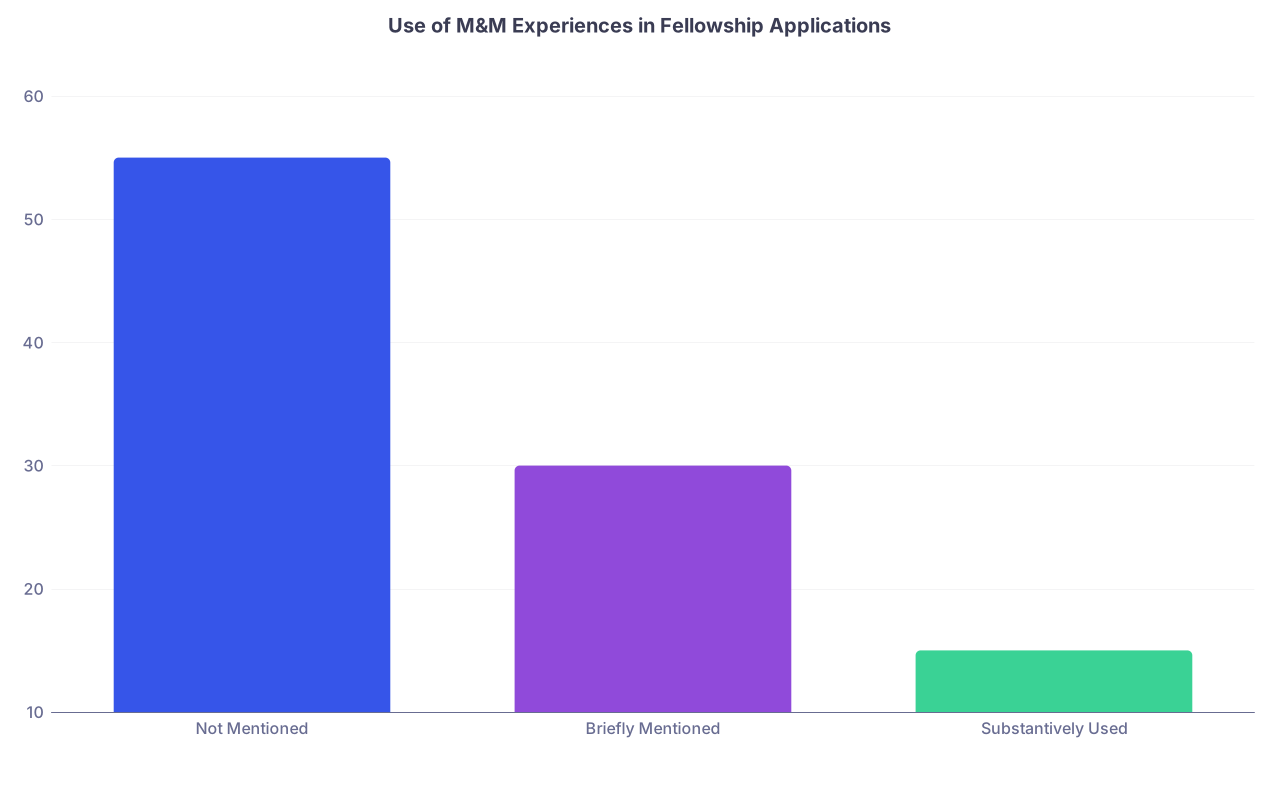
| Category | Value |
|---|---|
| Not Mentioned | 55 |
| Briefly Mentioned | 30 |
| Substantively Used | 15 |
The reality I have seen:
- Most M&M decks never become anything else.
- Residents rarely track post-intervention outcomes.
- Very few connect M&M work to QI projects, abstracts, or letters.
So the same experience that could demonstrate mature clinical judgment, systems thinking, and leadership instead dies in PowerPoint purgatory.
Your target is simple: move yourself into that 15% who use M&M substantively. And then into the top fraction of that group who back it with measurable change.
Step 1: Choose the “Right” M&M Case (Not Just the Most Dramatic One)
The worst M&Ms for applications are the ones residents love talking about: extreme zebras, catastrophic one-off events, or purely technical complications with no system component. Impressive clinically. Useless for fellowships.
For application value, the ideal M&M case has four elements:
A clear harm or near-miss that matters:
- Delayed diagnosis of PE due to anchoring on COPD exacerbation.
- Failed escalation in sepsis because of unclear responsibility overnight.
- ICU readmissions due to incomplete discharge communication.
A visible system failure:
- Handoff gaps.
- EMR design flaws.
- Protocols that exist but are not used.
- Role confusion between services.
A fix that is realistic:
- Standardized checklist.
- EMR order set change.
- New communication workflow.
- Simple protocol addition or clarification.
Outcomes that can be measured or at least monitored:
- Reduction in similar events.
- Improved time-to-intervention.
- Better documentation or adherence rates.
If you are early PGY-2 and you still have flexibility, be strategic. When your chief asks for M&M suggestions, do not blindly grab “interesting” cases. Grab fixable ones.
Examples of “high-yield for application” M&M topics:
- Recurrent DKA admissions due to inconsistent discharge planning.
- Repeat readmissions for heart failure due to poor follow-up coordination.
- Failure to escalate an abnormal overnight lab due to pager chaos.
These are gold because they easily convert into quality improvement (QI) and show system-level thinking—the exact language fellowship programs want to see.
Step 2: Design the M&M Like a QI Project from Day One
Most residents build M&M slides like a case report:
- HPI → hospital course → labs → imaging → complications → death or near-miss → “what we learned.”
That structure is fine for surviving the conference. It is terrible for reuse.
If you want to turn your M&M into application material, you need to structure it like the front end of a QI project. Even if you have not done the QI yet.
I usually push residents to frame their M&M using a modified QI structure:
- Case summary (brief, not the whole story)
- Problem statement
- Contributing factors (system + cognitive)
- Proposed interventions
- Outcome measures (even if future)
- Follow-up plan
Use a simple framework, for example:
- Problem: “Delayed recognition of septic shock in admitted patients on general wards.”
- Aim: “Within 6 months, reduce time to fluid resuscitation and antibiotics for ward patients with septic shock by 30%.”
- Drivers:
- Inconsistent vital sign monitoring.
- No clear escalation pathway.
- Unclear ownership overnight.

| Step | Description |
|---|---|
| Step 1 | M and M Case |
| Step 2 | Case Structured as QI |
| Step 3 | Identify Interventions |
| Step 4 | Implement Changes |
| Step 5 | Measure Outcomes |
| Step 6 | Abstract/Poster or QI Project |
| Step 7 | Used in Fellowship Application |
This framing does three things:
- It forces you to think like a systems person, not just a clinician.
- It creates a ready-made backbone for a later QI project or abstract.
- It gives you clean, crisp language for personal statements and interviews.
You are not just describing what went wrong. You are designing the fix in real time. That mentality is exactly what program directors in any procedural or non-procedural specialty want in a fellow.
Step 3: Convert One M&M into a Concrete QI Project
This is the inflection point where most residents drop the ball.
They present the M&M. They survive the questions. Then they never revisit the case. From an application perspective, that is like building a research database and never running the analysis.
The playbook is straightforward:
Right after your presentation, email the relevant people:
- Program director or associate PD.
- Unit director or nurse manager if the change involves a unit.
- QI officer or patient safety lead.
- Any attending who was involved and supportive.
Use very direct language:
- “I presented the case of [X] at last week’s M&M. I am interested in turning the identified issues into a formal QI project and would appreciate guidance / sponsorship.”
Propose one or two very specific, modest interventions:
- A standard escalation algorithm for hypotension on the floor.
- A simple order set for [common scenario], pre-populating key tests.
- A standardized sign-out template that addresses the identified failure point.
Define your metrics early:
- Process metrics: time to lactate draw, time to antibiotics, handoff completion rate.
- Outcome metrics: ICU transfers, readmissions, code blue events, length of stay.
Get onto the hospital’s QI radar:
- Get the project listed with your institution’s QI committee.
- Ask whether IRB review is needed if you might present externally.
- Identify a supervising faculty member who is already “a QI person.”
| M&M Theme | Process Metric | Outcome Metric |
|---|---|---|
| Delayed sepsis treatment | Time to IVF and antibiotics | ICU transfer, mortality |
| HF readmissions | Follow-up scheduled before discharge | 30-day readmission rate |
| Anticoagulation errors | Warfarin or DOAC reconciliation rate | Major bleed, thrombotic event |
| Missed critical labs | Time from lab result to provider note | RRT calls, ICU transfer |
Once you do this, your M&M is no longer “just a presentation.” It is the origin story of an institutional change you helped drive.
That origin story is application currency.
Step 4: Document Everything So You Can Use It Later
Fellowship applications are unforgiving in one very specific way: vague claims without documentation look like fluff. “I helped improve sepsis care at my hospital” is worthless if you cannot give numbers, roles, and specifics.
You want a paper trail. From day one.
What to keep:
- The original M&M slide deck (and save it under a sane name).
- Any emails showing you initiating or volunteering for follow-up.
- Meeting minutes where your intervention was discussed or approved.
- Before-and-after numbers on your primary metrics.
- Any educational materials you created (checklists, pocket cards, dot phrases).
- Dates of implementation and follow-up reviews.
That is how you transform your story from:
- Weak: “I presented an M&M on delayed sepsis recognition.”
To:
- Strong: “After presenting an M&M on delayed recognition of sepsis on the wards, I led a QI project implementing a standardized escalation algorithm and a sepsis order set. Over six months, median time to first dose of antibiotics decreased from 210 to 95 minutes, and ICU transfers for ward-onset sepsis fell by 18%.”
The latter jumps off a page in ERAS, SF Match, or whatever portal you are using. It also gives your letter writers concrete numbers to back you.
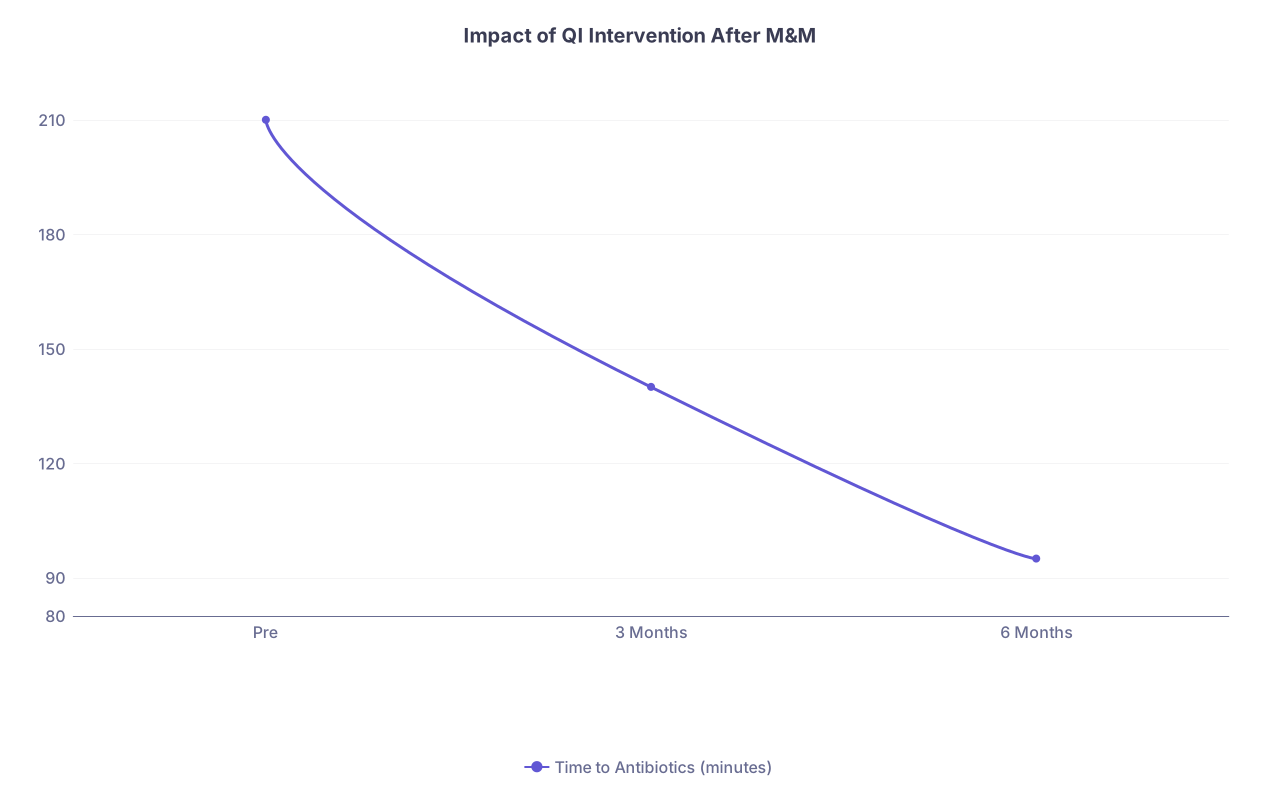
| Category | Time to Antibiotics (minutes) |
|---|---|
| Pre | 210 |
| 3 Months | 140 |
| 6 Months | 95 |
Do not trust that you will “remember the numbers.” In six months, you will be on nights, your brain will be mush, and you will guess. Guessing is how you end up with inconsistent numbers between your CV and your LORs. Committees notice.
Step 5: Where to Put M&M Work on Your Fellowship Application
Let’s go concrete. Here is exactly how M&M-related work can show up across your application components.
1. ERAS / Application CV Sections
You can leverage M&M work in three main CV areas:
Presentations:
- “Morbidity and Mortality Conference, Department of Medicine, ‘Delayed Recognition of Ward-Onset Sepsis’, Presenter, 2024.”
Quality Improvement / Leadership:
- “QI Leader, Ward Sepsis Pathway Development, Department of Medicine, 2024–2025.”
- Description: “Led multidisciplinary team to design and implement escalation algorithm and EMR order set for suspected sepsis on medical wards; reduced median time to antibiotics by 55% over six months.”
Teaching / Educational materials:
- “Developed and delivered resident-level teaching session on ward sepsis recognition and escalation, integrated into intern orientation.”
Do not bury your QI impact under “other.” If your specialty cares about systems and safety (cardiology, pulm/critical care, heme/onc, GI, etc.), put this in leadership / QI sections near the top.
2. Personal Statement
The mistake most residents make is dropping in a one-line mention of M&M as a throwaway.
Use one M&M case as a focused narrative if:
- It truly changed your practice or thinking.
- You can show growth (clinical judgment, humility, systems thinking).
- You can demonstrate follow-through (QI, education, measurable change).
Example structure:
- Opening paragraph: very concise description of the sentinel event (no melodrama, no identifying details).
- Middle: your discomfort / recognition of failure, then the systems analysis you did.
- Later: what you did after—M&M, QI project, education, institutional impact.
- Tie-in: how that experience shaped your choice of fellowship or your approach to that field.
Bad line: “Through this case, I learned the importance of communication and teamwork.”
Keep that off your page.
Better line: “The case forced me to confront how easily a stable ward patient can deteriorate unnoticed in a busy system that assumes ‘someone is watching.’ I stopped accepting ‘normal’ floor processes at face value and began asking how our system actually functions at 2 AM, not just on paper.”
You are not writing Hallmark. You are writing like someone who has seen real harm and chosen to do something about it.
3. Letters of Recommendation
One of the best uses of M&M work is seeding specific anecdotes in your letters.
Talk to your attending or PD who supervised the M&M or QI:
- Remind them of the specific case.
- Remind them of what you did afterward.
- Offer a 1-page bullet summary of:
- Case.
- Your presentation.
- Your interventions.
- The outcomes.
Good letters use phrases like:
- “After presenting a challenging M&M on a missed case of pulmonary embolism, [Name] took ownership of the issue and worked with our QI team to redesign our chest pain and dyspnea triage pathway.”
- “I was struck that [Name] did not treat M&M as a one-day exercise. They followed through for months, returning with data showing reduced time to diagnostic imaging and fewer unexpected ICU transfers.”
If you do not feed your writers this content, they will default to “hardworking team player.” Which means nothing.
Step 6: Using M&M in Fellowship Interviews Without Sounding Self-Serving
Interviews are where M&M work really shines—if you present it correctly.
You will get some version of:
- “Tell me about a clinical mistake you made or were involved in.”
- “Describe a time you saw a system failure.”
- “What is a project you are proud of that improved patient care?”
Pull from the M&M case–>QI arc.
Structure your answer ruthlessly:
- Brief case headline (two sentences max).
- The specific failure (system + your piece, if relevant).
- What you felt / realized (without over-sharing).
- Concrete steps you took.
- Measurable outcome or ongoing plan.
- How this changed how you practice now.
Example skeleton:
- “We had a patient admitted with presumed pneumonia who deteriorated overnight and was found to be in septic shock early the next morning.”
- “The M&M review showed that we had abnormal vitals documented for several hours with no escalation, and the on-call resident did not receive any direct notification.”
- “I felt uneasy that our default system relied on a nurse paging a covering resident who might be cross-covering 40 patients.”
- “After presenting this at M&M, I worked with our hospitalist and nursing leadership to design a standardized escalation protocol and added an EMR trigger for sustained hypotension.”
- “Over six months, time from first hypotensive reading to provider evaluation dropped from about 90 minutes to under 30.”
- “I now routinely ask about escalation pathways early when I rotate on new services. I have seen how fragile they are in real life.”
You are not the hero of the story. The system change is. You are the person who refused to let the case fade into memory.
That comes across as mature, not self-congratulatory.
Step 7: What If Your M&M Was a Mess or You Did Not Lead a QI Project?
Let’s be honest. Not every program has a healthy M&M culture. Some are blame-heavy, data-light, and hostile to QI follow-through. Or you were an intern, got assigned a gnarly case, and just survived it.
You still have options.
If the case was educationally high-yield, but no QI emerged:
- Use it as a growth story about clinical reasoning, humility, or communication.
- Focus on how it changed your day-to-day micro-practice (e.g., how you approach sign-out, code status, cross-cover calls).
If the M&M itself went badly (you were unprepared, defensive, overwhelmed):
- I have seen residents recover by later re-engaging with the topic:
- Join or initiate a more modest QI or education effort later (e.g., write a one-page guideline, give a short intern talk).
- Then the story becomes one of professional development: “I fumbled that first M&M. It stung. Here is how I came back from it.”
- I have seen residents recover by later re-engaging with the topic:
If you never presented at M&M:
- You can still use cases you participated in or attended as part of your narrative.
- Just be absolutely clear about your role:
- “I was the covering resident on call when…”
- “I was a member of the care team…”
- Avoid implying you were the primary or the lead if you were not.
Do not fabricate QI. Committees can tell when a “project” is just a name on a poster with no depth behind it.
If you did not lead the intervention, you can still describe what you personally changed in your own practice as a result. Done well, that can still be powerful.
Specialty-Specific Angles: How Different Fellowships Read M&M
You are not applying into a vacuum. Different specialties interpret M&M content through different lenses.
| Fellowship Type | What They Look For in M&M Stories |
|---|---|
| Cardiology / GI | Risk stratification, high-acuity decisions |
| Pulm/CCM / MICU | Systems-level escalation, ICU triage |
| Heme/Onc | Goals of care, communication, ethical nuance |
| Surgical fields | Technical + process analysis, ownership |
| Hospital Medicine | QI, sepsis, readmissions, care transitions |
If you are going into:
Cardiology or GI:
- Emphasize risk stratification, procedure timing, coordination between services, and managing adverse events.
- Example: delayed recognition of NSTEMI, GI bleed triage to ICU.
Pulm/CCM:
- Focus heavily on escalation pathways, ICU transfer criteria, code response, ventilator-related M&M.
- Lean into system design: RRT structures, airway response, etc.
Heme/Onc:
- Use M&M cases around neutropenic sepsis, chemotherapy complications, bleeding, or goals-of-care failures.
- Show nuance in balancing aggressive care vs. palliation, and how communication failed or succeeded.
Surgical subspecialties:
- Technical complications are fair game, but you must talk about cognitive steps, pre-op planning, and post-op systems.
- Not just “stuff happens in the OR.”
Match your case and your framing to what your future field actually deals with daily.
The Quiet Multiplier: Turning One M&M into Multiple Application Assets
Let’s step back.
One well-handled M&M case can give you:
- 1 conference presentation (your original M&M).
- 1–2 internal QI presentations (resident report, QI committee).
- 1 poster at a regional or national meeting.
- 1 QI project listed on your CV.
- 1 strong anecdote in your personal statement.
- 1 or more concrete stories for interviews.
- 1 anchor example for a letter writer.
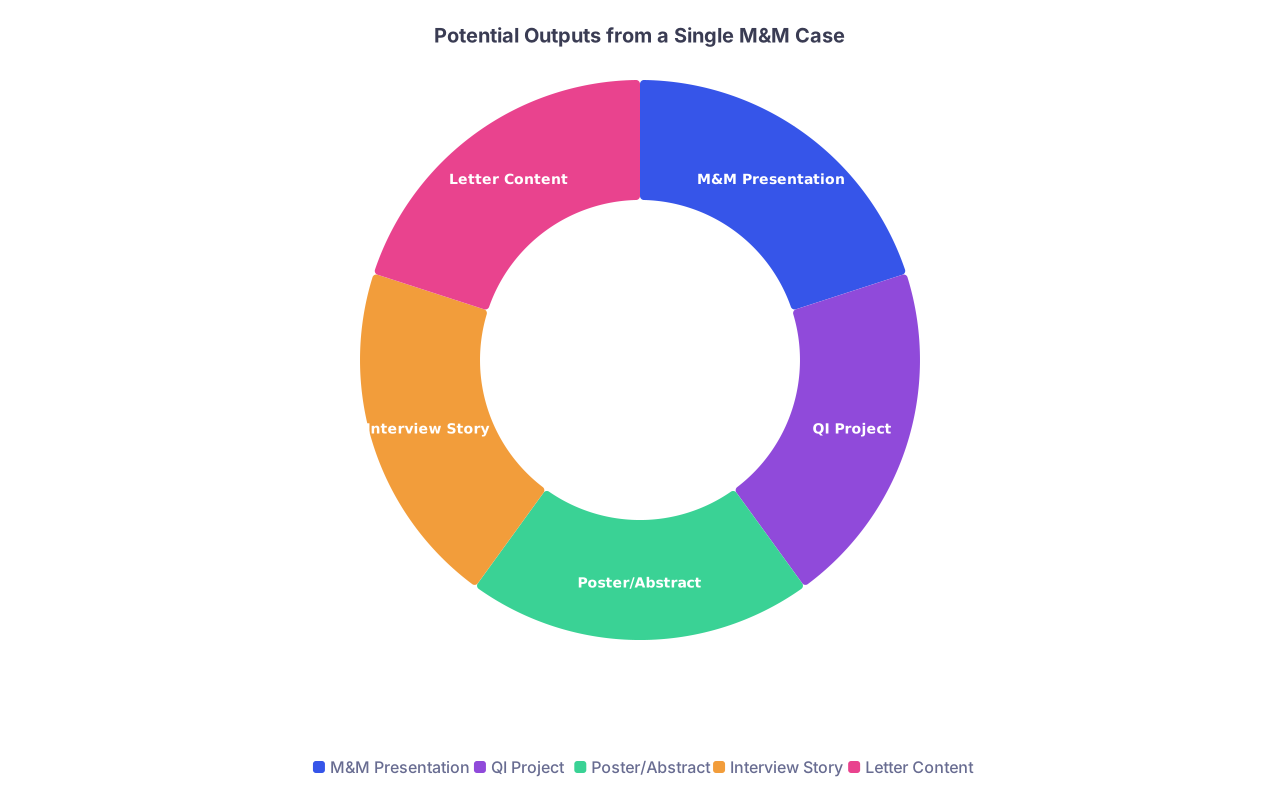
| Category | Value |
|---|---|
| M&M Presentation | 1 |
| QI Project | 1 |
| Poster/Abstract | 1 |
| Interview Story | 1 |
| Letter Content | 1 |
That is ridiculous ROI compared to yet another generic retrospective chart review where you are the fourth author.
Residents who get this early—usually mid PGY-2—show up to fellowship season with:
- Real institutional change stories.
- Data.
- Letters that sound different from the pack.
Residents who do not treat M&M strategically show up with:
- “I am hard working.”
- “I am a team player.”
- “I am passionate about [insert specialty].”
Guess which group program directors remember at rank list time.
Two Final Warnings
First: protect patient confidentiality obsessively.
- No names, ages that are too specific, dates, or details that could identify a real patient.
- When you present externally (poster, abstract) check with your institution’s rules about case-based material, especially if the harm event was significant.
Second: do not over-dramatize or over-own.
- Do not portray yourself as the single savior who “fixed the hospital.”
- Do not imply you coded patients alone as an intern, or rewrote hospital policies by yourself.
You are part of a team. You led where appropriate. You followed through. You measured. That is enough.
Key Takeaways
Treat every M&M as a potential origin story for a formal QI project, not a one-and-done obligation. Pick cases with actionable system failures and measurable outcomes.
Document your follow-through—interventions, metrics, presentations—so you can convert a single M&M into multiple application assets: CV entries, a compelling personal statement narrative, concrete interview stories, and stronger letters.
Frame your M&M work in the language your target fellowship values: systems thinking, ownership of harm events, data-backed improvement, and honest reflection that changes how you practice—not generic “teamwork and communication.”