

Most residents waste their research time chasing volume instead of building a niche. That is a strategic mistake.
If you want a competitive fellowship, you do not need a dozen random posters. You need a mini-niche — a small, coherent area where, on paper, you look like you know what you are doing.
Let me break this down specifically.
1. What a “Mini-Research Niche” Actually Is (And Is Not)
A mini-research niche is a tightly defined, fellowship-relevant theme that shows up repeatedly in your output over 2–4 years. It does not require R01-level depth. It does require pattern and intent.
Think of it as:
“Within my specialty, I consistently work on X problem in Y patient group using Z type of project.”
Concrete examples:
Internal Medicine resident aiming for Cardiology:
- “Risk stratification and outcomes in heart failure patients admitted through the ED”
- X = risk stratification, Y = HF in acute care setting, Z = retrospective cohort / QI with outcomes
Pediatrics resident aiming for PICU:
- “Ventilation and sedation strategies in mechanically ventilated children”
- X = ventilation/sedation, Y = PICU kids, Z = observational studies + protocol/QI projects
General Surgery resident aiming for Surgical Oncology:
- “Perioperative outcomes in minimally invasive GI cancer surgery”
- X = perioperative outcomes, Y = GI oncology cases, Z = NSQIP-type database + single-center cohorts
What it is not:
- Random collection of “whatever my attending has going on”
- Five unrelated case reports across five different disease areas
- One big project that never finishes and nothing else
Fellowship committees are pattern-recognition machines. When they scan your CV, they should be able to summarize you in one sentence:
“PGY-3 from University X, clearly focused on [micro-niche].”
If they cannot do that, you have no niche.
2. How Fellowship PDs Actually Look at Your “Research Story”
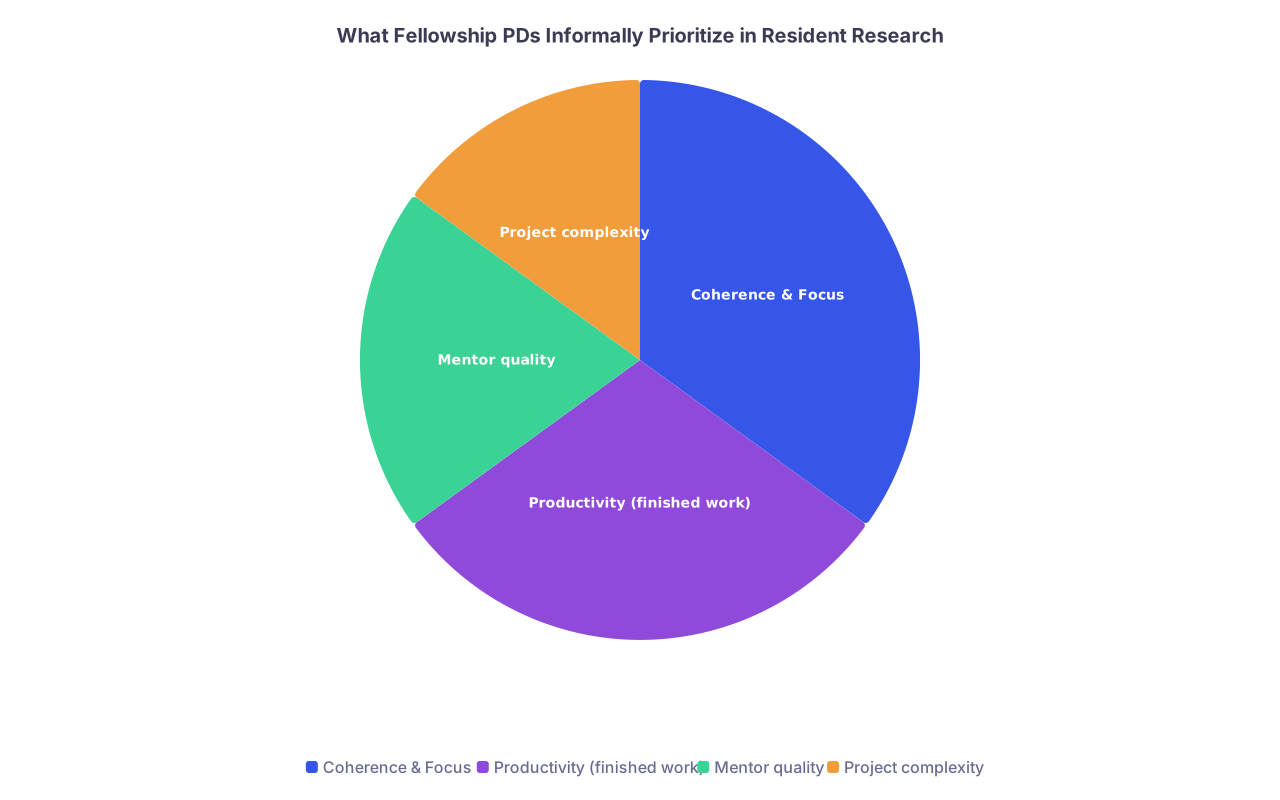
They do not care how many late nights you spent in the call room “doing stats.” They care about:
Coherence:
Do your projects talk to each other, or are they scattered?Trajectory:
Did you start small and then increase complexity or responsibility?Relevance:
Does this obviously connect to the fellowship’s clinical focus?Execution:
Did things actually get finished — abstracts, posters, publications?
| Category | Value |
|---|---|
| Coherence & Focus | 35 |
| Productivity (finished work) | 30 |
| Mentor quality | 20 |
| Project complexity | 15 |
Most residents get this backwards. They chase complexity (big database projects, fancy stats) before proving they can:
- Choose a lane
- Finish work
- Turn ideas into products on a deadline
Your mini-niche is the shortcut. It turns a messy list of activities into a clean arc:
- PGY-1: Case report / QI / small retrospective in niche
- PGY-2: Bigger retrospective or multi-year cohort in same niche
- PGY-3: Secondary analyses, review paper, guideline-ish QI, or pilot prospective study in same niche
That arc reads very well on a fellowship application.
3. Step 1: Choosing the Right Niche (Without Wasting a Year)
You do not need to “find your passion.” You need to choose a strategic, workable niche that:
- Aligns with your target fellowship
- Fits your institution’s existing strengths
- Has accessible data or patients
- Has at least one mentor who cares about it more than you do
Start with your end fellowship and work backwards
Examples:
- You want GI (advanced endoscopy):
- Candidate mini-niches:
- “Outcomes and complications of ERCP/EUS in older adults”
- “Management patterns for Barrett’s esophagus at our center”
- Candidate mini-niches:
- You want Heme/Onc:
- Candidate mini-niches:
- “Thrombosis and anticoagulation in cancer inpatients”
- “Patterns of neutropenic fever management and outcomes”
- Candidate mini-niches:
How to pick in 2–3 conversations instead of 20
Do this early PGY-1 or at worst early PGY-2:
- Identify 3–5 attendings who routinely publish in your target fellowship area.
- Email something like:
- “I am interested in Cardiology fellowship, especially heart failure and inpatient care. I would like to develop a focused research area during residency. Can we briefly discuss where your group sees ongoing data sets or question areas a resident can own?”
- In each meeting, ask directly:
- “If you had to suggest one subtopic where a motivated resident could become ‘the person’ over 2–3 years, what would it be?”
You are looking for:
- Repeated themes across mentors
- Ongoing data sources (registry, EMR pulls, local database, QI dashboards)
- A mentor who says things like “We have a lot of unmined data on X”
Between three such conversations, a niche almost always emerges.
4. Step 2: Defining Your Mini-Niche in One Sentence
If you cannot write a clear, one-sentence niche statement, your aim is still blurry.
Use this template:
“I focus on [clinical problem] in [specific population or setting], using [project types] to study [outcomes or questions].”
Examples:
“I focus on anticoagulation management in hospitalized cancer patients, using retrospective EMR cohorts and QI projects to study bleeding and thrombosis outcomes.”
“I focus on acute decompensated heart failure in ED and inpatient settings, using multi-year retrospective cohorts and decision-support QI to study readmission and mortality.”
Write this sentence down. Put it in your email signature blurb for mentors. Reference it when you say yes or no to projects.
If a proposal does not fit that sentence, you need a very good reason to accept it.
5. Step 3: Building a 3-Year Niche Roadmap (By PGY Level)
You are balancing call schedules, wards, exams, and life. Fine. That means the research plan has to be ruthlessly realistic.
Here is a model 3-year progression for a resident targeting Pulm/CC, with a mini-niche in “non-invasive ventilation in acute respiratory failure”:
| PGY Level | Project Type | Scope / Output |
|---|---|---|
| PGY-1 | Case series + QI pilot | 1 abstract, local poster |
| PGY-2 | Retrospective cohort | 1 national poster, manuscript |
| PGY-3 | Secondary analysis + review | 1 manuscript, invited talk |
The structure is similar across specialties:
PGY-1 (Exploration + quick wins):
- One or two tightly scoped projects with fast turnaround:
- Case report or small series in your niche
- QI pilot that uses existing flowsheets or dashboards
- Goals:
- Learn your mentor’s workflow
- Learn IRB basics
- Get your name on at least one submission by the end of PGY-1
PGY-2 (Core niche output):
- Main retrospective or database project anchored in your niche
- Possibly one spin-off abstract (secondary endpoint / subgroup)
- Goals:
- At least one national meeting abstract
- One manuscript submitted before fellowship application season
PGY-3 (Polish + depth):
- Refine or extend what you already did:
- Secondary analysis of the same cohort on a new question
- Systematic or focused review on your micro-topic
- Guideline or protocol implementation based on your QI
- Goals:
- Show “maturation” of your niche
- Have something to talk about at interviews that sounds longitudinal, not random
This is the pattern that makes PDs say during file review:
“They did X, then built on it with Y, and now they are working on Z. Clear direction.”
6. Step 4: Designing Projects That Actually Get Finished
Most resident projects die in three places:
- IRB hell
- Data extraction purgatory
- “We will write it up later” graveyard
You avoid that by choosing project formats that match your actual life as a resident.
Project types that are realistic in residency
Ranked from easiest to hardest to complete during training:
- Case reports / small series tied to your niche
- Chart-review QI projects using existing institutional dashboards
- Single-center, retrospective cohorts using relatively simple data fields
- Multi-year or multi-center database projects (only with strong infrastructure)
- Prospective interventional trials (almost never resident-led alone)
If you are PGY-1 with no experience and your first project is a manually abstracted, 2,000-patient chart review with 60 fields — that project is already dead. You just do not know it yet.
Better approach:
- Start with a 100–200 patient cohort with 10–15 essential variables.
- Use that as the pilot.
- Show your mentor you can actually deliver.
- Then expand if needed.
7. The Mentor Matrix: One Niche, Multiple Roles
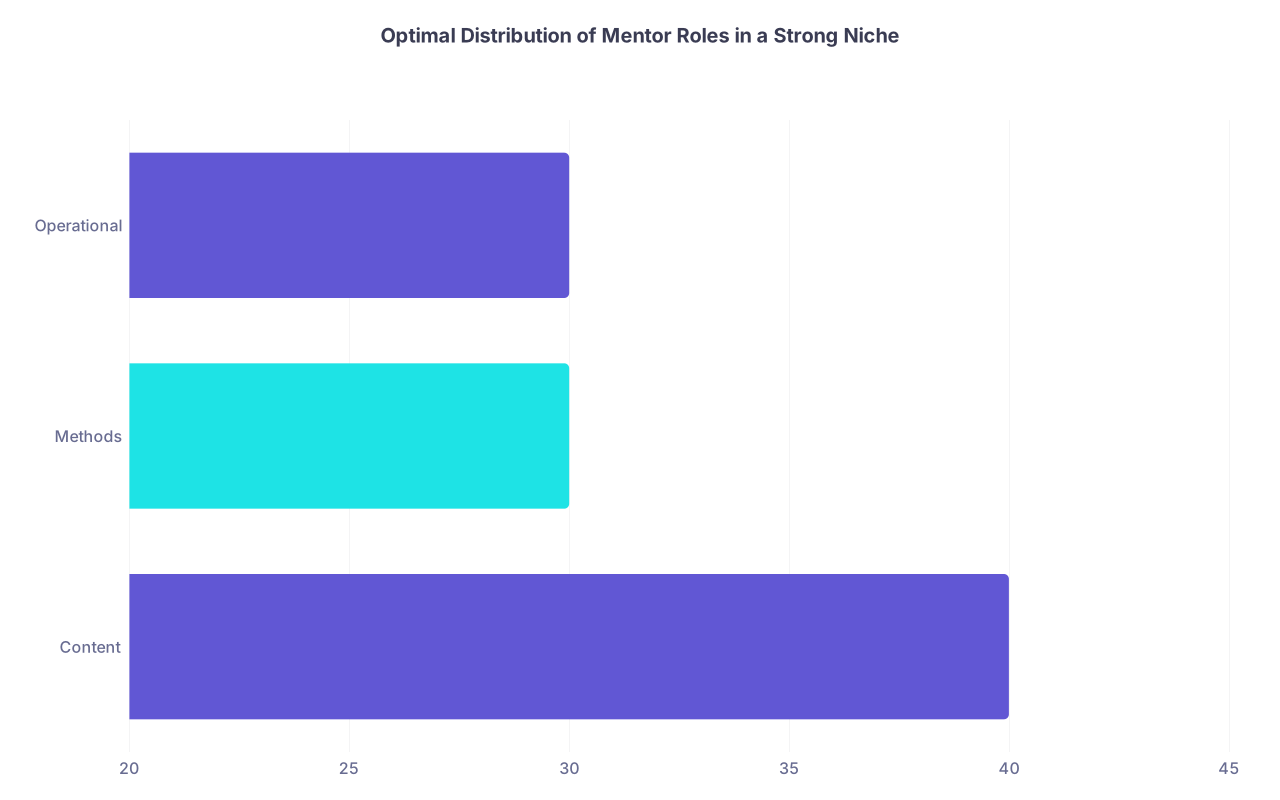
You do not need a single “god-mentor.” That person is often too busy anyway. You need a small mentor matrix aligned with your mini-niche:
- Content mentor:
- Deep in the clinical topic; ensures your questions are meaningful
- Methods mentor:
- Knows stats, study design, or QI methodology
- Operational mentor:
- Helps with IRB, data requests, local politics, getting things unblocked
| Category | Value |
|---|---|
| Content | 40 |
| Methods | 30 |
| Operational | 30 |
Sometimes this is one person. Usually not. The residents who move fastest are the ones who explicitly map this:
- “Dr. A is my heart failure content mentor.”
- “Dr. B (hospitalist with MPH) is my methods/statistics person.”
- “Dr. C (QI director) gets my QI and EMR access unstuck.”
You then intentionally route questions to the right person instead of dumping everything on one overwhelmed PI.
8. Saying “No” Without Burning Bridges
You will be offered garbage projects. Random case reports. Half-dead chart reviews from three years ago. “All you have to do is finish the writing” specials.
If you say yes to all of them, your niche evaporates.
Script you can use:
- “This is interesting, but I am trying to build a focused research area in [your niche one-liner] for fellowship. Is there a way to angle this project toward that area? If not, I may not be the best person to lead this, but I can help connect with other residents who might be interested.”
This does three things:
- Signals that you are focused, not lazy
- Provides an out without insulting the project
- Starts training people to associate you with your niche topic
You can take one or two off-niche things if they are low-effort and high-yield (e.g., second- or third-author on something nearly done). Just do not let them derail your capacity for the core niche projects.
9. Turning One Dataset into Multiple Products
A core skill of mini-niche design is efficient reuse. You do not want five entirely separate projects. You want:
One main cohort / QI effort → several outputs.
Example: IM resident, Cardiology niche: “Acute decompensated heart failure admissions.”
Single EMR cohort of 500 patients could yield:
- Primary paper:
- Predictors of 30-day readmission and mortality
- Secondary abstract:
- Subgroup of CKD patients and their outcomes
- QI project:
- Intervention on discharge education and follow-up; pre/post comparison using same cohort as baseline
- Review article:
- “Readmission reduction strategies in acute heart failure: a practical overview”
The trick is to plan this before data collection. During design, you and your mentor identify:
- Primary question
- 1–2 secondary questions
- Potential subgroups for later abstracts
That is how you build density in your mini-niche without multiplying your workload by five.
10. Integrating Research with Clinical Life (Without Imploding)
You will not “find free time” in residency. You will create protected pockets and defend them.
Two patterns that consistently work:
The “fixed weekly block” model:
- E.g., Every Thursday 2–5 pm on elective or clinic-lite days is research time.
- You tell your team and mentor: “This is when I work on our project.”
- You batch IRB, writing, and data work into that slot.
The “rotation-based sprint” model:
- During ICU or wards: almost no research. Just small maintenance tasks (emails, small edits).
- During elective / outpatient blocks: aggressive research sprints — IRB submissions, data cleaning, drafting.
Residents fail when they imagine they will consistently write after a 28-hour call. No. You will watch YouTube and eat cereal.
Plan around your humanity, not your fantasy.
11. Making Your Niche Obvious on Paper for Fellowship
You can do all of this work and then hide it in a chaotic CV. Do not.
Make the niche explicit across:
CV structure:
- Under “Publications / Abstracts,” group or annotate by topic:
- “Publications – Heart Failure and Acute Care”
- “Publications – Other”
- Under “Publications / Abstracts,” group or annotate by topic:
-
- First paragraph: one or two sentences about your clinical interest.
- Early middle: 3–4 lines summarizing your mini-niche in plain language, then highlight 1–2 key projects and what you learned, not just what you did.
Letters of recommendation:
- Ask your mentors explicitly:
- “Would you be comfortable commenting on my development of a focused research area in [niche] and my ability to carry projects from idea to submission?”
- Ask your mentors explicitly:
If three different letters mention your focused work in “anticoagulation in hospitalized cancer patients,” that sticks in the committee’s mind.
12. Common Pitfalls That Kill Mini-Niches
I have watched residents do all of these. Repeatedly.
- The “new shiny idea every month” resident:
- Ten project starts, zero finishes. On ERAS it reads as “unreliable.”
- The “over-scope the first project” trap:
- Massive dataset, complex stats, no analyst support. Two years later: nothing.
- The “single-mentor dependency” problem:
- When that PI goes on sabbatical, your entire research life collapses.
- The “all-QI with zero dissemination” pattern:
- QI is fine, but if nothing leaves your institution (no abstracts, no manuscripts), fellowship PDs barely see it.
- The “late start” issue:
- Beginning niche work at late PGY-2 and expecting a strong application for competitive fellowships. Harsh reality: you are already behind.
You avoid most of these by:
- Picking a realistic scope early
- Building a small mentor matrix
- Designing for at least one external product (abstract / paper) per major project
- Ruthlessly finishing what you start before opening new lanes
13. Quick Specialty-Specific Mini-Niche Examples
To make this more concrete, here are some focused, realistic niches by specialty and fellowship:

Internal Medicine:
- Cardiology:
- “Risk stratification and quality metrics in heart failure admissions”
- GI:
- “Patterns and outcomes of upper GI bleeding management in community vs. academic settings”
- Heme/Onc:
- “VTE prophylaxis and bleeding risk in hospitalized oncology patients”
Pediatrics:
- NICU:
- “Non-invasive respiratory support strategies in late preterm infants”
- PICU:
- “Sedation and delirium screening practices in mechanically ventilated children”
General Surgery:
- Surgical Oncology:
- “30-day outcomes after minimally invasive colorectal cancer resections”
- Trauma/Critical Care:
- “Resuscitation and transfusion strategies in blunt trauma patients”
Anesthesiology:
- Critical Care:
- “Postoperative respiratory failure and reintubation predictors in high-risk surgeries”
- Cardiac Anesthesia:
- “Hemodynamic management patterns in complex valve surgeries and their short-term outcomes”
Do not copy these exactly. Use them as models for the correct scale and tightness of a mini-niche.
14. How to Recover if You Are Already PGY-2 or Early PGY-3
If you are late and scattered, your job is not to pretend you had a niche all along. Your job is to retrofit coherence as best as possible.
Steps:
- Inventory everything you have touched:
- List all projects, even half-finished ones.
- Look for natural clusters:
- Maybe 3 out of 6 things are all about “hospitalized heart failure” or “infectious complications” or “perioperative outcomes.”
- Choose the richest cluster as your “retroactive niche.”
- Pour your remaining time into:
- Finishing those projects
- Framing your narrative around that cluster
- Letting the other scattered things quietly fade into the background
One decent-looking cluster is better than 10 totally unrelated titles.
15. The Bottom Line: What You Want a PD to Say in 8 Seconds
Fellowship application review is fast. Often brutal. 30–60 seconds per file on first pass.
You want the PD, skimming your ERAS, to be able to say:
- “They are clearly interested in [fellowship area].”
- “They developed a focused research niche in [micro-topic].”
- “They worked with strong mentors and actually finished things.”
You get there not by being a research superstar, but by:
- Choosing a small, realistic topic
- Building 2–3 years of progressively deeper work in that area
- Making that pattern painfully obvious on your CV and in your statements
That is a mini-research niche. And it is one of the highest ROI moves you can make during residency if you care about a strong fellowship match.
FAQs
1. How many niche-related publications do I actually need for a competitive fellowship?
For most fellowships, 1–2 first-author niche-related papers plus 1–3 additional products (posters, co-authorships, reviews) are enough to look serious. Some top-tier or highly competitive fields will expect a bit more, but the pattern and relevance matter more than raw count. A single strong, clearly aligned manuscript can outweigh three random case reports.
2. Can a QI-focused mini-niche be enough, or do I need “pure” research?
A QI-focused niche can absolutely work, especially in hospital medicine, critical care, EM, and some procedure-heavy fellowships. The catch: you must disseminate. That means abstracts at regional/national meetings, manuscripts in QI-oriented journals, or implementation reports. Purely internal QI with no external products is weak on paper.
3. What if my institution has almost no research infrastructure in my desired fellowship area?
Then you have three options: align slightly closer to what your institution does have (easiest), find external collaborators or multi-center networks that accept resident involvement, or build a smaller, QI-leaning niche that uses your own hospital’s data even without a big research machine. Waiting for perfect infrastructure is how people graduate with nothing.
4. How much should I talk about my mini-niche vs. general clinical interests in my personal statement?
Roughly one-third of a strong fellowship personal statement can be about your mini-niche: why you chose it, what you actually did, and how it shaped your thinking. Another third should cover your broader clinical motivations and experiences. The rest can outline your future direction and what you are looking for in a fellowship. If the research section is vague or feels like an afterthought, you underused a major asset.


