
43% of fellowship program directors say “poorly structured or unconvincing case logs” are a major reason they downrank an otherwise qualified applicant.
Not low volume. Not lack of research. The story your cases tell. Or fail to tell.
Let me be blunt: most residents treat their case log like a duty-hour attestation. Click, submit, forget. Then they are shocked when a PD looks at the same “evidence” and concludes they are not fellowship-caliber.
You are not just logging cases. You are building a quantitative argument that you are already functioning like a junior fellow in your target field.
Here is how to structure that argument so it actually lands.
Step 1: Decide What Story Your Case Log Must Prove
Before we talk numbers or spreadsheets, you need to decide what your fellowship case log is supposed to demonstrate.
Fellowship PDs are not asking, “Did this resident do some cases?” They are asking:
- Do the numbers and roles match what this person claims on their personal statement and letters?
- Has this resident already moved beyond “generic resident” into a proto-fellow in my niche?
- Will this person walk in on day 1 and slow us down… or speed us up?
So you reverse-engineer your case log from those questions.
Here is the mental model I use with residents:
- Baseline competence – You have the expected breadth and minimum volume for your primary specialty.
- Focused depth – You have a clear tilt toward your target fellowship area, not random scatter.
- Progression of autonomy – You did not spend 3 years assisting. Your role evolved.
- Environment and complexity – Your numbers mean something. 200 bread-and-butter community cases ≠ 200 tertiary-complexity cases.
- Consistency with your file – Letters, personal statement, CV, and case log should be obviously talking about the same person.
If your raw ACGME output does not clearly support those five points, you fix that with structure and supplemental detail. Not with spin.
Step 2: Know What PDs Actually Look For by Specialty
This is where residents get sloppy. They assume “more volume = better” and miss what matters for fellowship.
Let me narrow it down by some common fellowship types. These are patterns I have seen PDs explicitly comment on when they flip through logs or ask questions at interview.
| Fellowship Type | PD Focus in Case Logs |
|---|---|
| Surgical Oncology | Complex resections, index cases, role |
| GI / Advanced Endoscopy | Therapeutic procedures, independence |
| Interventional Cardiology | Primary operator PCI, complex cases |
| Critical Care | Procedures + longitudinal ICU exposure |
| Pediatric Subspecialty | Age mix, acuity, procedure comfort |
Surgical / Procedural Fellowships
Whether it is surg onc, MIS, vascular, transplant, advanced endoscopy, or IR – PDs are scanning for:
- Index cases in that field – Whipple, esophagectomy, complex colorectal, advanced laparoscopy, EVAR, TACE, complex PCI, high-risk EP, etc.
- Operator role – Not scrubbed “somewhere in the room.” Primary surgeon vs first assist vs observer.
- Trajectory – Did you start as assistant and gradually become primary on similar case types?
- Case clustering – A block of time where you clearly lived in that service (e.g., a surg onc-heavy chief year).
If your “advanced endoscopy” application is built on 18 supervised ERCPs where you did only cannulation on half of them, a sharp PD will spot that in seconds.
Medical Fellowships
Cards, GI, Heme/Onc, Pulm/CC, ID, etc. Here the log matters differently.
They care about:
- Procedures and comfort – TTE/TTE reads, stress tests, bronchoscopies, LPs, bone marrow biopsies, paracenteses, chest tubes.
- Setting – ICU vs wards vs consult, tertiary center vs community rotation.
- Acuity and responsibility – Were you managing the sickest patients, or mostly doing morning notes and moving on?
Pure “number of patients seen” is less helpful. Breadth of pathology + procedures + environment carries more weight.
Step 3: Fix the Core Problem – Your ACGME Log Is Not Built for Fellowship
The official ACGME / residency logging system is designed to prove you are safe and competent to graduate, not to advertise your subspecialty value.
On its own, it is too:
- Broad
- Ungrouped
- Context-free
- Role-agnostic (in practice, even if fields exist)
So you treat the official log as raw data. Then build a fellowship-focused case summary on top of it.
That summary can live as:
- A polished PDF you bring to interviews.
- A one-page “Key Cases and Experience” addendum some programs will accept as upload.
- Talking points you consistently reference when PDs ask about experience.
You do not alter the official log. You reinterpret it.
Step 4: Build a Fellowship-Focused Case Summary (Structure That Works)
Here is the structure I recommend, and that PDs actually understand quickly.
1. One-Line Context Header
At the very top, 1–2 lines:
“PGY-3 Internal Medicine resident at [Institution], applying for Pulmonary/Critical Care. Training at a 750-bed quaternary center with level 1 trauma and ECMO program. Below is a summary of experiences directly relevant to Pulm/CC fellowship.”
That sets the stage: training type, institutional complexity, your goal.
2. A Tight, Quantitative Overview Box
Right under the header, you put a succinct numbers snapshot tailored to the fellowship. Not your entire life’s work. Just what matters for that subspecialty.
Something like:
Pulmonary / Critical Care–Relevant Experience (as of Dec PGY-3)
– 28 total months with >50% time in ICU settings (MICU, SICU, CCU)
– Primary decision-maker overnight for ~120 high-acuity ICU admissions
– Procedures (primary operator): 45 bronchoscopies, 65 central lines, 80 arterial lines, 30 chest tubes, 12 percutaneous tracheostomies
– Led daily multidisciplinary rounds in MICU for 6 months as senior resident
Or for GI:
Gastroenterology–Relevant Experience (as of Jan PGY-3)
– 6 months GI consult service (high-volume tertiary center)
– Endoscopy exposure: 220 EGDs, 190 colonoscopies, 35 PEGs, 20 ERCPs, 10 EUS; primary scope operator on 140 EGDs, 120 colonoscopies
– Weekly IBD clinic longitudinal experience for 9 months
– Independent on-call management for GI bleeds after midnight for 120 nights
You want anyone reading this to be able to decide, in 30 seconds, “Yes, this person lives in my world.”
Now you back that snapshot up with structure.
3. Thematic Sections Aligned to Fellowship Expectations
This is where most people blow it. They just export by CPT code or rotation. That is noise.
Instead, you group cases into themes that mirror how PDs think:
- By procedure type (diagnostic vs therapeutic)
- By disease category (malignancy types, IBD, structural heart, etc.)
- By complexity (elective vs emergent, single-vessel vs left-main / multi-vessel PCI)
- By setting (OR vs cath lab vs ICU vs endoscopy suite)
For example, for surgical oncology:
A. Upper GI / HPB Oncology
– 16 pancreatic resections (6 Whipple, 10 distal pancreatectomy) – 8 as primary surgeon for resection portion under supervision
– 9 major liver resections (segmentectomy or greater), 3 as primary surgeon for parenchymal transection
– 12 gastrectomies for malignancy, 7 laparoscopic, 5 open – 6 as primary surgeon for reconstruction
B. Colorectal Oncology (Malignant Cases Only)
– 32 low anterior resections (15 open, 17 laparoscopic / robotic) – 12 as primary surgeon for the entire case under attending supervision
– 18 abdominoperineal resections – 9 as primary surgeon for abdominal portion, 6 for perineal portion
– 40 colon resections for malignancy (excluding diverticular / benign) – 22 as primary surgeon
You are not listing every single case. You are curating and aggregating in a way that highlights:
- Case type
- Malignant vs benign when that matters
- Your role
- Technical complexity
Same idea for interventional cardiology:
Complex Coronary Interventions
– 60 PCI as first operator (wire and device manipulation), 15 involving left main or bifurcation lesions
– 18 CTO attempts, 7 successful – active secondary operator in all, responsible for wire escalation and microcatheter manipulation in 10
– 40 STEMI activations with door-to-balloon <90 min, 25 where I was primary operator after initial wiring
That reads like someone who lives in the cath lab, not just a general cards resident who followed along.
Step 5: Show Progression of Autonomy – Explicitly
Fellowship PDs are allergic to residents who stay “comfortable assistant” forever. Your log has to demonstrate evolution.
The problem: the ACGME “role” field is noisy, inconsistently completed, and buried in raw exports.
So you extract and summarize role progression yourself.
Tactically:
- Pick 3–5 signature procedures for the fellowship.
- For each, show how your role changed over time.
- Use approximate dates or PGY levels, not a life story.
Example for Pulm/CC:
Procedural Autonomy Progression
– Central lines: PGY-1 – assistant / observer; PGY-2 – primary operator on ~30 lines with direct supervision; PGY-3 – primary operator on >35 lines, frequently supervising interns while attending present but hands-off.
– Bronchoscopy: Initially observational only; by the end of PGY-2 performing diagnostic bronch independently with attending present in room. PGY-3 – primary bronchoscopist on 30 cases, including BAL in severe ARDS and biopsy in immunocompromised hosts.
– Chest tubes: Began as assistant in trauma bay; now independent placement and management in MICU, often troubleshooting loculated effusions and advising surgery on timing of VATS.
Or for MIS fellowship:
– Laparoscopic colectomy: PGY-2 first assistant; PGY-3 – performing key steps (medial-to-lateral mobilization, high ligation, intracorporeal anastomosis) as primary surgeon; Chief year – 10 cases where I performed the entire dissection and anastomosis with attending scrubbed but not dictating steps.
You are quietly signaling: “I grow. I seek responsibility. I do not hide behind the attending.”
Step 6: Make Complexity and Context Visible
Raw numbers are nearly meaningless unless PDs know the complexity of your environment.
50 EGDs at a community hospital where you chased food boluses does not equal 50 EGDs at a transplant center with variceal bleeds at 3 am.
So you explicitly annotate:
- Type of center (quaternary referral, community, VA, county)
- Average patient acuity (ICU-level, multi-organ failure, transplant population)
- Call structure and responsibility
Do this briefly, not as a novel.
Examples:
“Of 45 bronchoscopies as primary operator, 30 were performed in mechanically ventilated ICU patients (many on high PEEP / FiO2), including 5 with massive hemoptysis where rapid decision-making and hemostasis were critical.”
“The majority of my complex GI oncology cases occurred at [Cancer Center], which receives regional referrals. Many patients had prior surgeries / radiation, increasing technical complexity and adhesions.”
“STEMI PCIs were performed in a high-volume regional center with 24/7 cath lab coverage; overnight fellow absence meant that during 3 months of CCU senior call, I was de facto first operator under attending supervision.”
You are converting the vague word “busy” into concrete, defensible complexity.
Step 7: Align Case Log Structure With the Rest of Your Application
If your personal statement sells you as “driven by complex inflammatory bowel disease and long-term relationships with patients,” but your case log summary screams “90% of my experience lives in acute GI bleed and oncologic resections,” there is a mismatch.
PDs notice. They might not call it out, but they feel the dissonance.
You fix this by:
- Picking a central theme for your fellowship identity.
- Building your case log summary sections to match that theme.
- Making sure your letters and statement reference the same types of cases you are showcasing.
Concrete example:
- Applying to colorectal fellowship. Your theme: complex pelvic surgery and cancer care.
- Case log sections:
- Malignant colorectal resections.
- Benign complex IBD / fistulizing disease.
- Reoperative pelvic surgery.
- Perioperative responsibilities and clinic exposure.
Not:
- “General abdominal surgery.”
- “Laparoscopic skills.”
- “Random mis-sorted gallbladders and hernias.”
You are curating. Selectively, but honestly.
Step 8: Use Visuals and Aggregation Wisely (Not Gimmicks)
A one-page table or graph that captures volume and role distribution beats a 14-page case dump.
Something like this for a surgical oncology–bound resident:
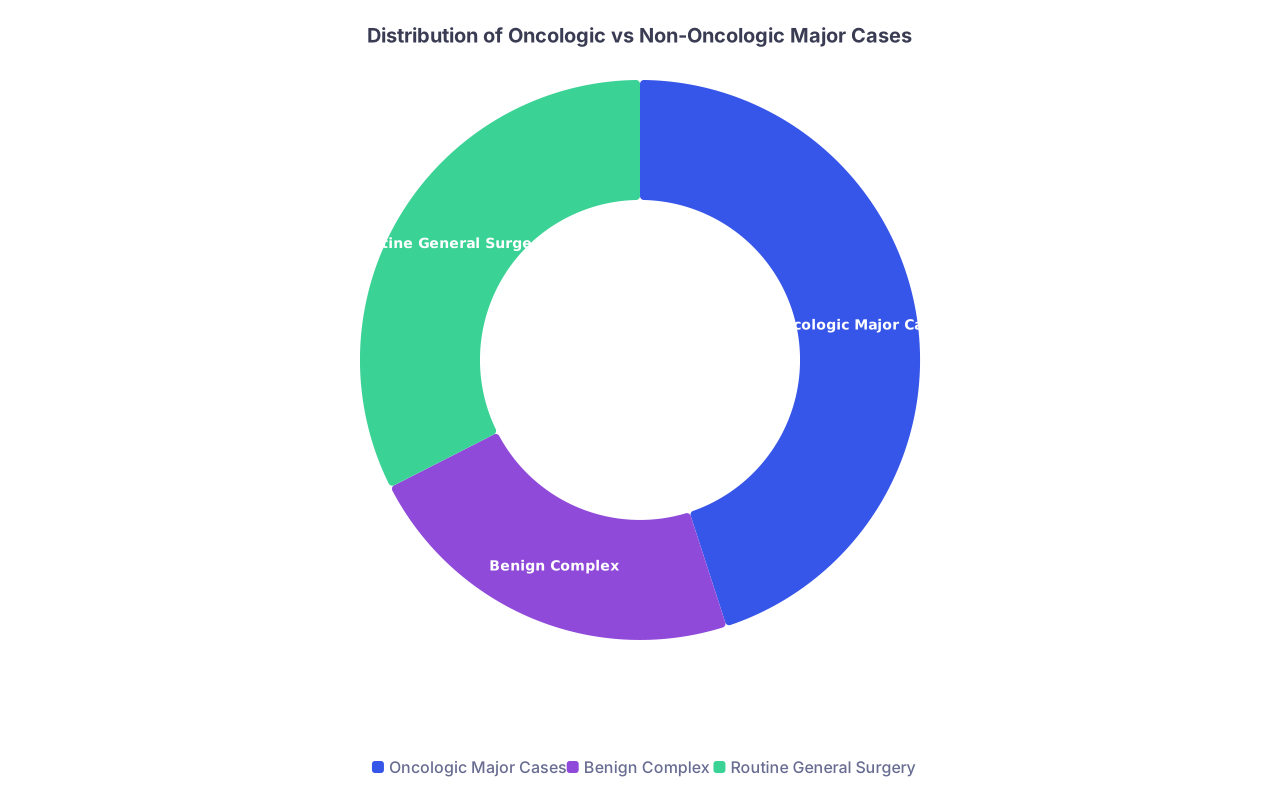
| Category | Value |
|---|---|
| Oncologic Major Cases | 180 |
| Benign Complex | 90 |
| Routine General Surgery | 130 |
Then, a simple table for your “index” cases:
| Case Type | Total Cases | Primary Surgeon | Assistant Only |
|---|---|---|---|
| Pancreaticoduodenectomy | 6 | 2 | 4 |
| Major Hepatectomy | 9 | 3 | 6 |
| Low Anterior Resection | 32 | 12 | 20 |
| Abdominoperineal Resection | 18 | 6 | 12 |
| Cytoreductive Surgery | 5 | 1 | 4 |
A PD glances and immediately understands:
- You have true exposure to the right operations.
- You were not just a passive observer.
- You have some primary experience but are not over-claiming.
No rainbow graphs. No microscopically small fonts. Just clean aggregation.
Step 9: Anticipate the Questions Your Log Will Trigger
Your structured log is not just for uploads. It is a script for your interview.
Imagine you are on Zoom, and a PD says, “Walk me through your experience with [X].”
If you have built your summary correctly, you already know your answer. Because you have:
- Grouped cases by fellowship-relevant themes.
- Quantified your role and complexity.
- Thought through 2–3 representative stories per theme.
For instance, you might be ready with:
“You will see in my log I have 45 bronchoscopies as primary operator, about 30 of which were in ventilated ICU patients. One case that stands out was a patient with severe ARDS on high PEEP where we had to balance diagnostic need with risk of decompensation…”
Now your case log is not just numbers. It is a launchpad for specific, credible stories.

| Step | Description |
|---|---|
| Step 1 | Raw ACGME Log |
| Step 2 | Thematic Summary |
| Step 3 | Key Metrics and Tables |
| Step 4 | Anticipated PD Questions |
| Step 5 | Prepared Case Stories |
If you skip that step and just “hope” your random cases line up with questions, you will ramble or overstate. And PDs have excellent radar for that.
Step 10: Common Case Log Mistakes That Quietly Kill You
I have watched people with excellent numbers get quietly downranked because their case log presentation was a mess. Some patterns:
Inflating primary roles.
If you document that you were primary for 40 ERCPs at a small program that does 20 per year, PDs will either laugh or ignore your numbers. Over-claiming is worse than being honest about limited volume and showing initiative in other ways.No discrimination of benign vs malignant, simple vs complex.
Lumping “laparoscopic colectomy for sigmoid diverticulitis” and “low anterior resection for rectal cancer post-radiation” into a generic “colectomy” bucket makes you look unsophisticated.Ignoring outpatient and longitudinal experience.
For fields like IBD-focused GI, heart failure, rheum, or heme/onc, clinic and continuity matter. You can and should quantify:- Number of half-days in disease-focused clinic.
- Approximate number of longitudinal patients followed >6 months.
- Participation in multidisciplinary tumor boards.
Dumping raw exports without synthesis.
Sending a 30-page chronological CSV printout communicates: “I did not think hard enough to summarize this.” PDs rarely read past page 2.Mismatch with letters.
If your main letter writer says “limited experience with X procedure” and your summary screams high-volume independent operator, there is a problem. Sync with your letter writers before finalizing your numbers presentation.Zero acknowledgment of environment limitations.
If your program genuinely does low volume in a key area, own it. Then show how you compensated:- Away rotations in high-volume centers.
- Simulation.
- Research / QI projects grounded in that area.
PDs respect realism and resourcefulness. They do not respect fantasy logs.
Step 11: How To Actually Build This Thing (Practical Workflow)
You are in the middle of residency. Time is not abundant. So here is the lean, realistic way to create a fellowship-focused log without losing your mind.
Export your current ACGME / system log to CSV.
Get it into Excel or Sheets. Include procedure, date, role, site, and rotation if available.Filter for fellowship-relevant categories.
Decide on 5–10 procedure / diagnosis buckets that matter for your fellowship and tag each row accordingly. This is the “paid work” step. It takes a few hours but is the foundation.Create pivot tables for each bucket.
Summarize:- Total cases per bucket.
- Breakdown by role (primary, assistant, observer).
- Optional: by PGY level or year.
Pull out 2–3 high-yield representative cases per bucket.
Not for the written summary, mostly for your interview prep. But knowing them will improve how you phrase the written sections.Draft your one-page summary.
Sections:- Context header.
- Quantitative overview box.
- 3–4 thematic subsections with numbers and 1–2 lines of context each.
- Short paragraph describing autonomy progression.
Run it by a mentor in the target field.
Ask them one question: “If you saw this from an applicant to your fellowship, what would you assume about their readiness, and what would you question?”Revise, then lock the structure.
As you do more cases, you update the numbers, not the layout. Consistency will save you time in the application year.
You are building an asset that should evolve over your senior year, not a last-minute PDF the night before ERAS submission.
Step 12: Special Cases – Residents With “Ugly” Logs
Some of you are reading this thinking: “My numbers are not impressive. I started logging late. My program volume is low. I am behind.”
All right. Then you lean into:
- Transparency and trajectory – Show that the last 6–9 months have been high value, even if earlier years were sparse.
- Relative strengths – Maybe fewer procedures, but deeper continuity or stronger ICU time.
- Supplemental efforts – Away rotations, elective time concentrated on your fellowship goal, sim lab, courses (e.g., bronchoscopy course, endoscopy courses, cath workshops).
Example phrasing:
“Formal ACGME procedural volume is modest compared to some tertiary programs, primarily because our center refers complex cases. Recognizing this early in PGY-3, I structured back-to-back electives in [referral center]’s interventional service, during which I logged an additional 30 PCIs as first operator and 15 femoral access procedures.”
That reads far better than pretending you are a volume monster when you are not.
Two Quick Visual Examples of Good vs Mediocre Structuring
Resident A and Resident B have similar raw case numbers in advanced endoscopy.
Resident A summary (mediocre):
“I have done over 200 EGDs and 180 colonoscopies during residency. I have also participated in ERCP and EUS procedures. I am comfortable with endoscopy and eager to learn more in fellowship.”
Resident B summary (structured):
“Endoscopy experience (as of Jan PGY-3):
– 220 EGDs (primary operator on 140, including 30 acute upper GI bleeds)
– 190 colonoscopies (primary operator on 120, independent cecal intubation rate ~90% on documented cases)
– 35 PEG placements (attending hands-off for 20 once access established)
– 20 ERCPs (completed cannulation and sphincterotomy in 10 as primary operator under direct supervision)
Training at a tertiary center with 24/7 GI bleed call; during 3 months of night float, I was responsible for triaging all potential after-hours endoscopies.”
Who do you think PDs believe is fellowship-ready?
Now you see why structure beats vague volume every time.

Final Calibration: What “Impressive” Actually Means
“Impressive” in fellowship applications is not mythical. It is concrete. When a PD flips through your case log or glances at your summary, you want them thinking three things:
This person clearly lives in my subspecialty environment already.
The case mix, settings, and responsibilities match what their fellows actually do.Their autonomy is appropriate and growing.
They are not reckless. But they are not hiding. They step forward when it matters.Their story is coherent across the application.
Personal statement, letters, CV, and case log shout the same message from different angles.
If your current log does not do that, you do not need magical extra cases. You need better structure, sharper curation, and honest, quantified context.
Do that, and you stop being “one more resident with a PDF” and start looking like what PDs are actually hunting for: a junior colleague who already behaves like a fellow.