

The fastest way to sink an otherwise strong fellowship application is to present your multidisciplinary work like a buffet instead of a thesis.
You are not applying as “a person who did many things.” You are applying as “a future [insert specialty] subspecialist whose cross‑disciplinary work fits our culture.” That alignment piece is where most residents fail.
Let me break this down specifically.
Step 1: Understand What “Fellowship Culture” Actually Means
Before you can align anything, you need to understand what you are aligning to. “Culture” is not hand‑wavy vibe talk. It shows up in very concrete patterns.
Here is what I look at when I help residents rewrite their research story for different fellowships:
| Dimension | What To Look For |
|---|---|
| Clinical vs Research | Clinic-heavy or lab/EPIC-light track |
| Methodological Style | RCTs, QI, big data, translational bench |
| Team Structure | Siloed vs highly collaborative |
| Intellectual Frame | Mechanistic vs population vs QI |
| Output Priorities | R01s, QI metrics, guidelines, tech |
How to read culture like an insider
Stop reading program websites like a brochure. Read them like an anthropologist.
Faculty CVs and PubMed
Look up 5–10 key faculty. Notice:- Are their big papers in Circulation / JCO / Gastroenterology (traditional clinical trials), or in JAMIA, BMJ Quality & Safety, Cell?
- Are first/last authors repeated (tight lab / PI‑driven culture) or widely distributed (team science, multi‑PI work)?
- Do they coauthor with engineers, statisticians, or computer scientists?
Recent fellows’ projects Look at current fellow profiles and “Fellowship News” pages:
- Are they mostly QI posters? RCT sub‑analyses? Database mining? Wet lab?
- Do they highlight “multidisciplinary” explicitly, or is that just your assumption?
Conferences they attend and brag about Oncology fellowship trumpeting ASCO, ASH, ESMO = classic subspecialty research culture.
The same fellowship highlighting AMIA, AcademyHealth, or Machine Learning in Healthcare = data / informatics leaning culture.Language clues Programs that say things like:
- “Scholarly projects” and “quality and safety” = QI/payor/system oriented
- “Mechanistic understanding,” “translational pipeline” = bench/translational culture
- “Implementation,” “care pathways,” “health services research” = systems/operations
You want a one‑sentence cultural snapshot of each program you care about. For example:
- “MGH Cardiology: classic, highly academic, RCT/registry heavy, very collaborative, strong biostats and imaging cores.”
- “Penn Pulm/CCM: heavy basic/translational in ARDS/fibrosis, big emphasis on mechanistic immunology, serious about K awards.”
- “UCSF HemOnc: diverse portfolio, health services and disparities work visible, strong big‑data culture with policy overlap.”
Write these down. Literally. Because everything you present about your multidisciplinary work gets filtered through those snapshots.
Step 2: Map Your Multidisciplinary Work into a Coherent Spine
Most residents with cross‑disciplinary CVs present their work as chaos: “I did QI in sepsis, a machine learning project in radiology, some ethics stuff, and a bench rotation.” Then they wonder why the fellowship director cannot figure out who they are.
You need a spine. A through‑line.
Core trick: One identity, multiple tools
Your multidisciplinary work is not “all the different things you have done.” It is “all the different tools you have used to chase one set of problems.”
So you decide:
“I am someone who uses [X methods or fields] to solve [Y type of problem] in [Z patient population or disease area].”
A few concrete examples:
- “I use data science and implementation science to improve ICU decision‑making for high‑risk respiratory failure patients.”
- “I combine health policy analysis and outcomes research to improve cancer care delivery for underinsured patients.”
- “I use informatics and natural language processing to detect and prevent cardiovascular complications earlier in at‑risk populations.”
Notice what I am not saying:
- I am not “someone who did a bioethics project and a QI project and an ML project.”
- I am building one identity with many methods.
Build a simple map of your projects
Take your CV and list every significant project. For each:
- Topic / disease area
- Methods involved (e.g., RCT design, NLP, QI, bench, survey)
- Primary “disciplinary language” (informatics, ethics, economics, etc.)
- Your specific role
- Tangible outcome (poster, paper, implementation, dataset, award)
Then group them around 1–2 stable anchors:
- Disease or domain anchors: “critically ill patients,” “cardio‑oncology,” “health equity,” “GI motility,” “arrhythmias.”
- Methods anchors: “data science,” “implementation,” “health services,” “bioengineering.”
If you cannot find at least one anchor tying 70% of your work together, you have a packaging problem, not a competence problem. We fix that with how you tell the story, not by erasing half your projects.
Step 3: Translate Each Discipline into the Fellowship’s Native Language
Here is where most residents lose committees: they insist on speaking each discipline’s dialect, instead of translating into the fellowship’s language.
A cardiology program director does not care that your CS collaborator wrote a clever attention mechanism. They care that you:
- Framed a cardiovascular question correctly,
- Structured data in a useful way,
- Understood model limitations,
- And connected it to patient outcomes or trial design.
You need to do the translation work for them.
The 3‑layer translation model
Take any multidisciplinary project. For each target fellowship, you will have three layers:
Clinical / fellowship‑native layer
How this work affects the patients and problems that fellowship cares about.Methodological / cross‑disciplinary layer
The specific non‑native tools you brought in (ML, econ, engineering, philosophy).Personal role and growth layer
What you actually did and what skills you built that are now relevant to their culture.
Let’s take a toy example: an NLP project flagging high‑risk heart failure patients in the ED.
Applying to Cardiology:
- Clinical layer: “We were trying to identify heart failure patients at risk for early readmission at the moment of ED presentation, to enable earlier cardiology involvement and more precise discharge planning.”
- Methodological layer: “We used NLP to extract features from unstructured ED notes that would be invisible to traditional claims‑based risk scores.”
- Personal layer: “I led the clinical framing—what ‘actionable risk’ means for cardiology consults, which endpoints cardiologists would respect, and how to define a model that would realistically change clinic workflows.”
Applying to Pulm/CCM with same project:
- Clinical layer: emphasize acute decompensation, ICU triage, escalation of care, not follow‑up clinics.
- Methodological layer: emphasize how early text signals from ED notes can guide ICU resource use and rapid response team alerts.
- Personal layer: your role in identifying which features matter for predicting decompensation, not just readmission.
Same project. Different cultural translation.
Step 4: Decide on Your “Fellowship‑Facing Identity”
You do not present as “I am half cardiologist, half computer scientist, half ethicist.” That is 1.5 people and 0.0 clarity.
You pick a primary identity that sits squarely inside the fellowship. Then you show how your multidisciplinary background makes that identity more powerful.
Think of it like this:
Fellowship‑native role + Cross‑disciplinary superpower.
Some examples that actually land with selection committees:
- “Future academic gastroenterologist who uses informatics to redesign how we detect and manage high‑risk liver disease in safety‑net populations.”
- “Pulm/CCM physician‑scientist using immunology and bioengineering tools to develop novel ARDS therapies.”
- “Cardiologist focused on inherited arrhythmia who leverages bioinformatics for genotype–phenotype mapping and risk stratification.”
What you should not say:
“I am very multidisciplinary and like to collaborate with many fields.”
That is fluff. Everyone says that.“I do a bit of QI, some ethics, and some data science in several clinical domains.”
That is incoherence. Committees dislike incoherence more than they dislike narrowness.
You will still talk about the breadth. But always as support for a clear fellowship‑native direction.
Step 5: Reshape How You Present Projects on Your CV and in Your Talk
Same activities, different framing. This is where you get very tactical.
On your CV / ERAS (or equivalent)
You cannot rewrite ERAS structure, but you can control the order, titles, and emphasis.
Order projects by thematic relevance, not chronology.
Leading with your random med school summer project in dermatology just because it is older is a mistake. Put your most fellowship‑aligned, identity‑defining work first.Retitle projects in a clinically meaningful way.
Do not list: “Machine Learning Predictive Modeling in EHR Data.”
Do: “Predicting Early Heart Failure Readmission from ED Notes Using NLP.”You are not dumbing it down. You are making the point legible to clinicians scanning quickly.
Bullet what you did in fellowship‑relevant terms.
Instead of:- “Developed gradient boosting model; tuned hyperparameters; AUC 0.87.”
Use:
- “Collaborated with data scientists to develop and critically evaluate risk models aimed at flagging high‑risk heart failure patients at ED presentation; led clinical definition of meaningful endpoints and thresholds.”
Same work. Different emphasis.
In your research talk (virtual or in‑person)
You will often get 10–20 minutes to present your “main project.” Smart people with multidisciplinary backgrounds use that slot to demonstrate how their way of thinking fits this fellowship.
Structure that talk with the fellowship’s culture in mind:
Problem frame first, methods second.
A transplant fellowship wants to hear that you understand how decisions about listing, allocation, and resource use get made. You start there. Only then do you introduce your multi‑field tools.One unifying problem, two or three methods.
For multidisciplinary candidates, I prefer a format like:- Part 1: “Here is the central clinical problem that animates most of my work.”
- Part 2: “Here are two different methods I used to attack that same problem from different angles.”
- Part 3: “Here is how I think those methods will expand within your fellowship environment.”
Translate stats and jargon ruthlessly.
You are not impressing anyone by describing your model architecture for 4 minutes. You are impressing them by saying, in two sentences: “We tried standard methods. They failed for reason X. So we did Y instead, which better reflects the clinical reality that Z.”
Step 6: Align with Different Fellowship Cultures Without Becoming Fake
You will likely apply to programs with different flavors. You do not rewrite your entire identity each time. You adjust emphasis.
Think of dials you can turn up or down:
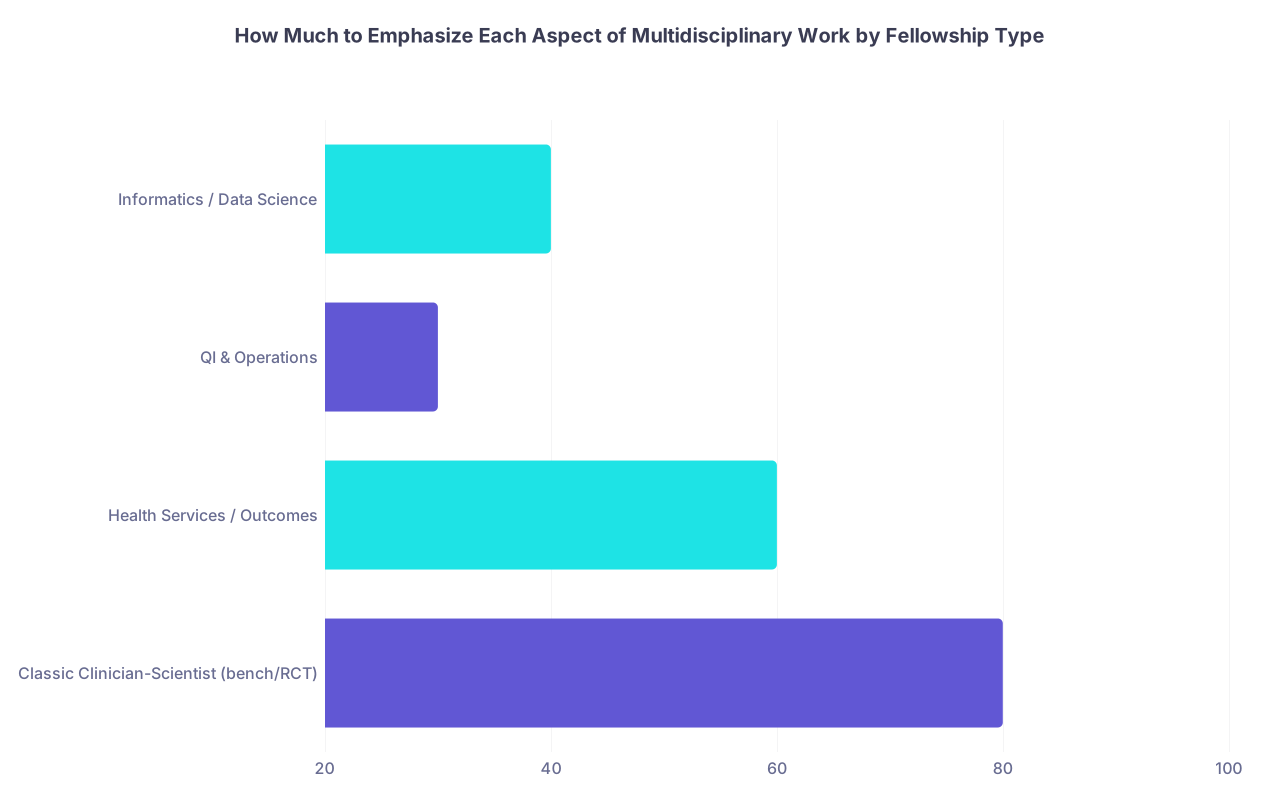
| Category | Value |
|---|---|
| Classic Clinician-Scientist (bench/RCT) | 80 |
| Health Services / Outcomes | 60 |
| QI & Operations | 30 |
| Informatics / Data Science | 40 |
Imagine an applicant with informatics + QI + health equity work staring at:
- A very traditional lab‑heavy heme/onc program.
- A systems‑oriented, QI‑heavy heme/onc program.
How do you tweak the same story?
For the classic lab‑heavy program
- Emphasize your ability to formulate rigorous, mechanistic questions from messy clinical problems.
- Highlight quantification, precise endpoints, disciplined study design.
- Show you understand the grind of multi‑year projects, deep dives into one question, and the politics of authorship.
You might describe your EHR project as:
- “A way to generate hypotheses about treatment response variability that could then be tested prospectively in more mechanistic studies.”
You are building a bridge from your world into theirs.
For the QI / systems‑heavy program
- Emphasize implementation, stakeholder buy‑in, metrics that changed operations.
- Highlight PDSA cycles, dashboards, integration into workflows, reduction of variation.
- Show you care about throughput, safety, cost, and equity as primary goals.
You describe the same EHR project as:
- “A risk stratification tool that allowed us to target case management resources and redesign follow‑up pathways, with measurable impact on readmissions.”
Same code. Different cultural landing pad.
You are not lying. You are deciding which real aspects to shine a light on.
Step 7: Handle “Jack of All Trades” Concerns Head‑On in Interviews
Fellowship PDs often look at a multidisciplinary CV and think: “Looks smart. But can this person actually commit to a track? Or are they going to bounce around and never finish anything?”
You defuse that directly.
How to answer “You have done a lot of different things—how do you see this fitting together?”
You do not say:
- “I just love learning new things.”
That is code for “I get distracted.”
More effective structure:
Acknowledge the breadth.
“You are right, my work to date spans informatics, QI, and some ethics.”State the unifying problem.
“The thread is that I am obsessed with how we make high‑stakes decisions for critically ill patients when time, information, and resources are limited.”Show convergence.
“Early on, I tried very different methods almost experimentally. Over the past 18–24 months, that has converged on using data science plus implementation science to change how we triage and treat acute respiratory failure.”Tie to their fellowship track.
“In your Pulm/CCM environment, where you have strong biostatistics support and an ICU telemedicine program, I see that converging further into a focused research agenda around [X].”
Structured, direct, and reassuring.
How to handle “Are you a clinician who codes, or a data scientist who sees patients?”
Many programs are suspicious of “shadow informaticians” who vanish into engineering groups and never develop true clinical judgment.
Your answer has to make clear where your center of gravity is.
- “I am a clinician first, who uses enough data science to be dangerous in the right way—meaning I can frame questions that matter, avoid naïve model use, and collaborate effectively with real data scientists. Long term, I see myself as the kind of cardiologist who leads clinically grounded, technically sophisticated projects, not as a full‑time engineer.”
If you genuinely want a cross‑appointed role (e.g., cardiology + CS department), be explicit:
- “My primary home is in cardiology. But I have already worked in computer science labs and can see a joint appointment eventually. I know that only works if I maintain clinical credibility and fellowship‑level expertise first—that is why I am applying here rather than to a pure informatics program.”
Step 8: Use Stories, Not Buzzwords, to Show “Multidisciplinary”
That overused word—multidisciplinary—means nothing by itself. Everyone claims it; few can prove it.
You prove it with short, specific stories that show:
- You spoke multiple intellectual languages in one project.
- You resolved real conflicts between fields.
- You saw the blind spots of each discipline and integrated them.
Think of one concrete moment from each of your big projects where the cross‑disciplinary nature actually mattered.
A few examples I have heard from successful fellows:
- “Our ethics consultant initially pushed for very conservative consent language that would have destroyed recruitment. I sat down with her and the trialist to reframe risk in a way that was both honest and operationally realistic. That negotiation is why the trial exists at all.”
- “The engineer leading our device project wanted to optimize a performance metric that was irrelevant at the bedside. I walked him through how nurses and fellows actually triage alarms at 3 a.m., and we changed the optimization target to something clinically meaningful.”
Tell those stories in your personal statement and interviews. That is how you distinguish real multidisciplinary work from “I attended a lot of meetings.”
Step 9: Calibrate How Much Technical Detail to Show
There is a spectrum from “hand‑wavey” to “way too technical.” Both are deadly.
Use this rule:
Enough detail to prove you owned the work and understand it, but always tied to a clinical or operational decision.
For fellowship interview audiences, that often means:
- Briefly naming the key method (e.g., “we used a random forest model because…”).
- Stating one key limitation and what you did about it.
- Tying numbers to decisions (“at a 15% risk threshold, cardiology agreed that a consult was warranted”).
What you avoid:
- Reciting the entire pipeline.
- Listing packages or software.
- Getting into model architecture debates that your audience is not equipped to judge.
In your slides: one method slide, max two. Everything else should be problem, results, and implications.
Step 10: Anchor Future Plans in Their Environment, Using Your Multidisciplinary Edge
Future plans are where alignment either clicks or falls apart.
“After fellowship, I want to combine my interests in machine learning, health policy, and clinical medicine to improve patient care” is meaningless. Too generic. Too divorced from the place you are standing.
Instead, you do this:
Name a specific problem in their environment.
“Your transplant program sees a large proportion of marginal donors and complex candidates.”Connect to your existing spine.
“My prior work has focused on decision support in high‑risk, resource‑limited settings.”Propose how your multidisciplinary tools plug in.
“I can see a project where we combine your existing registry data, EHR text, and imaging, working with Dr. X in informatics and Dr. Y in transplant, to build and test a decision support tool that…”Tie to realistic training milestones.
“In the first year, I would aim to [dataset assembly + pilot work]. In the second, [prospective evaluation / grant prep].”
You are not just saying “I will use my multifaceted background.” You are sketching a culture‑specific research and professional trajectory.
A Quick Reality Check: When Multidisciplinary Actually Hurts
Let me be blunt. There are situations where multidisciplinary work hurts more than it helps:
- You have ten tiny, shallow projects in unrelated areas with no clear spine.
- You never saw anything through to completion (no abstracts, no papers, no implemented QI).
- Your story changes completely between programs—cardiology at one, ID at another, informatics at a third.
Committees read that as lack of focus and poor follow‑through.
If that is you, the fix is not to double down on “I am so multidisciplinary.” The fix is:
- Pick one domain that is at least plausibly coherent with 2–3 of your projects.
- Make those your central story.
- Relegate the others to “earlier exploratory work” or do not emphasize them at all.
Depth beats breadth every single time at the fellowship level. Multidisciplinary work is only an asset when it amplifies depth, not when it replaces it.
Pulling It Together: A Model Script
Let me give you a compressed example of what “aligned multidisciplinary” actually sounds like to a selection committee. Imagine a Pulm/CCM applicant with QI + informatics + ethics work:
“Most of my work has grown out of frustration with how we make time‑pressured, high‑stakes decisions in the ICU with incomplete information. As an intern, I did a QI project on sepsis pathway adherence and realized that our paper protocols were completely disconnected from how nurses and residents actually thought and charted in the EHR.
That pushed me toward an informatics group, where I helped build an NLP‑based early warning tool for respiratory decompensation in ward patients. I was the clinical lead on defining what a ‘meaningful’ alert is. We iterated that with nursing and rapid response teams so it would not just be another ignored pop‑up.
At the same time, I worked with our ethics service on end‑of‑life decision support in the ICU, which gave me a different lens on what ‘decision quality’ means beyond prediction accuracy.
The thread across those projects is this question: how do we design systems that support better, more humane decisions in critical illness without overwhelming clinicians with noise?
In your Pulm/CCM fellowship, with your tele‑ICU infrastructure and Dr. X’s work in predictive analytics, I see a path to focus that question into a series of projects that start with better risk stratification and end with tested changes in how we triage and communicate with families. I would bring enough technical literacy to collaborate deeply with your data science group, while anchoring the work in day‑to‑day ICU reality and ethical constraints.”
That is multidisciplinary. But it is also clearly Pulm/CCM‑centric, coherent, and tuned to a specific fellowship culture.
With that level of intentionality, your multidisciplinary background stops looking like scattered curiosity and starts looking like the training ground for a distinct, valuable subspecialist identity.
Your next step? Pick two or three fellowships you are serious about. For each, write one paragraph defining their culture and one paragraph defining how your “spine” plugs into it. Then rebuild your CV bullets, your research talk, and your interview answers around those anchors.
Once you do that, you are no longer “trying to explain everything you have ever done.” You are presenting as the kind of focused, culturally aligned future colleague fellowship directors actually want to invest in.
The mechanics of turning those culture‑specific stories into a killer personal statement and letters is its own project—and that is a conversation for another day.


