

Quality improvement is only “soft” scholarship if you present it that way.
If you are a resident aiming for competitive fellowships, treating your QI work like a checklist item instead of serious academic output is a strategic mistake. The content is not the problem. The positioning is.
Let me walk you through how to turn “we reduced central line infections” from a line on a rotation eval into scholarship that program directors in cardiology, GI, heme/onc, PCCM, EM, you name it, will actually respect.
1. The Mental Reframe: QI Is Not the Junior Version of Research
Residents get fed a very specific hierarchy, usually from jaded seniors:
- RCTs and basic science: “real research”
- Retrospective chart reviews: decent
- Case reports: meh
- QI: “the thing you do to make ACGME happy”
That hierarchy is wrong for fellowship applications in 2026.
Fellowship PDs are under relentless pressure from:
- ACGME outcomes metrics
- CMS quality reporting
- Hospital leadership obsessed with readmissions, LOS, CLABSI, CAUTI, sepsis bundles, throughput
They need fellows who can:
- Understand clinical systems
- Move a quality metric in the right direction
- Work across disciplines without flaming out
- Produce work that can be presented, written, and replicated
You can show all of that with a well-structured QI project. Or you can bury it as “helped with a project to improve discharge summaries.”
Same activity. Different positioning. Different impact.
The reframe is simple:
You are not “doing a QI project.”
You are designing, implementing, and disseminating a systems intervention that improved care.
Your job is to prove that.
2. Build the Project Like Scholarship From Day One
If your “project” is a one-off educational talk or a poster glued together a week before resident QI day, you are already behind. Scholarship starts with structure.
Here is what separates serious, citable QI from checkbox fluff.
2.1 Have a real, focused question (and write it down)
If you cannot state your QI question in one clear sentence, your project will read like busywork.
Bad:
“We wanted to improve handoffs in our ICU.”
Better:
“Can implementing a standardized, EHR-embedded handoff template reduce night-time cross-cover pages related to missing information by 30% over 6 months?”
That second version has:
- Context
- An intervention
- A measurable outcome
- A time frame
Write your question down in your project notebook / Notion / Google Doc. Use it later in your CV bullet, abstract, and personal statement. Same wording. Consistency signals intention.
2.2 Align with a real metric that matters to someone with power
If your only outcome is a 3-question satisfaction survey you emailed to 12 people, it will be hard to make that sound serious.
You want metrics that:
- Already exist in your hospital’s dashboard
- Are tracked by quality, safety, or nursing leadership
- Can be pulled again later to show sustainability
Examples that play well on fellowship applications:
- CLABSI, CAUTI, VAP rates
- Door-to-needle, door-to-balloon times
- Appropriate anticoagulation for AF or VTE
- Time to antibiotics in sepsis
- 30-day readmissions for CHF, COPD, cirrhosis
- Guideline-concordant therapy rates (HF meds, DM control, asthma)
- ICU LOS, hospital LOS, ED boarding time
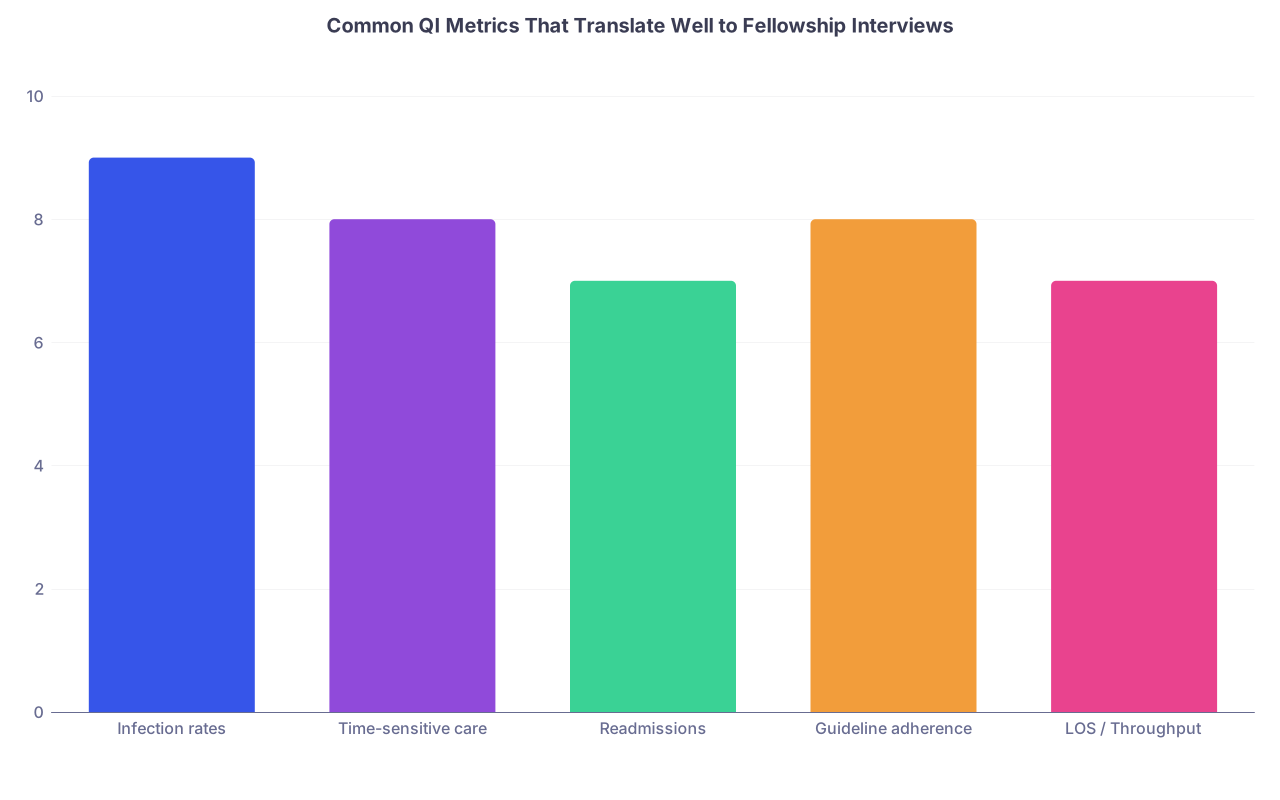
| Category | Value |
|---|---|
| Infection rates | 9 |
| Time-sensitive care | 8 |
| Readmissions | 7 |
| Guideline adherence | 8 |
| LOS / Throughput | 7 |
Those are the words that wake fellowship PDs up in an interview. Use them.
2.3 Use an established QI framework—and name it
Fellowships like systems thinkers, not hobbyists. Using (and explicitly stating) a QI methodology upgrades your work from “we tried this” to “we followed a systematic approach.”
Common frameworks:
- PDSA (Plan–Do–Study–Act) cycles
- Model for Improvement
- Lean / Six Sigma concepts
- Root cause analysis (RCA)
- Ishikawa (fishbone) diagrams
- Process mapping / swimlane diagrams
You do not have to worship at the altar of Lean. You just need to be able to say:
“We used repeated PDSA cycles to iteratively refine the intervention based on front-line feedback.”
That sounds like scholarship. Because it is.
2.4 Design for measurement before you touch the system
The most common QI mistake I see from residents: they implement first, then look around for data later. Which means they end with impressions, not evidence.
Before you start:
Define baseline:
- 3–6 months of pre-intervention data if possible
- At least enough data points to see a trend, not noise
Define post-intervention windows:
- Implement → stabilization → measurement
- Often 3, 6, 12 months depending on metric
Decide how you will collect it:
- QI department pull
- Manual chart abstraction (acceptable if consistent)
- EHR query
- Existing dashboards
Decide exact variables:
Not just “did they improve?”
Think:- Primary outcome
- Secondary outcomes
- Balancing measures (e.g. did reducing LOS increase readmissions?)
Document this in a simple project protocol. Two to three pages max. You do not need IRB-level detail, but you do need more than “we will see what happens.”
2.5 Loop in the right stakeholders early
Scholarship travels farther when the right people are attached to it.
Minimum team for real QI work:
- You (or a small resident team)
- A faculty mentor who actually does QI or holds a quality role
- A nurse leader or unit manager
- At least one front-line nurse or APP
- Someone from quality/safety or data analytics if available
You want:
- Buy-in to implement changes
- Help getting data
- Protection when the change annoys someone with seniority
Also: these people later become your co-authors, co-presenters, and letter writers. Fellowship PDs trust letters from directors of quality, ICU nurse managers, and QI chiefs far more than another generic “hard-working resident” letter.
3. Doing the Work So It Looks (and Is) Scholarly
Once the project exists, how you execute it matters. Sloppy implementation becomes very obvious when you try to publish or present.
3.1 Document your cycles, not just your final result
QI is iterative by design. Use that to your advantage.
Keep a simple running log:
- Date
- What you changed
- Rationale
- Qualitative feedback from staff
- Metric snapshots if available
Example entry:
10/15 – First PDSA cycle: added EHR discharge checklist for HF patients. Feedback from nurses: 3 extra clicks, discharge time slightly delayed. Post-call days saw poor compliance. Plan: integrate checklist into existing discharge navigator instead of separate tab.
That kind of detail turns into:
- A better methods section
- A stronger story in interviews
- Evidence that you did more than send one email and hope
3.2 Treat statistics like they matter, even if simple
You are not doing a randomized trial. You still need a minimal level of analytic rigor.
Bare minimum:
- Understand run charts and control charts (QI 101)
- Use pre/post comparisons appropriately
- Acknowledge secular trends or competing interventions
You can usually get help from:
- Hospital QI analysts
- Biostat support affiliated with your institution
- A faculty member who has published QI before
A simple story like:
“Over 12 months, our CLABSI rate decreased from 3.1 to 1.2 per 1,000 line days, sustained over 3 quarters, with no change in catheter days”
sounds far more serious than:
“CLABSI went down after our bundle.”
3.3 Pay attention to balancing measures
Savvy interviewers will ask:
“What were the unintended consequences?”
If your answer is “We did not check,” you just announced that your systems thinking is limited.
Examples:
- ED throughput improvement: Did LWBS (left without being seen) change?
- Reduced LOS: Did readmission or mortality rates change?
- Fewer lab orders: Did diagnostic delay complaints increase?
- Telemetry reduction: Any increase in rapid responses or codes?
You rarely need complex stats. You just need to show you looked.
4. Converting QI Into CV Gold: Titles, Sections, and Wording
Now we get to what most residents completely botch: how the work appears on paper.
4.1 Do not bury QI inside “Work Experience”
If your QI never leaves your institution and never becomes a presentation or poster, fine, it lives under “Quality Improvement Projects” or “Scholarly Projects” on your CV.
But your goal should be to push it into the Presentations and Publications section. That is where committees’ eyes go.
Structure your CV roughly like this:
| Section Order | Section Name |
|---|---|
| 1 | Education |
| 2 | Training / Positions |
| 3 | Publications |
| 4 | Abstracts & Presentations |
| 5 | Quality Improvement Projects |
Notice QI gets its own section, not lumped in with community service.
4.2 Title your QI like a paper, not a memo
Terrible title on a CV:
“QI project – Discharge summaries”
Serious title:
“Improving completeness of discharge summaries for heart failure patients through an EHR-based checklist: a resident-led quality improvement initiative”
You want:
- A verb that signals action: “Improving,” “Reducing,” “Implementing,” “Standardizing”
- Specific population/process: “heart failure,” “ED sepsis,” “ICU central lines”
- The tool or method: “EHR-based checklist,” “standardized order set,” “multidisciplinary bundle”
- Bonus: “resident-led” if true – it underscores leadership
4.3 Write CV bullets like mini-abstracts
Under a QI project entry, include 2–3 bullets that mimic the structure of an abstract.
Example for CV (under Quality Improvement Projects):
Improving appropriate VTE prophylaxis on the general medicine service through standardized order sets
Internal Medicine Residency, University Hospital
- Designed and led a multidisciplinary QI project using PDSA methodology to increase guideline-concordant VTE prophylaxis among general medicine inpatients.
- Implemented an EHR default order set incorporating weight-based dosing, renal dosing, and contraindication prompts, integrated into admission workflows across 4 resident services.
- Increased appropriate VTE prophylaxis from 68% to 92% over 9 months, sustained for 12 additional months, without an increase in documented bleeding events.
This reads like scholarship. It uses:
- Design
- Method
- Intervention
- Outcome with numbers
- Balancing measure
No fluff.
4.4 Distinguish roles clearly
Fellowship PDs care a lot about what you actually did versus what you observed.
Phrase it honestly but assertively:
- “Led” – for projects you initiated, drove, and coordinated
- “Co-led” – if you shared leadership meaningfully
- “Participated” – bare minimum, not ideal
- “Data collection and analysis lead” – if that was your main contribution
- “Presented results at…” – always specify
Do not write “involved in” anything. That phrase is code for “I sat at a couple of meetings.”
5. Turning QI Into Presentations and Publications
Here is where positioning really pays off. A generic residency QI day poster is fine. A regional or national abstract is better. A peer-reviewed QI article is best.
5.1 Think “abstract first” while still doing the project
You should be collecting data and screenshots with an abstract template in mind:
Typical abstract components (even for QI):
- Background / Problem
- Aim statement (with target)
- Methods (setting, framework, measures, analysis)
- Interventions
- Results (with real numbers and time frame)
- Conclusion / next steps
As you progress, write bullets in each section. By the time abstract deadlines hit (SHEA, SGIM, ACP, CHEST, ATS, AHA, etc.), you are not starting from zero.
5.2 Target the right venues
Some conferences are more QI-friendly than others. You want to aim where QI is not the stepchild.
Good targets:
- Society of Hospital Medicine (SHM)
- SGIM (multiple QI and education tracks)
- ACP (clinical vignettes + QI categories)
- CHEST, ATS, SCCM for critical care and pulmonary QI
- AHA, ACC for cardiology-related metrics
- Specialty-specific QI or “value” subtracks (oncology, GI, EM, anesthesia etc.)
- Institutional and regional QI symposia (often easy acceptance)
Map your project to the specialty you are applying to. A sepsis bundle in the ED plays fine for EM, PCCM, ID. A telemetry reduction project can be spun toward cardiology or hospital medicine.

| Step | Description |
|---|---|
| Step 1 | Identify Clinical Problem |
| Step 2 | Design QI Project |
| Step 3 | Collect Baseline Data |
| Step 4 | Implement PDSA Cycles |
| Step 5 | Measure Outcomes |
| Step 6 | Create Abstract |
| Step 7 | Submit to Local QI Day |
| Step 8 | Submit to Regional or National Meeting |
| Step 9 | Develop Manuscript |
| Step 10 | Submit to Peer Reviewed Journal |
You do not need to hit every node on that diagram. But you should at least get to G and preferably H.
5.3 Understand how fellowship committees read your presentations
Program directors scan presentation lists quickly. Here is what stands out:
- National meeting names – “ATS International Conference,” “American College of Cardiology,” “ASH,” “CHEST”
- First-author status – You as first author implies ownership
- Title alignment with fellowship – A heart failure QI project for cardiology. A ventilator-associated event project for PCCM.
Format it clearly on your CV:
Doe J, Smith A, Patel R, et al. Improving time to appropriate antibiotics in ED patients with sepsis through a multidisciplinary triage protocol. Poster presented at: Society of Critical Care Medicine Annual Congress; January 2025; Phoenix, AZ.
Notice:
- Your name first
- Italicized title
- “Poster presented at” – spells out your role
If you only presented at an internal event, still list it:
“… Poster presented at: Internal Medicine Residency Quality Improvement Symposium, University Hospital; May 2025; City, State.”
Not as shiny. But far better than silence.
5.4 Publishing QI: where and how
QI publishing is a bit of a different ecosystem than traditional clinical research.
Journals that often welcome QI:
- BMJ Open Quality
- American Journal of Medical Quality
- Joint Commission Journal on Quality and Patient Safety
- Journal of General Internal Medicine (QI section)
- Academic Medicine / MedEdPORTAL (for education-focused QI)
- Specialty journals with QI or practice improvement sections
Key points when writing:
- Use SQUIRE guidelines (Standards for QUality Improvement Reporting Excellence). Mentioning that you followed SQUIRE signals that you know the norms.
- Be brutally honest about limitations (single site, no control group, secular trends). QI reviewers expect imperfection but demand transparency.
- Emphasize generalizability of approach more than perfection of results. “Here is how this could be applied to similar inpatient services” is valuable.
6. Talking About QI in Fellowship Interviews (Without Sounding Fluffy)
You will almost certainly be asked some version of:
“Tell me about a project you worked on that you are proud of.”
This is your QI project’s audition. Do not blow it with vague generalities.
6.1 Use a tight, rehearsed narrative arc
Think: 2–3 minutes, clear structure, concrete numbers.
Template:
Problem and context
“On our general medicine service, appropriate VTE prophylaxis was only 68%, well below our institutional target of 90%, and we were seeing preventable DVTs.”Your specific aim
“Our goal was to increase guideline-concordant VTE prophylaxis to at least 90% over 9 months using an EHR-based intervention and resident education.”What you actually did
“I led a small team including a hospitalist mentor, a unit nurse manager, and an EHR analyst. We mapped the admission workflow, found that VTE orders were buried in an optional section, and built a standardized order set with prompts for contraindications. We tested it through three PDSA cycles, adjusting for edge cases flagged by nurses and night float residents.”Results
“Appropriate prophylaxis increased from 68% to 92%, sustained over the next 12 months. We did not see an increase in documented bleeding events, and the intervention is now standard across four medicine floors.”What you learned / why it matters for fellowship
“The project taught me how to work with nursing and IT to change workflows in a way that sticks. For cardiology, I am particularly interested in applying a similar approach to optimize GDMT for heart failure across transitions of care.”
That answer hits metrics, leadership, systems thinking, and specialty alignment. No buzzword salad required.
6.2 Anticipate the two hard follow-up questions
They may not always ask them explicitly, but they are thinking them.
“What would you do differently?”
You answer with a real limitation and a growth point.- “We did not include patient-facing education initially. Next time, I would incorporate patient input earlier to understand barriers to adherence post-discharge.”
“How do you know your results were because of your intervention?”
- “During our project period, there were no other VTE-related initiatives, and we saw a clear inflection point after the order set went live. That said, we did not have a concurrent control unit, so secular trends are a limitation. We tried to mitigate this by extending measurement for 12 months to show sustained effect.”
You are not graded on perfection. You are graded on how thoughtfully you have considered your own work.
7. Choosing and Shaping QI That Fits Your Target Fellowship
Not all QI is equal for all fellowships. You can absolutely leverage generic medicine QI for any specialty, but tailoring helps.
Here is a blunt matrix.
| Target Fellowship | High-Yield QI Themes |
|---|---|
| Cardiology | HF readmissions, door-to-balloon times, telemetry use, anticoagulation safety |
| Pulm/CCM | Ventilator bundles, VAE prevention, sepsis protocols, ICU LOS |
| GI/Hepatology | Variceal bleed prophylaxis, cirrhosis readmissions, colonoscopy prep quality |
| Heme/Onc | Chemo safety, central line infections, febrile neutropenia pathways |
| ID | Antibiotic stewardship, sepsis bundles, infection prevention |
If your current QI project is not obviously aligned, you can still connect the dots:
- Generic discharge summary QI → transitions of care in complex HF or oncology patients
- Medication reconciliation → polypharmacy in elderly cardio/onc patients
- ED throughput → door-to-balloon or door-to-needle adaptations
You are allowed to say:
“This project made me realize I am particularly interested in applying similar methods to [fellowship-specific domain].”
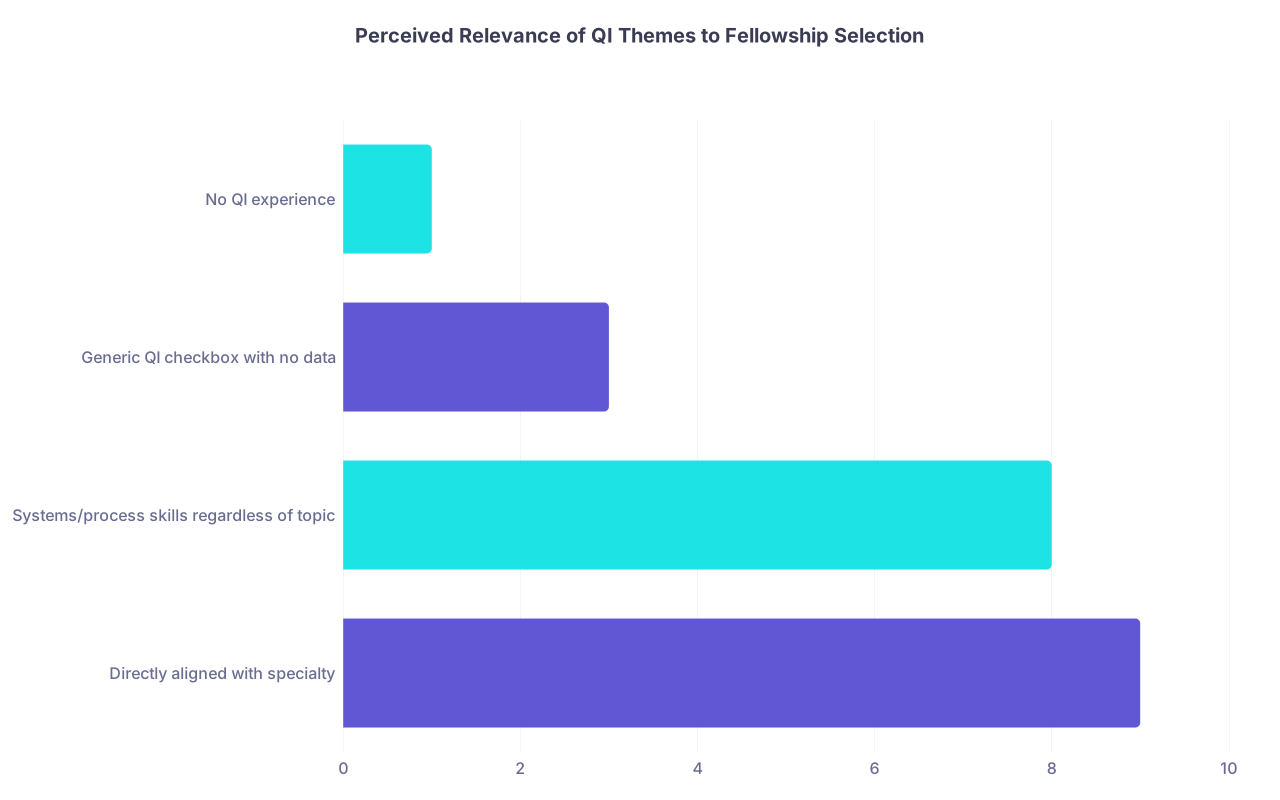
| Category | Value |
|---|---|
| Directly aligned with specialty | 9 |
| Systems/process skills regardless of topic | 8 |
| Generic QI checkbox with no data | 3 |
| No QI experience | 1 |
You see the pattern. It is not “do heart failure QI or bust.” It is “show me you can think and act like someone who improves systems.”
8. Handling Common Resident Pitfalls (So You Do Not Waste the Work)
Let me be blunt about the usual errors.
8.1 The “too late to publish” myth
I routinely see residents with solid QI buried in year 1 or 2 who never convert it to an abstract because “the QI day is over.”
You can resurrect almost any project if:
- Baseline and post data still exist (often in dashboard archives)
- Someone on the team still works at your institution
If it is 6–12 months old, still very salvageable. Even older can work if the intervention is ongoing.
8.2 The “my role was small” problem
If you were not the project lead, you can still claim meaningful contribution. But you have to be precise.
Bad:
“Helped with QI project.”
Better:
“Served as data collection and analysis lead for a resident-led QI project to reduce CT overutilization in low-risk PE evaluation; extracted and analyzed pre/post intervention imaging data for 400 ED encounters.”
You are not inflating. You are accurately describing the scope and depth of what you did.
8.3 Overstating results
Nothing torpedoes credibility faster than overclaiming.
If your gradient of improvement was small, say so:
“Our intervention increased compliance from 82% to 88%, which did not meet our pre-specified 90% goal, but the change was sustained for 6 months and highlighted key barriers around nursing workflow we are now addressing.”
That level of honesty is rare. It stands out.
9. How All This Looks From the Fellowship Committee Side
Let me pull back the curtain a bit.
On a typical fellowship review day, PDs and faculty will flip through 30–100 applications at a time. They are not reading your entire CV line by line. They are scanning.
On a candidate with strong QI, what they see:
- Publications: at least 1–2 abstracts, maybe a QI manuscript
- Presentations: something more than just internal resident day
- Letters: at least one letter writer describing you as “instrumental to a hospital-wide quality initiative” or “a resident I would trust to lead complex QI work”
- Personal statement: a paragraph tying clinical interests to systems improvement
The actual QI topic matters less than:
- Rigor of approach
- Persistence (longitudinal work, sustained results)
- Ability to lead across disciplines
- Evidence that you finished what you started
Your QI becomes a signal: this resident will show up, push a project through the inevitable friction, and leave our fellowship with tangible improvements attached to our name.
That is not soft. That is exactly what they need.
Key Takeaways
- Treat QI as structured, measurable systems intervention—not a checkbox—and design it with real baseline data, explicit aims, and recognized frameworks.
- Convert your QI into visible scholarship: strong titles, clear CV bullets, abstracts, presentations, and (when possible) publications aligned with your target fellowship.
- In interviews, present your QI as a concise, data-backed story that showcases leadership, systems thinking, and specialty-relevant interests, without exaggeration.


