
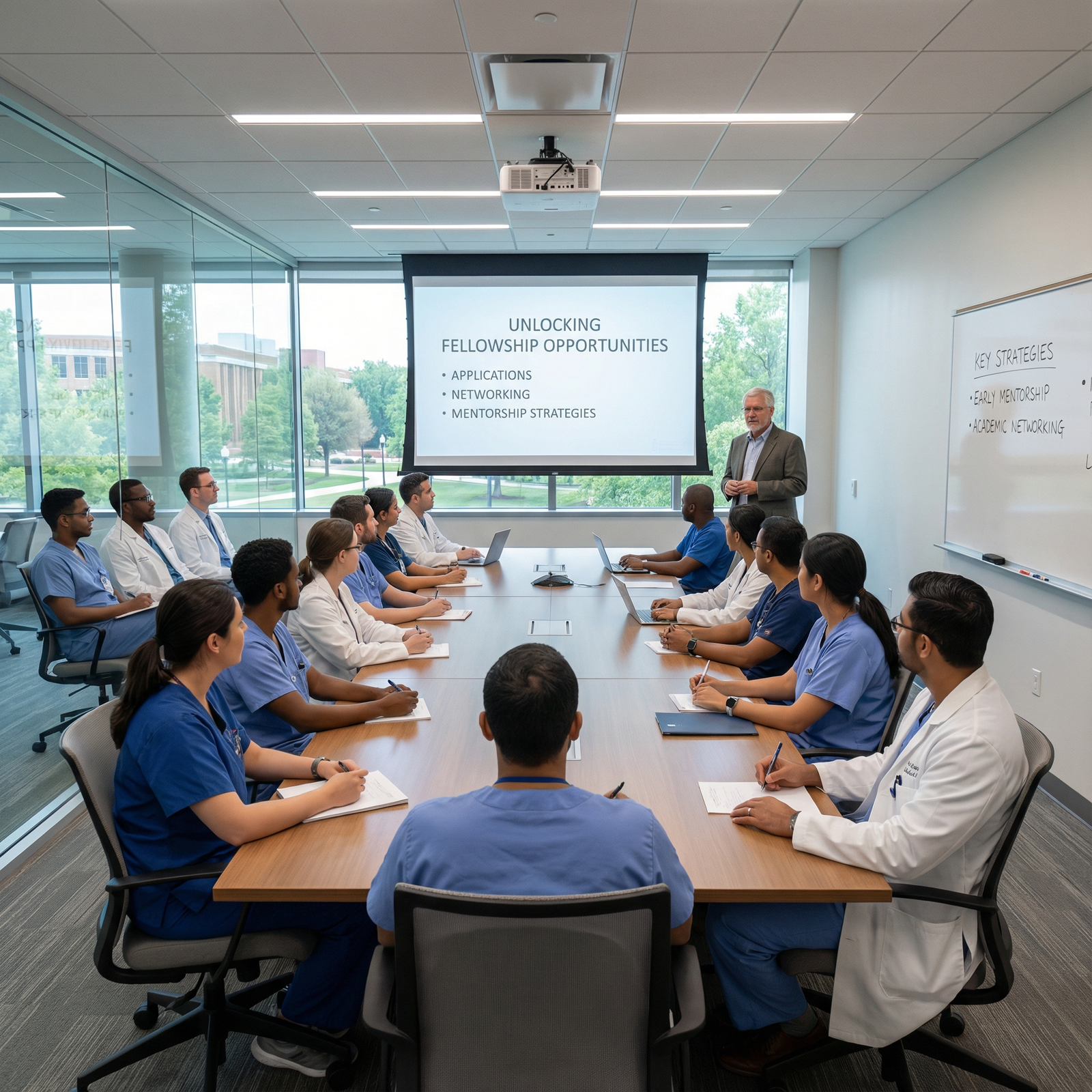
The residents who match into top fellowships do not just list “gave grand rounds” on a CV. They turn those talks into the spine of a coherent, compelling storyline.
Let me break this down specifically: if you are giving noon conferences, grand rounds, M&M, journal clubs, or invited talks and you are not deliberately using them to shape your fellowship narrative, you are wasting leverage you already earned the hard way.
This is not about padding your ERAS with “presentations.” It is about using those presentations as visible, verifiable proof that:
- You think like someone in that subspecialty.
- The faculty in that field have already trusted you as a near-peer.
- You can integrate clinical cases, evidence, and systems thinking at a level beyond average residents.
That is what fellowship committees want to see. The rest is window dressing.
Step 1: Decide Your Fellowship Storyline Before Your Next Talk
Most residents do it backwards. They say yes to random talks, then in PGY-3 they stare at their ERAS application and try to reverse‑engineer a theme from a pile of unrelated topics.
Flip that.
You need an explicit storyline first. Not a vague interest. A tight, testable thesis about who you are becoming as a subspecialist.
Examples of strong, specific narratives:
- Pulmonary/CC: “I am building expertise at the intersection of sepsis, hemodynamics, and ICU quality improvement.”
- Cardiology: “I focus on advanced heart failure and how guideline-directed therapies are implemented in safety‑net populations.”
- GI/Hepatology: “I am obsessed with high‑risk variceal bleeding and systems that prevent first bleeds and re‑bleeds.”
- Heme/Onc: “I am working on improving use of molecular diagnostics in community settings, especially in acute leukemias.”
Weak narrative: “I like cardiology and research” or “I’m interested in academic GI.” Useless. That describes half your competition.
Once you have that thesis, every significant talk you give should either:
- Deepen that theme
- Showcase higher‑order reasoning within that theme
- Or connect your current generalist work to that subspecialty lens
Grand rounds is not “just another requirement.” It is a signature chapter in that storyline.
Step 2: Choose Talk Topics That Act Like Receipts For Your Narrative
You are not choosing talk topics in a vacuum. You are choosing signals.
When I read fellowship applications, I bias toward people whose talks line up with their stated interests. It tells me they are not tourists.
Make your talks do that work for you.
A) Map talk types to narrative function
Different venues send different signals:
| Talk Type | Signaling Power for Fellowship | Best Use Case |
|---|---|---|
| Department Grand Rounds | Very High | Anchor your core subspecialty story |
| M&M (Morbidity & Mortality) | High | Show systems thinking and QI |
| Noon Conference / Core Curriculum | Moderate | Show depth and reliability |
| Journal Club | Moderate | Show evidence appraisal skills |
| Service Line / Division Conference | Very High | Show early integration into field |
If you know you want cardiology, and your only major talk is “High-Value Imaging in Low Back Pain,” you just wasted a prime chance.
Better:
- PGY-2 noon conference: “Interpreting High-Sensitivity Troponin in Complex Inpatients”
- PGY-3 grand rounds: “Type 2 MI: Overdiagnosed Label or Underappreciated Risk?”
Suddenly your application says: This person has been thinking like a cardiologist for years.
B) Concretely align topics with subspecialties
Let me give you specific examples.
Pulm/CC storyline examples:
- PGY-1 case presentation: “ARDS in the Morbidly Obese Patient – Ventilation Choices and Outcomes”
- PGY-2 journal club: “Steroids in Early ARDS – Moving Beyond ‘It Depends’”
- PGY-3 grand rounds: “The First 6 Hours of Septic Shock – What Actually Changes Mortality in the ICU?”
GI storyline examples:
- PGY-1 noon conference: “Approach to Iron Deficiency Anemia – When You Must Scope”
- PGY-2 M&M: “Missed Upper GI Bleed – System Barriers to Timely Endoscopy”
- PGY-3 grand rounds: “Acute Variceal Hemorrhage – From ED Triage to TIPS Referral”
Cards storyline examples:
- PGY-1 journal club: “Dual Antiplatelet Duration After PCI – What We Get Wrong”
- PGY-2 noon conference: “HFpEF in the Hospital – Stop Calling It ‘Just Diastolic’”
- PGY-3 grand rounds: “Decompensated HFrEF in the Safety‑Net System – Why Guidelines Fail Our Sickest Patients”
The pattern is obvious:
You take a clinically common problem, attach a subspecialty lens, and then escalate scope with seniority.
Step 3: Build a Mini‑Curriculum Across Your Residency
One talk is an event. Three thematically linked talks are a pattern. Patterns are what selection committees pay attention to.
Lay this out early. Literally on paper.
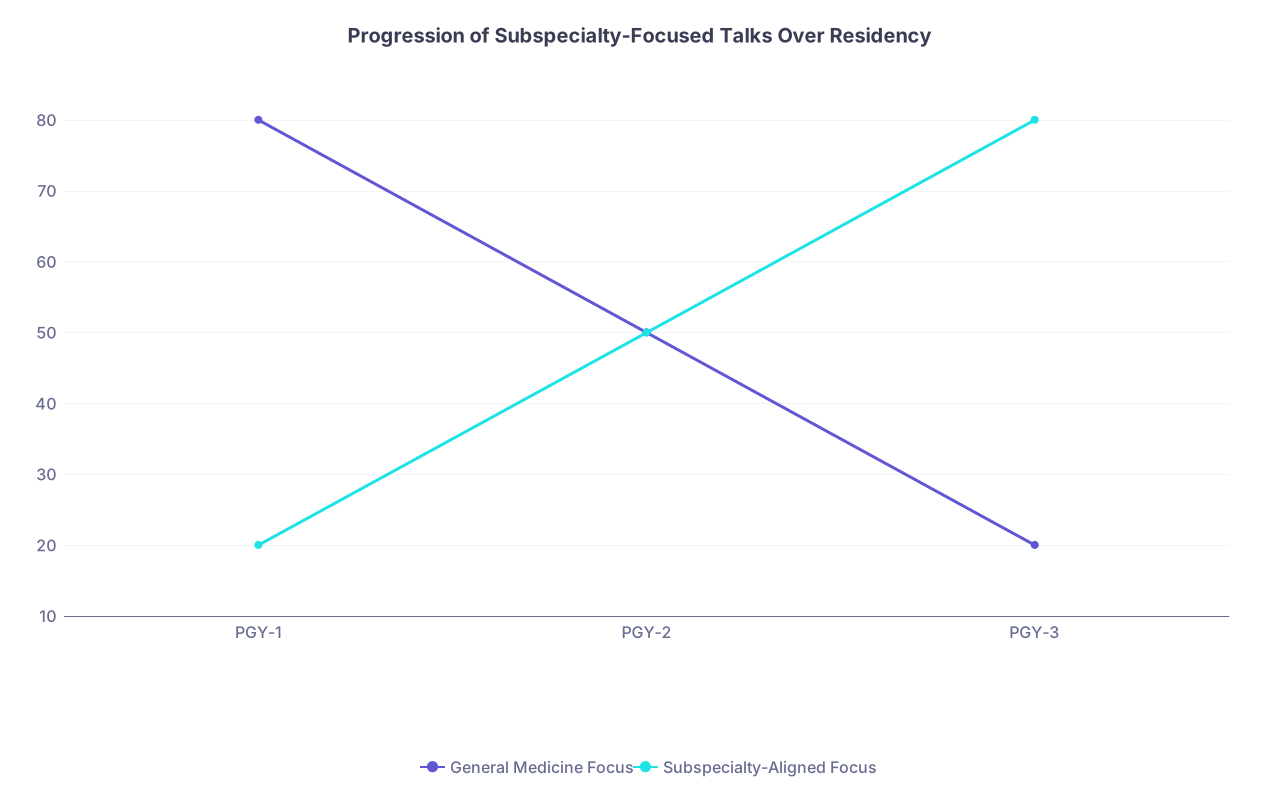
| Category | General Medicine Focus | Subspecialty-Aligned Focus |
|---|---|---|
| PGY-1 | 80 | 20 |
| PGY-2 | 50 | 50 |
| PGY-3 | 20 | 80 |
By PGY-3, most of your visible academic work should tilt heavily toward your intended field.
A) Concrete 3‑year progression example (Pulm/CC)
Let’s say your storyline is “sepsis and ICU quality.”
PGY-1 (orientation and foundation):
- Noon conference: “Evidence-Based Fluid Resuscitation in Sepsis – How Much Is Too Much?”
- Journal club: Trials on balanced crystalloids vs normal saline in critically ill patients.
PGY-2 (complexity + systems):
- M&M: “Delayed Recognition of Septic Shock on the Floor – Failure to Rescue in a Resource-Stretched Unit”
- Service line presentation: “ICU Checklist Compliance and Sepsis Outcomes in Our MICU.”
PGY-3 (leadership + synthesis):
- Grand rounds: “From Recognition to Rescue – A Systems Approach to Early Septic Shock Management in the ICU.”
- Bonus: Present some QI data you helped generate, even if small.
Now compare that to a resident whose talks are:
- “Hyponatremia Basics”
- “Antibiotic Choices in CAP”
- “Acute Pancreatitis: A Review”
Technically fine. Narratively useless.
B) Build a deliberate arc
Think of your talks like chapters:
- Chapter 1: “I understand the core clinical problem.”
- Chapter 2: “I have analyzed the evidence and controversies around it.”
- Chapter 3: “I am thinking about systems, outcomes, and implementation.”
You want your fellowship personal statement and your CV to make that arc obvious without spelling it out in neon.
Step 4: Design Each Talk To Showcase Fellowship‑Level Thinking
You are not just picking the right title. The internal structure of the talk is where you reveal your level.
There are four things that immediately separate “generic resident talk” from “this person is already thinking like a fellow.”
- Framing the clinical problem with real stakes
- Integrating high‑quality data, not just guidelines
- Addressing uncertainty and gray zones explicitly
- Connecting to systems, QI, or disparities where relevant
A) How you open the talk
Bad opening:
“Today I’ll be talking about venous thromboembolism.”
Better, fellowship‑oriented opening (Heme/Onc lens):
“Last year, three of our oncology patients died of preventable pulmonary emboli while admitted to this hospital. None of them had a documented VTE risk score. Today I want to walk through what actually went wrong, and what evidence‑based VTE prevention would look like for our cancer population.”
See the difference? Same broad topic. Completely different signal.
B) How you use data
Stop pasting guidelines as screenshots. Fellows do that. Residents who want fellowships should go further.
You should:
- Show key trial designs and limitations in 1–2 slides.
- Explicitly state: “This is what we know. This is where evidence is weak. This is pure expert opinion.”
- Highlight where your own practice—or your institution’s practice—diverges from evidence.
If you are giving a talk on HFpEF and you cannot name and summarize TOPCAT or PARAGON‑HF in plain language, you are not communicating fellowship‑level thinking.
C) How you handle gray areas
Committees love seeing someone who is comfortable saying:
- “Here is where I am uncertain.”
- “Reasonable experts disagree here because…”
- “My approach, given this data and this setting, would be…”
That is where you stop sounding like an UpToDate summary and start sounding like an emerging expert.
Step 5: Use Talks To Build Real Relationships With Fellowship Gatekeepers
Presentations are excuses to talk to the people who will eventually write your letters and advocate for you at rank meetings.
Most residents underuse this.

| Step | Description |
|---|---|
| Step 1 | Choose subspecialty aligned topic |
| Step 2 | Identify key subspecialty faculty |
| Step 3 | Request mentorship for talk |
| Step 4 | Co-create outline and slides |
| Step 5 | Deliver talk at conference |
| Step 6 | Debrief with mentor |
| Step 7 | Convert to project or abstract |
A) Before the talk
Identify 1–2 subspecialty faculty who care about your topic.
Email them a brief, targeted ask:
“I am planning to give a PGY-3 grand rounds on ‘Early Septic Shock Management in the MICU’ with a focus on quality and outcomes. This aligns with my interest in Pulm/CC. Would you be willing to look at my outline and give feedback from a critical care perspective?”
Most will say yes. You just generated a reason to meet.
B) During preparation
When you meet:
Show them an outline that clearly has some thought already baked in.
Ask targeted questions:
- “Where do you see fellows or attendings commonly misunderstanding this topic?”
- “What would you want a future fellow to highlight for our residents on this?”
You are quietly positioning yourself as “future fellow material” while actually learning.
C) After the talk
The debrief is where a lot of mentorship actually starts.
You say:
- “Thank you for the earlier feedback. I am interested in turning part of this into a small project or abstract. Is there existing data we can analyze, or would it fit with anything your group is working on?”
You are not begging for research. You are offering a high‑yield, already‑developed niche.
This is also how your letter writer later ends up saying:
“He gave one of the strongest resident grand rounds I’ve seen in years on sepsis and ICU quality, and then turned that into a QI project that we are preparing for presentation.”
Step 6: Turn Each Talk Into Multiple Application Assets
A single well‑planned talk can yield:
- 1 line on your CV under “Presentations”
- 1–2 lines under “Quality Improvement” or “Projects”
- A natural anchor anecdote in your personal statement
- An interview story that actually lands
A) CV entries: do not undersell
Bad CV line:
“Grand rounds: ‘Asthma Management,’ Department of Medicine, 2025.”
Better:
“Department of Medicine Grand Rounds, ‘From ED to ICU – High-Risk Asthma Exacerbations and Early Critical Care Involvement,’ 2025.”
You highlight acuity, systems, and specialty.
If you developed a protocol, QI measure, or data analysis from the talk, that becomes a separate entry:
“Project: Implementation of a Sepsis Huddle Protocol for MICU Transfers – Developed and presented as part of department grand rounds, 2025.”
B) Personal statement: use talks as anchor scenes
Do not list your talk topics in your personal statement. Tell one sharp, specific story.
Example (Cards applicant):
“In my third year of residency, I was asked to give grand rounds. I could have done a comfortable, broad review of atrial fibrillation. I chose instead to focus on a group of patients I kept seeing in our safety‑net clinic—those with advanced HFrEF who returned to the ED again and again, despite what looked like ‘guideline-directed’ therapy.
Preparing for that talk forced me to confront a gap I had only felt at the bedside. I pulled our hospital’s readmission data, interviewed our HF nurses, and mapped out the points where our patients fell off the evidence‑based pathway. On the day of grand rounds, an attending I respect stood up and said, ‘We have been missing this pattern for years.’
That experience crystallized what I want from cardiology fellowship…”
Notice how the talk is not the point of the story. It is the catalyst.
C) Interviews: have 2–3 “talk‑based” stories ready
You will get asked:
- “Tell me about a time you taught something important.”
- “What is a topic in our field you think is underappreciated?”
- “What academic work are you proudest of?”
You should be able to answer all of those with variations of your best talks.
Prepare, for each major talk:
- 1 sentence on the topic.
- 2–3 sentences on the clinical problem and why it mattered.
- 2 sentences on what changed because of the talk (practice, awareness, protocol, your own plans).
If you cannot answer “what changed because of this talk,” you either picked the wrong topic or did not push it far enough.
Step 7: Avoid Common Talk‑Storyline Mistakes
I have watched dozens of residents shoot themselves in the foot with how they pick and describe talks.
Here is what I see most frequently.
Mistake 1: Topic scatter with no theme
Pathology:
- PGY-1: “Hyponatremia in SIADH”
- PGY-2: “Antibiotic Stewardship Basics”
- PGY-3: “Management of DKA”
Then in September of PGY-3 they announce: “I’m going into nephrology.” Nothing in their talks supports that.
Fix:
Once you decide your fellowship target (even 60–70 percent sure), steer at least half of your remaining talks toward that domain or related physiology.
Mistake 2: Picking “sexy” topics you do not truly understand
You choose “Mechanical Circulatory Support in Cardiogenic Shock” because it sounds advanced. Then you barely grasp the differences between Impella, IABP, and ECMO strategies. Faculty see through that instantly.
Better: Pick something you have managed repeatedly on the wards or in the unit. Then pull it slightly up‑field into the fellowship domain.
For example:
From “COPD Exacerbation Management” → “Acute Hypercapnic Respiratory Failure – When and How to Use Noninvasive Ventilation Properly.”
You still sound advanced. But you are on solid ground.
Mistake 3: Failing to update talks into projects
Passive mode:
- Give talk
- Save slides
- Forget it happened
Active mode:
- Ask: “Is there a small data pull we can do here?”
- Turn 1–2 slides of your talk into an abstract or poster.
- Present at a local/regional conference.
You are not creating new work. You are repackaging and slightly extending what you already did.
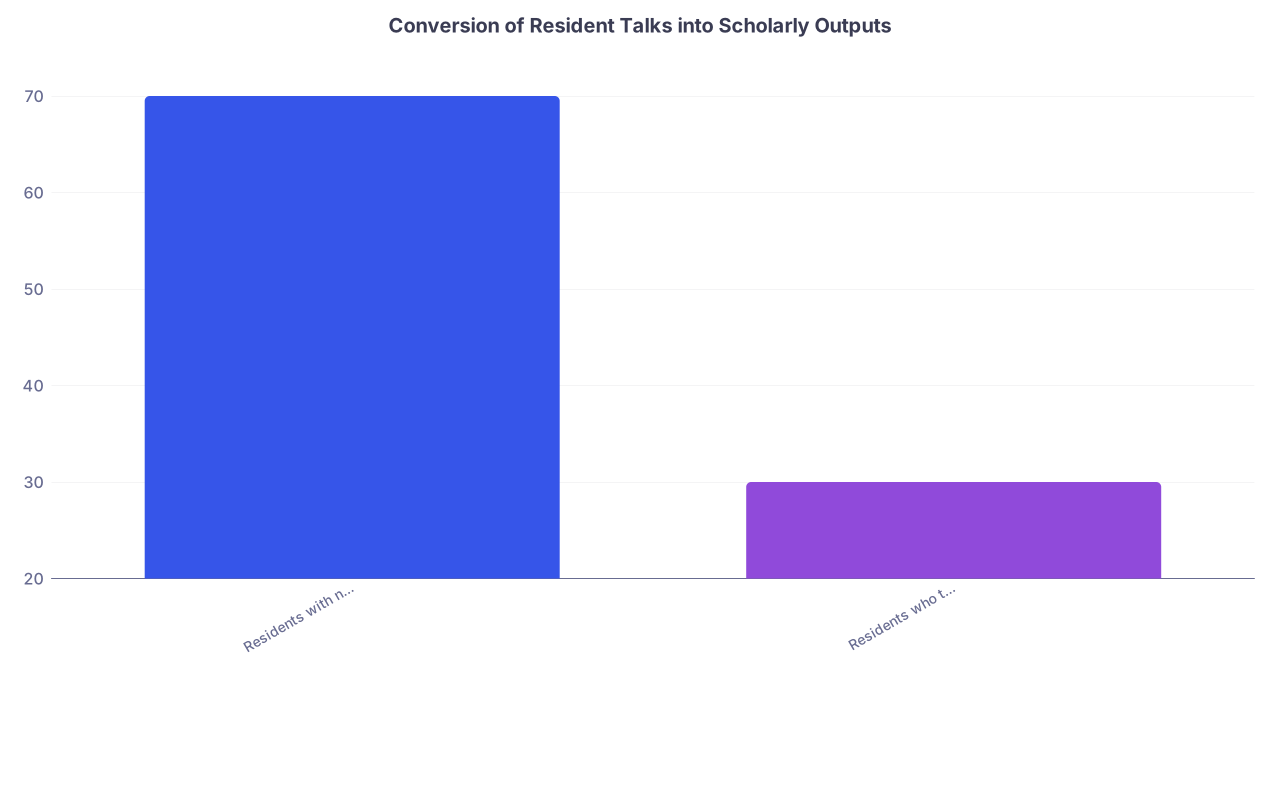
| Category | Value |
|---|---|
| Residents with no follow-up | 70 |
| Residents who turn talks into abstracts | 30 |
The 30 percent who convert talks into something citable disproportionately populate the match lists of competitive fellowships.
Mistake 4: Not documenting and archiving
Keep a simple record:
- Title
- Date
- Venue (department grand rounds, division conference, etc.)
- Faculty mentors involved
- Any associated QI or project files
You will forget the exact titles and dates by PGY‑3. Programs sometimes ask for specifics. Having that record lets you appear “put together” instead of “scrambling through old emails.”
Step 8: Calibrating Ambition to Your Program Reality
Not every resident is at a quaternary academic center with weekly subspecialty conferences and built‑in mentors. That does not let you off the hook.
What changes is scale, not strategy.

A) If you are in a community or smaller program
You might not have “grand rounds” in the classic sense. Fine.
You still have:
- Noon didactics
- Resident teaching conferences
- Joint sessions with local subspecialists or referral centers
- Hospital‑wide education committees
Your strategy:
- Pick 2–3 talks over residency that clearly point toward your fellowship interest.
- Loop in off‑site subspecialists (e.g., from the tertiary center you refer to) as virtual mentors.
- Frame your work around implementation in resource-limited settings—a narrative that top fellowships actually value.
“Building a practical, evidence‑based approach to decompensated cirrhosis in a community hospital without onsite transplant” is a very strong hepatology story if you tell it well.
B) If you are at a big academic center
You have more options, but you also have more competition. Half your co-residents will be “interested” in the same fellowships.
You differentiate by:
- Start your theme early (end of PGY‑1).
- Aim for at least one high‑visibility talk within the actual fellowship division.
- Tie your talks tightly to existing research/QI in that division so faculty see you as plug‑and‑play.
For example, if your Pulm/CC division has an ongoing ARDS outcomes registry, angle your grand rounds topic to line up with that. Then explicitly ask, “Can this fit into the registry work somehow?”
Step 9: A Concrete Playbook You Can Follow Tomorrow
Let me remove every excuse.
You want a roadmap. Here is one.
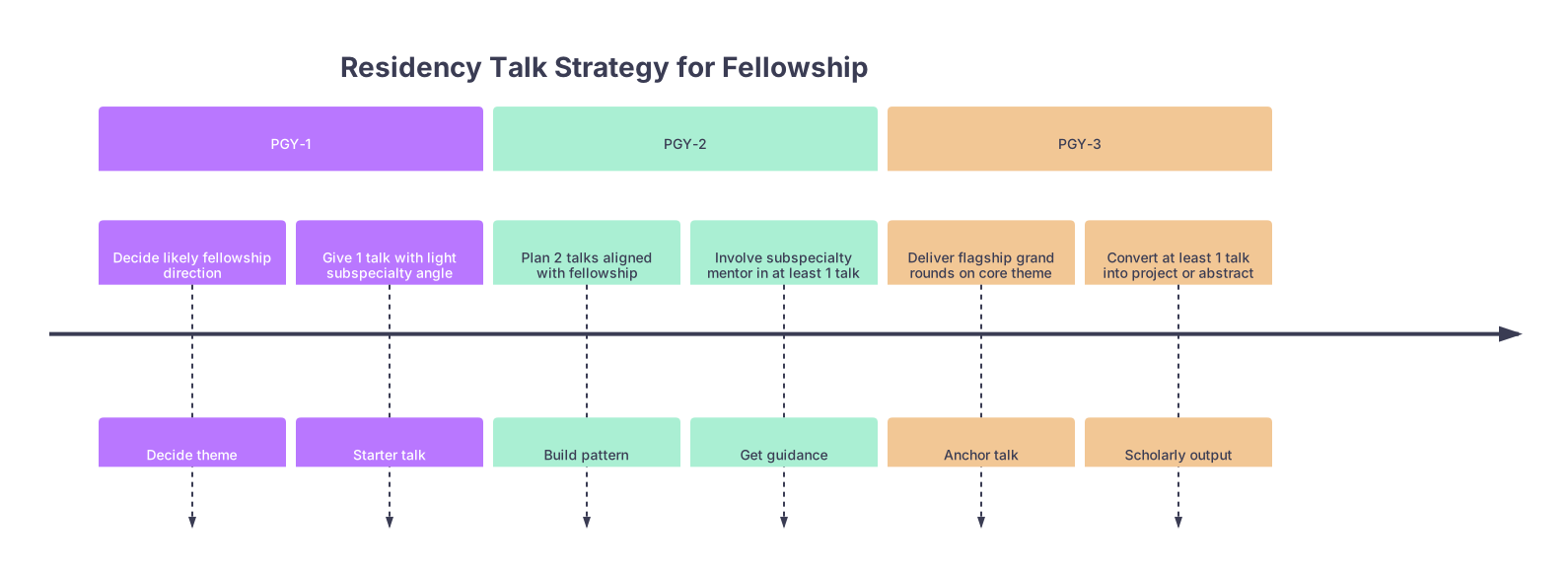
| Period | Event |
|---|---|
| PGY-1 - Decide likely fellowship direction | Decide theme |
| PGY-1 - Give 1 talk with light subspecialty angle | Starter talk |
| PGY-2 - Plan 2 talks aligned with fellowship | Build pattern |
| PGY-2 - Involve subspecialty mentor in at least 1 talk | Get guidance |
| PGY-3 - Deliver flagship grand rounds on core theme | Anchor talk |
| PGY-3 - Convert at least 1 talk into project or abstract | Scholarly output |
Then operationalize it:
PGY‑1:
- By January: pick a likely fellowship direction, even if not 100 percent.
- Spring: give one talk (case conference, noon conference, journal club) with a soft slant toward that area.
PGY‑2:
- Early in the year: talk to your program leadership about doing one subspecialty‑aligned talk per year.
- Identify 1–2 division faculty in your target field. Get at least one of them involved in a talk.
- Start hinting, in faculty conversations, that your grand rounds PGY‑3 will be on XYZ theme.
PGY‑3:
- Secure a grand rounds slot as early as possible.
- Design it to be the clearest expression of your fellowship storyline.
- Debrief with your subspecialty mentor afterward and explicitly discuss projects or abstracts.
- Use that talk and its fallout (QI, project, clinic changes) in your personal statement and interviews.
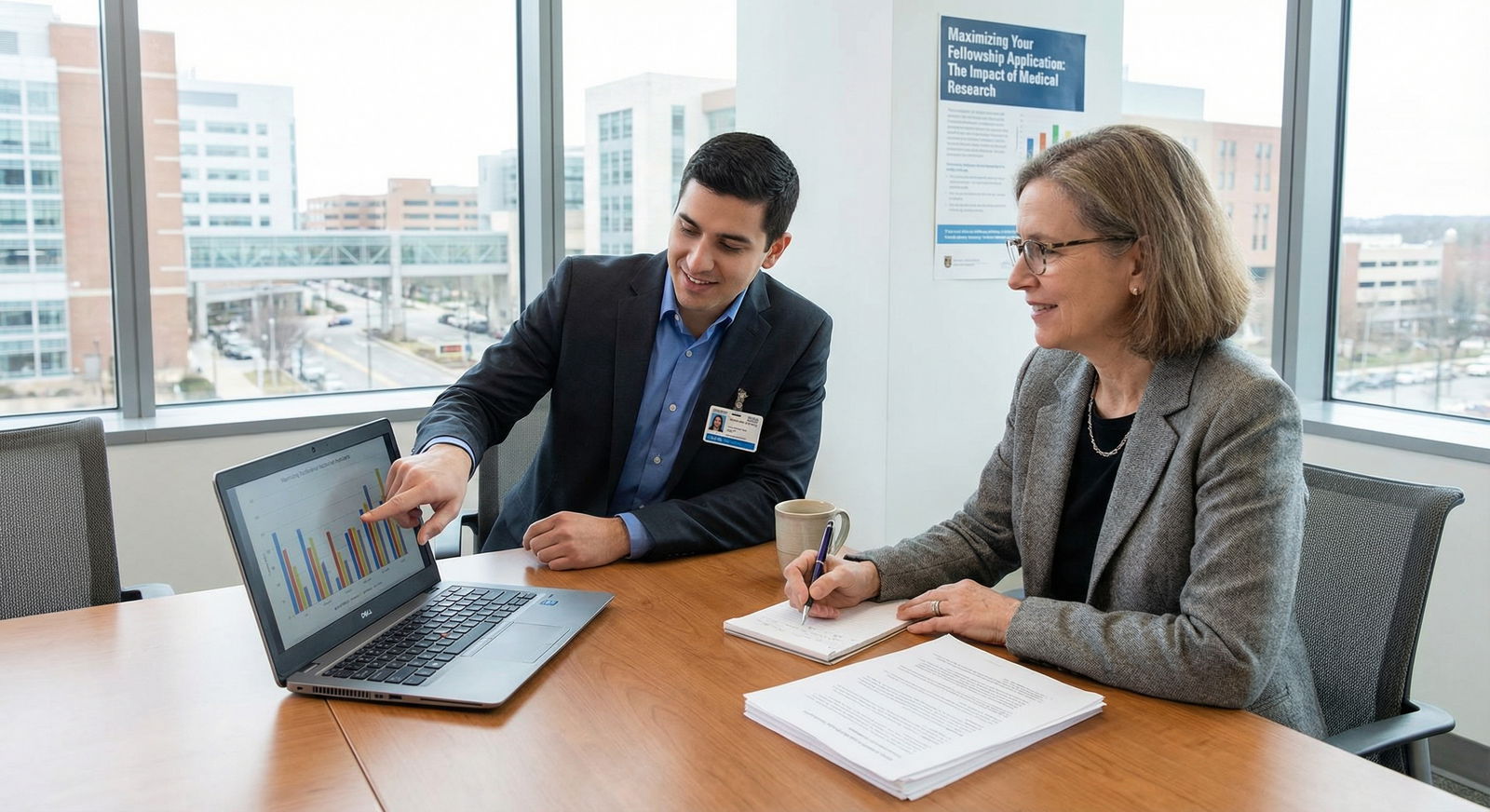
How This Actually Looks To A Fellowship Committee
Picture sitting in a cardiology fellowship rank meeting. You are comparing two IM applicants with similar board scores and decent letters.
Applicant A:
- CV presentations: “Resident Noon Conference: COPD Exacerbation,” “Resident Lecture: Hypertension Basics.”
- Personal statement: “I have always been fascinated by the heart…”
Applicant B:
CV presentations:
- “Resident Noon Conference: High-Sensitivity Troponin in the Inpatient Setting – Avoiding Overdiagnosis of MI.”
- “Journal Club: DAPT Duration after DES – Interpreting Conflicting Trials.”
- “Department Grand Rounds: Decompensated HFrEF in a Safety-Net Population – Bridging Guideline and Reality.”
Personal statement centers on preparing and delivering that grand rounds, including data from their own hospital.
One letter from the HF director explicitly references that talk as evidence of fellow‑level reasoning.
You already know who gets ranked higher.
You can be Applicant B. But not by accident. You build that file with eyes open starting now.

Three Things To Walk Away With
- Talks are not filler; they are structural beams. Pick topics and venues that explicitly support a clear, specific fellowship storyline.
- A flagship grand rounds, designed and mentored properly, can anchor your entire application—CV, personal statement, and interviews—if it reflects genuine subspecialty‑level thinking.
- Every talk should create follow‑on value: a mentor relationship, a small project, or at minimum a strong story about how you already think like the fellow you want to become.


