The residents who match the best fellowships do not just “like teaching.” They can prove they already function like junior faculty.
Let me break this down specifically: fellowship programs are quietly sorting applicants into two piles.
Pile A: “Future colleague who will teach, mentor, and build this program.”
Pile B: “Technically fine, but will disappear into the reading room / endoscopy suite / call room.”
If you want competitive fellowships, you cannot afford to be in pile B.
This is how you turn your messy, real-world resident teaching into a sharp, defensible fellowship strength—on paper, in your letters, and in your interviews.
1. What Fellowship PDs Actually Mean by “Strong Teacher”
Program directors are not impressed by “I enjoy teaching junior residents and medical students.” Everyone writes that. It is background noise.
When PDs talk about wanting a “strong teacher/mentor,” they usually mean:
- You can organize and communicate complex information under time pressure.
- You take responsibility for the learning environment—on rounds, in clinic, on call.
- You actively develop juniors instead of just supervising them.
- You improve systems: curricula, orientation, handoffs, templates, teaching materials.
- You are safe. Juniors paired with you get better, not more confused.
They see teaching and mentoring as proxies for:
- Leadership potential
- Emotional intelligence
- Accountability and reliability
- Maturity and professionalism
If you sell “I like teaching” without showing those underlying traits, you have wasted the opportunity.
The hierarchy of teaching experiences
Here is the unspoken value ladder most academic fellowship committees use when they skim your CV and PS:
| Level | Type of Experience | Typical Impact on PDs |
|---|---|---|
| 1 | Formal curriculum design / course director role | Very strong |
| 2 | Longitudinal mentorship program (assigned mentees, follow-up) | Strong |
| 3 | Structured teaching role (bootcamps, skills sessions, simulation faculty) | Strong |
| 4 | Small-group or didactic teaching with evaluations | Moderate–strong |
| 5 | Regular on-service teaching with specific examples & outcomes | Moderate |
| 6 | Vague “I enjoy teaching students and residents” | Weak |
Your job is to climb as high on this ladder as your residency environment allows—and then describe it precisely.
2. Audit Your Teaching: What You Really Have (Not What You Wish You Had)
Before you can showcase anything, you need a ruthless inventory. Most residents underestimate what they already do, and then describe it so vaguely it sounds unimpressive.
Take 15 minutes and actually list things.
A. Bedside and on-service teaching
Think about each core rotation as a senior resident or chief:
- Inpatient wards / ICU
- Night float
- Consult services
- Continuity clinic / subspecialty clinic
- ED or urgent care shifts
For each, ask:
- Who learned from me (students, interns, junior residents, NPs, PAs)?
- How often (daily, weekly)?
- What kind of teaching (micro-teaching, chalk talks, sim, debriefs, procedures)?
- Did I change anything about how teaching happened (new structure, schedule, tools)?
Example:
“Senior resident on the cardiology consult service. Led daily 15-minute focused teaching huddles with two interns and one student, using real-time consults to frame mini-cases on chest pain risk stratification, arrhythmia management, and CHF exacerbations.”
That is much stronger than “Did teaching on cardiology consults.”
B. Formal teaching roles
Look for anything with a title, scheduled date, or sign-up:
- Medical student small group facilitator
- OSCE/CPX examiner
- Skills lab instructor (airway, ultrasound, central line, MSK exam, pelvic exam)
- Simulation faculty or confederate
- M3 or M4 clerkship lecturer
- Board review or in-training exam review sessions
- Anatomy / path / radiology / ECG teaching sessions
Gather details:
- Topic
- Audience level (M1 vs M4 vs interns)
- Frequency (one-time vs series)
- Evaluations (if available)
C. Mentoring and advising
Programs underestimate how heavily this section can hit if it is structured.
You want:
Official mentorship roles:
- Assigned intern mentor
- Longitudinal med student mentor through the med school or SNMA/LMSA/WIMS or specialty interest groups
- Residency recruitment mentor (paired with applicants, postmatch follow-up)
Unofficial but REAL mentorship:
- Coached a junior through a research poster or QI project
- Helped a student remediate a failed rotation
- Guided an intern in choosing electives, managing burnout, or planning for fellowship
The key: you must show continuity and outcomes, not just “doors always open.”
D. Educational leadership and systems work
This is the stuff PDs love because it smells like future faculty:
Created or revamped:
- Orientation curriculum
- Intern bootcamp structure
- “Survival guide” or handbook
- Procedure log / checklist
- Teaching slide decks shared across the residency
Served on:
- Residency education committee
- Curriculum redesign working group
- Program evaluation committee
Led:
- Morning report as chief or recurring presenter
- M&M conference
- Journal club with explicit teaching goals
Once you have this messy list, you can start turning it into ammunition for your application.
3. Converting Teaching into Application-Ready Material
You do not get credit for vague “I teach a lot.” You get credit for specific, outcome-oriented descriptions that fit where they belong: CV, personal statement, letters, and interview answers.
Let’s go component by component.
A. CV: Turn “helped teach” into actual bullets
Your ERAS or fellowship CV is not a prose novel. It is a signal. PDs skim.
For every teaching item, you want:
- Role
- Audience
- Frequency
- Scope or impact
Compare these:
Weak:
“Resident teacher, wards”
Stronger:
“Senior resident, inpatient medicine – Led daily bedside teaching and case-based mini-lectures for 2–4 medical students and 1–2 interns per month-long block; emphasized diagnostic reasoning, safe discharge planning, and feedback.”
Another example:
Weak:
“Participated in intern bootcamp”
Strong:
“Co-facilitator, PGY-1 Bootcamp – Designed and led annual 3-hour simulation-based session on cross-cover calls for 18 new interns, integrating structured debriefing and standardized handoff language.”
Do this consistently:
- Use action verbs: led, developed, implemented, designed, mentored, facilitated, evaluated.
- Make the scale visible: how many learners, how often, how long.
- Highlight educational design when present: cases, debriefs, feedback tools.
B. Personal statement: Use 1–2 sharp examples, not a paragraph of fluff
You are not writing a teaching philosophy paper. You are subtly arguing: “I already function like a junior faculty member; your fellowship will amplify what I am already doing.”
Structure it like this:
One specific teaching/mentoring story that shows:
- Initiative
- Insight into learner needs
- Follow-through
- A concrete outcome
One or two sentences that generalize that story into your broader teaching identity.
One sentence that ties it to the fellowship’s strengths (education track, med ed certificate, high student volume, etc.).
Example excerpt (condensed):
On our busy MICU rotation, daily teaching was historically sacrificed to throughput. Halfway through my senior month, I realized our interns were leaving without a clear framework for ventilator changes. I started a 10-minute “vent huddle” at 3 pm, using one live patient and a one-page worksheet I created. We walked through indications, settings, and “what would you change next?” Over the month, I saw interns go from passively accepting orders to proposing rational changes on rounds. One of them later emailed me a photo of the worksheet from her new program’s ICU, saying she still used it on call.
That experience crystallized for me that my favorite part of critical care is not simply managing complexity, but making it teachable…
Notice what this does:
- Pinpoints a real problem
- Shows initiative (no one assigned them to fix it)
- Shows specific action (huddle, worksheet, time of day)
- Shows outcome (behavior change, long-term use)
This is what PDs remember.
C. Letters of recommendation: Engineer them to talk about your teaching
Most letters sound the same. You can influence that.
You want at least one letter writer who has seen you in a clear teaching or mentoring capacity. Then you make it absurdly easy for them to comment on it.
How to do this:
Choose the right people:
- APD or education chief who runs didactics or bootcamps
- Clerkship director who has watched you with students
- ICU or consult attending who saw you lead the team
When you ask for the letter, give them:
- A 1-page “brag sheet” with bullet points:
- “Led x, y, z sessions”
- “Mentored A, B, C”
- “Created this specific tool”
- A quick reminder of one or two teaching episodes they directly observed.
- A 1-page “brag sheet” with bullet points:
Sample email snippet (adapt the tone to your culture):
I am particularly hoping that one of my letters can speak to my teaching and mentoring on the MICU rotation. During our month together you saw me:
– Run the afternoon vent huddles with the interns and students
– Debrief the overnight codes with the team the following morning
– Coach the subintern through presenting at M&MIf any of those examples resonate with your experience of working with me, I would be grateful if you mentioned them in your letter.
No, not every attending will write exactly what you want. But many will be relieved you gave them concrete material instead of vague “he’s great.”
4. Building a Teaching Narrative That Fits Your Target Fellowship
Different fellowships care about teaching in different ways. You need to match your signal to what they value.
Think about three broad buckets:
- Highly academic fellowships with strong med-ed infrastructure
- Mixed academic/community programs
- Purely clinical, high-volume programs with constant learners
4.1 Academic powerhouses
Examples: top IM subspecialty fellowships at big-name university hospitals, places with:
- Clinician-educator tracks
- Medical education fellowships or certificates
- Required scholarly project in education
These programs are hunting for future faculty. Here, you emphasize:
- Curriculum design
- Systematic feedback practices
- Educational leadership roles
- Any scholarship in medical education (posters, workshops, publications)
You want your application to make the PD think: “We can plug this person into our medical student clerkship / residency didactics on day one.”
If you have anything resembling:
- “Co-created a flipped-classroom curriculum for M3 hospital medicine rotation”
- “Developed 5-case simulation series for intern cross-cover”
- “Presented at regional SGIM/ATS/ACP on an educational innovation”
…you highlight it aggressively.
4.2 Mixed academic/community programs
Here, the priority is: will you keep the hospital running and the learners safe, and will you be a positive force for the residency?
They care less about IRB-approved educational projects and more about:
- On-service teaching skill
- Being a go-to supervisor
- Practical mentoring of residents and students rotating through
Your narrative should lean on:
- Volume: taught many learners, consistently.
- Breadth: inpatient, clinic, off-service, nights.
- Reliability: staff trusted you to orient new people, handle cross-cover teaching, run sign-outs.
Show that you:
- Create calm and clarity during chaos
- Do not withhold teaching when the unit gets slammed
- Protect junior learners from drowning while still pushing them
4.3 High-volume clinical programs
These places are brutal for learners if the fellows are not competent teachers. They may not care about med-ed theory, but they absolutely care whether their fellows can:
- Efficiently supervise multiple learners
- Prevent errors
- Explain complex procedures or plans in simple terms
Emphasize:
- Situational teaching: night float, rapid responses, procedures.
- Safety: how your teaching reduced mistakes, improved sign-out, clarified protocols.
- Speed: your ability to teach efficiently within 5–10 minute windows.
5. Common Mistakes Residents Make (That Sink the Teaching Narrative)
I have watched otherwise strong fellowship applicants silently sabotage this strength. The patterns are predictable.
Mistake 1: Listing “teaching” as a hobby
No. Teaching is not a hobby. Do not bury it under “I enjoy hiking, cooking, and teaching students.” This trivializes it.
Teaching belongs in:
- Work experience (for formal roles)
- Leadership sections
- Personal statement core narrative, if it is a real strength
Mistake 2: Using generic phrases
Avoid these dead phrases:
- “Passionate about teaching”
- “Enjoy giving back”
- “Like working with students”
They do not differentiate you. Replace them with specific behaviors:
- “Provide structured mid-rotation feedback using X framework”
- “Standardized pre-op teaching script for new interns before the OR”
- “Built case bank of 20+ ECGs for intern night teaching”
Mistake 3: Overstating without receipts
Do not claim:
- “Lead curriculum for…” when you gave one lecture.
- “Mentored multiple residents” when you had one hallway conversation.
- “Passionate about medical education research” with zero output.
PDs smell inflation. And they talk across programs.
Better to be concrete and modest:
- “Co-led a portion of…”
- “Piloted a single session on…”
- “Currently working on an abstract describing…”
Mistake 4: Ignoring outcomes
Whenever possible, anchor your teaching to actual changes:
- Learner evaluations (“Consistently rated in top 10% of resident teachers by students”)
- Program changes (“Orientation schedule permanently adopted my sign-out workshop”)
- Behavior changes (“Interns began initiating ventilator changes after our sessions”)
- Recognition (teaching awards, nominations, invitations to repeat sessions)
You do not need all of these. One strong outcome beats a paragraph of adjectives.
6. How to Strengthen Your Teaching Profile If You Still Have Time in Residency
If you are PGY-1 or early PGY-2 reading this, you are in a good position. You can still build the story you want to tell.
Here is a pragmatic approach.
Step 1: Pick one environment to “own”
You cannot fix everything. Choose one high-yield setting aligned with your target fellowship:
- Future cardiology fellow: CCU or cardiology consults
- Future pulm/crit: MICU or thoracic step-down
- Future GI: GI consults / endoscopy pre/post
- Future heme/onc: inpatient malignant heme service or infusion center
- Future hospitalist: wards night float, cross-cover
Ask yourself:
- What teaching is already happening here?
- Where is the gap?
- What could realistically fit into the workflow?
Step 2: Implement one sustainable teaching intervention
Examples that work and do not get you hated:
- A 10-minute structured “micro-teach” daily or every other day
- A set of laminated pocket cards / one-page PDFs for common issues
- A standard debrief after codes, RRTs, or tough cases
- A weekly case-based chalk talk at sign-out
Document it. Keep your templates, slides, or handout. Make it reproducible.
Step 3: Seek feedback and iterate
Ask one or two trusted faculty:
- “Would you mind watching how I run teaching on the unit one day and giving me feedback?”
- “Is there anything you wish the interns understood better on this service that I could work into my sessions?”
This does three things:
- Improves your teaching.
- Signals to faculty that you are serious about education.
- Plants the seed for a strong letter.
Step 4: Layer in mentorship
You do not need a formal title to mentor:
- Take one intern or student on that service and commit: “I will check in with you weekly this month about how the rotation is going and your future plans.”
- Offer to review one note per week and give structured feedback.
- Help them prepare one mini-presentation for the team.
Again, document what you did and any visible outcomes.
7. Preparing For Interview Questions About Teaching and Mentoring
If you pitch teaching as a strength, expect to be challenged on it in interviews. That is good. It means they are taking you seriously.
You should have sharp, ready answers to:
- “Tell me about a time you taught a complex concept to a learner.”
- “How do you give feedback to struggling residents or students?”
- “What role do you see teaching playing in your future career?”
- “Describe a teaching session that went poorly. What did you change?”
Here is a simple, reliable structure:
- Brief context
- Your specific action
- The learner response or outcome
- What you learned and changed
Example (question 2):
We had an intern on nights who was consistently missing key data points in sign-out, which made cross-cover unsafe. I pulled two of his sign-outs and asked him to walk me through his mental checklist. It turned out no one had ever given him a structured template; he was copying bits from different seniors. I sat with him for 15 minutes, built a simple 4-part sign-out structure on paper, and then had him re-practice three patients using it. Over the next week, I spot-checked his sign-outs and they were much clearer. The main lesson for me was that what looks like “carelessness” is often just lack of structure. Now I default to giving concrete tools before I give criticism.
This shows:
- Safety awareness
- Non-punitive, coaching approach
- Practicality
- Self-reflection
That is what PDs want from a future fellow supervising their residents.
8. Where Data Helps: Showing Volume and Commitment
You are in medicine. Numbers still matter. You can quantify your teaching without making it look like a spreadsheet.
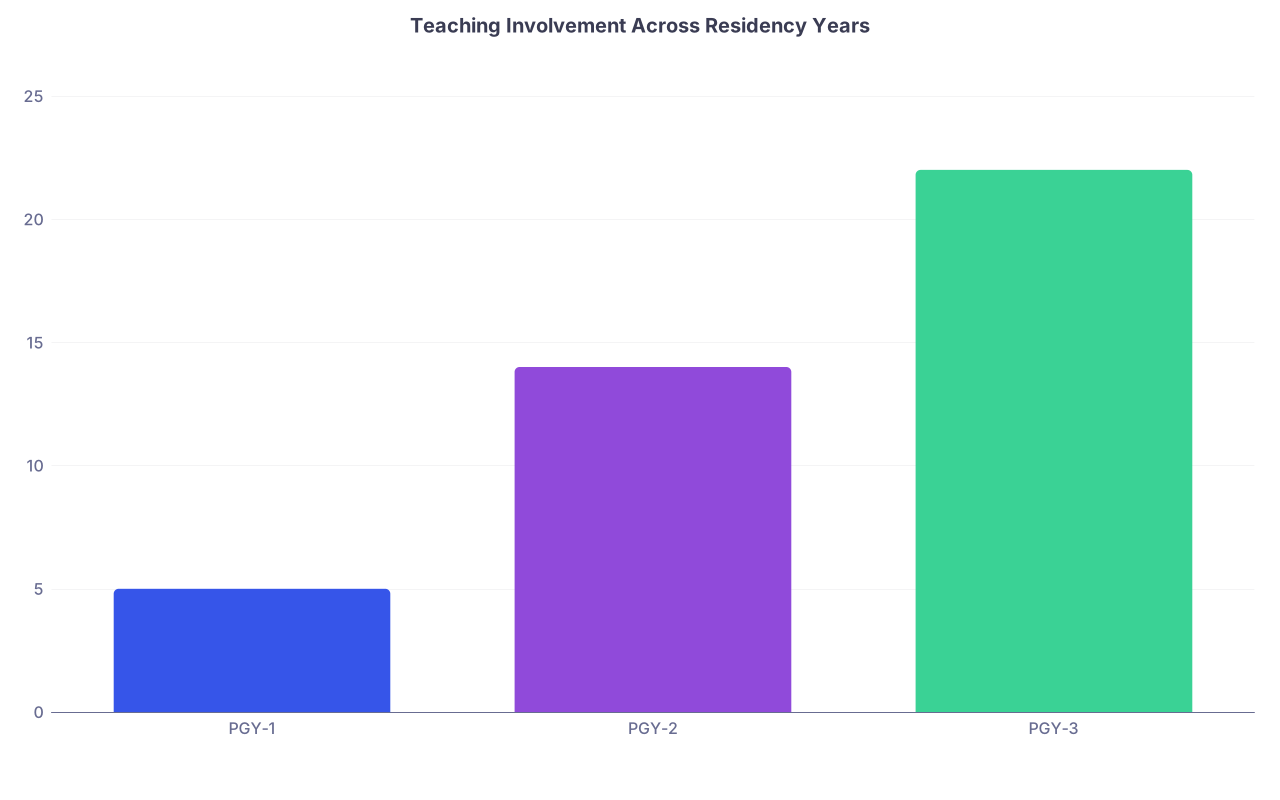
| Category | Value |
|---|---|
| PGY-1 | 5 |
| PGY-2 | 14 |
| PGY-3 | 22 |
You might say in your CV or PS:
- “Over residency, I have led 40+ structured teaching sessions for students and interns, including 12 ICU vent huddles, 8 intern night-float tutorials on cross-cover, and 20 case-based noon reports.”
Or:
- “Formally mentored 6 learners over 2 years (3 interns, 3 medical students), meeting monthly for goal-setting, feedback, and fellowship/career planning.”
The point is not to inflate. It is to show:
- This is not a one-off.
- You kept doing it despite service demands.
- You have enough repetitions that you are not experimenting on their learners as a brand-new fellow.
9. One-Level-Up: Educational Scholarship Without a PhD in Med Ed
If you have already done the hard part—noticed a recurring educational problem and built an intervention—you are 70% of the way to a small, respectable education project.
Basic pattern:

| Step | Description |
|---|---|
| Step 1 | Identify recurrent learner gap |
| Step 2 | Design small teaching intervention |
| Step 3 | Implement on one service/block |
| Step 4 | Collect simple feedback or outcomes |
| Step 5 | Present at local conference or grand rounds |
| Step 6 | Optional - Submit poster or brief report |
Examples:
- Short survey before/after your intern bootcamp session on comfort with cross-cover issues.
- Tracking how many pages about “X problem” occur before and after your one-page guideline.
- Collecting anonymous evaluations of your teaching over a few months.
Then you submit:
- A poster to your hospital’s education day
- A workshop to a regional meeting
- A “Brief Report” to a specialty journal’s education section
Even one modest educational abstract, paired with sustained teaching work, cements you in the PD’s mind as “clinician-educator trajectory.”
Key Takeaways
- Vague “I like teaching” does not move fellowship PDs. Specific, outcome-focused examples of teaching and mentoring do.
- You must deliberately convert real resident work—on-service teaching, bootcamps, mentoring, small curricula—into sharp bullets on your CV, targeted stories in your personal statement, and concrete material for your letters.
- If you still have time in residency, pick one environment to own, build one sustainable teaching intervention, and mentor a few learners well. That is how you cross the line from “good resident” to “future faculty” in the eyes of fellowship programs.