
It is January of your PGY-2 year. You just finished sign-out, you are half-scrolling through Epic in the workroom, and an email pops up: “Fellowship application season – key dates and preparation tips.”
You feel that small jolt. Not panic, exactly. More that sinking realization: “What is my story going to be?”
Because you know how this goes. Programs are going to ask:
“Tell me about your clinical experiences that led you to this fellowship.”
“Walk me through how your rotations prepared you for this field.”
And right now? Your CV looks like a chaotic menu: MICU, night float, clinic, wards, a random elective in rheum, a consult month, another ICU. Strong evaluations, but no obvious through-line.
Let me fix that. You have more of a narrative than you think. You just have not structured it yet.
Step 1: Decide What You Actually Are (Clinically)
Before you can build a cohesive narrative, you need a spine. A central clinical identity that everything else hangs on.
Not “I like cardiology.” Too vague. You need something like:
- “I am a resident who is drawn to high-acuity, physiology-driven care with a strong procedural component.”
- “I am a resident who gravitates toward longitudinal, relationship-based subspecialty care with complex decision-making.”
- “I am someone who cares about diagnostic uncertainty and pattern recognition in rare or undifferentiated disease.”
That spine then links logically to things like:
- Cardiology, pulm/crit, GI → physiology + acuity + procedures
- Heme/onc, rheum, ID, nephrology → longitudinal + complexity
- Allergy/Immuno, rheum, neuro, ID → diagnostic puzzles
Your first task over the next few weeks: define that sentence for yourself. One line. No buzzwords.
A decent template (edit this, do not parrot it):
“Clinically, I am most energized by [type of patient/problem] in [type of setting] where I can [what you actually like doing: interpret data, perform procedures, have difficult conversations, manage complex longitudinal trajectories].”
Then, everything that follows—your rotation choices, how you describe them, what you highlight in your ERAS or SF Match experiences—must reinforce that line. Not contradict it.
That is how you go from “random rotations” to “cohesive clinical narrative.”
Step 2: Map Your Rotations into a Narrative Framework
You already did the rotations. Now you back-construct the story.
You are not inventing things. You are choosing what to emphasize, what to underplay, what to connect.
Use a simple 4-bucket model for your clinical rotations:
- Core exposure to your target field
- Adjacent rotations that support your skills
- Contrast rotations that shaped your preferences
- Longitudinal / continuity experiences
Now plug in what you actually did.
| Rotation Type | Example Rotation | Narrative Use |
|---|---|---|
| Core | CCU, Heme/Onc consults | Direct exposure to target field |
| Adjacent supportive | MICU, Nephro, ID | Builds key skills / perspectives |
| Contrast | ED, Trauma, Gen Surg | Clarifies what you *did not* choose |
| Longitudinal | Clinic, continuity panel | Shows sustained commitment |
Once you map this out, you can see the arc:
- Early curiosity →
- Specific rotations that crystallized interest →
- Repeated, deepening exposure →
- Skills and perspectives from adjacent fields →
- Clear decision and commitment.
Programs want to hear: “There is a pattern, and it is not an accident.”
Step 3: Build a Rotation Log That Actually Serves Your Narrative
You need data. Memory is trash when you sit down to write your personal statement at 1 AM in June.
Start a simple “fellowship narrative log” now. One document. Nothing fancy.
Sections:
- Rotation name, dates, location
- What type (core / adjacent / contrast / longitudinal)
- One to three specific clinical cases that changed or reinforced something
- One to two skills you improved that matter for your target fellowship
- One moment of feedback or observation from a faculty member
Do not write paragraphs. Think in fragments:
- “CCU – PGY-2, September – 4-week block”
- Core
- Case: young patient with cardiogenic shock → learned importance of serial exams and hemodynamics.
- Skill: got comfortable managing inotropes, reading limited bedside ECHO findings.
- Faculty: Dr. X said during eval: “You think like a cardiologist—always integrating trajectory, not just snapshot labs.”
That kind of detailed scrap becomes powerful material later.
Here is why this log matters: when you are writing your personal statement or explaining your story on interview day, you can rapidly pull:
- A before/after: “Before this rotation, I thought X. After it, I understood Y.”
- Skill progression: “Initially I was overwhelmed by… Now I can independently…”
- Concrete faculty impressions: “I got repeated feedback that I…”
That is narrative. Not “I enjoyed the CCU.”
Step 4: Turn Individual Rotations into a Coherent Clinical Arc
Let me walk through how you turn a messy set of rotations into a cohesive narrative for, say, cardiology. Then I will generalize the pattern.
Example: Cardiology Fellowship Narrative
Raw CV:
- PGY-1: Wards, MICU, CCU (2 weeks), ED, Night Float, Clinic
- PGY-2: CCU (4 weeks), Cardiology consults, MICU, Nephrology, Heme/Onc, Clinic
- PGY-3: MICU, Advanced heart failure elective, EP elective, Clinic
How most residents describe this:
“I liked CCU, I did more cardiology, and I realized I wanted to do cards.”
Weak. Generic. Programs hear it 300 times.
Stronger arc:
Initial exposure:
- “My first exposure to high-acuity cardiovascular disease was a PGY-1 CCU rotation. I was struck by how real-time physiologic decisions—adjusting pressors, diuresis, temporary pacing—immediately changed outcomes.”
Tension / question:
- “I enjoyed the acuity, but I was not yet sure if this was something I wanted as a career or just an exciting month.”
Deepening + pattern:
- “Over the next year, I kept finding myself most engaged by patients whose primary problems were cardiovascular, even on non-cardiology rotations. On MICU, I gravitated toward shock and complex hemodynamics; on nephrology, I focused on cardiorenal patients; in clinic, I requested continuity with patients with advanced HF.”
Purposeful rotation choices:
- “Entering PGY-2, I deliberately chose a longer CCU rotation and cardiology consults. CCU gave me the chance to manage complex ACS and cardiogenic shock independently, and consults showed me the cognitive side of cardiology—risk stratification, longitudinal post-MI care, nuanced decisions about cath, EP referral, and advanced therapies.”
Confirmation + commitment:
- “By PGY-3, I structured my electives around heart failure and EP, solidifying that I am most drawn to advanced HF and device-based therapies. Those rotations confirmed that I enjoy the combination of physiologic complexity, high-acuity decision making, and longitudinal follow-up that cardiology offers.”
There is nothing magical here—you are just:
- Ordering the rotations
- Making your choices sound purposeful
- Showing growth and focus
The Pattern You Can Copy (Any Field)
For any fellowship (heme/onc, pulm/crit, GI, rheum, ID, nephro, palliative, etc.), the structure is the same:
First real exposure to the field:
“I encountered X. I noticed Y. I felt drawn to Z.”A question or uncertainty phase:
“I was not sure whether I wanted…”
“I struggled with…”
“At the time, I wondered if…”Recurrent pattern during other rotations:
“Even when not on [fellowship field], I gravitated toward…”
“On MICU / ED / clinic, I consistently took ownership of cases with…”Deliberate rotation choices:
“I then chose [rotation A] and [rotation B] to explore this interest more intentionally.”Final clarity and direction:
“After these experiences, I knew I wanted a career where…”
You are not trying to impress them with how early you ‘knew’ (“from M2 I was destined to be a nephrologist”). That sounds fake. You are showing a believable progression.
Step 5: Use Non-Obvious Rotations to Strengthen Your Case
Some of your strongest narrative elements will come from rotations that are not in your chosen field at all.
You just have to translate the value.
Examples:
Cardiology applicant:
- MICU → shows comfort with pressors, hemodynamics, ventilators.
- Nephro → cardiorenal understanding, volume management.
- ED → triage, chest pain risk stratification.
Heme/Onc applicant:
- Palliative care → goals-of-care conversations, symptom management.
- ID → immunocompromised host infections in oncology patients.
- ICU → neutropenic sepsis, acute complications of cancer therapies.
Rheum applicant:
- Nephro → glomerulonephritis, vasculitis.
- Derm → connective tissue disease manifestations.
- ID → differentiating infection vs flare vs drug reaction.
Your job is to explicitly make these connections in your narrative and on interview day.
Do not say: “I did nephrology, which was interesting.”
Say: “Nephrology was critical for my rheumatology development because it gave me repeated exposure to glomerular disease and vasculitis, where I had to coordinate tightly with rheumatology, interpret complex serologies, and manage high-risk immunosuppression.”
You are telling the program: these rotations were not random. They were building blocks.
Step 6: Align Your Clinical Narrative with Objective Data (Without Lying to Yourself)
Programs will cross-check your story against:
- What rotations you actually did
- How strong your letters are
- Comments in your evaluations
- Any supplemental application section / experiences list
Your narrative must be consistent with that reality.
Do a quick self-audit:
| Element | Question to Ask Yourself |
|---|---|
| Rotations | Do I have at least 2-3 clear core exposures? |
| Timing | Does my story match when I actually rotated? |
| Letters | Do my letter writers see me this way? |
| Evaluations | Do comments support my claimed strengths? |
| Experiences Section | Are my descriptions aligned with my arc? |
If you claim “I have been committed to heme/onc from early residency,” but your only onc contact is a single PGY-3 elective and no clinic patients or research, that falls apart.
Instead, be honest and precise:
- “I was late to heme/onc compared with some of my peers. My primary exposure came during PGY-2 when I… After that, I structured the remainder of my training deliberately around…”
Honesty plus intentionality beats fake “lifelong passion.”
Step 7: Translate Your Clinical Narrative into Application Components
Now we get tactical. You have the story in your head. You need to show it on paper and in person.
7.1 Personal Statement
Your personal statement is not a generic “why I like this field.” It is the written version of the arc we just built.
Core elements:
- Opening clinical snapshot that sets your theme
- Brief overview of your path into the field (with rotations as milestones)
- Concrete description of how your rotations shaped specific skills and perspectives
- Clear statement of what you want from fellowship and beyond
You should explicitly reference key rotations and what they did for you. Not as a list. As cause-and-effect.
Example structure (heme/onc):
- Paragraph 1: Single patient from your heme/onc rotation that encapsulates what draws you to the field
- Paragraph 2: Early experiences on wards / ICU where you encountered oncology patients and realized the complexity of their care
- Paragraph 3: Dedicated heme/onc consult rotation and continuity clinic – the moment you recognized the appeal of longitudinal, relationship-based cancer care
- Paragraph 4: Supporting rotations (palliative, ICU) and how they rounded out your ability to care for oncology patients
- Paragraph 5: Where you are headed – type of oncologist you want to be, type of program that will get you there
7.2 ERAS / SF Match Experiences Section
Most residents waste this section with vague blurbs. Use it surgically:
- For each clinical-heavy experience, hit:
- Scope (what types of patients, volume)
- Your role (what you actually did)
- A skill or perspective relevant to your fellowship
Bad:
“Cardiology consults – Evaluated patients and presented to attendings. Learned a lot about cardiac disease.”
Better:
“Cardiology consults – Evaluated 8–12 new consults daily, with emphasis on chest pain, heart failure exacerbations, and arrhythmias. Developed comfort independently triaging chest pain risk, interpreting serial troponins and EKGs, and providing follow-up recommendations for high-risk discharges.”
You are showcasing growth and responsibility level.
7.3 Letters of Recommendation
Your clinical narrative does not exist if your letters do not back it up.
Have at least:
- One letter from a core fellowship-relevant rotation attending
- Ideally one from a longitudinal mentor or clinic attending who has seen your progression
- Additional letter(s) from adjacent supportive rotations (ICU, palliative, nephro, ID, etc.) that you have already framed as important in your narrative
When you ask for letters, you do not just say, “Can you write me a strong letter?” You say:
“I am applying for [X fellowship]. I am building my narrative around my interest in [Y clinical domain: high-acuity physiology, longitudinal immunologic disease, etc.]. On your rotation, I felt I grew in [specific skills]. I would be grateful if you could comment on my clinical reasoning, independence, and suitability for [field].”
You are giving them the framework.
Step 8: How to Talk Through Your Narrative on Interviews
On interview day, you will get some version of:
- “Tell me how you became interested in this field.”
- “What clinical experiences in residency prepared you for a career in X?”
- “Walk me through the rotations that were most influential.”
You should have a 2–3 minute structured answer that hits:
- Early exposure (1–2 sentences)
- Two to three key rotations (CCU + consults + clinic, for example) and what each added
- One to two adjacent rotations and the specific skills they contributed
- Where you are now + what you still want to grow
Example (pulm/crit):
“My first real exposure to pulmonary/critical care was my PGY-1 MICU month, where I realized I was most engaged when I was at the bedside thinking through ventilator adjustments and shock states. At that point, I was unsure if that meant I wanted to be in the ICU long term or if I just liked the intensity.
Over PGY-2 and PGY-3, I kept finding that my favorite patients on wards and night float were complex respiratory failure, sepsis, and shock cases. I chose to do multiple MICU rotations and a dedicated pulmonary consult month. MICU solidified my interest in high-acuity physiology and end-of-life decision making, while pulmonary consults showed me the outpatient and longitudinal side—ILD clinics, follow-up of ICU survivors, and complex COPD management.
Supporting rotations in nephrology and cardiology strengthened my hemodynamic reasoning, especially in mixed shock and volume management. Palliative care gave me a framework for family meetings and goals-of-care discussions, which I used constantly in the ICU. Together, these experiences confirmed that I want a career balancing high-acuity ICU work with thoughtful longitudinal pulmonary care.”
Notice: specific, sequenced, and every rotation has a job in the narrative.
Step 9: Course-Correcting a “Messy” Narrative
Not everyone has a clean path. Maybe you:
- Thought you wanted GI, then shifted to heme/onc
- Started toward hospitalist track, then discovered rheum late PGY-2
- Have a research profile that suggests one thing and a clinical narrative that suggests another
You can still build a coherent narrative. You just have to own the pivot.
Key principles:
- Acknowledge the earlier interest.
- Explain what was missing or misaligned.
- Describe the experience that changed your mind.
- Show sustained action after the pivot.
For example:
“I initially gravitated toward gastroenterology because I enjoyed procedures and spent time on a GI consult rotation early in residency. However, as I progressed, I realized that what sustained my interest over time was not procedures alone but the longitudinal, complex decision making in patients with hematologic malignancies. During a heme/onc consult month in PGY-2, I found myself staying late to follow oncology patients and engaging deeply in their care plans. After that, I reoriented my electives and research toward heme/onc and have spent the last year building depth in this field.”
That sounds human. Programs can work with that.
Step 10: Protecting and Curating Your Remaining Rotations
If you are PGY-1 or early PGY-2 reading this, you actually have time to shape your remaining blocks to tighten your narrative.
Use them deliberately:
- At least 1–2 more core rotations in your field if possible
- 1–2 adjacent, clearly supportive rotations
- One longitudinal experience that bridges to fellowship (clinic, QI project, research with clinical overlap)
Visualize the rest of residency like a simple timeline.
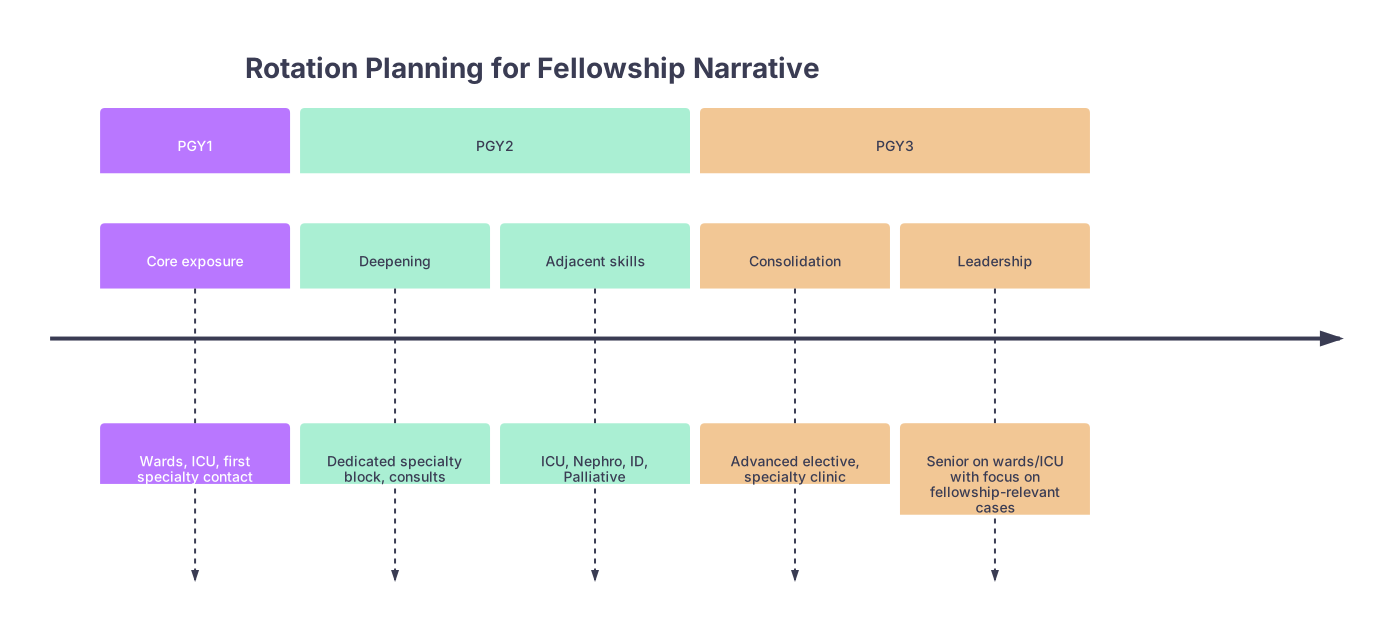
| Period | Event |
|---|---|
| PGY1 - Core exposure | Wards, ICU, first specialty contact |
| PGY2 - Deepening | Dedicated specialty block, consults |
| PGY2 - Adjacent skills | ICU, Nephro, ID, Palliative |
| PGY3 - Consolidation | Advanced elective, specialty clinic |
| PGY3 - Leadership | Senior on wards/ICU with focus on fellowship-relevant cases |
If you are late in the game and cannot change anything, then focus on:
- Getting strong letters from the rotations you do have
- Extracting specific stories and skills from whatever you have done
- Aligning everything in your application with the narrative, rather than scattering your focus
Step 11: Track and Showcase Your Growth, Not Just Exposure
Programs do not just want to hear “I did MICU three times.” They want to hear:
- What changed between MICU 1 and MICU 3
- How your level of responsibility escalated
- How your thinking evolved
So in your narrative, especially for repeated rotations, include:
- PGY-1 MICU: “First exposure, learned the basics, overwhelmed but fascinated.”
- PGY-2 MICU: “Began leading rounds on my own patients, independently titrating drips under supervision, more deliberate with ventilator changes.”
- PGY-3 MICU: “Functioned as de facto fellow overnight, supervising interns, leading codes, coordinating multispecialty care.”
That is the difference between “I liked the ICU” and “I am ready to train as a critical care fellow.”
Consider a quick mental model of your growth curve:
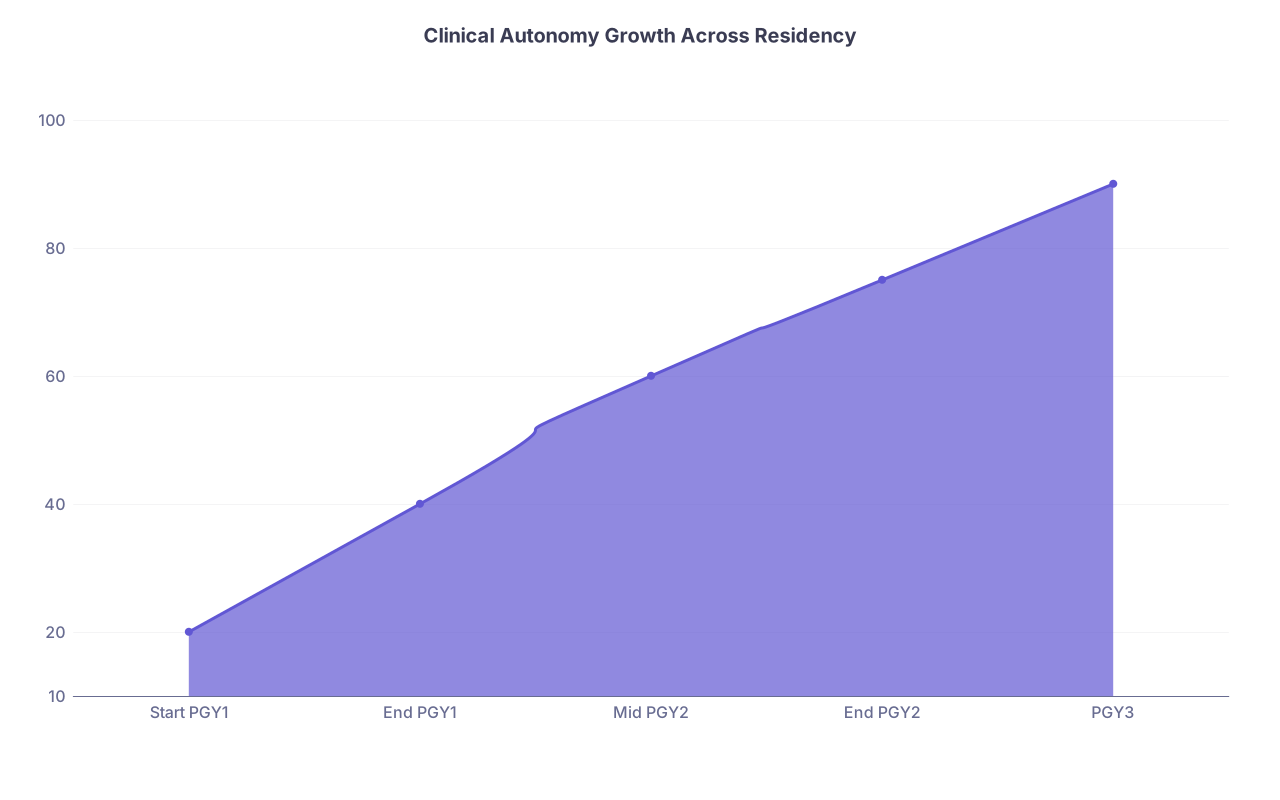
| Category | Value |
|---|---|
| Start PGY1 | 20 |
| End PGY1 | 40 |
| Mid PGY2 | 60 |
| End PGY2 | 75 |
| PGY3 | 90 |
Your narrative should trace that line. Higher autonomy, more complex decision making, more ownership.
Step 12: Integrate Research and Non-Clinical Work Without Derailing Your Story
This article is about clinical narrative, but residency reality is that your research, QI, and teaching roles exist too. The mistake people make is treating these as a separate universe.
Tie them in:
- Heme/Onc: “My heme/onc consult and clinic experiences led me to a research question about treatment-related toxicity in older adults, which I pursued through…”
- Pulm/crit: “After seeing repeated extubation failures in COPD patients in the MICU, I joined a QI project focused on…”
- Rheum: “Exposure to vasculitis on nephrology and rheum consults prompted my interest in studying outcomes in ANCA-associated disease…”
They should feel like natural extensions of your clinical path, not random CV padding.
And when you talk about them, anchor them back to patient care. Always.
Step 13: Common Mistakes That Break Your Narrative
I have seen these tank otherwise strong applications:
Overstating early certainty. “I knew from M1 that I would be a nephrologist.” No you did not. And if you did, it worries me more than it impresses me.
Laundry list storytelling. Reciting every rotation you ever did is not a narrative. It is a calendar.
Ignoring timing. Claiming “longstanding interest” when your first relevant rotation was late PGY-2. Programs do look at dates.
Disconnected research. Tons of research in one field, fellowship application in a completely unrelated one, with no believable bridge.
No growth. “I liked it, I did more of it, now I want to do a fellowship.” Where is the evolution? Where did you struggle? What did you gain?
Contradictory letters. If a letter writer casually mentions you were “undecided between fields until recently,” and your personal statement screams “lifelong passion,” you have a problem.
Step 14: A Simple Template to Draft Your Clinical Narrative Tonight
If you want something concrete to do after reading this, open a document and answer these prompts in 3–5 sentences each:
- First real exposure to your fellowship field – where, when, one patient
- What you found appealing but also what you found hard or uncertain
- How that interest showed up again on other, non-fellowship rotations
- The 2–3 rotations that most solidified your interest and what each contributed
- One longitudinal experience (clinic, panel, QI, research, mentorship) that kept you anchored to this field
- Where you see yourself clinically after fellowship, and how your residency rotations make that plausible
From that, you can cut, rearrange, and polish into:
- A personal statement
- A 2–3 minute interview answer
- Short blurbs for your experiences section
That is the point. One coherent story, repurposed across formats.

FAQ: Crafting Your Clinical Narrative for Fellowship
1. What if I decided on my fellowship very late (end of PGY-2 or start of PGY-3)?
Then you say that. Directly. Late does not equal weak if your actions since the decision are strong and focused.
Your narrative becomes: broad exposure → meaningful pivot → rapid, intentional deepening. Highlight:
- The exact experience that flipped the switch
- How you rearranged electives, sought out mentors, and engaged heavily in the field afterward
- Any high-yield contributions (research, QI, strong evals) you did in a compressed timeframe
Programs understand that people decide late. They do not like revisionist history.
2. I have rotations that were terrible experiences. Do I mention them?
Only if they are essential to understanding your path. And even then, do not trash people or programs.
You can say:
- “My first experience with X was challenging; I struggled with Y.”
- “I initially felt overwhelmed by…”
Then:
- “On later rotations, with better mentorship and more experience, I realized that…”
You are allowed to have a rough start. But it must lead to insight or growth, not bitterness.
3. How many times do I need to have rotated in my chosen field to seem serious?
There is no magic number, but as a rough floor:
- At least 2 solid, clearly documented clinical exposures in the field (e.g., consults + service, or ICU block with focus on your subspecialty)
- Plus, 1–3 adjacent rotations where it is very plausible you saw a lot of overlapping pathology
If you only have one true rotation in the field and zero adjacent supportive experience, you are behind. Not impossible, but you will need very strong letters and a compelling explanation.
4. My research is in a different field than my fellowship choice. How do I handle that?
You make it part of your evolution, not a contradiction.
Example:
“I initially pursued research in [field A] because of an early interest and available mentorship. As my clinical experiences accumulated, especially on [specific rotations], I found myself increasingly drawn to [field B]. I have carried forward skills from my prior research—study design, data analysis, critical appraisal—into my emerging interests in [field B] and plan to transition my scholarly focus during fellowship.”
Do not pretend your research is aligned if it is not. Show transferable skills and a believable pivot.
5. How do I handle being interested in a niche within a fellowship (e.g., advanced HF within cardiology) without sounding too narrow?
You name your specific interest, but you frame it inside a broad foundation.
For example:
“I am particularly drawn to advanced heart failure and mechanical circulatory support, but I value broad cardiology training and want to be competent in the full spectrum of cardiovascular disease. My rotations have given me experience both in general cardiology—chest pain, arrhythmias, chronic CAD—and in higher-acuity HF and shock. I see advanced HF as an area of focus layered on top of a comprehensive cardiology base.”
That sounds focused, not myopic.
6. Should I explicitly use the phrase “clinical narrative” in my application or interviews?
No. That sounds contrived. You live the narrative; they label it if they want.
Instead of saying “My clinical narrative is…”, say:
- “Over the course of residency, a few themes emerged in the patients I gravitated toward…”
- “Looking back, there is a clear progression in how my rotations led me toward…”
- “These experiences, taken together, pushed me toward a career in…”
The structure is for you. The language should sound like a human, not a career coach.
You are halfway through residency, or maybe in the final stretch. The rotations are mostly set. But how you understand and present them? That part is still very much in your hands.
If you start capturing your experiences now—one log entry per rotation, one or two patients that changed you, one sentence about how each block fits your spine—you will not be staring at a blank screen in June. You will be assembling a story you have already been living.
With that clinical foundation built and coherent, your next step is obvious: aligning programs, mentors, and research with the version of yourself you actually want to become. But that is a next-phase problem. For now, get the story straight.