

Late career subspecialty switches are absolutely still viable. The myth that “if you do not subspecialize straight through, you are done” is lazy, outdated, and only half-true in a few narrow situations.
The real story is more uncomfortable: late switches are possible, but the friction is financial, logistical, and cultural—not strictly academic. Programs are not allergic to older fellows; they are allergic to risk, red flags, and vague stories.
Let’s rip this apart properly.
The Myth vs. Reality: Age, Timing, and “Too Late”
The common hallway narrative:
- “Once you are past PGY-5 or 6, nobody will take you.”
- “Programs only want straight-through, 30-something applicants.”
- “If you have been an attending for a while, fellowship doors close.”
The data and match outcomes say otherwise.
Look at recent NRMP fellowship match reports (Cardiology, GI, Heme/Onc, Pulm/CC, Pain, ICU, etc.). You will not find an age cutoff. Programs rank applicants. They do not submit a date-of-birth filter. In practice, what I’ve seen in actual program rank meetings:
40-something applicants get ranked high when:
- They have a clear, coherent narrative (“I practiced hospitalist medicine for 5 years, now focusing on pulm/CC with strong ICU experience”).
- Their letters explain the transition and vouch for performance now, not just in residency.
- Their “recent” academic/clinical work in the field is solid.
They get tanked when:
- There is a big unexplained gap or erratic job-hopping.
- Scores, performance, or professionalism issues are present and not addressed.
- The story sounds like “I am bored and need a change,” not “I am committed and already doing the work.”
Programs care about: performance, fit, and likelihood of success. Age is a proxy only when it signals higher risk (burnout, unwillingness to learn new systems, poor adaptability). If you counter those, the age concern basically collapses.
Where Late Transitions Actually Work (and Where They Don’t)
You cannot talk about “late career switches” in the abstract. It’s completely different for a 33-year-old hospitalist vs a 48-year-old community surgeon. So let’s be concrete.
| Target Field | Late Switch Viability | Typical Barriers |
|---|---|---|
| Academic IM subspecialties (Cards, GI, Heme/Onc, Pulm/CC) | Moderate–High | Research, productivity, call intensity |
| Lifestyle-driven IM subspecialties (Allergy, Rheum, Endo) | High | Lower positions, but strong fit matters |
| Non-op procedural (Pain, Palliative, Critical Care) | High | Procedural skills, ICU exposure |
| Surgical subspecialties (Ortho fellowships, CT, etc.) | Low–Moderate | Technical curve, need recent heavy case log |
| “Hot” fields (Derm, plastics, IR from scratch) | Very Low | Extreme competitiveness, pipeline bias |
General pattern I see in actual match lists and CVs:
Internal medicine subspecialties are reasonably open to people who have been:
- Hospitalists
- Nocturnists
- Academic generalists
Surgical subspecialties are much more suspicious of anyone who is not “fresh” out of residency, because:
- Technical skills degrade without volume.
- Case logs matter.
- There is a bias that older surgeons will be slower to adopt newer techniques.
“Lifestyle” specialties (Allergy/Immunology, Rheum, Endo) often like mature candidates who bring communication and system-level experience—if they can prove they actually understand the field they’re switching into.
So no, the door is not closed. It is narrower in surgery and in ultra-competitive “prestige” subspecialties, and it is surprisingly open in ICU/pain/palliative/allergy/rheum.
What Programs Actually Worry About With Older Applicants
You are not fighting a formal rule. You are fighting assumptions.
Here are the real concerns program directors voice behind closed doors:
Trainability and hierarchy tolerance
Will a 42-year-old former attending handle being a first-year fellow again? Taking overnight call like a resident, being corrected in front of others, following orders from faculty who are younger?Return on investment
A 3-year fellowship on someone who might practice the subspecialty for only 10–15 years vs 25–30. They will not say this on the website, but they absolutely think it.Burnout and energy
Will this person survive the call, ICU nights, long procedural days? Or will they flame out because they underestimated the grind?Academic productivity and adaptability
Can this applicant publish, present, and adapt to new guidelines, new EMR workflows, new fellowship-specific expectations? Or are they stuck in “this is how we did it at my hospital 10 years ago”?
Every part of your application has to quietly answer those four questions.
The Hard Numbers: Timing, Match Rates, and “Gaps”
NRMP does not publish a clean table of “match rate for people >40,” but you can infer a couple of things from patterns:
Re-application in fellowships is not rare. Plenty of fellows match on 2nd or 3rd attempt, which usually means:
- They worked as hospitalists for 1–3 years.
- They strengthened research or letters.
- Then they matched into GI, Cards, Heme/Onc, Pulm/CC, etc.
Non-US grads and gap years are common in fellowships. Programs are used to applicants who:
- Finished residency abroad years ago.
- Practiced independently before US fellowship.
- Show strong recent activity in the subspecialty.
If someone who finished residency abroad 7 years ago can match into US Cardiology after some transitional work, a US-trained hospitalist with 5 years’ experience is not inherently “too late.” The key is what you did in those years.
Look at typical match rates (rounded, from recent NRMP data):
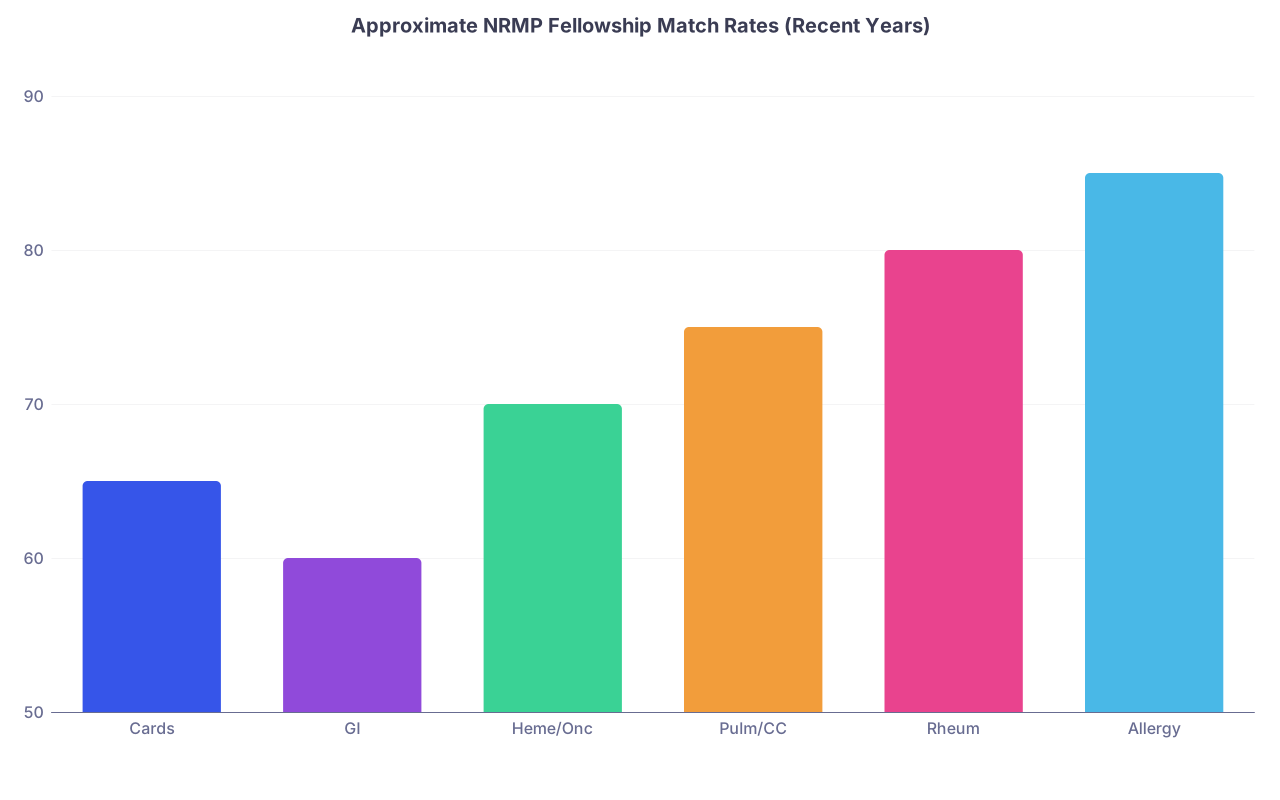
| Category | Value |
|---|---|
| Cards | 65 |
| GI | 60 |
| Heme/Onc | 70 |
| Pulm/CC | 75 |
| Rheum | 80 |
| Allergy | 85 |
Notice the pattern: some subspecialties are brutal, some are forgiving. Late applicants tend to match where:
- There are more positions relative to applicants.
- Programs value maturity and clinical horsepower.
- The field is less fetishized by “must-do-research-from-M1” culture.
You are not fighting a binary yes/no about being “late.” You are fighting supply/demand plus your profile.
The Three Stories That Actually Work for Late Switchers
Program directors are not swayed by sentimental “lifelong dream” essays. They want a clean, believable trajectory. The late career changes that consistently work usually fall into three buckets.
1. The Deepening Specialist
Example: 3–7 years as an IM hospitalist → Pulm/CC, Heme/Onc, or Palliative Care.
The narrative:
- “I’ve been running codes, managing ICU borderlines, co-managing cancer patients, and working closely with X subspecialty, and now I want to deepen that focus.”
- The CV shows:
- ICU shifts, procedural experience, oncology or ICU QI projects.
- Recent CME, board review, or mini-fellowships in the target field.
- Strong letters from subspecialists who already see you functioning as “almost one of us.”
Programs love this. You are derisked: they’ve already seen your performance in the trenches.
2. The Burned-But-Not-Broken Proceduralist
Example: Anesthesiologist → Pain Medicine Fellowship after 8 years; EM attending → Critical Care, Toxicology, or Ultrasound fellowships mid-career.
The narrative:
- “I want to narrow my practice to a specific patient population and procedure set, and I’ve already been doing pieces of this for years.”
You bring:
- Significant procedural volume.
- Comfort with critical illness.
- Systems-level thinking from previous attending roles.
The concern here is burnout, so you must show: that you are energized by the fellowship focus, not running away from your current life.
3. The Systems and Teaching Convert
Example: Community pediatrician → Academic Allergy/Immunology; Family physician → Academic Sports Medicine after years as team physician.
The narrative:
- “I’ve realized that my best work is at the overlap of clinical care, teaching, and system improvement in this focused niche.”
Your proof:
- Teaching awards.
- QI leadership.
- Protocol development and guideline implementation.
- Ongoing involvement in the target field (sports teams, allergy clinics, specialized clinics).
Programs like this because you fit the “academic citizen” role well: clinics, teaching, QI, maybe some modest research.
The stories that do NOT work? “I am burned out on primary care, GI makes more money,” or “I need a lifestyle specialty now that I have kids.” Those might be true, but if that is your stated narrative, you will be buried on the rank list.
The Real Constraints: Money, Family, and Ego
Let me be blunt: the biggest barrier is not the match. It is you.
Financial hit
Fellowship means:
- Salary reduction vs attending income (often by $150k–$300k per year).
- Moving costs.
- Twin pressures of loans and maybe kids.
Three practical filters:
If you are within 5–7 years of being able to scale back or hit financial independence, a long fellowship (3 years) may never pay back strictly on dollars. You may still choose it for meaning, but don’t lie to yourself about the math.
If you are early/mid in your career with high earning potential afterward (e.g., Cardiology, GI, Pain), the long-term financials can still work out, even starting in your 40s.
You must run real numbers: income drop, years to recoup, and realistic post-fellowship salary (not the rosy brochure version).
Family and relocation
Older applicants have:
- Spouses with careers.
- Kids in school.
- Aging parents.
Programs know this. They worry you will rank them but then not move, or that family stress will torpedo your performance. You need a grown-up plan for:
- Where you are willing to live.
- What your partner thinks.
- How you will handle childcare during call-heavy months.
Ego and re-learning hierarchy
This is the quiet killer. I’ve seen ex-attendings:
- Struggle being called “fellow” and having to ask for help.
- Bristle when residents question their decisions.
- Undermine younger faculty subtly.
If that is you, do not apply. You will be miserable and so will everyone else.
If you can honestly say, “I’ll show up like a learner again, no chip on my shoulder,” you are already ahead of half the “late” applicants.
How to De-Risk Yourself as a Late Applicant
If you are serious, you cannot just fire off ERAS applications cold. You have to neutralize the predictable doubts.
1. Build recent, targeted experience
Within 12–24 months before applying:
- Shift your clinical mix toward your target field (ICU shifts, oncology units, specialized clinics, etc.).
- Take on a substantive project: guideline implementation, QI, registry work, or small clinical study in that area.
- Get involved with the department you want to join: conferences, case discussions, even unpaid teaching shifts.
2. Get heavyweight, recent letters
You need at least two letters that:
- Are from respected subspecialists in your target field.
- Speak specifically to your current skills and learning capacity.
- Explicitly address the “late switch” and endorse it as a smart use of your trajectory, not a crisis move.
Generic “hard worker, loved by patients” letters will not save you.
3. Own the narrative in your personal statement and interviews
Your story must:
- Acknowledge your trajectory directly. “I spent eight years as a hospitalist because X. Over time, Y shifted. Now I have done Z in this field and am committed to it.”
- Show evidence-based commitment: specific patients or patterns that shifted your focus, not a Hollywood epiphany.
- Highlight what you bring that 3rd-year residents cannot: real-world judgment, system understanding, teaching chops.
If your statement sounds like a midlife crisis journal entry, fix it.
Quick Reality Checks Before You Leap
Before you blow up your life for a fellowship:
Talk to someone who actually did a late switch into that exact subspecialty.
Ask them:
- “If you had to do it again, would you?” (Half will hesitate before answering. Pay attention to that.)
- “What surprised you the most about fellowship after being an attending?”
- “Financially and family-wise, did it work out as you expected?”
Look at fellowship schedules, call burdens, and research expectations. Do not romanticize this; it is still training.
Ask yourself: “If I did not match after two cycles, would I be content staying where I am?” If the answer is absolute misery, you may be using fellowship as an escape from a broader dissatisfaction that training will not fix.
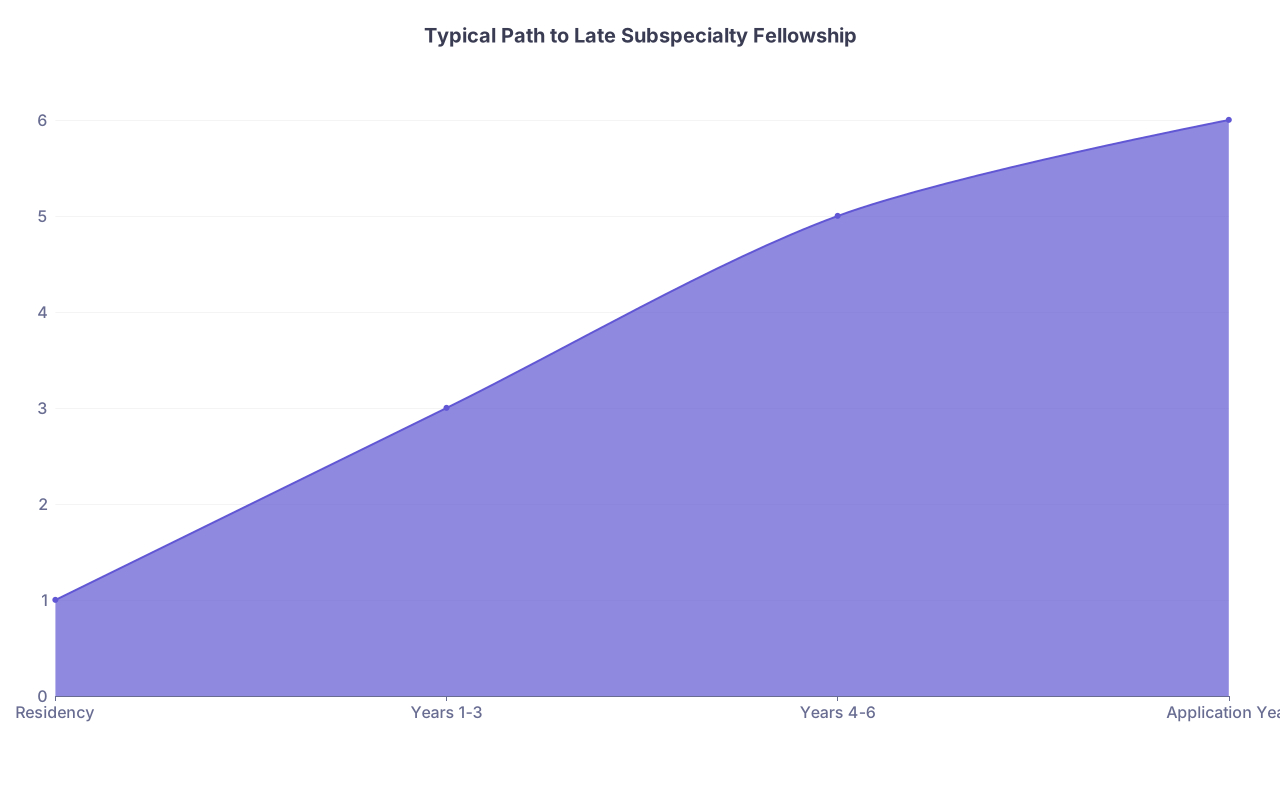
| Category | Value |
|---|---|
| Residency | 1 |
| Years 1-3 | 3 |
| Years 4-6 | 5 |
| Application Year | 6 |
FAQs
1. Is there a specific age that programs quietly consider “too old” for fellowship?
No formal cutoff, and I have seen fellows start in their late 40s. The problem is not the age; it is the profile. Once you get past roughly 45, you need a very compelling, well-prepared story and realistic financial/family planning. Programs will scrutinize your energy, call tolerance, and long-term commitment more closely, but there is no magic age where ERAS auto-rejects you.
2. Does being a former attending actually help, or do programs see that as a red flag?
It helps if you use it correctly. Being a former attending is a plus when it translates into: better clinical judgment, comfort with responsibility, and proven reliability. It is a minus when it shows up as entitlement, resistance to feedback, or an unwillingness to participate in the unglamorous parts of fellowship. Your letters and interview behavior will decide which category you land in.
3. How many years of attending work is “too many” before applying to fellowship?
There is no hard upper limit, but once you go beyond about 7–10 years, you must show concrete, recent involvement in the subspecialty you are targeting. If you spent 12 years as a pure outpatient generalist and then suddenly apply to ICU without recent critical care experience or projects, it will look random. If those 12 years include 4–5 years of ICU-heavy work, QI, and collaboration with intensivists, it can still be a strong application.
Key points to remember: Late subspecialty switches are not dead; they are just unforgiving of vague motives and lazy preparation. The real gatekeepers are your narrative, your recent track record in the target field, and your ability to handle the financial and personal hit of going back into training. If you can get those three right, “too late” is more myth than rule.


