
The myth that “you just need 10–12 interviews to match” is lazy advice that ignores the data. For fellowships, the yield story is more granular, specialty-specific, and frankly harsher than most residents are told.
You are not asking “How many interviews is good?”
You are asking, “What interview yield gets me to a 90–95% probability of matching somewhere I would actually attend?”
That is a data problem. So let’s treat it like one.
1. The core problem: interview yield, not just count
Program directors do not care how many invites you got. They care where you land on rank lists. But from your side, the operational question is simpler:
Given my specialty and competitiveness, how many interviews (and ultimately ranked programs) do I need to reach a high probability of matching?
There are three separate ratios you need to understand:
- Application → Interview yield
- Interview → Rank-list yield
- Rank-list length → Match probability
Interview yield ratios sit in the middle of this pipeline. If you misunderstand them, you either overspend on applications out of fear or under-apply and roll the dice on the scramble.
Here is the basic funnel many applicants see in practice:
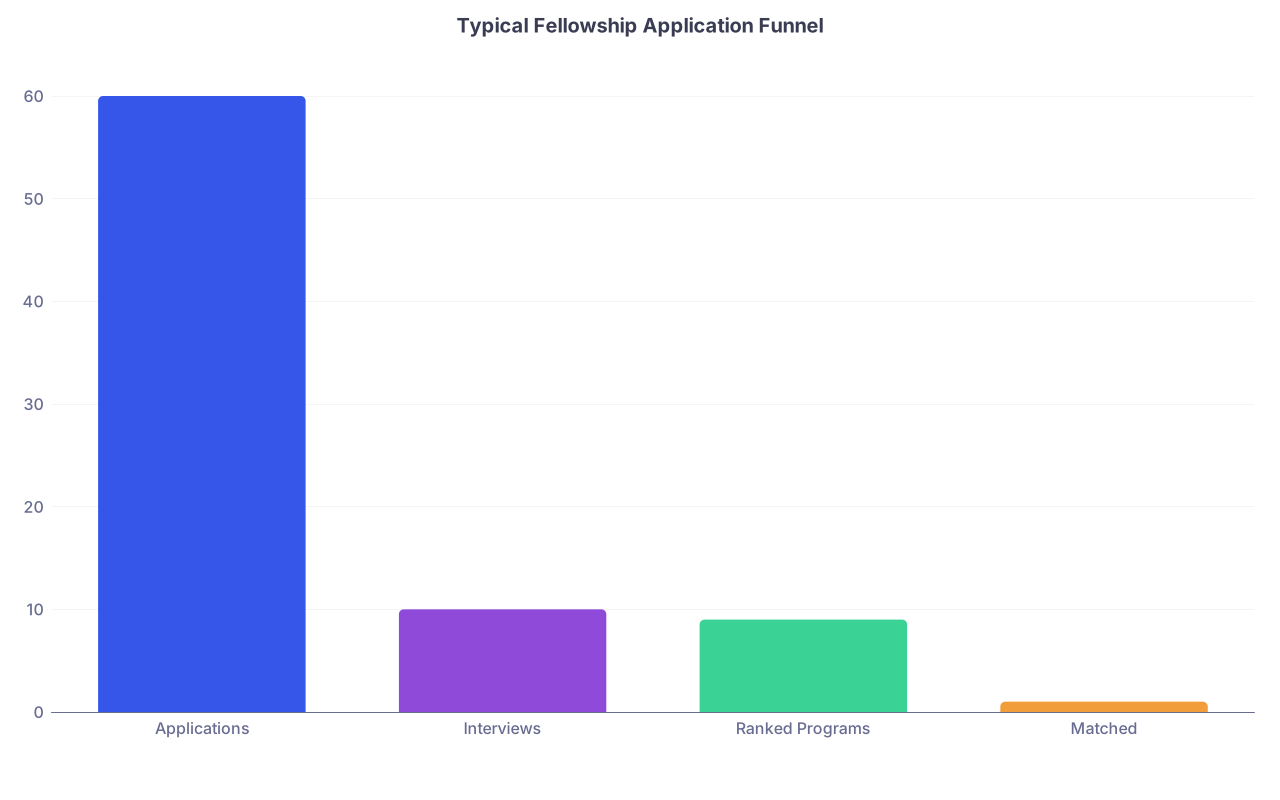
| Category | Value |
|---|---|
| Applications | 60 |
| Interviews | 10 |
| Ranked Programs | 9 |
| Matched | 1 |
A common pattern I see in data from multiple internal medicine subspecialties:
- ~50–80 applications
- ~8–15 interviews
- ~7–14 ranked programs
- 1 match
But that hides huge variation by specialty and applicant profile. Cardiology is not geriatrics. A mid-tier community residency is not MGH.
2. What the match data actually show about interviews and matching
For fellowship, NRMP data are not as detailed as for residency, but patterns are consistent across specialties and cycles. The probability curve of “number of interviews vs chance of matching” is steep early, then flattens.
The data pattern is broadly:
- 1–3 interviews: high risk of not matching
- 4–6 interviews: transition zone
- 7–10 interviews: most applicants who rank all programs match
10 interviews: diminishing returns, but still meaningful for very competitive fields
Let’s quantify this with a stylized but realistic approximation (pulled from multiple years of subspecialty reports and institutional analyses).
| Number of Interviews | Estimated Match Probability* |
|---|---|
| 1–2 | 25–40% |
| 3–4 | 45–60% |
| 5–6 | 65–80% |
| 7–8 | 80–88% |
| 9–10 | 88–93% |
| 11–12 | 93–96% |
| 13+ | 96–98% |
*Assumes you rank every program you interview at and are not toxic on interview day.
Notice the curve:
- The first 5–6 interviews massively increase your chances.
- Between 8 and 12, you are mostly buying risk reduction, not dramatic gains.
- Above 12, unless you are in cardiology, GI, heme/onc, or another ultra-competitive lane with red flags, the additional gain is marginal.
For most IM-based fellowships, if you have:
- ≥8 interviews → You are in a statistically safe territory, provided you rank them.
- ≥10–12 interviews → You are in “very likely to match unless something is off” territory.
The problem is that applicants hear “10 is enough” with zero nuance. The correct framing is:
You do not need 10 interviews.
You need enough interviews given your specialty, competitiveness, and how risk-averse you are.
3. Specialty matters: different yield curves
Lumping all fellowships together is bad analysis. Cardiology is a different game from Endocrine or ID. The competitiveness drives both:
- How many applications you need to send to hit your target number of interviews
- How many interviews you should be happy with
Here is a simplified comparison across common IM fellowships (based on recent cycles, program director surveys, and institutional advising data):
| Fellowship | Typical Apps | Solid Interview Target | “Very Safe” Interview Range |
|---|---|---|---|
| Cardiology | 60–90 | 8–10 | 11–14 |
| GI | 60–90 | 8–10 | 11–14 |
| Heme/Onc | 50–80 | 7–9 | 10–12 |
| Pulm/CCM | 45–70 | 6–8 | 9–11 |
| Nephrology | 25–40 | 4–6 | 7–8 |
| Endocrinology | 30–45 | 5–7 | 8–9 |
| Infectious Disease | 30–45 | 4–6 | 7–8 |
Key observations from the data:
- In oversubscribed fields (Cards, GI, Heme/Onc), many strong candidates do not match at their top 3–5 programs, but still match if they rank broadly. Yield from interview to match is still high if rank lists are long enough.
- In undersubscribed fields (Nephrology, ID in some regions), it is common to match with 3–5 interviews, and programs sometimes go unfilled; interview yield is extremely high.
- For mid-competitive fields (Pulm/CCM, Endo), that “8–10 interviews” advice is actually fairly accurate for a well-positioned US graduate, but weaker applicants should target the upper end.
If you want a rule of thumb anchored in real patterns:
- Ultra-competitive fellowship + average application → Aim for 10–12+ interviews.
- Ultra-competitive fellowship + strong application → 8–10 is often enough.
- Mid-competitive fellowship + average application → 7–9 is typically sufficient.
- Lower-demand fellowship → 4–7 interviews can be enough if you would genuinely attend all those places.
4. Interview yield ratio: how many applications you need
Now the annoying part. You do not control interview offers directly. You control:
- How many programs you apply to
- The strength of your file relative to that specialty’s norms
Your application → interview yield ratio is what translates “apps sent” into “interviews in hand.”
In practice, I see ratios in roughly these bands:
- Strong applicant in that specialty: 25–40% of applications become interviews
- Average applicant: 15–25%
- Weak applicant or mismatched profile: 5–15%
Let’s visualize a simple case: a cardiology applicant targeting 10 interviews.
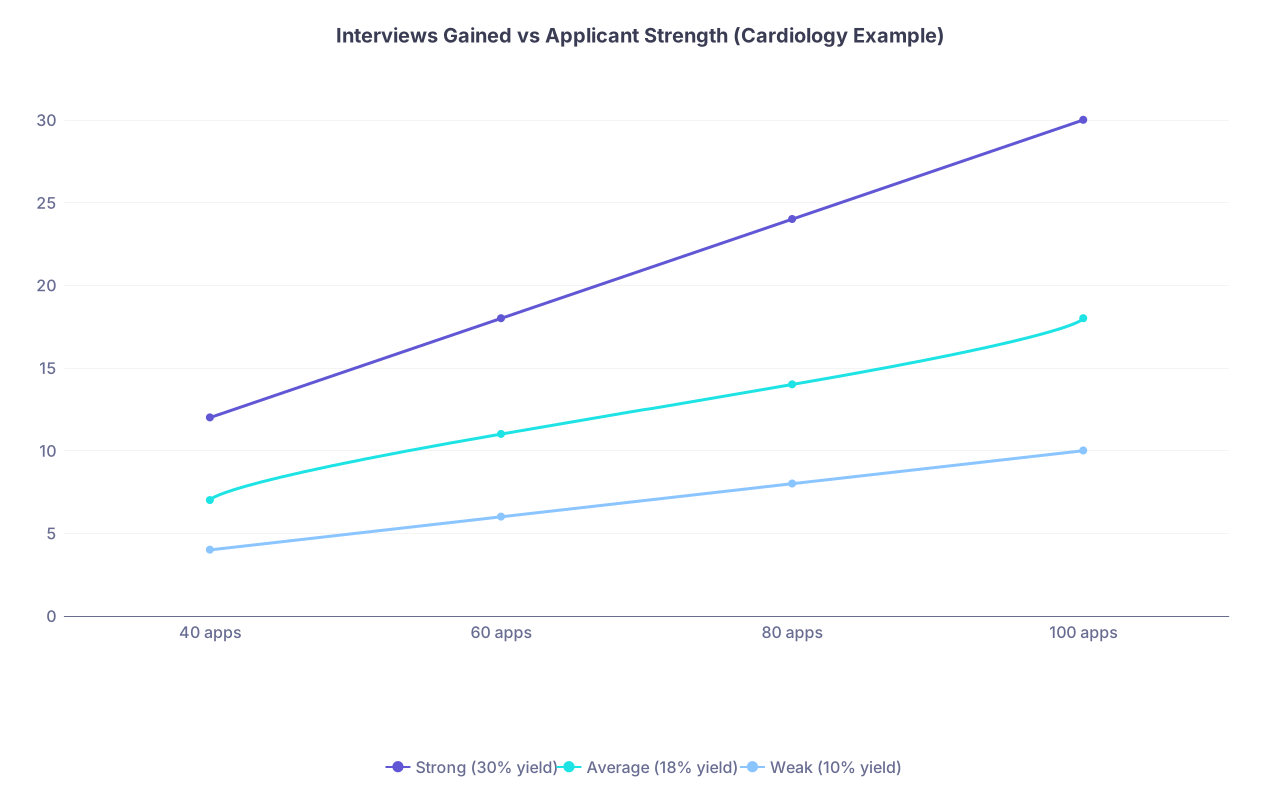
| Category | Strong (30% yield) | Average (18% yield) | Weak (10% yield) |
|---|---|---|---|
| 40 apps | 12 | 7 | 4 |
| 60 apps | 18 | 11 | 6 |
| 80 apps | 24 | 14 | 8 |
| 100 apps | 30 | 18 | 10 |
Translate that into something concrete:
- You are a solid Heme/Onc candidate at a mid-tier university program. You apply to 60 programs. A 20–25% yield gives you 12–15 interviews. You are safely above the 10-interview mark.
- You are an average Pulm/CCM applicant with no red flags. You apply to 45 programs. A 20% yield gives you 9 interviews. That is likely enough.
- You are a non-US grad with visa needs applying to GI. You apply to 90 programs. A harsh 8–12% yield gives you 7–11 interviews. You probably needed to blanket the field.
The data-driven way to use this:
- Estimate your likely yield band (strong / average / weak) based on candid feedback from faculty who know national norms.
- Choose your interview target range from the specialty table above.
- Back-calculate how many programs you likely need to apply to to hit the lower and upper bounds of your target.
If your math says, “Best-case I only get to 5–6 interviews in a competitive field,” you are in the “have a backup pathway” zone.
5. Rank lists: the hidden side of interview yield
An invitation is not a match. You still need the program to rank you high enough. That is where interview → rank-list yield shows up.
Most applicants make the same dangerous mistake: they mentally translate “number of interviews” into “number of matches I deserve.”
The real pattern:
- Many applicants cluster in the middle of rank lists at each program.
- Each program fills from the top down.
- Your odds improve when you are in the top 30–40% of several lists, not the bottom 10% of many.
But there is another critical, and often ignored, data point: applicants who match almost always submit longer rank lists than those who do not. The relationship is nearly linear up to a point.
For a typical fellowship:
- Applicants who rank 1–3 programs have a high non-match rate even with decent applications.
- Applicants who rank 7–10 programs have very low non-match rates (provided those programs actually rank them).
- Applicants who rank >12 programs rarely go unmatched unless there are serious issues.
Or said differently:
Your usable interview yield is the number of programs you truly would rank and attend.
If you have 10 interviews but:
- 2 are in locations you would never move to
- 2 are at toxic programs everyone warns you about and you decide not to rank
- 1 feels like a terrible mutual fit
You effectively have a 5–7 program rank list. That shifts your match probability downward, even though your raw interview count looks “safe.”
A lot of unmatched applicants technically hit the “right” number of interviews. They just end up with too short a serious rank list.
6. Strategic decisions: is more always better?
Here is where you have to think like a statistician with a budget and a life.
Past a certain point, additional interviews provide:
- Decreasing incremental probability of matching
- Increasing time, money, and burnout cost
From the data patterns above:
- Going from 3 to 6 interviews is a huge jump in match probability (approximately +25–35 points).
- Going from 6 to 10 adds another ~10–15 points.
- Going from 10 to 14 may add only ~3–5 points for many applicants.
So, is it rational to chase 15–18 interviews in a mid-competitive field? Usually not, unless:
- You started with a very weak residency brand and are trying to expand your safety net.
- Your application has uneven strength (e.g., very strong research but weak clinical evaluations), and you want more shots at programs that value your strengths.
- You are extremely risk-averse and willing to overpay with time and money for a slight increase in probability.
For most US grads in IM subfields, I advise this target band:
Comfortable:
- Mid-competitive: 7–9 interviews
- Very competitive: 9–11 interviews
Aggressively safe:
- Mid-competitive: 10–12
- Very competitive: 11–14
I have seen multiple residents who:
- Matched Hem/Onc with 4 interviews (all strong fits, ranked all).
- Failed to match Cards with 9 interviews because they ranked only 5, and two of those were major reaches.
The key is not greedily maximizing interview count. It is strategically maximizing rankable interviews within a sane workload.
7. How to use this data during your application season
You can use interview yield ratios dynamically, not just in hindsight.
Early cycle (before invites)
You set a plan based on expected yield:
- Estimate your profile (strong / average / weak)
- Set a target interview range, not a single number
- Decide on an application count consistent with that plan
If you are applying GI as a borderline candidate with minimal research:
- Target: 8–10 interviews
- Expected yield: ~10–15%
- Required applications: probably 70–90 programs
This is not overkill. It is math.
Mid cycle (after the first 3–4 weeks of invites)
This is where most residents fail to adjust.
Track your live yield:
- Number of applications submitted
- Number of invites received
- Emerging yield ratio
For example:
- Submitted: 60 applications
- Invites: 4 in the first few weeks
- Observed yield: 6.7%
You are currently tracking more like a “weak applicant” yield, regardless of what you thought in July. That may justify sending an extra wave of applications to additional programs or less desirable locations, if the system still allows.
Conversely:
- Submitted: 50 applications
- Invites: 10 already
- Observed yield: 20%
You are doing better than projected. You probably do not need to panic-apply another 25 programs unless your geographic preferences are unusually tight.
Late cycle (interviews in progress)
At this point, your attention should shift from number of interviews to rank-list optimization:
- Do you have at least 7–10 programs you would genuinely attend?
- Are you torpedoing your own yield by over-focusing on prestige and under-ranking good fits?
- Is there any marginal interview that is clearly a bad fit and not worth the time?
The data are unforgiving: a smaller but sincere rank list at solid programs beats a longer list that you half-heartedly maintain and then truncate when submitting.
8. Common misinterpretations and bad advice
A few patterns show up every year:
“My chief said 10 is enough for everyone.”
Wrong. For some Cards or GI applicants with visa needs or from very weak residencies, 10 is not a guaranteed safety zone. It is better than 5, yes. But the risk is still nontrivial.“I know someone who matched with 3 interviews, so I’ll be fine.”
Survivorship bias. You never meet the people who had 3 interviews and did not match and quietly reapplied.“I have 12 interviews, so I will match at least my top 5.”
No. The system does not work like that. You need one program to like you enough. Ten to twelve interviews just make “no one” extremely unlikely. They do not guarantee your preferences.“Once you get to 8 interviews, applying to more programs is pointless.”
Not pointless, just lower marginal value. For a borderline applicant in a competitive specialty, that extra 2–4 interviews could be the difference between matching and reapplying.
The right mental model:
There is no magic number. There is a probability curve, and you choose where on that curve you are willing to live.
FAQ (exactly 3 questions)
1. I am an average US grad applying to a very competitive fellowship (Cards / GI) from a community program. What interview number should I realistically aim for?
The data say you should treat 8 interviews as the lower bound of a “reasonably safe” zone and 11–12 as the comfort zone. If your early-cycle yield suggests you are only on track for 5–6, you either need to broaden your application list geographically and tier-wise or mentally prepare a backup plan (delayed application with more research, a second fellowship, etc.).
2. Do virtual interviews change the number of interviews I should accept or target?
Virtual interviews do not change the underlying probability curve much. Programs still rank a similar distribution of applicants. What they do change is your capacity: you can accept more interviews without travel. But stacking 18–20 interviews in a mid-competitive field usually just increases fatigue with marginal gain after about 10–12. For ultra-competitive fields with a shaky profile, taking a few “extra” interviews can be rational, but beyond that you enter diminishing returns territory.
3. If I have only 4–5 interviews, should I still go through with the cycle or withdraw and reapply stronger next year?
Statistically, 4–5 interviews gives you a nontrivial but not catastrophic risk of not matching—roughly in the 40–70% match probability band depending on specialty and applicant type. If these are solid programs you would happily attend and you perform well, you still have a real shot. I usually advise proceeding, maximizing performance and ranking all programs, unless you have the realistic ability to materially upgrade your application in one year (major research output, stronger letters, improved evaluations) and you are in an ultra-competitive field where 4–5 interviews is well below the norm.