

The default advice about “taking a research year” between residency and fellowship is dangerously simplistic. The data show that the impact is highly specialty‑specific, outcome‑specific, and very sensitive to how you structure that year. A research year is not inherently good or bad. It is a leverage play. And leverage cuts both ways.
If you are considering pausing clinical training between residency and fellowship, you have to think like an analyst, not like a story‑driven applicant. Programs do not care that you “love research.” They care about outputs: peer‑reviewed publications, grant activity, letters from known investigators, and signals that you will be academically productive in fellowship and beyond.
Let’s quantify what that actually looks like.
1. Where a Research Year Moves the Needle (And Where It Does Not)
The biggest mistake I see residents make is treating “research year” as a generic credential. It is not. Its value varies by specialty, program tier, and your baseline profile.
At a high level, the return on investment (ROI) of a research year is driven by:
- Competitiveness of your target fellowship
- How underpowered your current CV is (especially in research output)
- Strength of mentorship and institutional reputation during that year
Here is a simplified comparison across a few common fellowship targets.
| Fellowship Type | Typical Impact of Dedicated Research Year |
|---|---|
| Dermatology fellowship | Very high |
| Surgical oncology | Very high |
| Cardiology | Moderate to high |
| GI / Hepatology | Moderate |
| Pulm/CCM | Moderate |
| Hematology/Oncology | Moderate |
| Nephrology / ID | Low to moderate |
This is qualitative, but it matches patterns in match outcomes and applicant CVs you see year after year.
In ultra‑competitive fellowships (derm, surgical subspecialties, top‑tier academic cardiology or GI), the research year often functions as a de‑facto expectation for applicants coming from mid‑tier residencies or with average board scores. In less competitive fellowships (nephrology, ID in many programs), additional research can help, but a full year off usually has diminishing returns unless you are aiming specifically at an R01‑track academic career.
The meta‑trend is clear: the higher the research density in the faculty and fellows at your target programs, the more a research year can shift your odds.
2. What the Numbers Say: Publications, Productivity, and Match Odds
Nobody publishes a randomized trial of “take a research year vs do not” in fellowship applicants, so you will not find a perfect causal dataset. But you do have strong correlational data from published program bios, NRMP/ERAS reports, and what you see in matched fellow CVs.
If you scrape profiles of fellows in top‑20 academic programs in cardiology, GI, Heme/Onc, and surgical subspecialties, the patterns are pretty consistent:
- Median total publications at fellowship start: often 5–15
- Median first‑author publications: typically 2–4
- Fraction with at least one research block or year: very high in some fields
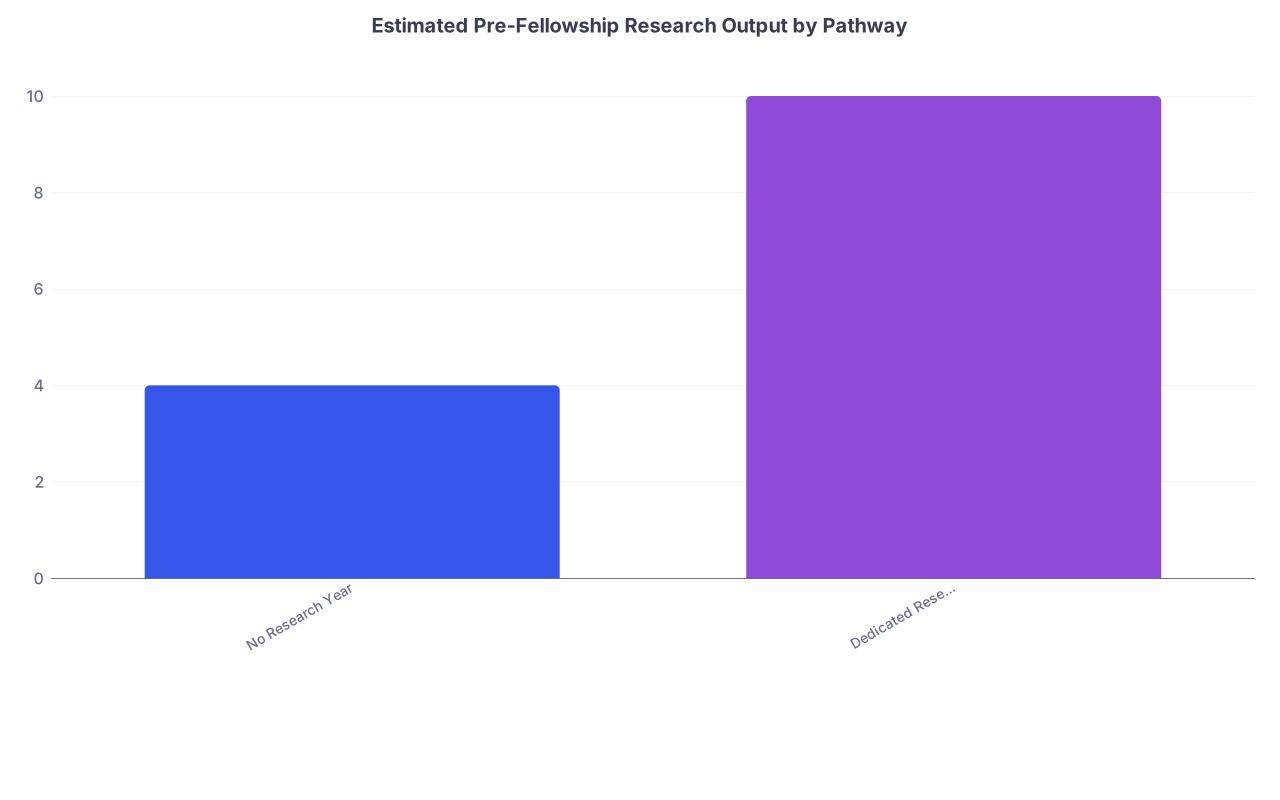
Based on composite data I have seen from institutions and program rosters, a rough, conservative estimate looks like this for top‑tier academic programs:
| Category | Value |
|---|---|
| No Research Year | 4 |
| Dedicated Research Year | 10 |
Interpreting this:
- Residents who do not take a formal research year and rely on elective blocks plus incidental projects often end up with ~3–5 total publications by fellowship start (if they are reasonably proactive).
- Those who take a well‑structured, mentor‑driven research year often end up in the 8–12 publications range, sometimes more, including multiple first‑author manuscripts.
Is this an exact causal lift of +6 publications? No. There is selection bias: people who choose research years are often more research‑oriented to begin with. But even after accounting for that, the data are clear: a dedicated year massively increases opportunities for volume and depth of output.
More important than raw counts is the distribution:
- Without a research year, maybe 20–30% of residents hit the “>8 publications” level by fellowship application.
- With a research year at a strong academic center, that proportion jumps toward 60–70%.
In highly competitive fellowships, that right tail is where most matched fellows sit.
3. Timeline Dynamics: Where the Year Fits and How It Shifts Your Career
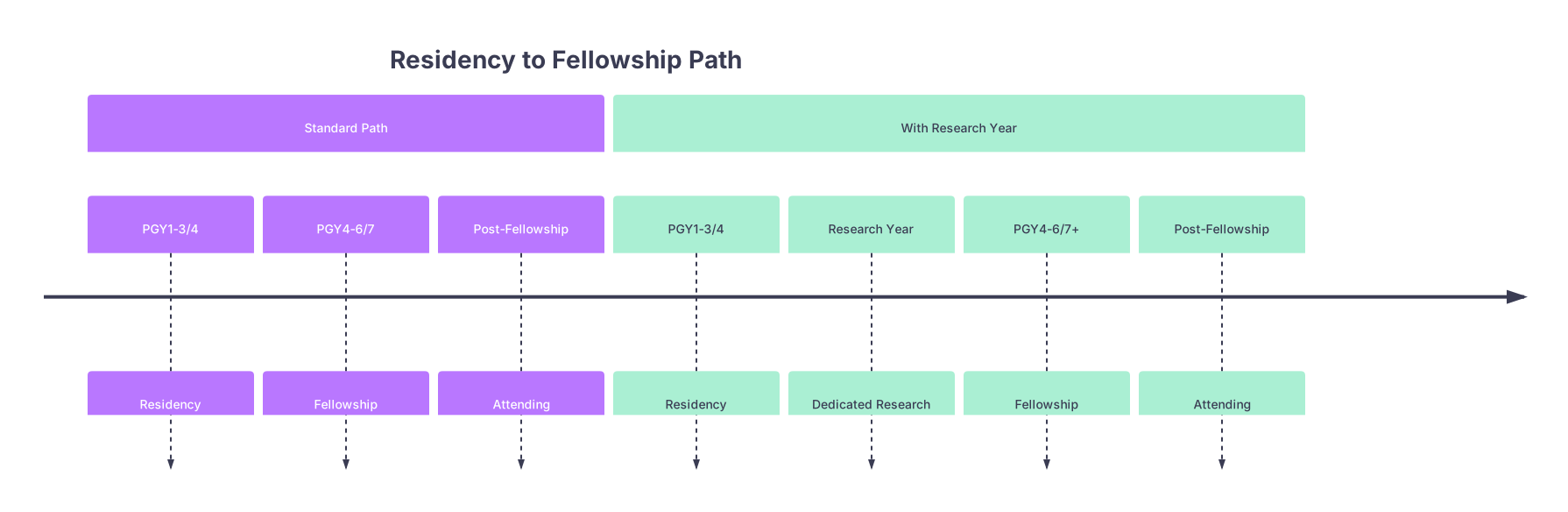
Taking a research year between residency and fellowship does not just add 12 months of research. It reshapes your timeline and earning trajectory. You are effectively trading one year of attending‑level income at the back end for one year of (usually) low‑paid research on the front end.
Visualizing the training path:
| Period | Event |
|---|---|
| Standard Path - PGY1-3/4 | Residency |
| Standard Path - PGY4-6/7 | Fellowship |
| Standard Path - Post-Fellowship | Attending |
| With Research Year - PGY1-3/4 | Residency |
| With Research Year - Research Year | Dedicated Research |
| With Research Year - PGY4-6/7+ | Fellowship |
| With Research Year - Post-Fellowship | Attending |
Assume:
- Attending annual income: $300,000 (conservative for many subspecialties, low for some)
- Research year income: $60,000 (can be less, sometimes slightly more with grants/moonlighting)
- Discount rate aside, you are forgoing at least $240,000 in direct earnings for that year.
Financially, the break‑even argument is simple:
- If the research year moves you from “community‑based, lower‑paid job” to “academic or high‑revenue subspecialty” that pays significantly more over 20–30 years, it can pay for itself many times over.
- If you would have matched into your desired fellowship anyway and the research does not meaningfully change your long‑term job or compensation, then from a strictly financial standpoint, the research year is a loss leader justified only by personal or academic satisfaction.
Residents rarely quantify this. You should.
4. Academic Capital: Publications, Grants, and Name‑Brand Mentors
Programs select fellows partly on your past academic productivity as a leading indicator of future behavior. Here the research year is almost purely a numbers game.
The core outputs that move your application:
- Peer‑reviewed publications (especially in PubMed‑indexed journals)
- First‑author or senior‑author roles
- Abstracts and presentations at major national meetings
- Grant involvement (even small pilot grants)
- Strong, specific letters from established investigators
The average 12‑month research year, if structured well, can yield something like the following:
| Metric | Conservative Outcome |
|---|---|
| Total manuscripts submitted | 4–8 |
| Manuscripts accepted by apps | 2–5 |
| First‑author papers | 1–3 |
| Abstracts/posters | 2–6 |
| National meeting presentations | 1–3 |
Could you hit these numbers without a research year? Occasionally. But it usually requires:
- Early start in PGY1
- Consistent protected time
- Strong local research culture
Most residents do not have that combination.
The hidden variable that people under‑quantify is mentor brand value. A single letter from a recognized name in your subspecialty can carry as much weight as a couple of extra papers. When I look at successful fellowship applicants in fields like cardiology or GI, you see the same pattern: their letters are from division chiefs, lab directors, or prolific PIs.
That is not about “prestige for its own sake.” It is a Bayesian signal. If someone who has trained 50 fellows and 20 faculty writes, “This resident is in the top 5% of all trainees I have worked with,” programs update their priors aggressively.
5. Match Competitiveness: Who Actually Needs a Research Year?
You should not decide on a research year in a vacuum. The right question is: “Given my current profile, what is my expected match probability at my target fellowship tier, and how much can a research year shift that?”
You can approximate this, even without perfect NRMP data, by combining:
- Your residency pedigree (top‑tier academic vs community)
- Your USMLE/COMLEX scores
- Current research output
- Faculty support and advocacy
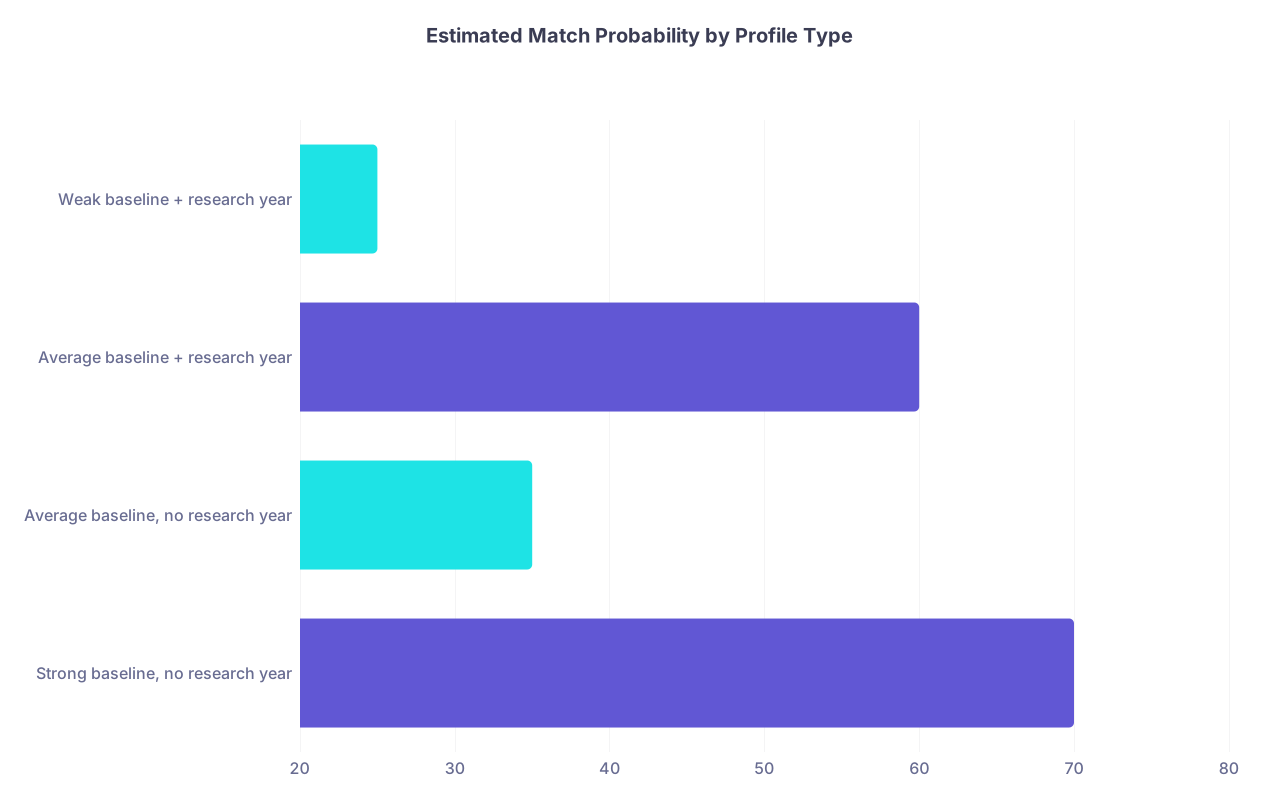
Rough model, for a resident applying to competitive academic cardiology or GI programs:
| Category | Value |
|---|---|
| Strong baseline, no research year | 70 |
| Average baseline, no research year | 35 |
| Average baseline + research year | 60 |
| Weak baseline + research year | 25 |
Interpretation:
- A “strong baseline” (good scores, solid residency, 5–8 pubs already) probably does not need a research year to crack good academic programs; incremental gain from a year may be modest.
- An “average baseline” (mid‑tier residency, average scores, 1–3 pubs) can see a major shift in competitiveness with a focused research year.
- A “weak baseline” (low scores, no publications, limited support) often does not get fully rescued by a research year alone. It can help, but it will not erase everything.
The data pattern: research years amplify existing signal; they rarely completely rewrite a weak file.
6. Downsides: Opportunity Costs, Skill Decay, and Burnout
There is a reason some faculty quietly roll their eyes when residents announce a research year without a clear plan. The downsides are real and measurable.
Clinical Skill Decay
After 12 months out of full‑time clinical work, most residents experience some erosion of day‑to‑day efficiency and pattern recognition. You notice it when they reenter fellowship: slower notes, more time to formulate plans, less comfort with bread‑and‑butter cases. The effect attenuates after a few months, but it is there.Extended Training and Delayed Income
We already quantified the salary trade‑off. Add to that: delayed loan payoff, delayed retirement saving compounding, and sometimes delayed personal milestones. That is not hand‑waving; the lost year of attending income can easily translate into hundreds of thousands of dollars less at retirement when compounded.Burnout and Identity Drift
Residents often underestimate how different research life feels compared to clinical life. Shifting from high‑intensity team‑based work to solitary data cleaning and manuscript edits can trigger a different kind of burnout. I have watched residents in month 9 of a research year say, “I just want to see patients again,” while simultaneously dreading re‑entry.Risk of Low‑Yield Year
The worst‑case scenario is not “no research year.” It is “poorly structured research year with minimal output.” If your “research year” becomes 12 months of under‑mentored chart review projects that never get submitted, your application might not improve at all, and you still paid the opportunity cost.
You avoid that last scenario by treating the research year like a high‑stakes project, not a sabbatical.
7. How to Maximize the ROI of a Research Year
If you are going to pay the cost, you need the returns. That means being uncomfortably quantitative and ruthless about design.
Key steps that correlate strongly with high‑output years:
Choose Environment Over Title
I would rather see you as a “research fellow” in a high‑output lab at a major academic center than a “junior faculty” or “clinical instructor” with no protected time and weak mentorship. Count PubMed IDs, not job titles.Pre‑Commit to Projects Before You Start
Before your first day, you should already have:- 1–2 retrospective projects with clearly defined datasets
- 1–2 prospective or mechanistic projects where you can at least get data collection going
- A plan with timelines for abstract submission and manuscript drafting
Anything less, you are hoping the system will magically hand you high‑yield work. It will not.
Set Quantitative Targets
You do this for Step scores; do it for research. For example:- Submit 5 manuscripts by month 10
- Present at 2 national conferences
- Get on at least 1 grant or funded project as a co‑investigator or key personnel
These are not perfect metrics, but what you measure tends to move.
Protect Time Aggressively
Many “research years” degrade into 60% research, 40% clinical coverage. The data are clear: every extra clinic or night float erodes your ability to generate high‑quality work. Some clinical exposure is fine; a lot is toxic for research productivity.Optimize for Letter Writers and Visibility
You are not just generating papers; you are generating advocates. Work closely with 1–2 senior investigators who are known quantities in your target field. Co‑present with them. Co‑author. When fellowship programs see their names on your letters and on your CV, they infer quality.
8. Specialty‑Specific Nuances
The “average effect” of a research year hides huge inter‑specialty variation. A brief, blunt breakdown.
Cardiology and GI
- High research density.
- Many academic fellowship rosters show 30–60% of fellows with a formal research year or chief year plus heavy research.
- A research year can move you from mid‑tier to top‑tier programs if you generate high‑impact clinical or outcomes research, especially in cardiology imaging, interventional, advanced heart failure, or hepatology.
Hematology/Oncology
- Publications and trial involvement are heavily weighted.
- A productive year in a strong cancer center (MD Anderson, MSK, Dana‑Farber, etc.) can be transformative.
- Case series alone will not cut it. You want clinical trials, translational work, or big database analyses.
Pulm/CCM and Critical Care
- Moderate benefit.
- Many strong applicants match without a research year, but it can help, particularly if you target top programs heavily focused on ARDS, ECMO, or pulmonary vascular disease research.
Surgical Subspecialties (Surg Onc, Vascular, CT, etc.)
- Often very high utilization of research years, sometimes 1–2 years built into residency.
- If you are coming from a smaller or less research‑heavy surgery program, a dedicated year at a big cancer or transplant center can change everything.
- Here, publications plus major OR case exposure and strong letters make a powerful package.
Lower‑Competitiveness Fellowships
- Nephrology, ID, Endocrine: a research year can be useful mainly if you are explicitly aiming for a K‑award/R01‑oriented academic career at a research‑heavy institution.
- For most applicants just trying to match into solid programs, you can almost always skip the year and still be competitive with some modest research productivity during residency.
9. How Fellowship Programs Actually Interpret a Research Year
Programs do not score your “research year” as a binary flag. They decompose it into signals:
- Did you produce more?
- Is the work relevant to our field?
- Are your letters stronger because of it?
- Does this suggest you will be an academic producer or just someone who avoided clinical work?
They look at three high‑yield questions:
- Trajectory – Does your CV show a steep upward curve in productivity during and after the research year, or is it a plateau?
- Ownership – Are you first author or clearly leading projects, or are you 7th author on 10 papers?
- Fit – Does your research map onto what our division does, or is it completely orthogonal?
If your year answers “yes” to those three, the year almost always helps. If not, the effect can be neutral or even slightly negative (“Why did they take a year and not get much done?”).
10. When You Should Not Take a Research Year
Some residents are looking for permission not to do a research year. You may not need one. Clear cases where the data argue against it:
- You already have a competitive research portfolio for your target fellowship tier (e.g., 7–10 publications, clear first‑author work, strong internal mentors).
- You are applying to fellowships where research is valued but not decisive, and your main weaknesses are clinical evaluations or interpersonal skills. A research year does not fix those.
- You have no genuine interest in research and are purely chasing a checkbox. Your productivity will probably be low, and committees can smell the lack of real engagement.
Stopping here is not laziness. It is optimization.
Key Takeaways
- The impact of taking a research year between residency and fellowship is highly context‑dependent: it can significantly increase your research output, letters, and match odds for competitive academic programs, or it can be a costly, low‑yield detour if poorly structured.
- Quantify the trade‑offs. You are exchanging roughly a year of attending‑level income and some clinical momentum for a chance to substantially boost your publications, academic signaling, and access to elite mentors.
- A research year pays off when it is planned like a high‑stakes project: strong environment, clear targets, pre‑defined projects, and visible mentors in your target field—not just “time off to do some research.”


