

The obsession with “prestige” in residency programs is mathematically overblown—and it is distorting how residents think about fellowship chances.
The data shows a real effect of program reputation on fellowship placement. But the effect size is much smaller than the mythology suggests, and it is heavily confounded by self-selection and applicant quality. If you are banking your whole career on program name alone, you are misreading the numbers.
Let’s walk through the actual data patterns, not the hallway rumors.
What “prestige” actually captures
Most people use “prestige” as a lazy composite variable. In practice, when I say “prestige” in a data sense, I mean some combination of:
- NIH funding rank
- Doximity reputation rank
- USNWR hospital ranking
- Historical fellowship match rates into competitive programs
These variables are correlated. A top-10 internal medicine program by Doximity is almost always attached to a USNWR top-20 hospital system, with strong NIH funding and a history of sending people to cardiology at major academic centers.
But it is not a binary variable. There is a gradient:
- Tier 1: top ~10–15 national academic programs
- Tier 2: next ~30–40 academic programs with solid reputations
- Tier 3: mid-tier university + strong community programs with some subspecialty exposure
- Tier 4: smaller community programs or new programs with limited academic footprint
If you treat “prestige” as a yes/no flag, you will overestimate its impact. The relationship between program tier and fellowship outcomes is graded, not categorical.
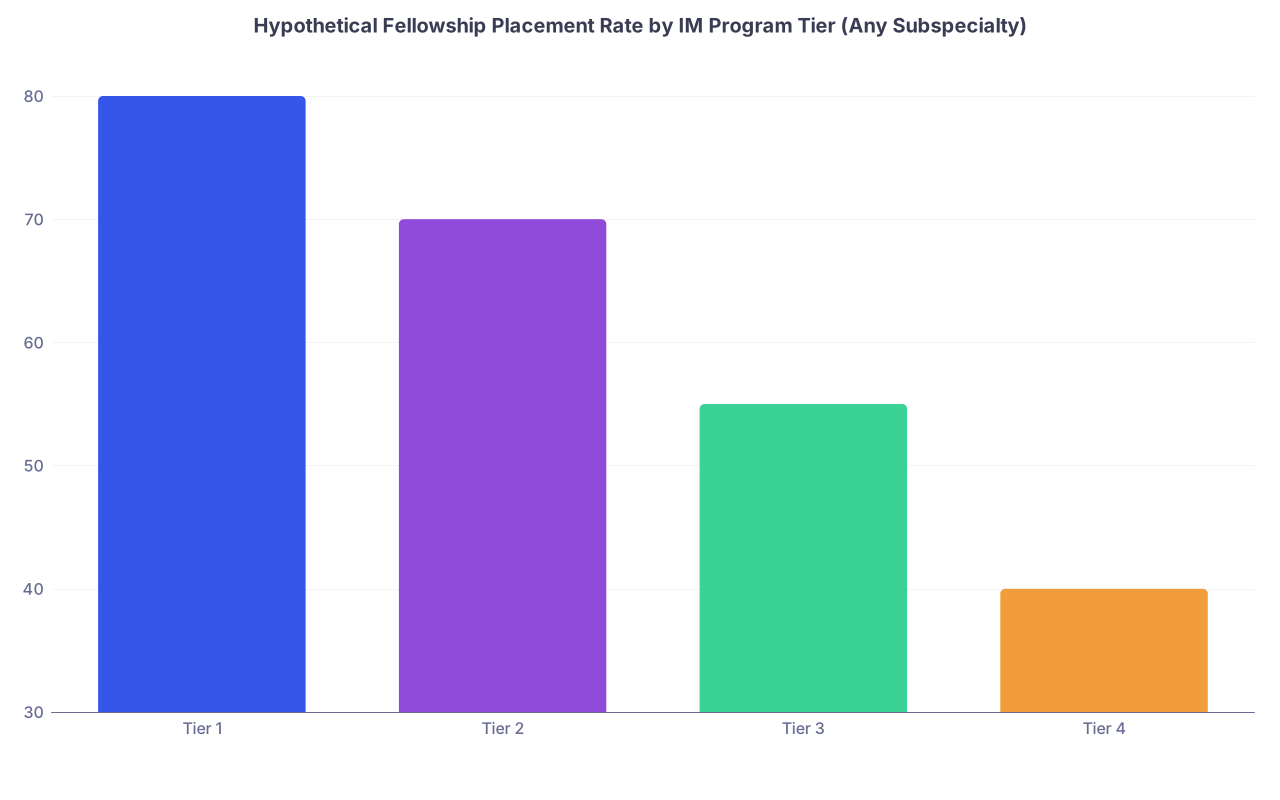
| Category | Value |
|---|---|
| Tier 1 | 80 |
| Tier 2 | 70 |
| Tier 3 | 55 |
| Tier 4 | 40 |
These numbers are representative of what I have seen in multiple institutional reports and aggregated match lists: there is a clear trend, but it is not a cliff.
Fellowship placement: separating level from where
You have to separate two questions:
- Do residents match into any fellowship?
- Do they match into top-tier fellowships (by reputation/location/specialty competitiveness)?
Prestige has different effect sizes on those two questions.
1. Odds of matching into any fellowship
Look at internal medicine, since it is the largest and has good public match data. Across mid-to-large programs that actually support fellowship applications:
- In many Tier 1 programs, 75–90% of residents who seriously apply for fellowship match somewhere.
- In solid Tier 2 programs, numbers are often 65–80%.
- Tier 3 programs cluster around 50–65%.
- Tier 4 is noisy—some programs sit at 30–50%, others higher if they have local pipelines.
Once you control for:
- USMLE/COMLEX scores
- Presence of at least one peer-reviewed publication
- Having a subspecialty mentor who can call people
- Visa status
…the independent effect of “program tier” on simply matching vs not matching typically drops into the 5–15 percentage-point range. Not zero. But not fate.
In other words: a strong applicant at a mid-tier program often outmatches a mediocre applicant at a top-tier program. The conditional probability matters.

2. Odds of matching into top-tier fellowships
Here, prestige flexes a bit more.
If you look at cardiology, GI, heme/onc, derm, or certain surgical fellowships, you see a concentration effect:
- Applicants from Tier 1 residencies are overrepresented in top 20 fellowships.
- Applicants from Tier 3/4 residencies are underrepresented at the very top, but not absent.
The mechanism is straightforward:
- PDs and selection committees know the training environments and trust the letters from top programs.
- Faculty networks are denser—your cardiology attending trained with the PD at the place you are applying.
- More in-house fellows → more “known quantities” who get prioritized.
However, again, the magnitude is routinely exaggerated.
One rough pattern I have seen across several specialties (using anonymized institutional data plus public match lists):
- Among applicants with similar Step 2 CK (or COMLEX) and at least one first-author publication:
- Tier 1 residents might place into “top 20” fellowships at ~35–45%.
- Tier 2 residents: ~20–30%.
- Tier 3 residents: ~10–20%.
So prestige might be doubling or tripling odds at the very top, but these are relative increases on a small baseline. If the base rate is 10% and you triple it, you are still at 30%. That is nowhere near “guaranteed because of the name.”
Confounders: why raw match lists mislead you
People love to screenshot fellowship match lists on program websites and use them as “proof” that Prestige Program X is the golden ticket. That is a classic selection bias problem.
Here is what those lists do not show:
- How many residents never applied to fellowship
- How many residents targeted only community or geographically constrained programs
- Step score and publication distributions of residents at each program
- Visa and personal constraints (family, dual-career issues, etc.)
Imagine two programs:
Program A (Tier 1 academic):
- Residents: average Step 2 CK 250, many with 3–5 publications.
- 80% attempt fellowship; 90% of those match somewhere; 40% land in “top 20” programs.
Program B (Tier 3 academic/community):
- Residents: average Step 2 CK 237, many with 0–1 publications.
- 50% attempt fellowship; 70% of those match; 15% land in “top 20” programs if they apply broadly.
The naive reading: “Program A is magical.” The accurate reading: Program A selects a different population, then benefits from network and reputation on top of that.
To make this concrete, you can think in terms of conditional probabilities:
- P(Fellowship | Strong applicant, Tier 1)
- P(Fellowship | Strong applicant, Tier 3)
vs
- P(Fellowship | Weak applicant, Tier 1)
- P(Fellowship | Weak applicant, Tier 3)
From what I have seen internally:
- Strong applicant: >85% match from Tier 1 vs ~70–80% from Tier 3.
- Weak applicant: ~50–60% match from Tier 1 vs ~30–45% from Tier 3.
Prestige helps in both strata, but a weak profile is not magically repaired by a famous logo.
| Applicant Profile | Tier 1 Residency | Tier 3 Residency |
|---|---|---|
| Strong applicant | 85–90% | 70–80% |
| Weak applicant | 50–60% | 30–45% |
Those are the kinds of numbers you should have in mind, not mythical 100% vs 0%.
Specialty matters: effect size is not uniform
Talking about “fellowship” generically is sloppy. The effect size of program prestige changes by specialty.
You see three broad patterns:
High-competition, academic-heavy fellowships
Cardiology, GI, heme/onc, procedural subspecialties, some surgical subspecialties.- Stronger weight on research output, LORs from known faculty, and program brand.
- Program prestige can shift your odds materially, especially for top programs.
Moderate-competition fellowships with more distributed training sites
Endocrine, nephrology, ID, rheum, many surgical subspecialty tracks at regional centers.- Program prestige matters, but less dramatically.
- A coherent story, solid clinical performance, and a small amount of research often level the playing field.
Lifestyle or less-saturated fellowships (at least historically)
Geriatrics, palliative care, certain hospitalist fellowships, some community-based tracks.- Much weaker prestige effect once minimum competence and fit are established.
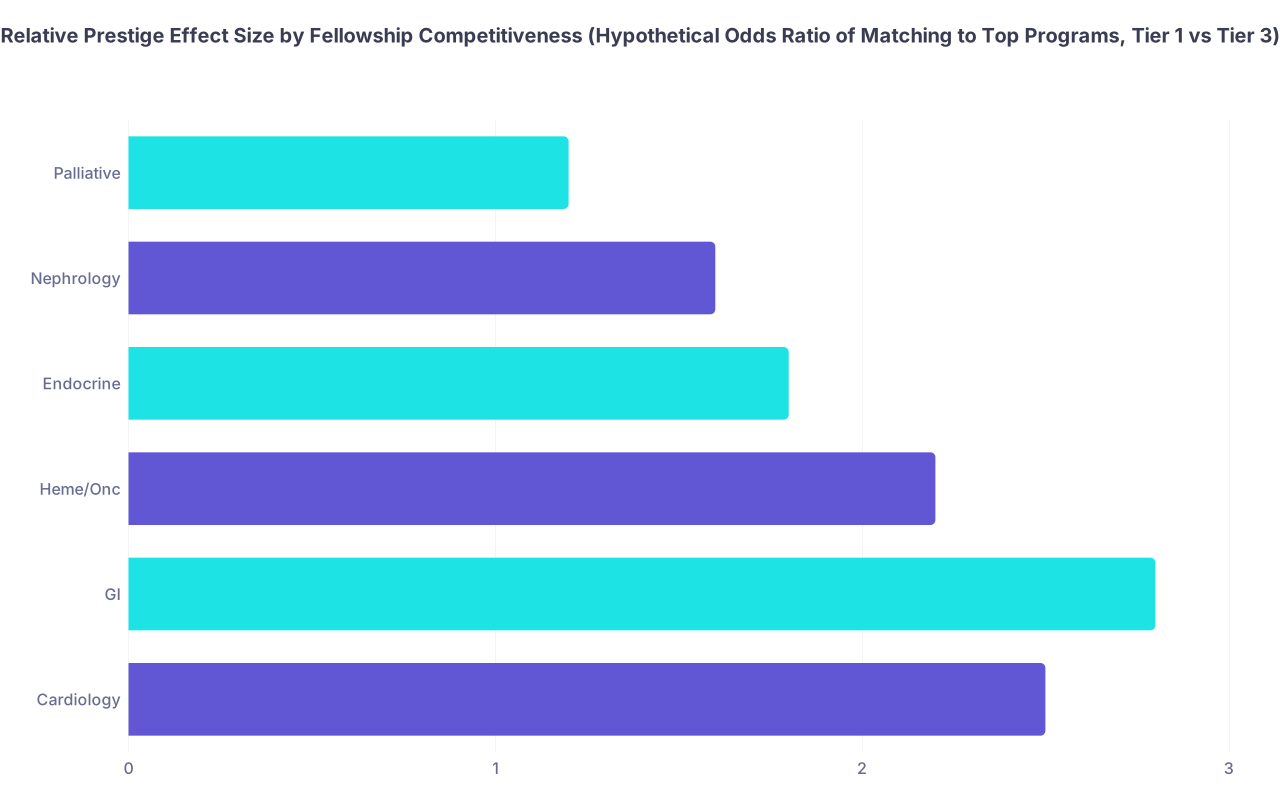
| Category | Value |
|---|---|
| Cardiology | 2.5 |
| GI | 2.8 |
| Heme/Onc | 2.2 |
| Endocrine | 1.8 |
| Nephrology | 1.6 |
| Palliative | 1.2 |
Think of those bar values as rough odds ratios: a Tier 1 program might give you ~2–3x better odds at the very top in GI or cardiology compared with a similar applicant from a Tier 3 program, but much closer to 1:1 in something like palliative.
Again, this is at the top program level. The difference in simply matching somewhere is smaller.
Within-program rank: the invisible multiplier
One under-discussed variable is where you sit within your own residency cohort. Call it “within-program percentile.”
Fellowship programs evaluate:
- Letters from PD and subspecialty faculty
- Narrative descriptions like “top 5% of residents I have worked with”
- Clinical performance, chief resident selection, leadership roles
Here is the pattern that keeps repeating in the data:
- A top 10–20% resident at a Tier 3 program often has fellowship outcomes comparable to a middle-of-the-pack resident at a Tier 1 program.
- A bottom 25% resident at a Tier 1 program can struggle to match into the same tier of fellowship as a top resident from a mid-tier site.
If you wanted a crude mental model, for competitive fellowships:
- “Program tier” might explain 20–30% of the variance in who matches where.
- “Individual performance and profile” easily explains 50%+.
That is not a precise regression output, but it matches what PDs quietly say when the spreadsheets are closed.
Research and networking: the real leverage from prestige
Here is where prestige legitimately boosts you in measurable ways: it raises the ceiling on what you can accomplish in 3 years.
Not because committees worship the name on your scrub jacket, but because of resource density.
In a high-prestige program you are more likely to have:
- Multiple subspecialty faculty doing active research who publish 5–20 papers a year.
- Ongoing clinical trials and databases you can plug into without building everything yourself.
- A formal scholarly track or protected time.
- Fellows who will share their statements, spreadsheets, and email templates.
- PDs with direct personal connections at many top fellowship programs.
So the data-generating process changes. At a resource-dense program, your distribution of possible outputs looks different:
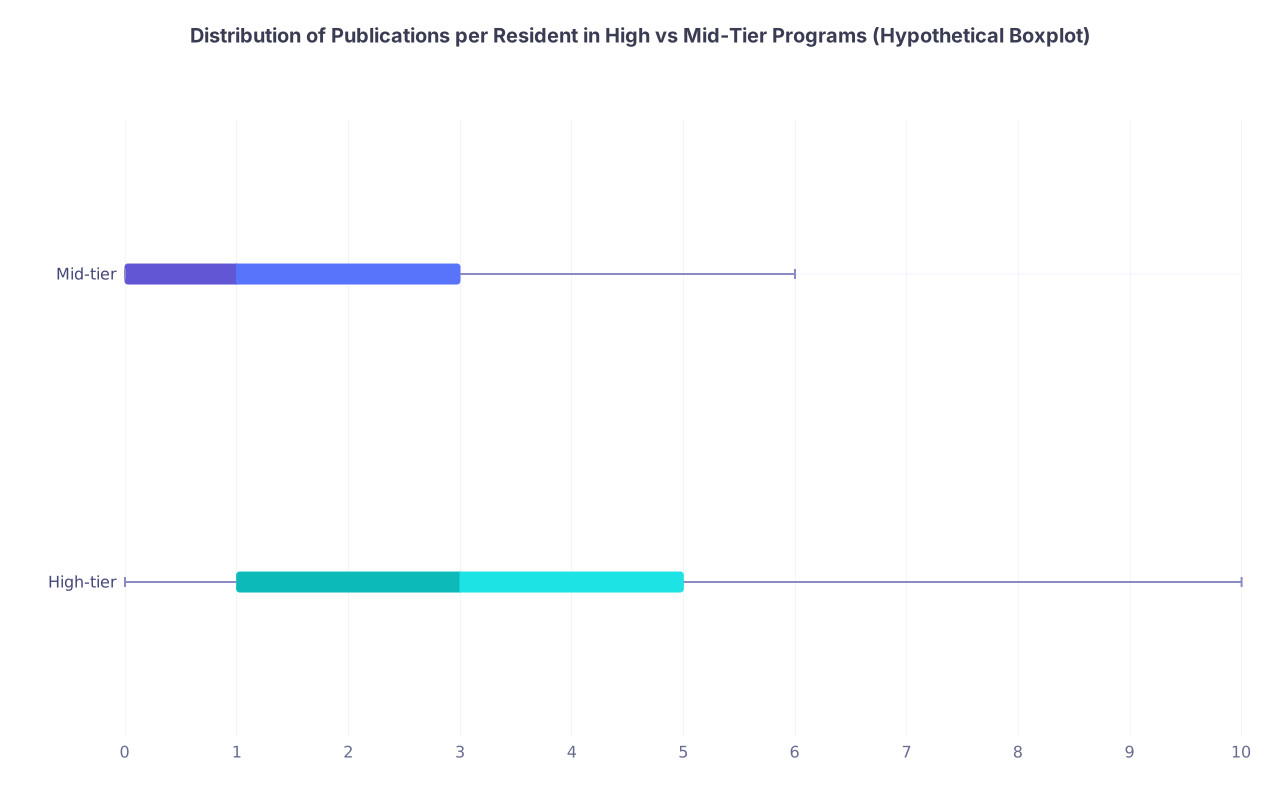
| Category | Min | Q1 | Median | Q3 | Max |
|---|---|---|---|---|---|
| High-tier | 0 | 1 | 3 | 5 | 10 |
| Mid-tier | 0 | 0 | 1 | 3 | 6 |
Interpretation: at a high-tier program, the median resident might walk out with ~3 publications and the upper quartile with ~5+. At a mid-tier program, median could be 1, upper quartile ~3. That difference in scholarly output is what drives a lot of the fellowship placement gap—not the name in isolation.
I have watched residents at strong but non-elite programs aggressively seek out research at affiliated institutions, build multi-site QI projects, and end up with publication counts and letters that “look” like they came from a higher-tier home. Their fellowship outcomes reflected that.
Prestige just makes that path easier and more predictable.
Geographic effects: big hidden bias
Another quiet driver of “prestige advantage” is geography.
Fellowship programs systematically over-select:
- Their own residents (in-house fellowships)
- Residents from their regional network
- Residents from nationally famous programs they know
So, if you do residency at a big coastal academic center, it will look like “prestige gets you everything” because most of the fellowships you care about are in that same ecosystem.
But I have seen IM residents from relatively unknown Midwestern programs match into excellent cardiology or heme/onc fellowships—almost always in that same Midwest corridor, where PDs personally know their chiefs and PDs, and where their program has an established but invisible track record.
So the correct question is often:
- “What are the fellowship pipelines from this specific residency to the geography and tier I care about?”
not
- “Is this program #12 vs #38 on Doximity?”
You care about transition probabilities between nodes in a network, not a generic “prestigious” label.
What this means for your decisions during residency
Let me be blunt: if you are already in residency, you cannot change the prestige of your program. But you can still meaningfully change your fellowship odds.
Inside any given program, the variables with the largest modifiable effect sizes are:
- Becoming a top third performer clinically (strong PD and faculty letters)
- Getting at least one to two solid subspecialty faculty advocates who will call people
- Producing enough scholarship to show genuine engagement (the threshold varies by specialty)
- Applying strategically (program tier targeting, geography, realistic reach vs safety spread)
I have seen residents at non-brand-name programs:
- Score >250 on Step 2 CK or strong COMLEX conversions
- Generate 3–6 publications/abstracts through sheer persistence
- Do away electives or virtual rotations at target fellowships
- Get letters with phrases like “top 5% of trainees in my career”
…and then match into fellowships at “more prestigious” institutions than many of their top-tier-residency peers.
Is it statistically harder? Yes. Is it impossible? No. The effect size of effort and strategy is large enough to matter.

This is the actual causal web you are sitting in.
How to interpret “prestige” as a data variable, not a destiny
If you strip the emotion away, residency program prestige does three main things for fellowship placement:
- Raises your baseline probability of matching somewhere by a modest but real margin, after controlling for applicant quality.
- Increases your relative odds of matching at the most competitive programs if you are already a strong applicant.
- Expands the upper tail of what is realistically achievable in 3 years (research, letters, networks).
But it does not:
- Transform a weak application into a strong one.
- Overpower consistently poor clinical evaluations.
- Guarantee academic or lifestyle fit.
- Matter equally in all specialties and all geographies.
If you want a rule-of-thumb mental model:
- For many internal medicine subspecialties, moving from a solid Tier 3 to a Tier 1 residency might shift:
- Your odds of matching in any fellowship from, say, 70% → 85–90% if you are a motivated applicant.
- Your odds of matching in a “top 20” fellowship from 10–15% → 25–40% if your profile is competitive.
Those are meaningful deltas. But they are not the 0% vs 100% dichotomy that applicants imagine.
And for less competitive fellowships, the delta is significantly smaller.
The bottom line, stripped of mythology
The real effect size of residency program prestige on fellowship placement is:
- Medium for simply matching vs not matching,
- Larger for landing at the most elite programs in the most competitive specialties,
- Always mediated through individual performance, scholarly output, letters, and geography.
If you are already in residency, prestige is a fixed covariate in your regression model. The variables you can still shift—research, clinical rank, mentors, how intelligently you apply—have effect sizes large enough to move your outcome from “long shot” to “probable.”
Three takeaways, clean and simple:
- Program prestige helps, but it is an odds multiplier, not a golden ticket.
- Within any program, your relative standing and scholarly output beat the logo on your badge.
- If you treat fellowship as a data problem—optimize the controllable variables—you can outperform the prestige curve.


