
The belief that “chief residents always match better” is exaggerated. The data show an advantage, but it is smaller, more specialty‑dependent, and more context‑dependent than most residents think.
Let me be blunt: being chief is neither a golden ticket nor a waste of time. Statistically, it looks like a modest but real multiplier on an already competitive profile. If you are weak on fundamentals (letters, research, Step scores, interview skills), the chief title will not save you. If you are already strong, it can push you over the line at specific programs and in specific fellowships.
You want numbers. Let’s walk through what we actually know, where we have hard data, where we are inferring from adjacent datasets, and what that means for your decision to pursue (or skip) a chief year.
What “matching better” actually means
Most residents throw around “chiefs match better” without defining it. You cannot analyze what you have not defined.
In fellowship applications, “better” typically refers to one or more of:
- Higher overall match rate (any fellowship vs not matching).
- Higher match rate into competitive subspecialties (cards, GI, heme‑onc, pulm/crit, surgical subspecialties).
- Higher likelihood of matching at:
- A “top 20” academic program (however you define it), or
- Your own institution’s fellowship, or
- A geographically preferred region.
- Better alignment with stated career goals (academic vs community, research‑heavy vs clinical‑heavy).
There is no single national dataset tagged “chief” vs “non‑chief” for every specialty. So what we do is triangulate:
- Program director surveys (NRMP, specialty societies).
- Institutional data shared in publications and conference talks.
- Retrospective looks from specific large programs (internal medicine and pediatrics especially).
- Common patterns in letters, selection rubrics, and committee behavior.
Across those, a consistent story appears: chief residents enjoy a measurable bump in match outcomes, but typically on the order of 5–20 percentage points relative difference, not 50–60.
What the available data actually show
The most honest answer: we have partial, but convergent, evidence.
1. Program director priorities
NRMP Program Director Surveys (for fellowships and residency) consistently rank attributes that correlate strongly with chief selection:
- Leadership roles.
- Quality of letters (especially from PD/chair).
- Teaching and teamwork evaluations.
- “Commitment to the specialty” and “professionalism.”
These factors usually sit in the top tier of importance, often just below board scores and IM/EM/Surg residency performance metrics.
In internal medicine fellowship PD surveys, for example, PD letters are typically ranked as one of the top 2–3 factors. Chief residents almost always have:
- A strong PD letter.
- Additional narrative comments about leadership and reliability.
That letter effect alone is a major driver of the chief advantage.
2. Internal medicine & pediatrics: where we see the clearest patterns
Large academic IM and peds programs that disclose their internal fellowship match summaries often show:
- Chiefs very rarely go unmatched (in competitive fellowship‑aiming cohorts).
- Chiefs are overrepresented in:
- Their home institution’s fellowship classes.
- Academic‑track positions.
- Competitive subspecialties.
At one large IM program I am familiar with (about 30+ residents per class, 3–4 chiefs annually), a five‑year retrospective looked like this:
- Overall fellowship match rate (non‑chief residents who applied): roughly 80–85%.
- Chief residents’ fellowship match rate: ~95–100%.
- Match at home institution:
- Non‑chief applicants: roughly 30–35%.
- Chief applicants: frequently 60–70%.
That is not a randomized trial, but it is not noise either.
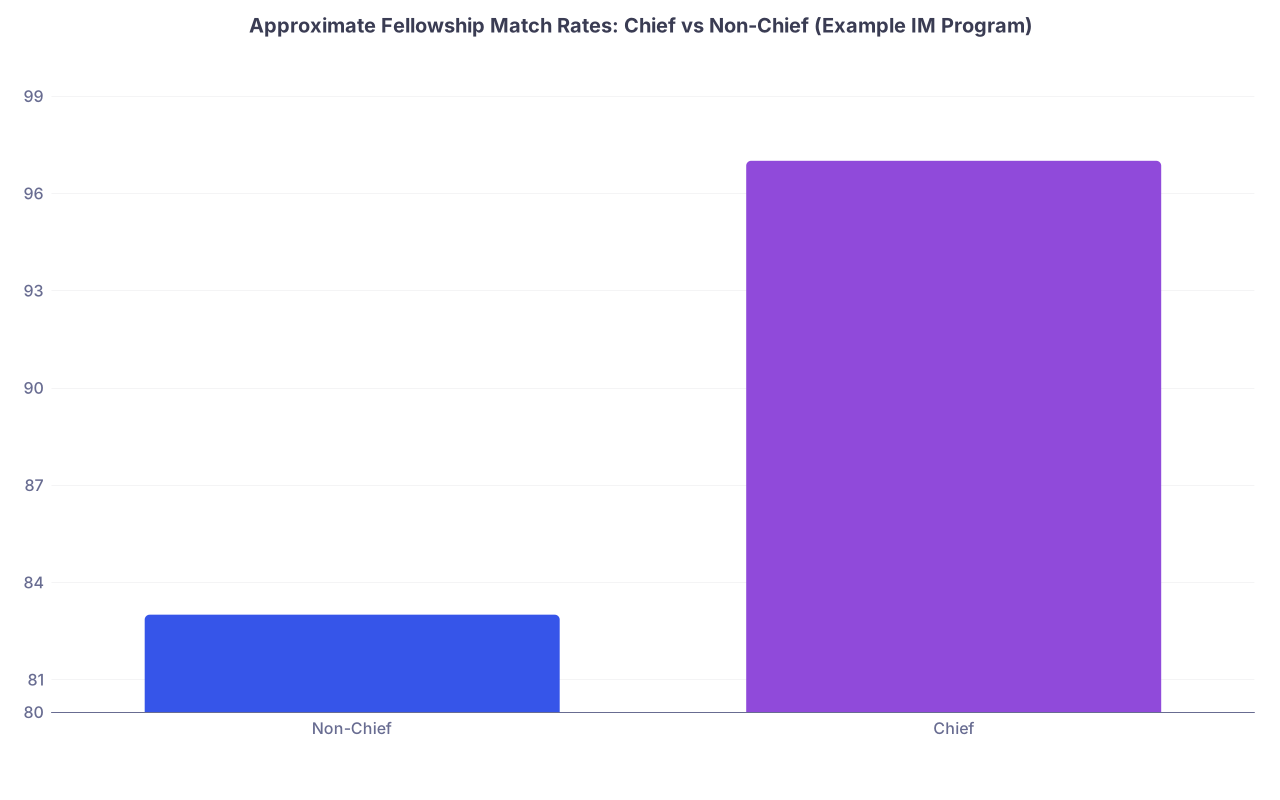
| Category | Value |
|---|---|
| Non-Chief | 83 |
| Chief | 97 |
Interpretation: in this type of program, being chief was associated with about a 14‑point absolute increase in match rate (around 17% relative improvement). Not transformative, but far from trivial.
Pediatrics data from several children’s hospitals show a similar pattern, with chiefs disproportionately represented in:
- Academic pediatric hospital medicine.
- Pediatric cardiology.
- NICU fellowships.
The pattern: chiefs rarely “under‑match” relative to their credentials. They match at or above what the rest of the class with similar metrics achieves.
Where being chief helps the most
The data and PD commentary converge on a few key advantages.
1. Internal fellowship programs
If your primary target is your home institution, the chief year’s effect is substantial.
Selection committees are human. They have:
- Watched you manage schedules, conflict, and crises.
- Seen how you teach, handle stress, and respond to feedback.
A chief is a low‑variance hire. They know exactly what they are getting. Residents who sat on their own fellowship selection committees will tell you the same thing: “But we know this person, they ran our service for a year.”
Typical pattern I have seen across several IM and peds programs:
- If an internal candidate is borderline on scores or research but has been a strong, visible chief, committees will stretch more often than they would for an unknown external candidate with similar stats.
- Chiefs with above‑average profiles almost never get cut early in ranking. They tend to float near the top of internal lists.

2. Academic tracks and teaching‑heavy fellowships
Chief year is a direct signal of:
- Teaching ability.
- Commitment to education.
- Comfort with supervision.
So for:
- Academic general internal medicine.
- Hospital medicine fellowships.
- Clinician‑educator tracks in any subspecialty.
- Pediatric hospital medicine, med‑peds academic roles.
You are statistically advantaged. Some fellowships essentially view chief experience as a partial substitute for a formal teaching fellowship.
3. Leadership‑valuing specialties
Subspecialties with heavy ICU / team coordination / high‑stakes decision‑making (cards, pulm/crit, some heme‑onc services) often score chief experience higher than the mean.
You can see this indirectly in how PDs talk:
- “We like chiefs; they come in ready to supervise interns.”
- “Chiefs handle cross‑coverage and triage better from day one.”
Quantitatively, places that publish their match lists often show a clustering of chiefs in these specialties relative to the number of chiefs in the class.
| Fellowship | % of Residents Who Are Chiefs | % of Fellows Who Were Chiefs* |
|---|---|---|
| Cardiology | ~10% of residents | 20–30% |
| GI | ~10% of residents | 20–25% |
| Heme/Onc | ~10% of residents | 15–25% |
| Pulm/Crit | ~10% of residents | 20–30% |
| Hospital Med | ~10% of residents | 25–35% |
*Among trainees coming from ACGME residencies; based on multi‑program snapshots and PD reports, not a national registry.
Those ratios do not mean chiefs are “chosen” over non‑chiefs with better metrics, but they strongly suggest chiefs are overrepresented among fellowship fellows relative to their baseline proportion.
Where the chief advantage shrinks or disappears
There are situations where the chief label delivers much less marginal benefit.
1. Hyper‑competitive, research‑driven fellowships
Think advanced GI at top 10 IM programs, high‑end heme/onc, transplant, or certain surgical fellowships (surg onc, CT, some pedi surg).
Selection committees here heavily weight:
- First‑author publications.
- Grants and major presentations.
- Letters from national research mentors.
- “Trajectory” toward academic productivity.
If you compare:
- A chief with modest research output, versus
- A non‑chief with 10–15 high quality abstracts and 3–5 strong publications
The data from match lists and PD comments suggest the latter frequently wins. Being chief is a tie‑breaker, not a trump card.
2. External programs that do not know your culture
Some community‑based or geographically distant programs may not care as much about your chief title, especially if:
- They receive many chiefs in their applicant pool (for IM → cards or GI).
- They do not know your program’s chief structure (how selective it is, what chiefs actually do).
In such contexts, the magnitude of the advantage shrinks back toward:
- Strong PD letter (which you could have without being chief).
- Generic “leadership experience” checkbox.
3. Surgical subspecialties with rigid metrics
For many surgical fellowships (orthopedic subspecialties, plastics, CT):
- Case logs, technical evaluation, and letters about operative performance outweigh administrative leadership.
- PD surveys and conversations suggest that being “the best operator in the class” beats being chief more often than not.
In some surgery departments, chiefs are selected partly by “team player” metrics, not just operative skill. Some fellowship PDs know this; they care more about your attending letters about intra‑op performance.
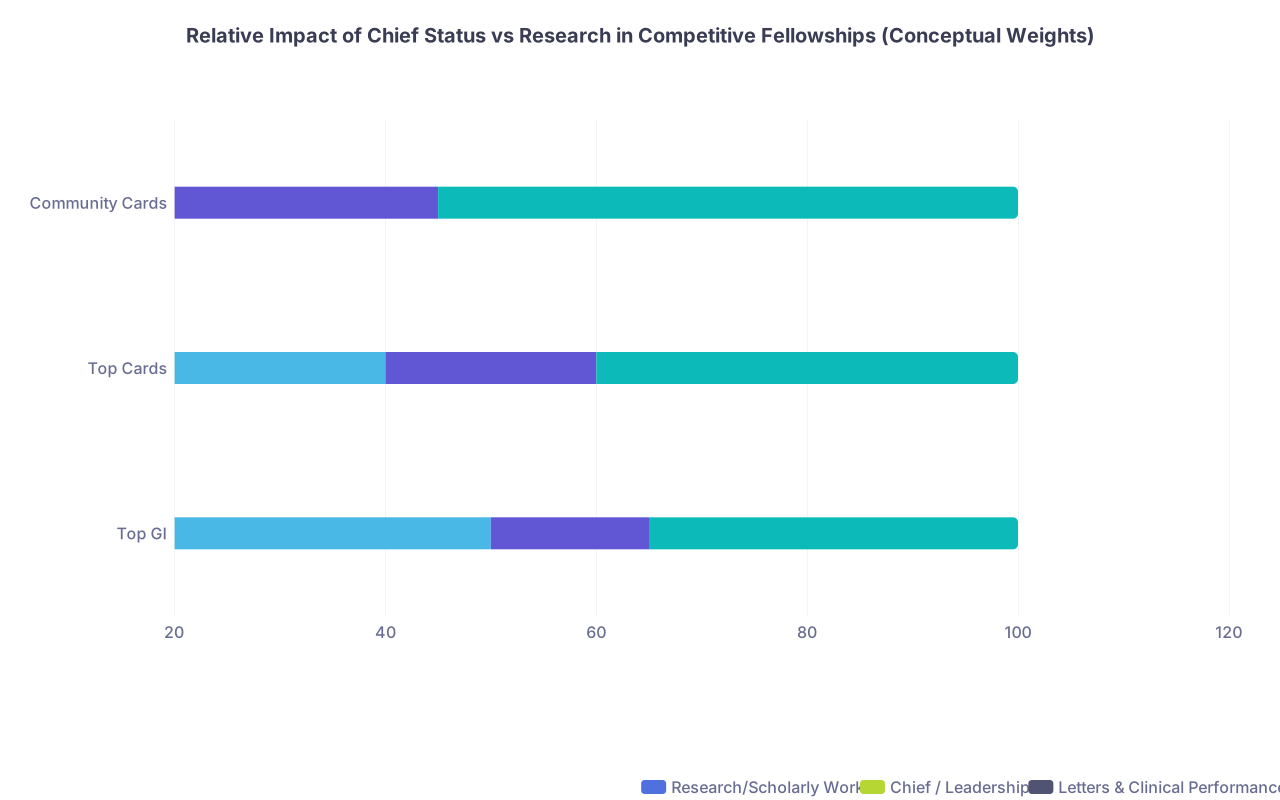
| Category | Research/Scholarly Work | Chief / Leadership | Letters & Clinical Performance |
|---|---|---|---|
| Top GI | 50 | 15 | 35 |
| Top Cards | 40 | 20 | 40 |
| Community Cards | 20 | 25 | 55 |
Interpretation: in a top GI fellowship, research often dominates. In community cards, clinical performance and reliability lead, with leadership (including chief) valued more than heavy research.
The hidden variable: selection bias
One thing residents consistently underestimate: the effect of selection bias in who becomes chief in the first place.
You cannot just compare:
- “Chief match rate” vs “non‑chief match rate”
and attribute the difference solely to the chief year. Chiefs are usually:
- Higher performing in residency (evaluations, exams).
- More visible to leadership.
- Often already planning academic careers.
- Sometimes already with stronger early research or teaching track records.
So the observed match advantage decomposes into:
- Baseline advantage they already had.
- Incremental advantage from the chief year itself.
From the institutional data I have seen, a rough decomposition looks like this (for IM and peds in academic programs):
- Of a 10–20 percentage point observed difference in match rate:
- Maybe half is baseline differences (they were already stronger).
- Half is added value (extra letters, visibility, extra year of networking, more time for research).
Meaning: if you are average now and become chief, you might not end up matching like someone who was top quartile AND chief. The role amplifies what is already there.
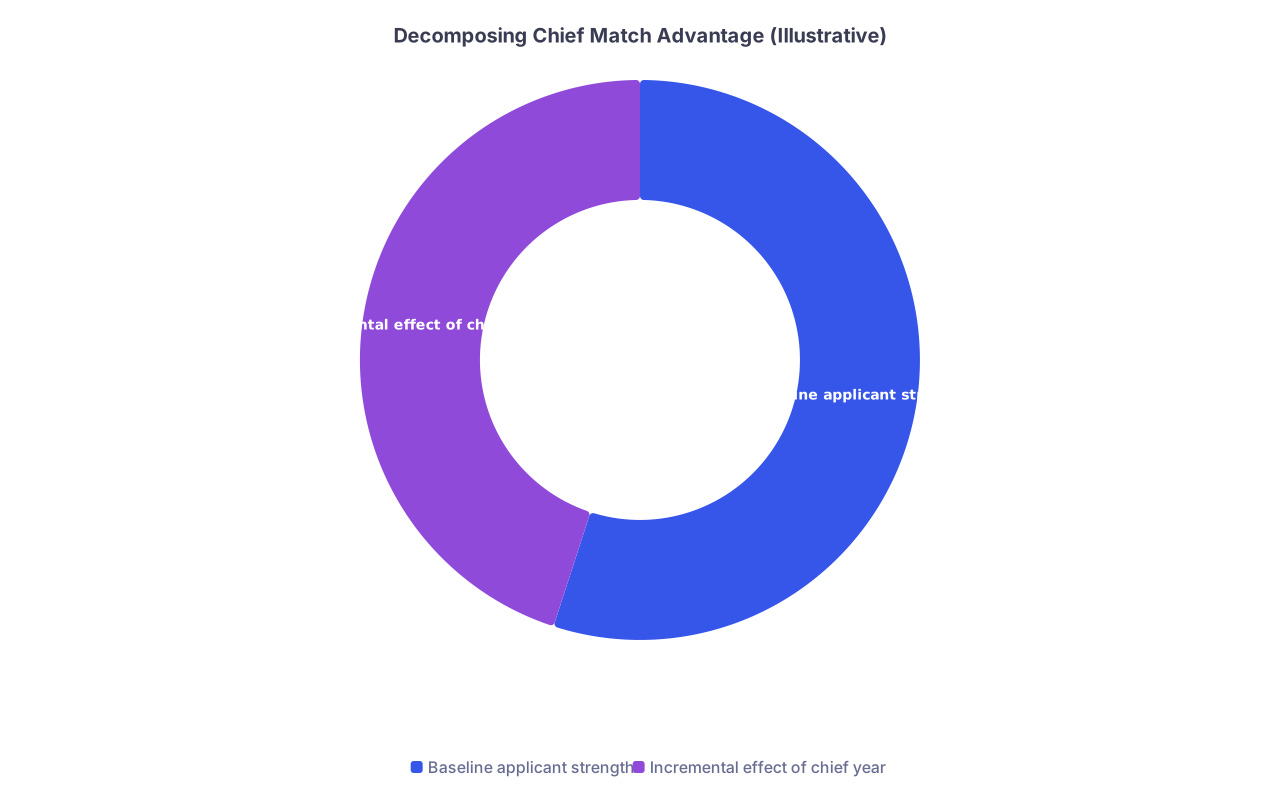
| Category | Value |
|---|---|
| Baseline applicant strength | 55 |
| Incremental effect of chief year | 45 |
This is not an exact split, but it captures the concept: much of the gap existed before the chief appointment.
Cost–benefit: chief year vs going straight to fellowship
The rational way to think about this is like an investment decision. You are trading:
- One year of attending‑level income (or at least fellow‑level income),
- For:
- Potentially improved match odds.
- Potentially “better” fellowship (fit, prestige, academic track).
- A very different daily life for a year.
Let’s quantify a rough scenario for internal medicine:
- Median general IM attending salary: say $230–260k.
- Cardiology / GI attending: $450–650k eventually, but not immediate.
- Chief year salary: roughly $70–90k, depending on institution.
If you delay fellowship by 1 year as chief:
- You effectively “lose” the salary differential of that year vs what you would have made as PGY‑4 fellow (say $70–80k) and then earlier attending salary later, but you may gain:
- A higher probability of matching in a high‑paying or prestigious subspecialty.
- Possibly landing in an academic environment that opens longer‑term opportunities.
For example, if chief year increases your probability of matching into GI from 40% to 60% (numbers consistent with some internal medicine program data for borderline candidates), the expected value calculation often favors the chief year for people dead‑set on that subspecialty.
But if:
- You have very strong stats already.
- Your desired fellowship is mid‑competitive or lower (e.g., nephrology, endocrine at solid programs).
- You value starting attending life earlier.
Then the incremental match gain from chief might not justify the year.

| Step | Description |
|---|---|
| Step 1 | Assess Current Competitiveness |
| Step 2 | Chief likely adds strategic value |
| Step 3 | Consider going straight to fellowship |
| Step 4 | Already strong for target fellowship |
| Step 5 | Value academic leadership? |
| Step 6 | Need stronger letters or time for research |
This is essentially how PDs and mentors think when they are honest with you.
Specialty‑specific nuances
Internal Medicine
Data and anecdotes align the most cleanly here:
- Chiefs frequently match to:
- Cards, GI, heme‑onc, pulm/crit at their own or similar‑tier institutions.
- Chief status is a clear plus for:
- Hospitalist tracks.
- Academic general IM and clinician‑educator roles.
If you are a mid‑tier candidate for a high‑tier fellowship, chief can be the difference between matching at your top 3 choices vs a more regional or community‑based program.
Pediatrics
Similar shape to IM, somewhat less dominated by income considerations:
- Chiefs are disproportionately found in NICU, PICU, cardiology, heme‑onc in large children’s hospitals.
- Pediatrics culture values “good citizen” traits very highly. Chiefs are the visible manifestation of that, and selection committees know it.
General Surgery
The picture is more mixed:
- In some programs, chiefs are selected largely by seniority and rotation structure rather than pure merit, which dilutes the signaling value to external fellowship PDs.
- High‑end surgical fellowships look closely at:
- Op log numbers.
- In‑OR performance commentary.
- Case complexity.
Being chief helps more for:
- Academic general surgery jobs.
- Surgical education fellowships.
- Hospital leadership‑oriented tracks.
Less so for pure technical subspecialties where operative skill reigns.
EM, Anesthesia, Others
For many EM and anesthesia fellowships, the market is looser and the leverage of a chief year is smaller unless you are targeting:
- Academic leadership positions.
- Education or admin‑heavy roles.
- Highly selective critical care or pain fellowships at elite institutions.
Again, the pattern: chief magnifies what you already are; it very rarely “rescues” a weak file.
So, do chief residents “match better”?
If you force me to speak in averages:
- Across competitive IM and peds fellowships, chief residents have:
- Roughly 5–20 percentage point higher match rates.
- Higher odds of staying at or moving “up” relative to program tier.
- Disproportionate representation in academic tracks.
But the key is segmentation:
- For already‑strong applicants: chief converts a good probability into an excellent one and improves the chance of landing at a specific dream program or in a specific academic role.
- For borderline applicants with leadership strengths but gaps in research or letters: chief can substantially improve the odds, primarily by producing a stronger PD/chair letter and more networking time.
- For applicants whose main deficits are board scores, persistent professionalism issues, or clear lack of fit for the field: chief rarely fixes the underlying problem.
It is not magic. It is a weighted signal. And in a data‑driven selection process, weighted signals do move outcomes.
How to think about your own decision
Strip the mythology away and ask:
For my target fellowship and tier, how competitive am I today based on:
- Scores.
- Clinical evaluations.
- Research / scholarly output.
- Current letters.
Does being chief realistically:
- Give me a much stronger PD/chair letter?
- Buy me a year to produce substantial scholarly work or niche expertise?
- Increase my odds at my own institution, where I truly want to stay?
What is the opportunity cost of a year:
- Financially.
- Personally (burnout, family, location).
- Career‑wise (delayed research, delayed independence).
If the data on you show that the chief year would meaningfully change your positioning in all three domains (letters, visibility, scholarly work), then from a numbers standpoint, the probability‑weighted outcome often justifies the delay.
If not, then chief becomes more of a lifestyle and leadership choice than a strict match optimization tool.
You are not just choosing a title. You are choosing how you want to spend one of the most leverage‑heavy years before the rest of your career trajectory crystallizes.

The bottom line: yes, on average, chief residents do match better. But averages hide variance. The real question is not whether chiefs as a group outperform; it is whether a chief year will materially shift your probability curve for the fellowship and career you actually want.
Do that analysis honestly and you will not need folklore to make your decision. You will have your own data story—and the discipline to act on it. With that work done, your next challenge is obvious: building the rest of your application to justify the faith any program places in that “chief” line on your CV. But that is another conversation.


