

The obsession with board pass rates as a proxy for fellowship outcomes is statistically lazy.
Programs flaunt “100% board pass rate for 5 years” as if that alone predicts who ends up in cardiology at a top-10 institution. Applicants parrot it. PDs market it. But when you look at the data structure—inputs, confounders, selection bias—the neat narrative falls apart quickly.
This is a correlation-heavy space with very shaky causal claims.
Let’s walk through what the numbers actually support, what they clearly do not, and how you should think about board performance when you care about fellowship outcomes.
1. What We Actually Mean by “Board Pass Rates” and “Fellowship Outcomes”
The first problem: people throw these terms around like they are precise variables. They are not.
Board pass rates: the shiny but blunt KPI
When residents and applicants say “board pass rates,” they are usually referring to:
- ABIM (or equivalent) first-time pass rate for the last 3–5 graduating classes
- Sometimes combined 3‑year rolling pass rate
- Occasionally Step 3 or in‑training exam (ITE) performance gets bundled in informally
Programs love to post things like:
- “Our 3-year rolling ABIM first-time pass rate: 97%”
- “National average: ~88–92%” (depending on the year and specialty)
The metric looks clean. One number. Easy comparison.
But the data structure behind that one number is messy. It bakes in:
- Resident selection (USMD vs DO vs IMG; prior test performance)
- Institutional culture around exams
- Support for structured board prep
- Program-level consequences for low ITE scores (remediation, pressure, threats that “you will not sit for boards unless…”)
You are not just seeing “teaching quality.” You are seeing an output of a whole pipeline.
Fellowship outcomes: one phrase, 10 different metrics
“Strong fellowship outcomes” is even fuzzier. It can mean:
- % of residents matching into any fellowship (cardiology + GI + heme/onc + others)
- % matching into “competitive” fellowships (cards, GI, heme/onc)
- % matching into academic vs community fellowships
- % matching at top‑tier or “name-brand” institutions
- Match rate for specific subspecialty
Those are not interchangeable metrics. A program might have:
- Very high overall fellowship placement, but largely into mid-tier programs
- Modest fellowship placement rate, but those who match go to top-10 institutions
- Strong cardiology outcomes but weak heme/onc outcomes
When you compare “board pass rate” to “fellowship outcomes,” you are often correlating a crude exam binary with a composite career-success index built from wildly heterogeneous elements.
2. The Correlation: What the Data Actually Suggests
Despite all that noise, there is a real signal. Board performance and fellowship outcomes are not independent.
The data—both published and what PDs see internally—tend to show:
- Residents with strong in‑training exam performance and first-time board passes are over‑represented among those who match into competitive fellowships.
- Programs with consistently abysmal board pass rates rarely dominate subspecialty fellowship match lists.
This is not surprising. Standardized exams are upstream filters.
Let’s make this concrete with a stylized example based on typical ranges PDs discuss behind closed doors.
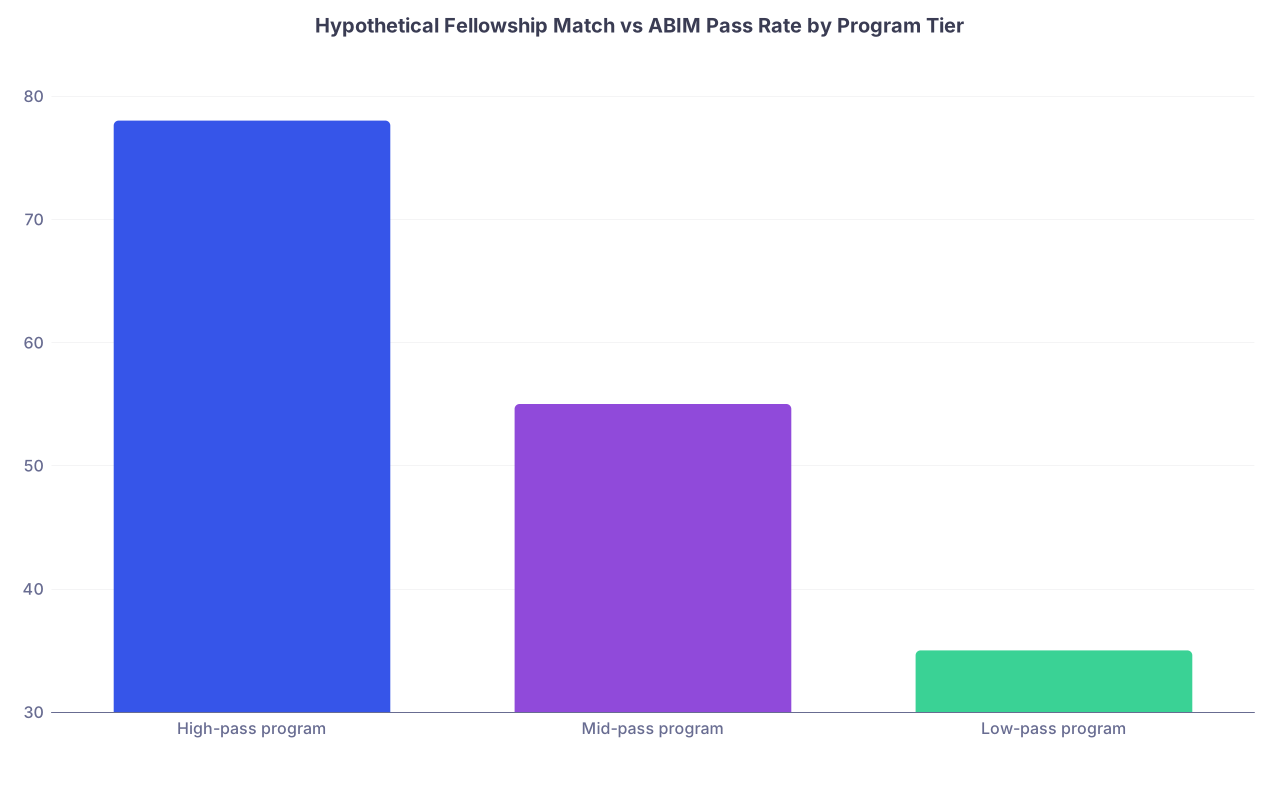
| Category | Value |
|---|---|
| High-pass program | 78 |
| Mid-pass program | 55 |
| Low-pass program | 35 |
Interpretation (hypothetical but realistic):
- High-pass program: ABIM first-time pass rate ~95–100%. About 70–80% of graduates pursue and match into some fellowship.
- Mid-pass program: ABIM first-time pass rate ~85–90%. Maybe 50–60% of graduates match into fellowship.
- Low-pass program: ABIM first-time pass rate ~70–80%. Fellowship match rates fall into the 30–40% range.
You see a monotonic association: higher board pass rates tend to co‑occur with better fellowship match metrics. So yes, correlation exists.
But you are not allowed to stop there. That association is full of confounding.
3. The Confounder Stack: Why Correlation ≠ Causation Here
Let me be blunt: a “97% ABIM pass rate” does not cause a “75% fellowship match rate.” Both are downstream products of the same input characteristics and environment. Once you understand those inputs, the mystique evaporates.
Here are the big confounders that most applicants completely ignore.
3.1 Resident applicant pool
High board pass rate programs tend to recruit:
- Higher Step 1/Step 2 CK scorers
- More US MDs, fewer IMGs or DOs (in many institutions)
- Students from medical schools with strong track records in standardized exams
Those same residents are:
- More likely to be targeting fellowship from day one
- More likely to have pre‑residency research, AOA, honors—exactly the variables that impress fellowship selection committees
So when you see a high board pass rate and high fellowship match rate, you are often just seeing a self‑selected, high-performing applicant cohort doing what high-performing cohorts usually do.
Boards did not create their fellowship success. The underlying applicant quality did.
3.2 Academic environment and institutional prestige
Institutions with strong board pass rates usually share several structural advantages:
- Strong academic culture (grand rounds, subspecialty conferences, journal clubs that do not suck)
- Robust subspecialty divisions (cards/GI/heme-onc faculty who publish, hold national roles, run trials)
- Internal fellowships that preferentially take their own residents
- Protected research time or at least a culture where “doing research” is normal, not an exception
Those same features directly improve fellowship outcomes, often independent of raw ABIM scores. Having a heme/onc PD who will call their colleague at MD Anderson does more for your match odds than your board outcome alone.
3.3 Self-selection into exam culture
Programs differ in how aggressively they push board prep:
- Some tie ITE performance to formal remediation, extra didactics, or limitations on moonlighting.
- Others basically ignore ITE until PGY-3.
Residents respond accordingly. The ones who care about academic careers and subspecialties usually:
- Choose programs known for “strong teaching and exam culture”
- Engage more with question banks, structured review
These residents also tend to build stronger CVs: more research productivity, more networking with subspecialty faculty. Again, the same underlying group drives both better boards and better fellowship outcomes.
So when people say, “Look, high board pass rate program → great fellowship match,” what they are often describing is: “Program that attracts ambitious, exam-savvy residents → those residents succeed on multiple metrics.”
That is correlation, not a mechanistic causal impact of the board pass rate itself.
4. Where Board Performance Does Matter Causally
Now let’s flip to the other side. There are real, direct pathways where board outcomes influence fellowship outcomes—not just correlated noise.
4.1 Red flags and selection thresholds
Fellowship programs, especially competitive ones, do not like risk. Failing boards is a red flag. This shows up in several ways:
- An ABIM failure forces program directors to write explanatory language in your letters. That alone can tank some applications.
- Some fellowships have internal policies that strongly prefer or formally require board certification (or passing the certifying exam) before completion of fellowship. A prior fail triggers concern about future failures.
Even if fellowship PDs say they review “holistically,” a board fail or chronic low ITEs function as negative selection filters. They do not guarantee no match, but they clearly reduce the probability, especially into higher-tier fellowships.
Here, causation is more direct: fail → some programs will not rank you → lower match rate.
4.2 Time lost and opportunity cost
Failing boards is not just a line item on your CV. It has utility cost:
- You lose weeks or months to remediation and re‑prep.
- You may not be able to focus on research or networking during that period.
- You might have to delay starting fellowship or even delay applications.
That lost time and attention can directly harm your competitiveness. So again, performance on that exam has a causal effect on your ability to build the rest of the application.
4.3 Internal promotion and “home fellowship” bias
Some institutions heavily favor their own residents for fellowship spots. Internal PDs tend to:
- Prefer residents they perceive as “low risk” academically
- Use ITE and ABIM expectations as part of their mental model of risk
If your program historically has 100% board pass rates, internal fellowship PDs are used to trusting “our residents do fine with exams.” Troublemakers—low ITEs, professionalism issues, etc.—stand out more.
If you fail boards or scrape by with multiple remediation flags, you are much less likely to be the one they pick for that last heme/onc spot. That is a direct pathway from exam performance to fellowship outcome, especially within one institution.
5. Program-Level Data: How to Read It Without Fooling Yourself
Residents often ask: “Should I choose Program A (98% ABIM pass rate) over Program B (88% pass rate) if I want cardiology or GI?”
My answer is numerical: the difference in pass rate is a very weak independent predictor of your eventual fellowship match compared with resident input quality, research infrastructure, and mentorship access.
You need to deconstruct the available data.
| Metric | Relationship to Fellowship Outcomes |
|---|---|
| ABIM first-time pass rate | Weak-to-moderate positive correlation |
| ITE score distributions | Moderate correlation for individual outcomes |
| Resident pre-residency CV | Strong predictor (research, school, scores) |
| On-site fellowships in specialty | Strong positive association |
| Research output (per resident) | Strong positive association |
If you want to think like a data analyst here, treat ABIM pass rate as:
- A quality signal about the floor of academic support
- A proxy for the kind of peers you will have
- A rough indicator of how seriously the program takes exams
But not as an independent, dominant predictor of your fellowship match.
You should be asking:
- How many residents actually apply to fellowship from this program each year?
- Of those, how many match, and where?
- What are the match outcomes specifically in my target field?
- How many graduates go into hospitalist or primary care by choice vs by necessity?
Programs rarely publish that level of detail, but good ones will share approximate numbers if you ask directly.
6. Individual-Level Data: What Actually Moves Your Probability
Now, shift from program-level stats to you. What variables materially affect your fellowship odds, assuming average to above-average performance?
In rough priority order, for competitive subspecialties like cards/GI/heme/onc, I would weight them something like this (yes, this is opinionated, but it tracks with how selection committees talk):
, Training institution reputation, Board/ITE performance, Interview and fit](https://cdn.residencyadvisor.com/images/articles_svg/chart-relative-influence-of-factors-on-competitive-fello-9944.svg "Relative Influence of Factors on Competitive Fellowship Match (Conceptual Weights)")
| Category | Value |
|---|---|
| Research and scholarly output | 30 |
| [Letters and mentorship](https://residencyadvisor.com/resources/fellowship-application-guide/what-your-program-director-really-writes-in-supportive-letters) | 25 |
| Training institution reputation | 20 |
| Board/ITE performance | 15 |
| Interview and fit | 10 |
Interpretation of those conceptual weights:
Research and scholarly output (~30%)
Publications, abstracts, conference presentations. Especially in your target specialty. This is where your time pays off the most for academic or competitive fellowships.Letters and mentorship (~25%)
Strong letters from well-known faculty in the subspecialty are a huge predictor. The informal calls matter even more than what is written.Training institution reputation (~20%)
Not just “big name” but specifically strength of the subspecialty division you are going into. A mid-tier IM program with a powerhouse cardiology division can punch above its weight.Board/ITE performance (~15%)
You need to clear the competence bar and avoid red flags. A strong performance helps, but going from “solid” to “stellar” yields diminishing returns.Interview and fit (~10%)
This matters, but if the upstream variables are weak, a charismatic interview will not rescue a thin CV.
The point is simple: board performance is one minor‑to‑moderate driver among several, not the master variable everyone pretends it is.
7. Causality: How to Think About It Without Doing a PhD
Let’s be concrete about what causation would even look like here.
If board pass rates caused better fellowship outcomes at the program level, you would expect:
If Program A suddenly implemented a new board-review curriculum that boosted ABIM pass rates from 80% to 98%, fellowship match outcomes would jump in lockstep in a few years, even if applicant quality and research infrastructure stayed the same.
Residents who otherwise had identical CVs and clinical performance, but differed only in whether they passed boards on the first try, would show dramatically different fellowship match results—even in noncompetitive fields.
What you actually see in the real world:
Program-level improvements in board pass rates often track with several simultaneous interventions: better recruitment, more faculty, stronger research culture. The improvement in fellowship outcomes is driven by all of these, not just the exam piece. You cannot isolate the board change cleanly.
Individual-level board failures hurt primarily at the margins. A superstar candidate with one exam hiccup and a genuine explanation still often matches. A marginal candidate with a fail frequently does not. Boards are a multiplier, not a sole determinant.
From a data standpoint, the board outcome is a mediator between resident capability and fellowship placement, not a pure cause.
If you want one sentence: boards filter extremes; they do not generate excellence.
8. Practical Strategy: How You Should Use These Metrics
You are in residency or approaching it. You care about fellowship. What do you do with all this?
Choosing a residency program
Use board pass rates as:
- A minimum bar: anything consistently below ~85% ABIM first‑time pass rate should raise questions. It may signal systemic issues.
- A tie‑breaker among roughly comparable programs. If Program X has 97% and Program Y has 88%, and everything else is equal, pick X.
But put more weight on:
- Clear evidence of strong fellowship match lists in your target field
- Access to mentors who publish and are known nationally
- Institutional culture that supports scholarly work
During residency
Treat board exams as:
- A threshold constraint: passing on the first attempt removes a barrier and avoids a red flag.
- A nontrivial, but not dominant, component of your fellowship competitiveness.
Your optimization problem is not “maximize ABIM percentile.” It is “be safely above the competence threshold while freeing up as much time and energy as possible for research, relationships, and clinical performance.”
Practically:
- Use ITEs as a barometer. If you are below program or national means, you must invest more here because a fail would be costly.
- If you are above mean and improving, do not over-invest to chase a perfect score at the expense of scholarship and networking.
Avoid the common error
The worst analytic mistake I see residents make: using a high board pass rate as an excuse to ignore program weaknesses.
“I matched at a program with 100% ABIM pass rate; I’ll be fine for GI even though they have no GI fellowship, no GI research, and two overworked GI attendings who hate academia.”
The data says the opposite: your board outcome will likely be fine, but your fellowship odds will be limited by lack of infrastructure and mentorship.
9. Summary: Correlation vs Causation in One Graph
To visualize the logic, imagine a simple causal diagram.

| Step | Description |
|---|---|
| Step 1 | Resident baseline ability and drive |
| Step 2 | Board and ITE performance |
| Step 3 | Research and CV strength |
| Step 4 | Clinical performance and letters |
| Step 5 | Program environment and resources |
| Step 6 | Fellowship odds |
Board performance (B) sits alongside research (C) and clinical/letters (D) as parallel mediators between your baseline ability/drive (A), program environment (E), and ultimate fellowship odds (F).
So yes, B affects F. But A and E affect everything. And C and D are at least as important as B for competitive fellowships.
FAQs
1. If I fail boards once, are my chances at a competitive fellowship like cardiology or GI ruined?
No, they are not automatically ruined, but the probability drops. The data and anecdotes from PDs line up: a board failure functions as a significant negative signal. To counteract it, you need stronger positives elsewhere—robust research productivity, outstanding letters from well‑known subspecialty faculty, and a clear, credible explanation for the failure. Some programs will screen you out regardless; others will look past it if the rest of your application is exceptional.
2. Should I prioritize a program with higher board pass rates over one with better research and subspecialty mentorship?
If you are serious about a competitive fellowship, favor research infrastructure and subspecialty mentorship over a modest difference in board pass rates, assuming neither program has glaringly poor ABIM performance. A program with strong subspecialty divisions, research opportunities, and a track record of placing people into your target field will almost always serve you better than a marginally higher exam-pass statistic.
3. How much time should I realistically allocate to board prep vs research during residency?
The optimal allocation is asymmetric. You should invest enough in board prep to keep ITE scores in a “safe” zone (around or above national mean) and pass the certifying exam on the first attempt. For many residents, that means steady baseline studying plus a dedicated push in the final 3–4 months before boards. The majority of your discretionary effort beyond that should go into research, networking, and clinical excellence, because these variables have a larger marginal impact on competitive fellowship outcomes once you have cleared the exam threshold.


