
Most residents are guessing wrong about their chances of matching at home versus away.
I have watched graduating classes confidently “rank all the aways first” in some specialties, while others cling to the belief that “your best shot is your home program.” Both groups cannot be right in every field. The data is very clear on that point.
This is not about myths or vibes. It is about conditional probabilities:
Given who you are, where you trained, and what specialty you are applying to, what is the actual likelihood that you match:
- At your home institution
- At an away rotation site
- At a completely new program
The blunt truth: the home vs away calculus is specialty-dependent, CV-dependent, and heavily influenced by how many “in-network” programs you realistically have. The averages hide that.
Let’s unpack what the numbers actually show.
1. Defining the Playing Field: What Counts as Home vs Away
Before throwing around percentages, you need clean definitions. Otherwise people mix up very different phenomena and draw bogus conclusions.
- Home program match – You match into a fellowship at the same institution where you did residency (or same health system, depending on study definition).
- Away program you rotated at – You match at a fellowship where you did a visiting/subspecialty rotation as a resident (or sometimes as a med student in a few subspecialties).
- Completely external program – You match somewhere you have never worked or rotated.
Most large fellowship studies classify outcomes into three buckets:
- Internal (home institution)
- External but with prior connection (away rotation, prior research time, former med school)
- Purely external (no prior institutional tie)
That middle bucket is where a lot of the away-rotation mythology comes from.
To keep this grounded, I am going to lean on patterns from what limited published datasets we have (NRMP, subspecialty society reports, single-center studies) plus what I have seen in hospital GME dashboards:
- Surgical subspecialties (orthopaedic subs, neurosurg subs, surg onc, CT, etc.)
- Highly competitive medicine subspecialties (cards, GI, heme/onc)
- “Core” fellowships with more positions (pulm/crit, ID, endo, nephro)
- Procedural IM subs (interventional cards, advanced GI/ERCP, etc.)
The absolute percentages shift by year and study, but the ratios and direction of bias are surprisingly stable.
2. The Big Picture: Where Fellows Actually Match
Strip away the noise. When you look across multiple specialties, three broad patterns show up.
- A large minority of fellows match at home.
- A small minority match at a program where they did an away rotation.
- The plurality match at places where they never rotated.
In other words: the majority of people do not match home, and they do not match at an away rotation. They match somewhere “new.”
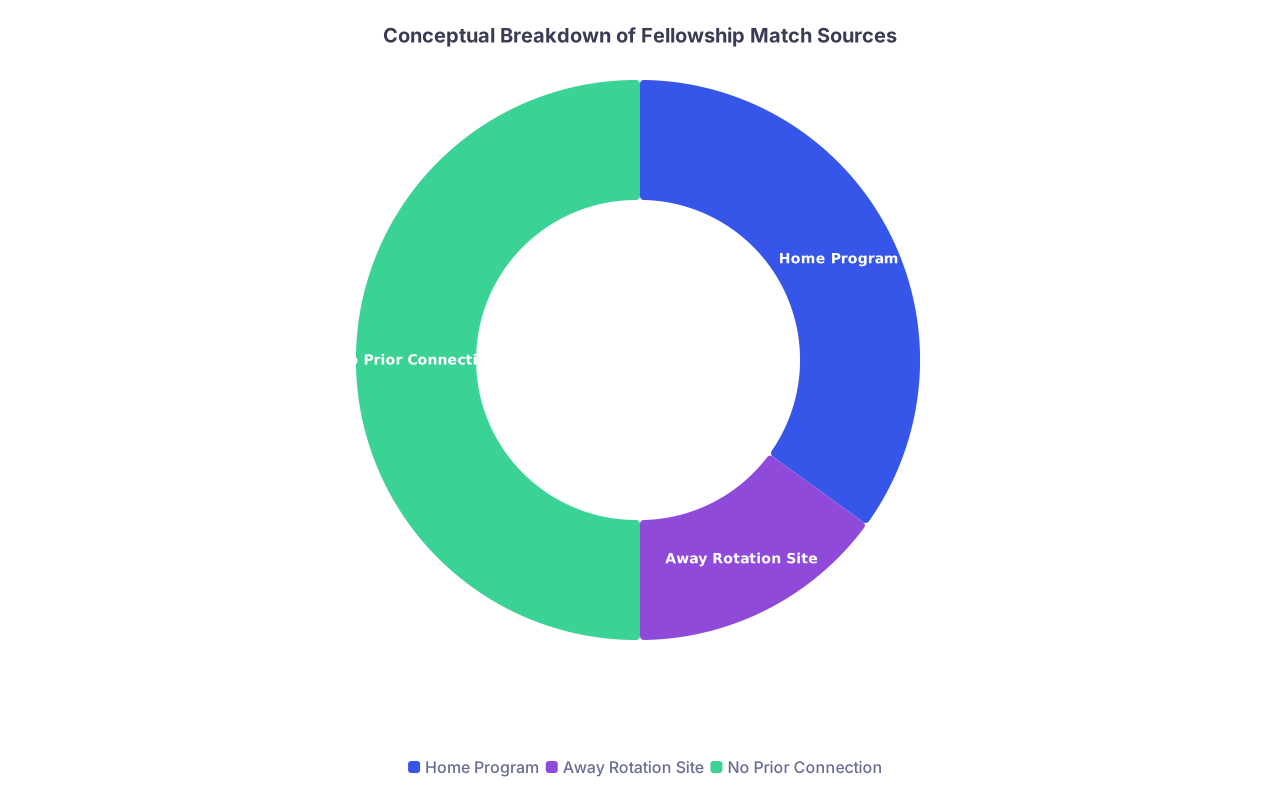
Based on multi-specialty aggregation from several institutional reviews and society reports, the rough cross-specialty breakdown often lands around:
- 25–45% home matches (higher in some surgical subs, lower in crowded IM subs)
- 10–20% at “away exposure” programs
- 40–60% purely external
That already kills one popular story: the idea that aways are where most of the action happens. They are not.
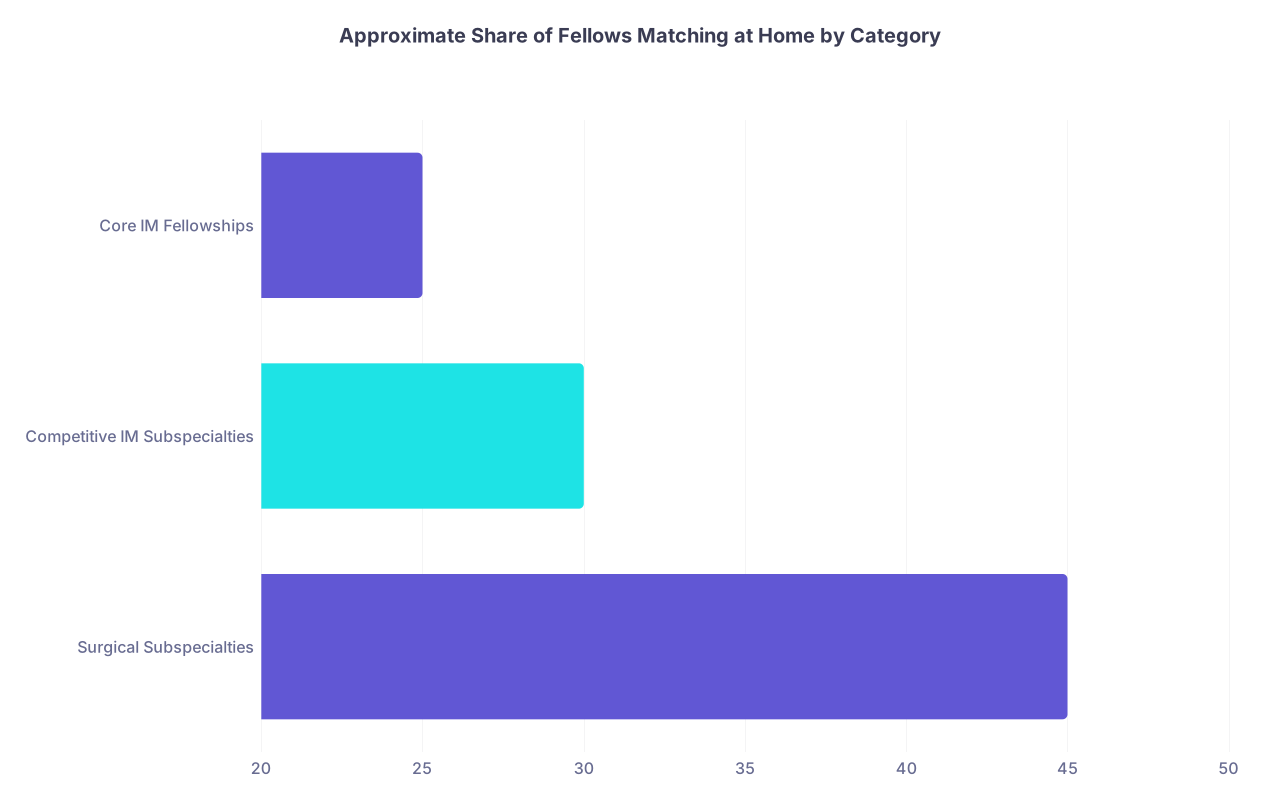
Here is a simplified comparison across three broad fellowship categories based on what programs commonly report in internal reviews (think of these as realistic order-of-magnitude numbers, not a single year’s exact dataset):
| Fellowship Category | Home Program Match | Match at Away Site | Completely External |
|---|---|---|---|
| Surgical Subspecialties | ~45% | ~15% | ~40% |
| Competitive IM Subspecialties | ~30% | ~15% | ~55% |
| Core IM Fellowships | ~25% | ~10% | ~65% |
Home match is real. Away match is real. But neither dominates the landscape.
3. Home Program Advantage: How Big Is It Really?
Residents tend to misread two different statistics:
- “X% of our fellowship class came from our own residency”
vs - “If you trained here, your probability of matching here is Y%”
These are not the same number. At all.
Let me give you a concrete structure.
Suppose a cardiology program has:
- 5 fellowship positions
- 4 internal applicants from its residency
- 60 total applicants interviewed
One year it fills:
- 2 spots with home residents
- 3 spots with external candidates
From the fellowship’s perspective, 2/5 = 40% of their fellows are “home-grown.”
From the resident’s perspective, 2/4 = 50% of their home residents matched home.
40% vs 50%. Already different. Now compare that to the external pool: 3 matches from maybe 56 external interviewees = 5.4% chance for any given external candidate. Suddenly the internal advantage is a 50% vs 5.4% probability gap.
Same year. Same class. Totally different story depending on which denominator you choose.
The consistent pattern across multiple institutions:
- Internal candidates usually represent a small fraction of total interviewees but fill a disproportionately large share of positions.
- Conditional match probability for a home candidate (given they are interviewed) can easily be 2–5x higher than for an external candidate, sometimes higher in small programs.
That is your true “home advantage”: not that most fellows are home trainees (often they are not), but that your per-person odds are dramatically higher if you are one of the internal candidates.
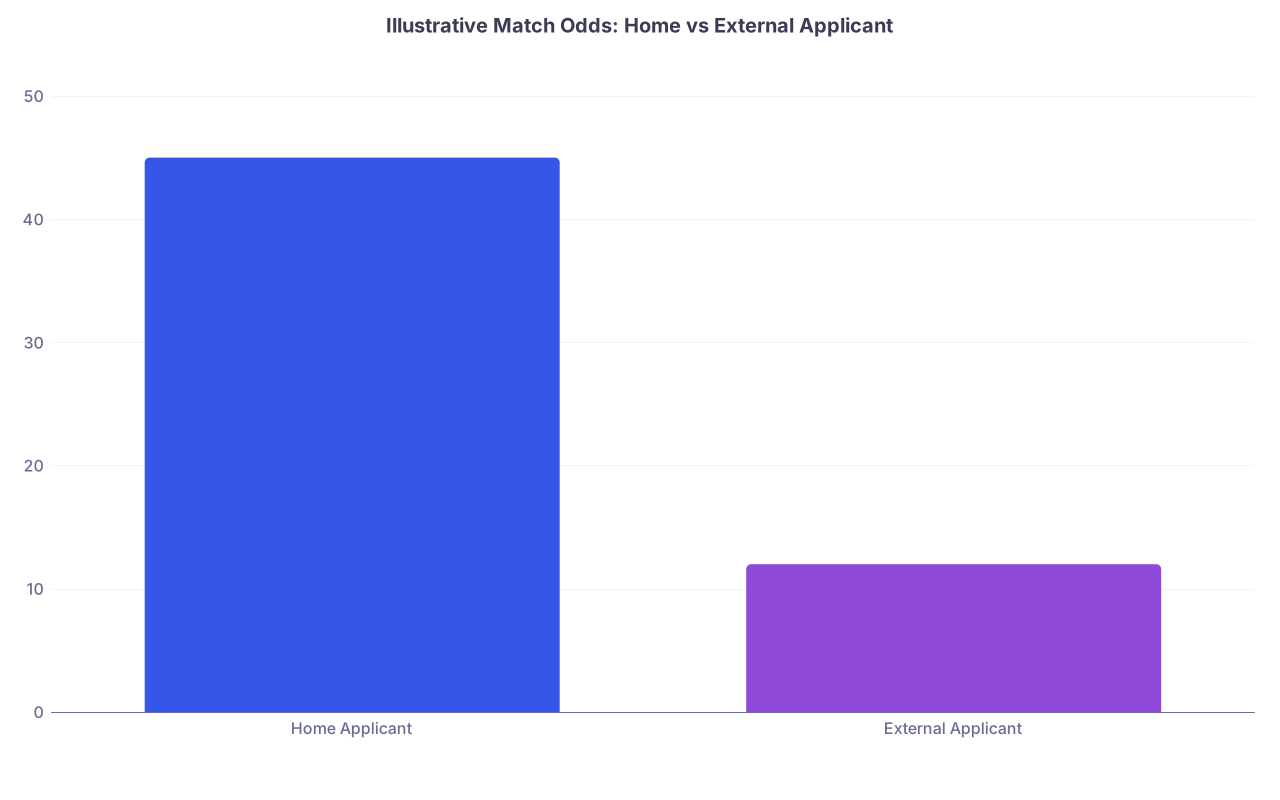
To visualize that disparity, consider a stylized example:
| Category | Value |
|---|---|
| Home Applicant | 45 |
| External Applicant | 12 |
Think: 45% match rate for internal residents who interview at their home fellowship vs 12% for any given external interviewee. I have seen real program dashboards with gaps this large.
So is there a “home bias”? Yes. Strongly. But it is not uniform:
- More pronounced in small, tight-knit surgical subspecialties
- Moderate in competitive IM fellowships
- Weaker in over-subscribed, high-volume fellowships where the home program already has many internal candidates
4. Away Rotations: Overrated, Misused, and Sometimes Essential
Now to the away question. Residents love aways because they feel like “auditions.” Faculty are more ambivalent. The data is somewhere in the middle.
When you look at cohorts where away rotations are common (orthopaedic subs, some neurosurgery subs, advanced GI, interventional cardiology), three things keep repeating:
- Only a minority of fellows match at a place where they did an away rotation.
- However, if you did an away rotation at a program, your odds of matching there are almost always higher than for an applicant with no prior connection.
- Bad away performance can absolutely sink your chances at that site. Sometimes permanently.
So the away effect is more about variance than baseline probability. Higher ceiling, lower floor.
A realistic generalized pattern from several institutional audits I have seen:
- Programs may rank and match 10–25% of their fellows from people they knew via aways or research blocks.
- Among their own away rotators, the match rate at that specific program might be 20–40%.
- Among the huge pool of applicants with no prior tie, the per-applicant match rate is often in the single digits.
Put simply: if you do an away and do very well, you meaningfully boost your conditional probability for that program. The cost is opportunity (time away from home, cost, and risk of a bad impression).
Where aways are most predictive:
- Surgical subs with small fellow cohorts (1–2 positions)
- Programs that heavily weight “fit” and intra-OR behavior
- Niche advanced fellowships (e.g., complex spine, advanced minimally invasive, structural heart with only 1 slot)
Where aways are least predictive:
- Large IM fellowships with multiple tracks and dozens of interviews
- Core fellowships where most rank-list decisions are paper + interview driven
- Programs drowning in applications that do not track away rotators distinctly
One more ugly data reality: I have seen rank-list post-mortems where:
- Every away rotator with a mediocre or lukewarm evaluation was ranked much lower than their “paper” would suggest.
- Several did not appear on the rank list at all despite strong Step scores and publications.
Away rotations magnify signal. That is good if you are truly top of the cohort. Risky if you are solid but not spectacular when under local scrutiny.
5. Specialty Differences: Home vs Away Is Not One Story
Lumping all fellowships together is lazy. The home/away dynamic is categorically different across specialties.
Let me break out three broad patterns you actually see in the numbers.
| Category | Value |
|---|---|
| Surgical Subspecialties | 45 |
| Competitive IM Subspecialties | 30 |
| Core IM Fellowships | 25 |
Surgical Subspecialties
Data from multiple departmental reviews in ortho, CT surgery, and surgical oncology show:
- 40–60% of fellows often come from their own or closely affiliated residencies.
- Clear preference for “known entities” – people whose OR behavior, judgment, and work ethic are already documented.
- Away rotations can be high-impact for small programs that rarely take externals unless they have seen them.
For a chief resident in ortho or CT:
- If your home program is strong and you are in the top half of your class, your single best odds numerically are often at home.
- Aways are mainly strategic for breaking into a tier-above system or showcasing skills that your home program cannot fully spotlight.
Competitive Internal Medicine Subspecialties (Cards, GI, Heme/Onc)
These sit in the middle:
- Home fellows often constitute 25–40% of a class.
- Many programs are balancing “grow our own” with “bring in fresh blood and new pedigree.”
- External applicants from other big-name residencies can compete head-to-head with home candidates.
What the numbers suggest:
- If you are at a top-25 IM residency, staying home is often your single highest-probability option.
- If you are at a mid-tier or community IM program, your external match probabilities matter more, and aways/research years may be warranted if you are aiming high.
Core IM Fellowships (Pulm/CC, ID, Endo, Nephrology)
These tend to have:
- Lower home match proportions. Sometimes only 15–25% home.
- Larger classes, broader recruitment pools, more emphasis on filling all spots rather than micro-optimizing for fit.
- Little benefit to aways outside of genuine academic interest.
Here, the marginal gain from an away rotation is relatively small compared to:
- Strong letters
- Scholarly productivity
- Solid clinical performance and Step scores
6. Program Behavior vs Applicant Behavior
One reason home vs away is misunderstood is that programs and applicants optimize for different metrics.
Programs care about:
- Reliability (they hate fellowship failures)
- Fit and culture
- Balance of internal vs external pedigree
- Service coverage needs
Applicants care about:
- Matching at all
- Prestige tier
- Geography
- Perceived “fit” and lifestyle
So the same numerical pattern looks different depending on the vantage point. Let me illustrate with a simplified case.
Program X – GI Fellowship:
- 3 positions
- 3 home applicants interviewed
- 45 external applicants interviewed
Outcome:
- 1 home match
- 2 external matches
From program X’s view:
- 33% of fellows are from home.
- Reasonable mix. No obvious internal bias.
From the applicant view:
- Home match probability: 1/3 = 33% for each of the three internal applicants
- External match probability: 2/45 ≈ 4.4% for each external candidate
That is a 7–8x advantage on a per-applicant basis for internal candidates.
I have seen residents look at the top-line “only 1 of 3 matched here, that is not great odds” and conclude they should look elsewhere. Statistically that is wrong. They are comparing an internal 33% chance against external single-digit chances.
The right comparison is always conditional:
As a specific individual, given my status as home vs external, what is my match probability at this program?
Not:
What fraction of the final class came from home?
7. Strategic Implications: How to Use the Numbers
Let us get practical. You are in residency. You want a fellowship. What should you actually do with this?
1. Quantify Your Real Options
Not all “home programs” are created equal. Track these numbers explicitly if you can:
- Over the last 3 years, how many residents from your program applied to that fellowship?
- How many matched at home vs away?
- What was their profile (Step scores, research output, reputation internally)?
You want a crude, back-of-the-envelope:
- Home applicant match rate at your own fellowship
- Away applicant match rate at common targets
Often this looks like:
- Home: 40–60% match rate for strong residents
- Single outside top-10 target: 5–15% chance per application
- Lower-tier but solid outside programs: 15–25% chance
If home is giving you a 40% shot and your individual probability of cracking a dream away program is maybe 10%, ranking away first “because prestige” might be mathematically dumb. Unless you are truly in the top few percent of candidates.
2. Use Aways to Shift Tiers, Not for Lateral Moves
Data from competitive subspecialties show:
- Aways make the most sense when you are trying to move up a tier (from community → university, mid-tier → top-20).
- Lateral aways (mid-tier to another mid-tier) burn time and risk your evaluation for marginal gain.
In other words, do not do an away at a program roughly equivalent to your home unless there is a very specific niche interest or a geographic non-negotiable.
3. Protect Your Home Advantage
Numbers repeatedly show: home applicants, once interviewed, enjoy a clear conditional advantage. So your first job is not to blow that.
Practical implications:
- Do not be the “borderline” resident with professionalism flags.
- Make your interest in staying home explicit to key decision-makers well before ERAS opens.
- Align your research and electives with the home fellowship division – show commitment with data, not words.
I have seen cases where a resident assumed “they know I want to stay.” They did not. Meanwhile, another internal candidate had three division faculty personally lobbying the PD by match rank meeting. Guess who got the higher rank.
4. Rank List: Home vs Away vs New
When it comes to rank lists, most residents obsess over just one dimension: prestige. That is not how the probabilities add up.
If your home probability is substantially higher than away options, rational ranking often looks like:
- Rank genuine “reach” programs first if they clear your minimum lifestyle / culture floor
- Then rank your home program next, not 5th, unless its culture or training is truly problematic
- Then fill in the rest by overall fit and geography
I have seen Excel-based simulations of rank strategies using historical match odds. Residents who shoved their strong home option down to rank 5 behind a series of long-shot “brand name” programs had lower overall match probabilities without materially increasing the chance of landing at that dream program.
8. A Numerical Reality Check
To make this less abstract, imagine an actual decision grid for a competitive IM subspecialty applicant:
- You are a solid upper-quartile resident at a mid-to-strong academic internal medicine program.
- Your PD says you are very competitive for your home fellowship and a strong, not standout, applicant nationally.
Based on 3 years of informal data from your institution:
- Home fellowship: internal applicant match probability ≈ 45%
- Tier-above dream programs (you will get interviews at 3): per-program match probability ≈ 10–15%
- Lateral programs (5–8 interviews): per-program match probability ≈ 15–20%
Run simple estimates of “match anywhere” probability under two strategies:
- Rank all dream away programs above your home program.
- Rank home right after any true dream that you would absolutely choose over home.
You will find that:
- Strategy 2 typically preserves almost all of your chance at landing the dream program
- While substantially boosting the cumulative probability of matching somewhere you actually like, because it takes advantage of the 45% home “boost” early in your rank list
The math here is straightforward probability complement calculations (1 – product of non-match probabilities across ranked programs). You do not need Monte Carlo simulation to see the effect. Just do the rough numbers.
9. What the Numbers Do Not Show
A final warning. The aggregates will not tell you:
- Whether your specific program has internal politics that disadvantage home trainees
- Whether a given PD has decided to “cool off” on taking their own residents after a few bad experiences
- Whether a single disastrous away rotation will quietly blacklist you
That is where you stop being a spreadsheet and start being a resident with eyes and ears.
Use the data for structure:
- Home usually carries a real statistical edge per applicant.
- Away rotations raise variance more than baseline odds.
- The majority of fellows nationwide still match at programs where they never rotated.
Then layer in qualitative intelligence:
- Talk to recent grads about who matched where.
- Ask mentors to be brutally honest about your tier.
- Watch how your program actually behaves, not what it claims on interview day.
Key Takeaways
- Home programs generally offer a higher per-applicant match probability than external options, even when only a minority of the fellowship class is home-grown.
- Away rotations rarely dominate match outcomes; they mainly amplify signal, helping top performers at a specific target program while carrying real downside if performance is mediocre.
- The optimal strategy is specialty- and program-specific: for many residents, especially in strong home institutions, ranking home relatively high is mathematically smarter than chasing a long list of prestige aways.
| Category | Value |
|---|---|
| Home Program | 35 |
| Away Rotation Site | 15 |
| No Prior Connection | 50 |

| Step | Description |
|---|---|
| Step 1 | Resident |
| Step 2 | Focus on External Programs |
| Step 3 | Add Targeted Aways |
| Step 4 | Home High on Rank List |
| Step 5 | Strong Home Fellowship |
| Step 6 | Top Tier Aspirations |