

The mythology around fellowship match is wrong. It is not a pure meritocracy or a complete black box. The data shows that who you are and where you train systematically shifts your odds. Sometimes dramatically.
Let me walk through what actually moves the needle, using what we know from NRMP, specialty societies, and program behavior. Then you can decide where you fit on the curve.
1. The Big Picture: What Actually Predicts Fellowship Match
Strip away the anecdotes, and a few variables dominate fellowship outcomes across specialties:
- Residency pedigree (institution and program type)
- Research productivity (especially first-author and PubMed-indexed)
- Exam performance (USMLE/COMLEX, now mostly Step 2 / Level 2)
- Visa status and medical school origin (US MD vs DO vs IMG)
- Niche factors: letters, subspecialty mentors, and away rotations
The exact weights shift by field, but the pattern is consistent: background is not destiny, but it changes your starting probability.
To quantify some of this, here is a stylized comparison of match odds by resident background for highly competitive vs moderately competitive fellowships, synthesizing trends from multiple NRMP and society reports.
| Resident Background | Competitive (e.g., Cards, GI, Heme/Onc) | Moderate (e.g., Endo, ID, Rheum) |
|---|---|---|
| US MD, university IM | 70–85% | 85–95% |
| US MD, community IM | 45–60% | 70–85% |
| US DO, university-affiliated | 40–55% | 65–80% |
| US DO, community | 25–40% | 50–70% |
| US IMG, university IM | 35–50% | 60–80% |
| US IMG, community IM | 15–30% | 35–55% |
These are not official NRMP numbers; they are conservative estimates reflecting what program directors and match outcomes repeatedly show. The relative differences, not the exact percentage, are the point.
Now, let’s dissect the main background variables one by one.
2. Residency Program Type: Where You Train Still Matters
Program prestige is not a vanity metric. It functions as a probability multiplier.
The data from multiple specialties (cardiology, GI, pulmonary/critical care, Heme/Onc) show the same pattern: university-based and top-tier academic programs send a higher fraction of residents into fellowships, and especially into competitive ones.
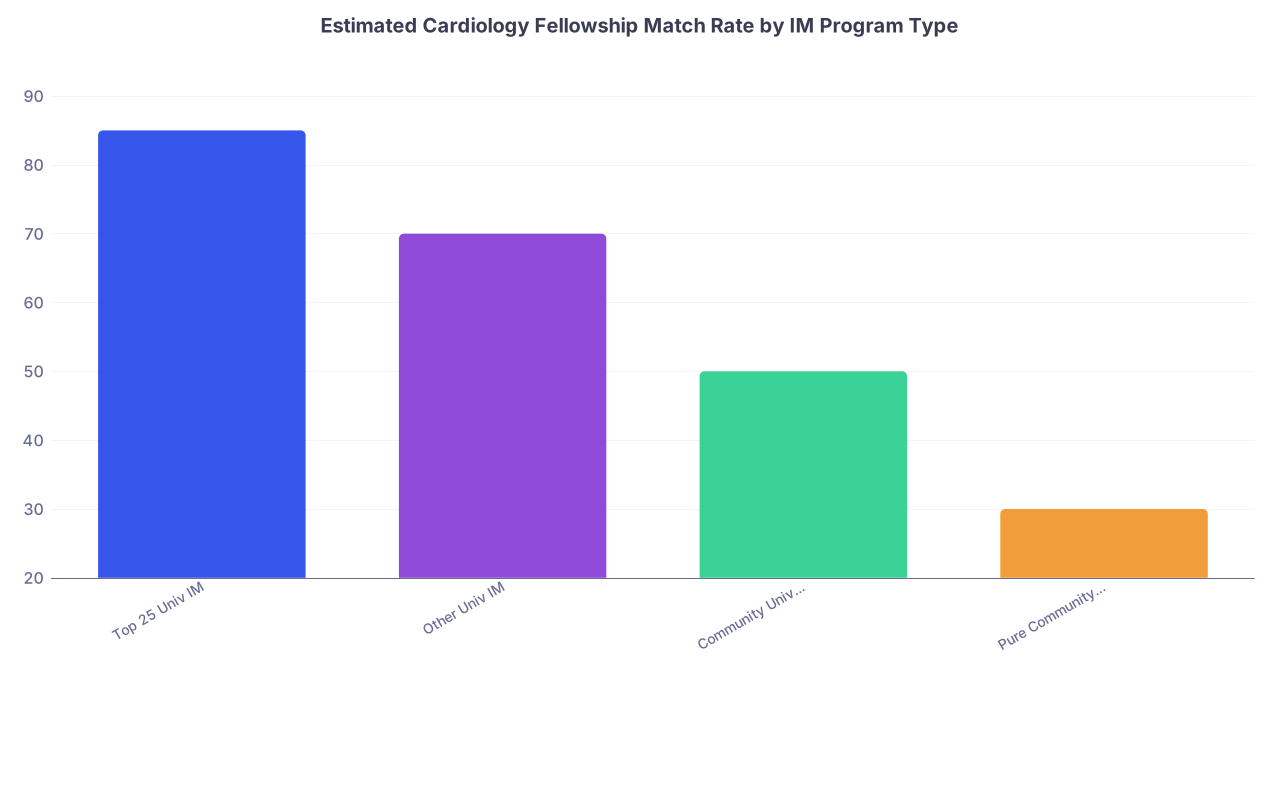
| Category | Value |
|---|---|
| Top 25 Univ IM | 85 |
| Other Univ IM | 70 |
| Community Univ-Affil | 50 |
| Pure Community IM | 30 |
Here is how residency background tends to play out:
Top-tier university IM (think MGH, UCSF, Duke, Penn)
- Pipeline effect: Longstanding relationships with fellowship PDs nationwide.
- Structural advantage: Built-in research infrastructure, protected time, high-volume faculty with national reputations.
- Result: Higher match into elite fellowships, often at peer institutions.
Other university IM (mid-tier academic)
- Strong match into regional academic fellowships and solid community-affiliated programs.
- Outcomes heavily modulated by individual research and letters.
University-affiliated community IM
- Variable. Some behave like academic programs; others function like service-heavy community programs with minimal research.
- Your specific site, mentors, and what you produce (papers, abstracts) become critical.
Pure community IM with limited academic exposure
- Lower baseline odds for top GI/cards/Heme-Onc unless you overperform on research and networking.
- Better relative odds in specialties struggling to fill (ID, nephrology, geriatrics).
I have watched residents from mid-tier university IM match GI at top-10 institutions because they had a stacked CV and heavyweight letters, and residents from “name-brand” programs miss out because their portfolio was thin. Prestige opens doors; your output decides if you get to walk through.
Key takeaway: your residency program background sets your default bracket. Your efforts move you up or down within that bracket, but the bracket still exists.
3. US MD vs DO vs IMG: Structural Bias in the Numbers
Program directors do not admit it loudly, but selection bias by degree and med school origin is obvious when you examine fellowship rosters.
US MD Graduates
Baseline advantage in most subspecialties, purely from familiarity and historical training pipelines.
- Top IM university programs are overwhelmingly US MD.
- For very competitive fellowships, US MD + strong home residency = “default preferred” candidate type.
DO Graduates
The data show improving trends but persistent gaps.
Common patterns:
- DOs fare better in fellowships with historically more open doors: nephrology, ID, pulm/critical care (but that is tightening), and some community-based cardiology.
- DOs from university-affiliated IM programs do significantly better than DOs from smaller, standalone community programs.
Here is a rough comparative grid for competitive IM-based fellowships:
| Background | Estimated Match Odds |
|---|---|
| US MD, university IM | 70–85% |
| US MD, community IM | 45–60% |
| DO, university-affiliated IM | 40–55% |
| DO, pure community IM | 25–40% |
IMGs (US and Non-US)
“IMG” is a lazy umbrella. The variance is massive.
US-IMG (Caribbean, etc.) in university IM
- Reasonable shot with strong CV.
- Many cardiology and Heme/Onc programs specifically mention having IMG fellows; they often come from solid US residencies.
Non-US IMG in university IM
- More visa friction but still strong outcomes for those with publications and strong US mentorship.
- In some specialties (ID, nephrology), many programs are IMG-heavy by design.
IMGs in small community programs
- This is the hardest path into top-tier competitive fellowships.
- Not impossible, but you will need outsized research, networking, and likely willingness to geographically compromise.
The data from NRMP’s “Charting Outcomes in the Match” equivalent for fellowship (where available) repeatedly show lower match rates for IMGs and DOs in top-competitive specialties, even after controlling for exam scores.
That is structural bias. You can complain about it, or you can game it.
4. Exam Performance: Step 1 is Pass/Fail, but Scores Still Lurk
Step 1 going pass/fail did not magically remove test score bias. Programs just shifted focus.
Here is how exam background shapes fellowship evaluations now:
Step 2 CK / COMLEX Level 2
- Many PDs use this as a crude filter, especially for applicants from less-known programs or IMGs.
- For highly competitive fellowships, practical cutoffs in the minds of PDs still exist (e.g., Step 2 CK > 245–250 often labeled as “academically strong”).
Prior Step 1 numerical scores (for older residents)
- Still in files, still glanced at for older cohorts.
- High scores can buffer a less “brand-name” residency background.
ITE (In-Training Exam) scores
- Internal to your residency, but often reflected indirectly in your letters (“top 10% of class on annual ITE”).
- Some competitive fellowships ask explicitly about ITE performance.
The effect size: exam scores rarely win a borderline application by themselves. But they strongly influence whether an application is thoroughly reviewed vs quietly downranked.
5. Research, Publications, and “Academic Profile”
This is where background and behavior collide hardest.
Residents at university programs have a structural advantage: built-in mentors, access to IRBs, statisticians, ongoing trials, and regular academic conferences. Community programs often do not.
When I look at fellowship match data, one proxy predicts success especially well for academic-oriented fellowships:
- Number of PubMed-indexed publications, especially with:
- First- or second-author positions
- Subspecialty relevance (cardiology research for cardiology fellowship, etc.)
- Reputable journals, not predatory or non-indexed
Let’s quantify with a stylized example for cardiology fellowship applicants from IM:
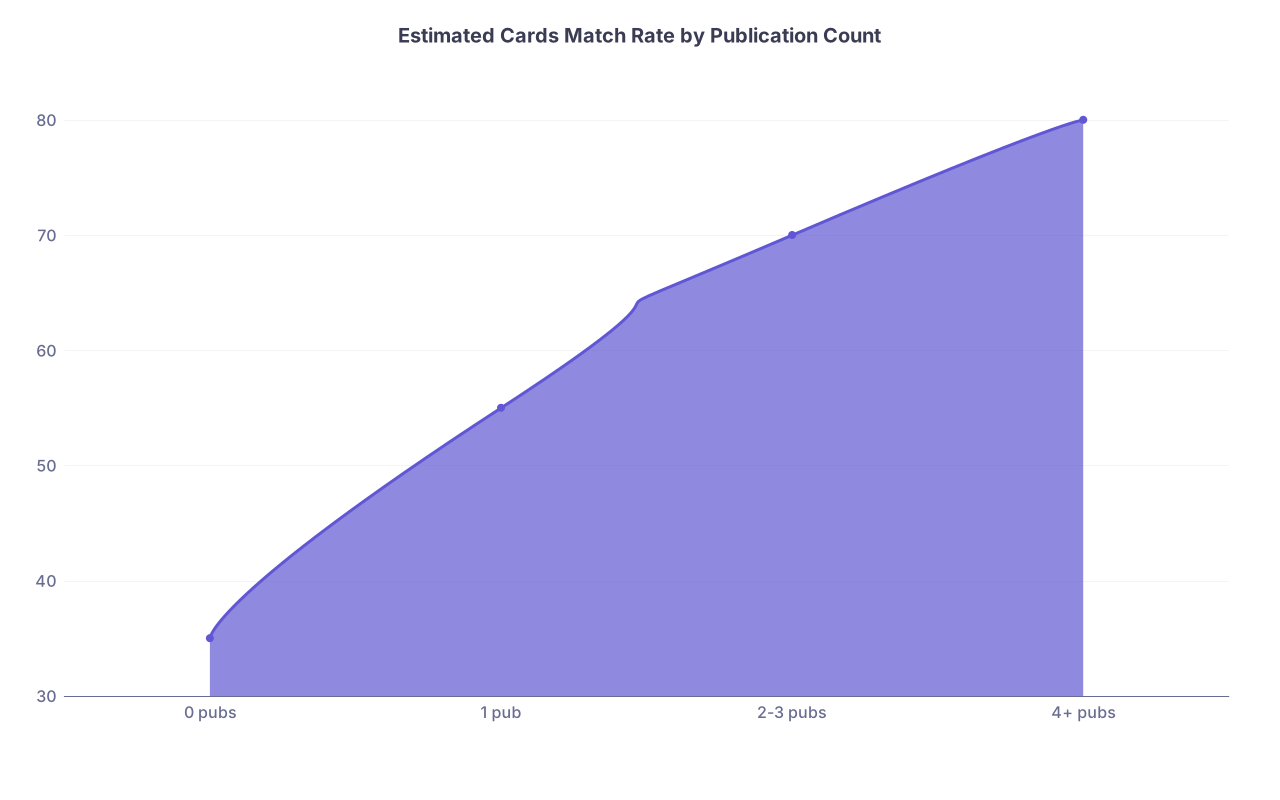
| Category | Value |
|---|---|
| 0 pubs | 35 |
| 1 pub | 55 |
| 2-3 pubs | 70 |
| 4+ pubs | 80 |
Pattern I have seen repeatedly:
- 0 publications: You need a strong brand-name residency and outstanding letters to overcome this, especially for GI/cards/Heme-Onc at academic centers.
- 1 publication: Minimum credible academic profile. Often enough for less hyper-competitive specialties or strong community fellowships.
- 2–3+ publications: Now you look like a serious academic applicant, especially with subspecialty focus.
- 4+ and/or major conference presentations: This moves you into “research-oriented’’ tiers, especially if your mentor has name recognition.
Your background modifies how this is interpreted. A resident with 2 pubs from a small community IM may look “remarkably productive,” while 2 pubs at a top university IM might be seen as expected output.
Again: where you train shifts expectations. The number on your CV interacts with that baseline.
6. Letters, Mentors, and Networking: The Invisible Variables
Some of the most powerful background effects never appear in official data tables.
Letter Writers
A letter from:
- “Cardiology attending at decent community hospital”
vs - “Program Director of Cardiology fellowship at major academic center, known nationally”
These are not equivalent signals.
Your background determines who you can access:
- Residents at large academic centers can collect letters from field leaders, guideline authors, and society committee members.
- Residents in community programs might have only a few subspecialists, sometimes not deeply connected to academic networks.
Program directors read between the lines. When Dr. Famous says you are one of the best residents they have worked with, that is weighted differently than praise from someone they have never heard of.
Mentors and Pipelines
Some residencies function like feeder programs to specific fellowships. You will see the pattern if you track where graduates land for 5–10 years.
- A mid-tier university IM might send 2–3 residents per year to a specific regional cardiology fellowship, year after year.
- That is a pipeline. It reduces randomness.
Residents without these built-in pipelines must recreate them manually through away rotations, conferences, and cold-emailing. Doable, but more work.
7. Visa Status: A Hard Constraint, Not Just a Detail
Visa status is one of the sharpest filters, particularly for IMGs.
Here is how background changes your fellowship options:
US Citizens / Permanent Residents
- Broadest options. No institutional cap-related issues.
- Competitive fellowships more likely to rank you without hesitation.
J-1 Visa
- Many academic programs accept J-1s, but a subset of top-tier fellowships will quietly prefer US citizens/GC holders for logistical reasons.
- You will also face the post-fellowship waiver job puzzle, but that is another conversation.
H-1B Visa
- Fewer programs sponsor H-1B at fellowship level. Shrinks your program list significantly.
- Some high-demand academic programs avoid H-1Bs due to institutional policy or administrative headaches.
Residents from IMG-heavy residencies on visas often end up clustered in certain fellowships and geographic regions that are known to be more open to sponsorship. This is not about your competence. It is about institutional friction.
8. Specialty-Specific Background Effects
Lumping “fellowship” as one monolith is lazy. The impact of your background depends heavily on the subspecialty you are targeting.
Hyper-competitive IM-based: Cardiology, GI, Heme/Onc
- Strong preference for:
- US MDs
- University IM
- Demonstrated research
- Known letter writers
Community IM, DO, and IMG applicants absolutely match here, but the bar is higher and the selection is narrower (often community or less research-heavy programs).
Solid but not insane: Pulm/CCM, Nephrology, Rheum, Endo
- More balanced applicant pools.
- Research helpful but not always strict gatekeeper.
- Community and DO/IMG representation is higher.
Historically struggling to fill: ID, Geriatrics, some Nephrology programs
- Much more forgiving of background.
- Visa sponsorship more common.
- Research and academic interest are still valued but the supply-demand imbalance gives you leverage.
This leads to a very real tension: residents from more disadvantaged backgrounds (IMG, DO, community IM) often do better relatively in fields that are less competitive or less financially lucrative. The market sorts aggressively.
9. How Residents Can Strategically Offset Their Background
You cannot change your med school or your residency at this point. You can absolutely change your trajectory within those constraints.
The data and patterns suggest a few high-yield moves:
Maximize subspecialty-specific exposure early
- Align electives, QI projects, and case reports with your target field by PGY-1 or early PGY-2.
- Late pivots are possible but harder for competitive specialties.
Manufacture research even in low-resource settings
- Case reports and small retrospective reviews are often feasible anywhere if you find one engaged attending.
- Partner with academic collaborators remotely; many divisions are open to multi-site QI and registry projects.
Exploit regional or institutional pipelines
- Identify where your program has historically placed fellows. Prioritize those programs when applying.
- Meet graduates from your residency who are now fellows; their internal advocacy matters.
Be brutally realistic on target specialty vs background
- With a community IM + IMG + no research profile, applying to top-10 GI programs exclusively is self-sabotage.
- Either upgrade your CV aggressively (research, away rotations, exam performance) or adjust specialty/geographic expectations.
Over-apply where the numbers are against you
- Residents from lower-visibility backgrounds who matched competitive fellowships almost always applied widely—sometimes 60–80+ programs.
- Expensive and exhausting, yes. But the data shows it often works.
10. Putting It Together: Probability, Not Destiny
Fellowship match is a probabilistic game with heavily weighted priors. Your background—degree, residency type, citizenship, research environment—sets those priors.
But it does not fix the outcome.
If you visualize two applicants:
- Applicant A: US MD, top-25 IM, 3 cardiology publications, Step 2: 255, letters from big-name cardiologists.
- Applicant B: IMG, community IM, 1 general IM case report, Step 2: 235, good but unknown letter writers.
Listen carefully: Applicant B can still match cardiology. It happens every cycle. But the probability curve is brutally different, and it demands a smarter, broader, and more targeted application strategy.
The residents who lose this game are usually not the weakest. They are the ones who misread where they sit on the distribution.
FAQ (Exactly 4 Questions)
1. I am at a small community IM program with no real research. Do I still have a chance at a competitive fellowship like cardiology or GI?
Yes, but the probability is lower and the path is narrower. You will need to compensate with: strong exam performance, proactive creation of research (even simple projects), and broad applications that include community and less-famous programs. Away rotations at fellowship sites and networking at national conferences (ACC, ACG, ASH) can materially change your odds by giving you known letter writers.
2. I am a DO resident at a university-affiliated IM program. Which fellowships are realistically within reach?
From the data and what I have seen, you are competitive for most IM-based fellowships, including cardiology and Heme/Onc, provided you have solid board scores and at least some research or academic activity. Your success will depend less on the DO label and more on your individual CV and the strength of your letters. You will still see some silent bias at a subset of top-10 programs, but many mid- to high-tier academic fellowships match DOs regularly.
3. How many publications do I “need” for a strong fellowship application?
There is no official cutoff, but the pattern is clear: for highly competitive fellowships, having at least 1–2 PubMed-indexed publications (ideally in your target subspecialty) moves you from “barely academic” to “serious candidate.” More than 3–4 with good author positions and conference presentations positions you strongly for academic centers. For less competitive fellowships, 0–1 publication can be enough if the rest of the application is strong.
4. I am an IMG on a J-1 visa. Should I avoid applying to certain fellowships or regions?
You should filter strategically, not blindly. Many academic programs sponsor J-1s routinely, especially in ID, nephrology, geriatrics, and certain pulm/CCM programs. Some high-demand cardiology and GI fellowships either do not sponsor visas or quietly de-prioritize visa holders. Use program websites, fellow rosters (look for international med schools), and alumni from your residency to identify visa-friendly programs. Apply broadly but intelligently, focusing on institutions with a history of matching IMGs on visas.
Key points: your background does not decide your fate, but it shapes your probability curve. Where you train, what you publish, and who vouches for you all interact with your degree, citizenship, and exam history. The residents who win the fellowship match game are the ones who understand where they start on that curve—and then stack every possible variable in their favor.


