
The data shows that “apply everywhere” is one of the most expensive, least strategic pieces of advice in fellowship applications today.
For residents in the middle of 80-hour weeks, blanket over-application feels rational. The stakes are high, the market looks brutal, and everyone has a story of the PGY-3 who “only matched because they applied to 80 programs.” But once you look at the numbers—NRMP fellowship match reports, SF Match data, and institutional application patterns—the picture is less romantic and more coldly efficient.
Over-applying does help a narrow slice of applicants. It clearly hurts another slice. And for the majority, it just burns money and time while adding noise to an already saturated system.
Let me walk through the data, not the anecdotes.
The scale of over-application in fellowships
Fellowship over-application is no longer a soft impression; it is quantifiable.
Across multiple subspecialties, the average number of programs per applicant has climbed faster than the number of available positions. You see this clearly if you track the last 8–10 years of NRMP and SF Match data.
Take three broad patterns:
Competitive subspecialties (e.g., cardiology, GI, heme/onc, certain surgical fellowships):
- Average applications per applicant often sit in the 30–50 range.
- A meaningful subset (top quartile) is pushing 60+.
Mid-competitiveness specialties (e.g., pulmonary/critical care in many regions, nephrology at stronger programs, ID at top centers):
- Applications per applicant commonly in the 20–35 range.
- Spread is wide—some apply to 10–15, others 50+.
Less competitive specialties (geriatrics, endocrine in some regions, nephrology in certain years, palliative):
- You still see applicants filing 20+ applications even when there are more positions than applicants.
To make this concrete, here is a stylized but representative snapshot that mirrors patterns visible in NRMP fellowship data.
| Fellowship Type | Avg Apps/Applicant | Programs per Applicant (25th–75th pct) | Applicants per Position |
|---|---|---|---|
| Cardiology | 45 | 30–65 | ~1.5 |
| Gastroenterology | 50 | 35–70 | ~1.7 |
| Hematology/Oncology | 40 | 25–60 | ~1.4 |
| Pulm/Critical Care | 30 | 18–45 | ~1.2 |
| Infectious Disease | 20 | 12–30 | ~0.9 |
| Geriatrics | 15 | 8–22 | ~0.7 |
You can argue with a few numbers at the margins, but the pattern is consistent: application volumes are high, often out of proportion to actual competitiveness for many candidates.
Now look at how often those extra applications convert into real opportunities.
Diminishing returns: the core math problem
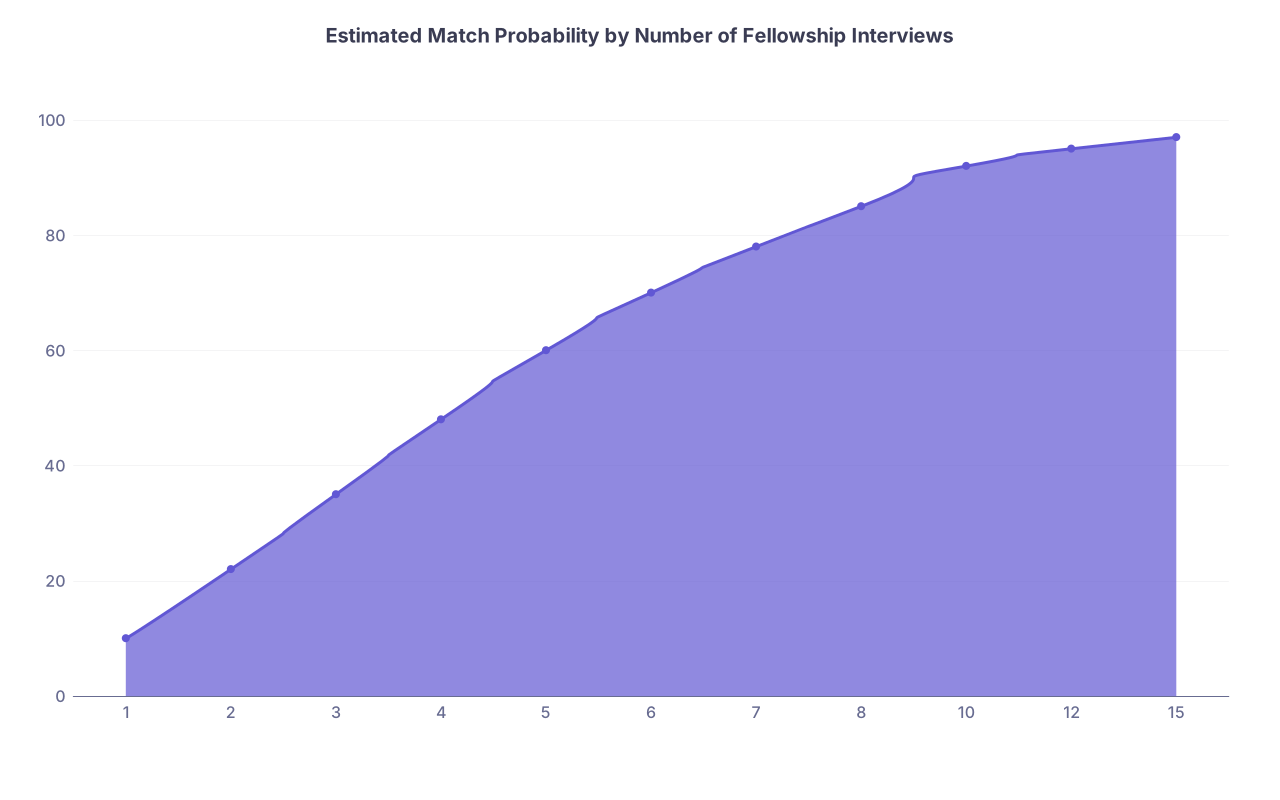
Once you have 8–12 interviews for most medicine-based fellowships, your probability of matching is extremely high. The NRMP has published exactly this relationship for residency; for fellowships the curves look similar, even if the underlying reports are less polished.
If you plot “number of interviews” on the x-axis and “probability of matching” on the y-axis, you get a rapidly rising curve that flattens early. It looks roughly like this (generalized, not specialty-specific):
| Category | Value |
|---|---|
| 1 | 10 |
| 2 | 22 |
| 3 | 35 |
| 4 | 48 |
| 5 | 60 |
| 6 | 70 |
| 7 | 78 |
| 8 | 85 |
| 10 | 92 |
| 12 | 95 |
| 15 | 97 |
By the time you hit 8–10 interviews, your match probability is in the 85–92% range in most medicine subspecialties, often higher for non-ultra-competitive fields. Extra interviews beyond that help, but each new one is buying you only a few percentage points of additional security.
Now connect that to application behavior:
- To go from 0 to ~8 interviews, you might need 15–25 applications, depending on your profile and specialty.
- To push from 8 to 12 interviews, some residents are not adding 5–10 applications. They are adding 25–40 more.
The marginal interview—interview number 11, 12, 13—often costs you 5–10 extra applications each. That is where the math starts to look ugly.
Cost-wise, a typical ERAS fellowship applicant might pay:
- ERAS initial + per-program fees: easily $600–$1200 if you scatter broadly.
- Interview costs (even virtual) in protected time, lost moonlighting, and prep: hundreds to thousands in opportunity cost.
For the vast majority of applicants, the “slope” of the curve flattens early. The data problem is simple: you are paying linear or super-linear cost for sub-linear benefit after a fairly modest threshold.
Who actually benefits from applying widely?
Blanket statements like “never over-apply” are just as wrong as “apply everywhere.” The data suggests that broad application volume benefits a specific subset of candidates:
Applicants with clear objective risk factors:
- Step failures or low percentiles.
- No home fellowship in the specialty.
- Visa requirements, especially in tight markets.
- Significant time off or non-traditional training pathways.
Applicants targeting a geographic region with high preference but low density of programs.
Example: You want to be in the Mountain West or Pacific Northwest for family reasons, but your specialty has only a handful of programs there. You over-apply regionally and add backup regions.True “borderline competitive” candidates in high-stakes subspecialties (GI, cards, heme/onc at elite programs) whose profiles sit on the edge—solid, but not obviously top tier.
For these groups, the “yield” per application is lower. A strong, on-paper candidate might need 15–20 applications to secure 8–10 interviews. A weaker-on-paper candidate might need 35–45. For them, more applications can be mathematically defensible.
Where this goes wrong is that everyone thinks they are in group 3. Most are not.
From what I have seen in departmental advising meetings:
- Top-quartile residents in IM with strong Step scores, publications, and strong letters routinely apply to 40–60 cardiology or GI programs when 25–35 targeted applications would give them the same 10–15 interview set they need to match safely.
- Mid-range applicants in less competitive fields (ID, geriatrics) apply to 20–30 programs and end up with 12–15 interviews, far more than the curve suggests they require.
The data pattern is simple: top applicants drastically overshoot the point of diminishing returns because they are copying the behavior of anxious peers, not doing a basic expected value calculation.
Where over-application clearly hurts you
There are three ways over-application backfires that you actually feel as the applicant.
1. Time and cognitive overload
Filing 60 applications is not just a financial issue. It is a logistical one.
Each application demands:
- Tailoring experiences to program strengths.
- Tracking program-specific questions or supplemental forms.
- Managing communication, interview invites, and schedule juggling.
By the time you hit 30–40 programs, your system breaks down unless you are unnaturally organized. I have watched residents double-book interviews, miss emails, and bungle communication because they were tracking 25+ open threads in Outlook while on nights.
The more programs you add, the more you are:
- Rushing personal statements or failing to tune them for different tiers.
- Sending generic, obviously copy-pasted emails to PDs.
- Struggling to research programs before interviews (which shows in the room).
Over-application trades depth for breadth. And real PDs can spot it.
2. Interview fatigue and performance decay
Virtual interviews reduced travel time. They did not reduce cognitive load.
If you accept 15–20 fellowship interviews, that is 15–20 days of intense performance layered on top of resident life. That level of repetition creates two visible problems:
- Answer fatigue: your responses become mechanical, less engaged, more scripted.
- Emotional flattening: you seem less excited about each program because, frankly, you are not.
Residents routinely tell me by interview #12 they cannot remember which program had the structured research time, which one had the heavy night float, or which one had the strange call system. That confusion bleeds into rank lists and into how convincingly you can articulate “why this program” in later interviews.
From a data perspective:
- If interviews 1–10 yield 85–90% match probability, but interview quality degrades 10–20% for interviews 11–20, the net effect on your actual match probability is smaller than the naïve curve suggests.
- In extreme cases, spreading yourself across too many interviews may lower average quality enough that your “best fit” programs do not rank you as highly as they would have with a tighter, more focused schedule.
3. Strategic misalignment with your real goals
Over-application leads to noisy interview sets—programs you do not actually want, in locations you would never choose if you were honest about your life.
The typical narrative I hear in June:
“I am applying everywhere. I will sort it out once I see where I interview.”
Then October comes and you are staring at 14 interview offers, 9 of which are in cities you actively dislike or programs with obvious red flags. You still feel pressure to attend “just in case.” So you invest time and mental energy pumping up backups that you secretly hope never become real options.
The misalignment becomes very obvious at rank-list time. Residents create long rank lists that do not match their actual preferences, but reflect sunk cost:
- “I interviewed there, so I might as well rank it.”
- “I flew out, I met the PD, it seems rude not to rank them.”
This is how people end up spending three years in programs they knew were bad fits from the first half-day.
Does over-application hurt the overall system?
Short answer: yes, and you feel the downstream effects.
More applications per applicant produce:
Screening arms races.
Programs cannot genuinely review 800+ applications per cycle, so they default to crude filters: Step cutoffs, “home program first,” Ivy bias, etc. That punishes good but non-obvious candidates.Response volatility.
PDs struggle to infer genuine interest from volume. When everyone applies to 60 programs, “they applied here” is a weak signal. Programs hedge by over-inviting, then cancelling or wait-listing interviews when acceptance rates are unpredictable.Earlier, more aggressive timelines.
Programs push earlier interview offers to “lock in” good candidates. That disadvantages residents from programs with slower letter writers or weaker advising structures.
You cannot fix the system alone, but you should understand that your marginal application is not neutral. At scale, over-application worsens the signal-to-noise ratio for exactly the people who need a clearer signal—the mid-range but strong candidates without brand-name institutions behind them.
Narrow vs broad strategy: what the numbers suggest
Let us compare three archetypal applicants in a competitive medicine subspecialty (e.g., cardiology). These are stylized, but they mirror actual patterns.
| Applicant Type | Profile Summary | # Programs Applied | Expected Interviews | Match Probability (Est) |
|---|---|---|---|---|
| A - Strong | Top-quartile scores, strong research, top IM program | 25 | 12–15 | 95–98% |
| B - Solid Middle | Average scores, good letters, mid-tier IM program | 35 | 8–10 | 85–92% |
| C - Risk/Borderline | Step failure, no home fellowship, visa need | 55 | 6–8 | 65–80% |
Now imagine each of them adds 20 more programs:
- Applicant A goes from 25 → 45 programs. Expected interviews: 13–16 (vs 12–15). Marginal gain: maybe a 1–2 percentage point increase in match probability.
- Applicant B goes from 35 → 55. Expected interviews: 9–12 (vs 8–10). Marginal gain: perhaps 3–5 percentage points.
- Applicant C goes from 55 → 75. Expected interviews: maybe 7–9 (vs 6–8). Marginal gain: 5–7 percentage points.
Who gets the most actual risk reduction from over-application? Applicant C.
Who usually over-applies the most in real life? Applicant A.
That is the core misallocation produced by fear-driven strategy.
A data-driven way to decide how widely to apply
Instead of copying what your co-resident did, you can back into a reasonable application range with three steps.
Step 1: Estimate your realistic interview yield
Use three inputs:
Historical interview counts from your program in your specialty for people like you.
Example: last 3 years, residents with similar board scores, research output, visa status.National match data for your specialty. Specifically:
- Applicants per position.
- Proportion of applicants who match with 1–3, 4–6, 7–10 interviews (when available).
Your specific risk modifiers:
- Positives: strong research, home fellowship, unique skill set.
- Negatives: Step issues, visa, lower-tier residency, geographic inflexibility.
From that, classify your expected “interviews per 10 applications”:
- Strong: 4–6 interviews per 10 apps.
- Average: 2–3 interviews per 10 apps.
- Risk: 1–2 interviews per 10 apps.
Step 2: Target an interview count, not an application count
You are not buying applications. You are buying interviews.
For most medicine fellowships:
- Target 8–10 interviews as a “comfortably safe” goal.
- If you are risk-heavy and the specialty is brutally competitive, you may aim for 10–12.
Now solve backward.
Example:
- You estimate you are “average” with 2–3 interviews per 10 apps.
- Target 9 interviews.
- That implies ~30–45 programs.
If your program data suggests that people like you have historically needed 30 applications to hit 10 interviews, stop at 35–40 unless something major changes in your profile.
Step 3: Add a small, not massive, cushion
Over-application is not going from 35 to 75. It is going from 35 to 45.
A 20–30% cushion over your data-driven estimate is reasonable:
- Strong applicant: 20 predicted → apply to 25.
- Average applicant: 30 predicted → apply to 36–40.
- Risk applicant: 45 predicted → apply to 55 or so.
Beyond that, the math ceases to justify the cost.
How to avoid the “panic escalate” during application season
You will be tempted to panic-add programs when early responses are slow. Every year, people do this, and most regret the last-minute tail of applications.
Use clear thresholds and a time-based check-in.

| Step | Description |
|---|---|
| Step 1 | Submit initial apps |
| Step 2 | Wait 4 weeks |
| Step 3 | Continue and monitor |
| Step 4 | Add 20 percent more programs |
| Step 5 | Interviews < target/2? |
| Step 6 | Expand list modestly |
| Step 7 | Hold steady |
| Step 8 | Any interview invites? |
Instead of reactive expansions:
- Pick a 4-week and 6-week checkpoint.
- Decide in advance: “If I have fewer than X interviews by date Y, I will add Z programs.”
This protects you from the common scenario where you add 25 more applications at 11:30 pm on call night because your co-resident mentioned they got a new invite.
Where a truly “wide” strategy is justifiable
There are a few situations where I do not argue with 50–70 applications:
Visa-dependent applicants in competitive specialties
Because many programs quietly avoid visas or restrict them severely, your true pool is much smaller than it appears on ERAS. Over-application becomes a blunt but rational tool.Applicants from very small or non-university programs without local fellowships
Without a home fellowship, your letter writers may be less known, and PDs may be less familiar with your residency. Yield per application drops.Significant red flags that cannot be offset by other strengths
A Step 1 failure, a prolonged LOA for non-obvious reasons, major professionalism issues that show up in your transcript. Here, you might need volume simply to find the handful of programs willing to look past those issues.
Even then, the strategy should be: wide, but still targeted.
I have seen people in exactly these categories match at solid programs with 40–50 thoughtful applications and 7–9 interviews. The ones who go to 80 often end up with the same or only slightly better outcome but far more exhaustion.
The quiet cost: your time as a resident
One thing residents consistently underprice: their own time.
During application season, you are averaging:
- 60–80 clinical hours per week.
- Personal responsibilities, board prep, maybe moonlighting.
- Now add 30–60 applications and 10–15 interview days.
That time has a value:
- Lost moonlighting shifts: $800–$2000+ easily over a season.
- Lost study time for boards or in-service: can hurt your performance in ways that outlast fellowship recruitment.
- Lost rest and recovery: translates to worse performance both clinically and in interviews.
A smaller number of well-chosen applications and interviews lets you reallocate cognitive bandwidth to:
- Deeper preparation for each interview.
- Better relationships and advocacy from your home program faculty.
- Actual rest, which shows up as clarity and engagement in interviews.
Once you price your own time realistically, the “cost” of each extra marginal application is not just an ERAS fee. It is the chain of commitments that follows if that application turns into an interview.
So, does applying widely help or hurt?
The data points in one direction:
For most applicants, extreme over-application does not materially change match outcomes once you reach a reasonable interview count. The match probability curve flattens around 8–10 interviews for many fellowships.
Over-application does have measurable costs—financial, cognitive, and strategic—that degrade the quality of your actual interviews and distort your rank list.
Targeted, moderately broad application strategies outperform blind volume. Applying to 30–40 programs chosen with clear reasoning almost always beats 60–70 scattershot applications for anyone who is not clearly at the margins.
If you remember nothing else:
- Aim for an interview target, not an arbitrary application count.
- Use local data from your program to estimate how many applications you actually need.
- Add a modest cushion, not a panic-driven multiplier.


