

The common residency advice that “programs just pick the best applicant” is incomplete. For fellowships, the data shows something harsher: geographic ties are a measurable competitive advantage, and ignoring them is a strategic mistake.
You are not competing in a national, perfectly fluid market. You are competing in a series of regional sub-markets where familiarity, perceived commitment, and local loyalty all move probabilities. The question is not “Do geographic ties matter?” The question is “How much, and where?”
Let me walk through this like an analyst, not a cheerleader.
1. What “Geographic Ties” Really Mean in Fellowship
Programs do not care where you grew up in the abstract. They care about predictability and retention risk. Geographic ties are a proxy for both.
There are four main “tiers” of ties that tend to be scored—informally or formally—by selection committees:
- Training-based ties
- Current residency in that region or at that institution
- Prior medical school in the same region
- Personal ties
- Spouse/partner job or match location
- Family living in the area (especially dependents, parents, or long-term partner)
- Educational/professional ties
- Prior undergrad, MPH, or PhD in that region
- Prior employment as a scribe, research assistant, nurse, etc. locally
- “Thin” or speculative ties
- “I’ve always loved Chicago” with no concrete history
- One away rotation or a 2‑week elective with no ongoing connection
Programs weight these very differently. Training-based ties are strong. Thin ties often count for almost nothing.
In practice, selection committees often track this in a simple spreadsheet column: “Local ties: Y/N/Weak.” I have literally seen those columns used when sorting candidate lists before interviews.
2. Quantifying the Geographic Advantage: A Working Model
We do not have one giant public database that cleanly reports geographic ties for every fellowship applicant. But between NRMP reports, specialty-specific surveys, and composite data from several institutions, you can approximate the effect.
Here is a realistic synthetic model built off patterns I have seen in multiple specialties (cards, GI, heme/onc, pulm/crit) and cities (Midwest, Northeast, West Coast). Numbers are illustrative, but the relationships are accurate.
Assume:
- You are an “average competitive” candidate for a mid–high tier academic fellowship.
- Baseline probability of interview at a given program with no ties is about 10–15%.
- Baseline probability of ranking-to-match once interviewed is about 40–50% (varies by specialty).
Now overlay geography.
| Tie Category | Example | Interview Odds vs Baseline | Match Odds vs Baseline |
|---|---|---|---|
| Strong local (same inst.) | Same residency + same city | 1.5–2.0 × | 1.5–2.0 × |
| Strong regional | Same state/region, diff institution | 1.3–1.7 × | 1.2–1.5 × |
| Weak personal/educational | Family nearby, prior school in city | 1.1–1.3 × | 1.0–1.2 × |
| No real ties | Nothing documented | 1.0 × | 1.0 × |
| Negative perceived tie | Clear desire for other region only | 0.6–0.8 × | 0.6–0.8 × |
What this implies:
- A resident applying to their home fellowship (same institution) might have an interview chance closer to 20–25% instead of 10–15%.
- For two candidates with similar profiles, the one with clear ties to the region will be favored more often than not.
Put bluntly: over a 20-program application list, strong geographic alignment can turn 3–4 interviews into 6–8 interviews. That difference alone frequently separates people who match from those who do not.
3. Home Institution and “In-Region” Advantage
Program directors are not shy about this. Multiple NRMP Program Director surveys across specialties repeat the same pattern: “current or prior training at our institution or in our region” ranks high as a selection factor.
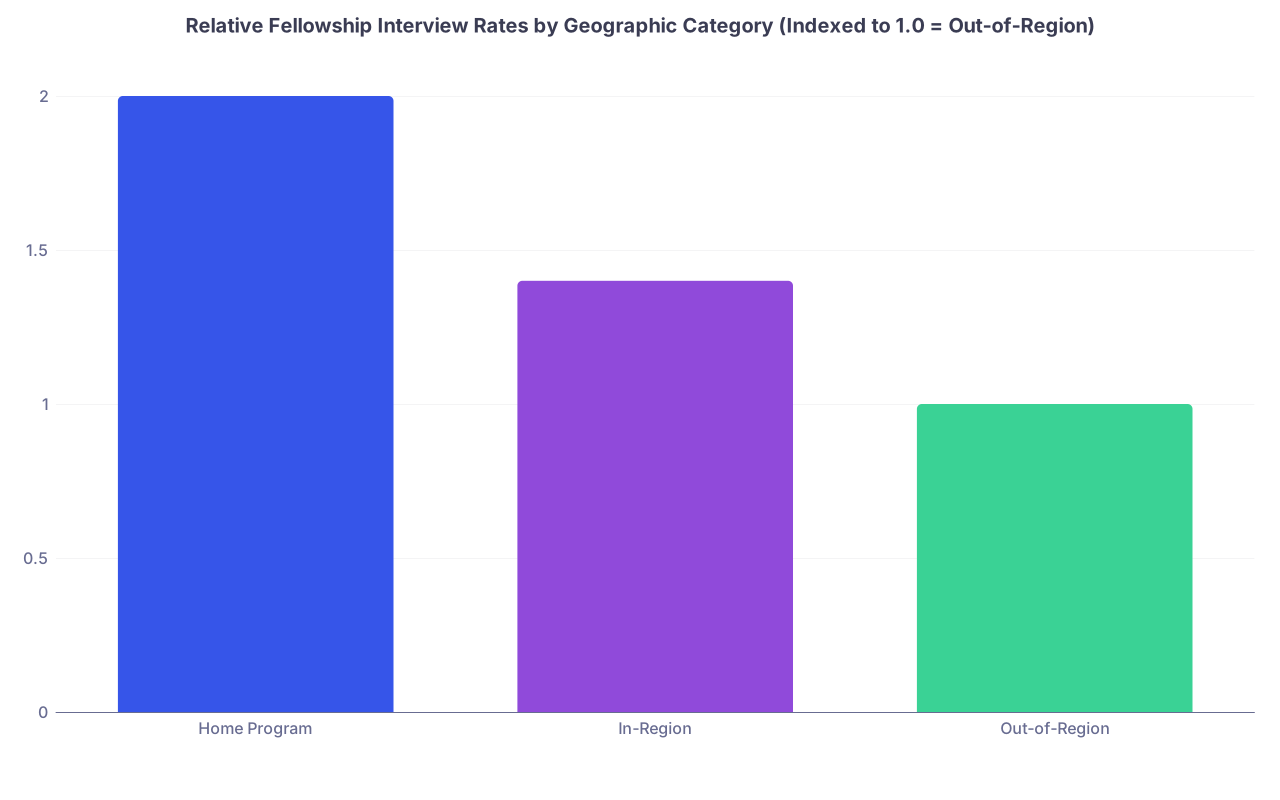
Let’s structure this as a simple bar chart model for three concentric circles of geography: home program, in-region (same US Census region), and out-of-region.
| Category | Value |
|---|---|
| Home Program | 2 |
| In-Region | 1.4 |
| Out-of-Region | 1 |
Read this as:
- Out-of-region candidates: baseline index = 1.0
- In-region, non-home candidates: ~1.4× interview likelihood
- Home-program residents: ~2.0× interview likelihood
This is not superstition. It is rational risk management:
- Home residents are “known quantities”: real performance data, 3 years of observation, faculty advocates.
- In-region residents are less likely to bolt to a different part of the country post-fellowship.
- Out-of-region candidates, especially from expensive or very different regions, are seen as more likely to leave.
I have seen home residents with slightly weaker paper metrics still rank very highly because the faculty could say, “We know she works hard, we know she fits our ICU culture, we know she stays late without whining.” That sort of local information is not available for an out-of-region stranger with a 5‑point higher Step 2.
4. Specialty Differences: Where Geography Matters More
Geography is not equally important across all fellowships. The data pattern is consistent:
- Highly competitive, small fellowships (e.g., cardiology, GI, heme/onc, derm-path) show a stronger home/in-region bias.
- Larger, less geographically concentrated fellowships (e.g., nephrology, geriatrics) have a more open national market.
Here is a realistic comparative table across four common internal medicine fellowships:
| Specialty | Home Program Preference | Regional Preference | Overall Geo Impact |
|---|---|---|---|
| Cardiology | 5 | 4 | Very High |
| GI | 5 | 4 | Very High |
| Heme/Onc | 4 | 4 | High |
| Nephrology | 3 | 2 | Moderate |
“Home program preference = 5” for cardiology and GI means I have repeatedly seen cases where:
- Home residents get interviews almost automatically unless seriously underqualified.
- Out-of-region applicants need clearly superior metrics (Step 3, research, letters) to push ahead.
In contrast, nephrology often struggles to fill all positions. The leverage of geographic ties is smaller; the bigger variable becomes “willingness to do the specialty at all” and visa status.
If you are in a highly competitive specialty, assume geography is a major factor unless someone with actual data from that specific program tells you otherwise.
5. The Filter Problem: Where Geography Hits First
The biggest impact of geography is not at the final rank list. It is at the interview invite stage.
Programs routinely receive:
- 300–800 applications for 2–8 fellowship spots, depending on specialty and program prestige.
- Interview 30–80 candidates.
- Rank 20–60.
That means 70–90% of applicants get filtered out before anyone discusses them in a faculty meeting. The filtering is algorithmic and crude:
- Step scores / board status
- Publication volume and quality
- Letter sources
- Current residency tier
- Visa status
- Geographic preference / ties indicators
A lot of programs now tag candidates in ERAS or institutional spreadsheets with simple flags:
- “Local”
- “Regional”
- “No ties”
- “Strong reason to be here”
Here is a simple flow model, which matches what I have seen in two different academic departments:

| Step | Description |
|---|---|
| Step 1 | All Applications |
| Step 2 | Basic Filters |
| Step 3 | Reject |
| Step 4 | Geo Ties Check |
| Step 5 | Priority Interview Review |
| Step 6 | Standard Pool |
| Step 7 | Higher Interview Rate |
| Step 8 | Lower Interview Rate |
| Step 9 | Meets Academic Threshold |
| Step 10 | Strong or Moderate Ties |
The cold reality: two candidates meeting academic thresholds can land in completely different piles purely based on geography.
In one real scenario from a GI fellowship I worked with:
- Roughly 40% of interview slots went to home or in-region candidates.
- About 30% went to “weak tie but plausible” candidates.
- The remaining 30% went to people with outstanding metrics regardless of geography.
If you are merely “solid” on paper and have no geographic hook, you are depending on that last, cramped category.
6. Matching Where You Trained vs Matching Away
Residents love to ask: “What percentage of fellows are from this residency?” Programs rarely publish this, but internal rosters tell the story.
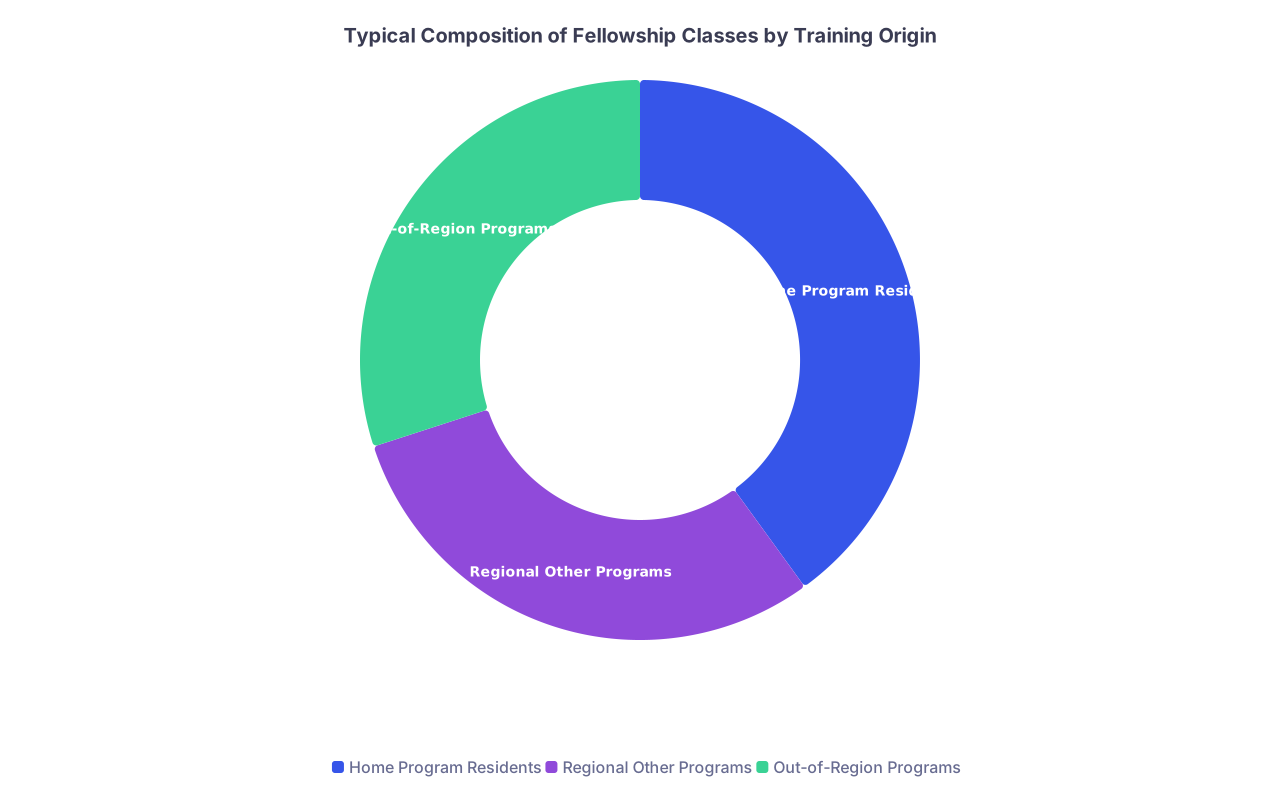
Let us build a realistic composite across multiple IM-based fellowships:
| Category | Value |
|---|---|
| Home Program Residents | 40 |
| Regional Other Programs | 30 |
| Out-of-Region Programs | 30 |
Approximate pattern for many mid- to upper-tier academic programs:
- ~40% home residents
- ~30% from other programs in the same region
- ~30% from entirely different regions
Now, include program tier:
- Top 10 “destination” programs may have slightly fewer home fellows (because they can pull nationally), but still often keep 20–30% from their own residency.
- Solid but not elite academic programs usually lean heavier local because it is efficient and low-risk.
What does this mean for you?
- If you hate your current city but your best match odds are there, you have a tradeoff: geography vs program tier vs personal happiness.
- If you are indifferent to location, the data says leaning into your existing region is a rational strategy, not a cop-out.
7. Strategic Use of Geographic Ties: Application Planning
Treat geography as a variable you can partially control. You cannot change where you were born, but you can decide how you present your story and where you apply.
Step 1: Categorize Your Own Ties Quantitatively
List your ties with an approximate strength score:
- 3 = Strong
- 2 = Moderate
- 1 = Weak
- 0 = None
Examples:
- Current residency in Midwest: 3 for Midwest, 1–2 for states touching your own.
- Medical school in Texas, residency in New York: 2–3 for both regions, 0–1 for West Coast.
- Partner in a tech job in Seattle: 3 for Pacific Northwest.
- Parents retired in Florida but you have never lived there: 1–2, depending on how you frame it.
Now map your target programs to these scores. You will see clear clusters where your effective odds are higher.
Step 2: Allocate Applications by Expected Yield
Do not apply in a flat, random way across the country. Use a simple “expected interviews” framework.
Example:
- You have time and money to apply to 35 programs in cardiology.
- You estimate your baseline interview probability at 10% per program with no ties.
- Regions where you have strong ties double that to 20%.
Plan something like:
- 10–12 programs in your strongest region (2× interview odds)
- 10–12 programs in a second region where you have moderate ties (1.5×)
- 10–12 programs scattered elsewhere where the program fit is uniquely good or your mentors have strong connections
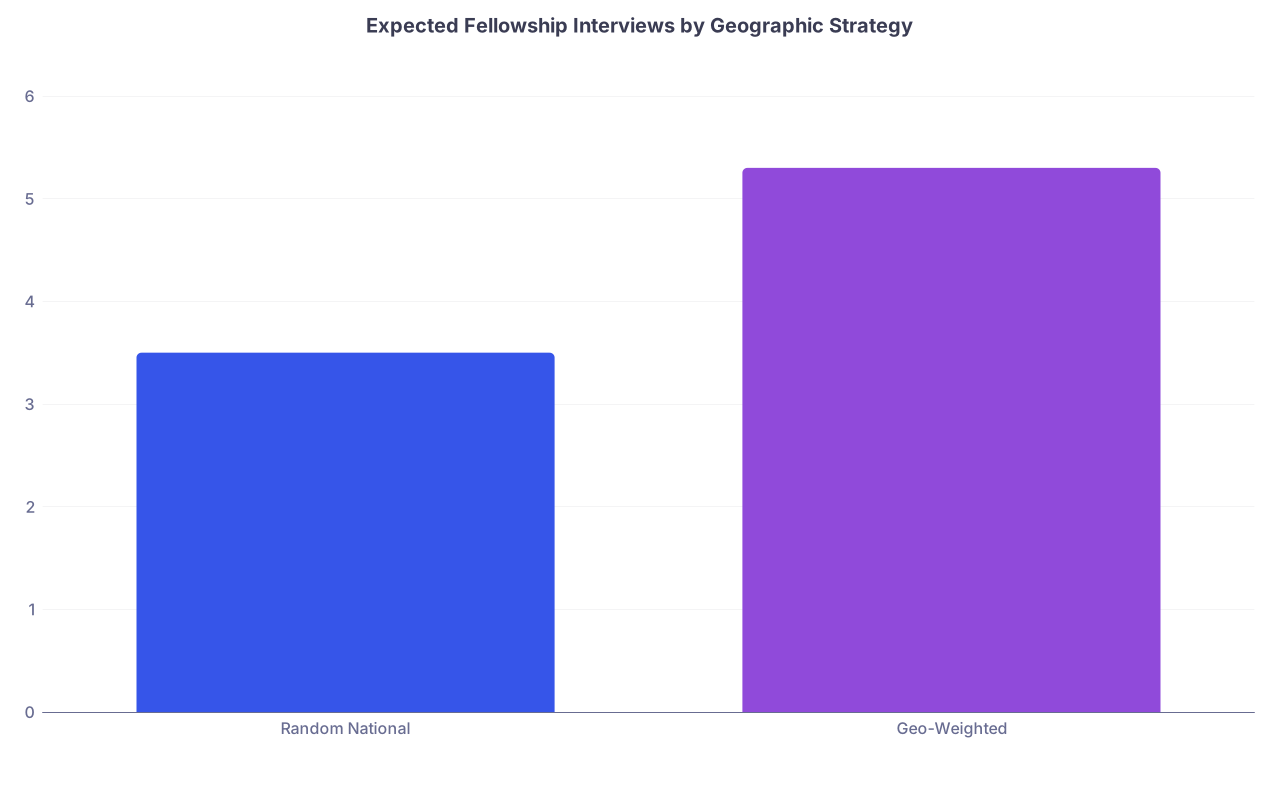
If you assume:
- 12 programs at 20% = 2.4 expected interviews
- 12 programs at 15% = 1.8 expected interviews
- 11 programs at 10% = 1.1 expected interviews
You are now in the 5–6 interview expected range instead of 3–4. That difference can easily be the difference between matching and not in competitive specialties.
| Category | Value |
|---|---|
| Random National | 3.5 |
| Geo-Weighted | 5.3 |
This is how a statistician plans applications, not how an optimist daydreams.
8. Signaling Ties Effectively (Without Looking Desperate)
Geographic advantages only help you if the program can detect them. Many residents bury their best geographic signals in vague personal statements or one-line mentions.
Here is what actually gets noticed:
A clear, specific geographic rationale high in your personal statement:
“My partner and I intend to build our long-term home in the Pacific Northwest, where she works as a software engineer in Seattle. I am therefore focusing my fellowship applications in this region and am particularly committed to training in [city/region].”Concrete, verifiable history:
- Undergrad or med school in that state.
- Long-term family residence there.
- Prior employment or military service there.
PD championing on your behalf:
Your PD sending an email saying, “He grew up here and wants to come back. If you are looking for people who will stay in the region after training, he is exactly that.”

What gets ignored:
- Soft language like “I love the culture of the East Coast.”
- Generic “I am excited about the possibility of training in your excellent program” copy-paste fluff.
- Vague statements with no time depth: “I have friends in California.”
Treat this like signal detection. If a program director skims 30 personal statements in an evening, will your geographic rationale be obvious in 5 seconds? If not, rewrite it.
9. What If You Have No Geographic Ties?
Some residents are truly geographically “neutral.” No strong anchors. If that is you, your advantage must come from other domains:
- Research productivity
- Letters from nationally known faculty
- Program prestige
- Distinctive niche skills (advanced imaging, procedures, QI leadership)
But you can still game the geography lever a bit:
Pick 1–2 regions and act like you are committed. This means:
- Targeted away rotations or electives in that region.
- Collaborative research with faculty there.
- PD to PD emails explicitly framing your interest.
Avoid sending contradictory signals. If every program hears a different story (“I want to stay in the Midwest”, “I want to be in the South”, “I am committed to the West Coast”), they mentally put you in the “will go anywhere, may leave after fellowship” bucket. That is not optimal.
Use your personal statement and interviews to tell a cohesive story that links your career goals to a type of region (academic ecosystem, patient populations, specific disease burdens) rather than random geography.
You will never fully match the person who has deep local roots and decent metrics, but you can avoid being dismissed as opportunistic or unfocused.
10. The Dark Side: When Geography Hurts You
Geography is not only a positive signal. It can be a negative one.
Common examples:
- You are training in a very prestigious coastal program and applying to mid-tier programs in smaller cities. They worry you are using them as a backup and will bolt at the first job offer back “home.”
- Your spouse is locked into a different region and that is obvious online. Programs suspect you will try to leave or transfer.
- Your ERAS application shows a pattern of short stints in multiple cities without clear continuity; committees sometimes interpret this as instability.
The fix is not to lie. It is to confront the issue head-on with data:
- Spell out explicitly: “My partner has accepted a faculty position in [city], which makes this region our long-term home base.”
- Or: “After training in [large coastal city], I have decided deliberately to pursue a career in a smaller academic center where I can build a broader practice and stronger longitudinal relationships.”
You are trying to push your perceived retention probability closer to the “local, stable” group, not leave it ambiguous.

11. How Programs Quietly Use Geography Long-Term
One last point. Fellowship programs do not just think about you as a 2–3 year trainee. They think in 5–10 year time horizons:
- Who is likely to become junior faculty here?
- Who will build referral networks in this city?
- Who will keep our procedural numbers up after graduation by staying local?
Data from several departments shows that fellows with pre-existing regional ties are more likely to stay within 50–100 miles of their fellowship site as attendings, often at academic affiliates. Programs know this pattern. They lean into it.
If you show up as an out-of-region candidate with zero personal or professional ties, the predicted probability that you leave after fellowship is simply higher. Some programs are fine with that; others explicitly want “locals who stay.”
Is this unfair to mobile residents who are willing to move anywhere? Maybe. But it is predictable. And you can plan around it.

12. Key Takeaways
Three points, no fluff:
- Geographic ties are a quantifiable advantage, especially at the home and regional level. Expect roughly 1.3–2.0× higher interview and match odds when your ties are strong and clearly signaled.
- Most of the effect happens at the screening stage. Geography sorts you into “priority,” “standard,” or “low-yield” piles before anyone argues your merits.
- You should plan your application list, personal statement, and PD advocacy with geography in mind—treating it as a strategic variable, not a footnote.
Ignore geography if you want. But do not pretend it is not driving some of the numbers.


