

The idea that doing a transitional year (TY) or preliminary (prelim) year “brands” you forever and kills your fellowship prospects is wrong. Not just exaggerated. Wrong.
What hurts you is why you did it, what you did during it, and how the rest of your record looks. The label “transitional” or “preliminary” on its own is basically background noise to most fellowship committees.
I’m going to walk through what actually matters when you go for cards, GI, heme/onc, critical care, or any other competitive fellowship after a non‑categorical PGY‑1. And I’m going to be blunt about the real handicaps that get falsely blamed on the TY/prelim year.
First, define the thing correctly: TY vs prelim vs categorical
People throw these terms around sloppily, then build myths on top of the confusion.
A transitional year is a broad, usually cushy intern year: medicine, surgery, electives, maybe some ICU. They exist to feed into advanced specialties (derm, rads, ophtho, rad onc, anesthesia) that start at PGY‑2. They can be malignant or chill, but structurally they’re flexible.
A preliminary year is usually more focused: prelim medicine or prelim surgery. You’re doing someone else’s scut while you either:
- have an advanced position lined up (e.g., anesthesia PGY‑2), or
- are using the year as a one‑year stop while you reapply for a categorical spot.
A categorical year is PGY‑1 of a normal residency you’ll theoretically finish there (IM, peds, gen surg, etc.).
Fellowship PDs know all this. Nobody on a cardiology selection committee is “surprised” that you did a TY with lots of electives. They know exactly what they’re looking at.
The question is: does that year itself hurt you long term?
Short answer: only in specific scenarios. The year label alone is not the problem.
What fellowship programs actually look at (and where PGY‑1 fits in)
Step out of the rumor mill and look at how selection actually works. Programs do not sit in conference rooms saying, “Reject all transitional year people.” They sort by signals they care about.
Here’s what consistently matters for competitive internal medicine–based fellowships (cards, GI, heme/onc, PCCM):
- USMLE/COMLEX scores (especially Step 2 now that Step 1 is pass/fail)
- Performance in your core residency (IM, peds, surgery, etc.)
- Letters of recommendation from known attendings in that specialty
- Research and scholarly output (aligned with the field)
- Program reputation and perceived rigor of your categorical residency
- Perceived trajectory: improving, stable, or crashing?
PGY‑1 is a small piece of that picture. It’s background context and sometimes a tiebreaker. The categorical residency you ultimately match into is the real anchor.
Think about how the ERAS application shows up to them:
| Path Type | What They Focus On Primarily |
|---|---|
| Straight categorical IM 3 years | IM performance, IM letters, research |
| TY → advanced (e.g., rads, derm) | Mostly irrelevant for IM fellowships (you are not applying) |
| TY/Prelim → switch to categorical IM | Categorical IM performance, letters, research; TY/prelim explains backstory |
| Prelim surg → categorical IM → cards | IM performance and cards‑relevant research; surgical prelim is footnote |
If you ultimately complete a solid categorical IM residency and you’re competitive there, the fact that you started in a transitional or prelim spot is mainly a story question: why?
Programs do not care about the label. They care if your trajectory looks erratic, unstable, or underpowered.
The three real risks of a TY or prelim year
Let’s separate superstition from genuine structural disadvantages. A TY/prelim year can hurt you, but usually in these three ways.
1. Lost time for research and networking in your actual field
The big one. A lot of TYs/prelims are service‑heavy and not at research‑heavy institutions. Or even if they are, you’re drowning in admissions and night float. If you spend that entire PGY‑1 without any:
- relevant research,
- relevant mentors,
- or clear specialty exposure,
you start IM PGY‑2 (or PGY‑1 at a new program) a step behind your co‑residents who’ve been lining up projects from day one.
Competitive fellowships care about scholarly output. Not “in theory,” but in hard numbers on a CV. A TY that’s 100% clinical with zero opportunity or desire to publish can cost you.
That’s not because it’s a transitional year. It’s because you wasted a year where others were stacking abstracts and manuscripts.
I’ve seen the contrast up close:
– Resident A: TY at a strong community program, found one cardiologist willing to loop them into a registry project, has a poster by July of IM PGY‑1.
– Resident B: TY in a malignant shop, barely coping, nothing on the CV.
Same label (“transitional year”). Wildly different fellowship trajectories.
2. Program‑hopping that looks like instability
This is the part nobody on Reddit likes to hear.
If your path reads:
DO school → failed to match categorical IM → prelim medicine → SOAP into low‑tier categorical IM → wants GI at a top university
Is it impossible? No. Is there a handicap? Yes.
But the handicap is not: “You did a prelim year, so we hate you.”
The handicap is: “You were a weaker applicant once, and we can see the pattern.”
Fellowship committees know the usual narratives:
- Couldn’t match the first time (scores, red flags, or weak application)
- Needed a gap year to reapply
- Transferred programs once or twice
Some of those stories are completely legitimate: visa mess, health issues, family emergencies, abusive program you wisely escaped. When explained clearly and backed by a strong later performance, they’re recoverable.
But the more your path looks like a string of “backup plans,” the harder you have to work to prove you’re now an A‑tier candidate. That’s about the pattern, not the fact you held a prelim contract.
3. Weak or irrelevant letters from your intern year
This is where TY/prelim residents shoot themselves in the foot.
They treat PGY‑1 like a disposable holding pattern. They focus on surviving, not building relationships. They get end‑of‑year form letters like, “Dr. X completed this year satisfactorily” from people no one in their target field knows.
If your only strong letters are from a transitional program director at a small community hospital who doesn’t know a single cardiology PD personally, you’re at a disadvantage. Again, not because it's “TY,” but because the letters are low‑power.
The residents who do this right are predators about it. They:
- Identify an attending who has real academic weight or personal connections
- Show up early, stay late, ask for feedback, act like an R2 by the end of the year
- Get a letter that reads like: “This person outperformed my categorical interns; you want them”
Very different outcome.
What the data and match trends actually show
There isn’t a giant NRMP table titled “TY years ruin fellowship chances,” so you have to triangulate from what we do have.
A few realities:
Plenty of successful fellows started off-cycle or non‑categorical.
Look around any big‑name IM fellowship. You’ll find:- Former prelim surg residents who switched to IM and ended up in cards/CCM
- People who did a TY while trying for derm, missed, converted to IM, then went heme/onc
- International grads who did a prelim year as a foothold before landing a categorical spot
They’re not unicorns. They’re just quiet about the detour once they’re there.
The strongest predictor of fellowship success is how you perform in your categorical residency, not whether you had a detour.
Programs recruit from the people they see for three years, not people they vaguely infer something about from an intern year two institutions ago.Program reputation and mentorship density matter more.
A mediocre categorical IM at a place with no research, no subspecialty presence, and no mentorship pipeline is far more of a permanent handicap than a TY at the same place followed by a real IM residency at a strong academic center.The “permanent stain” myth distracts from the real question:
Where do you end up for your main residency, and what can you do there?
Here’s the kind of tradeoff people don’t analyze rationally:
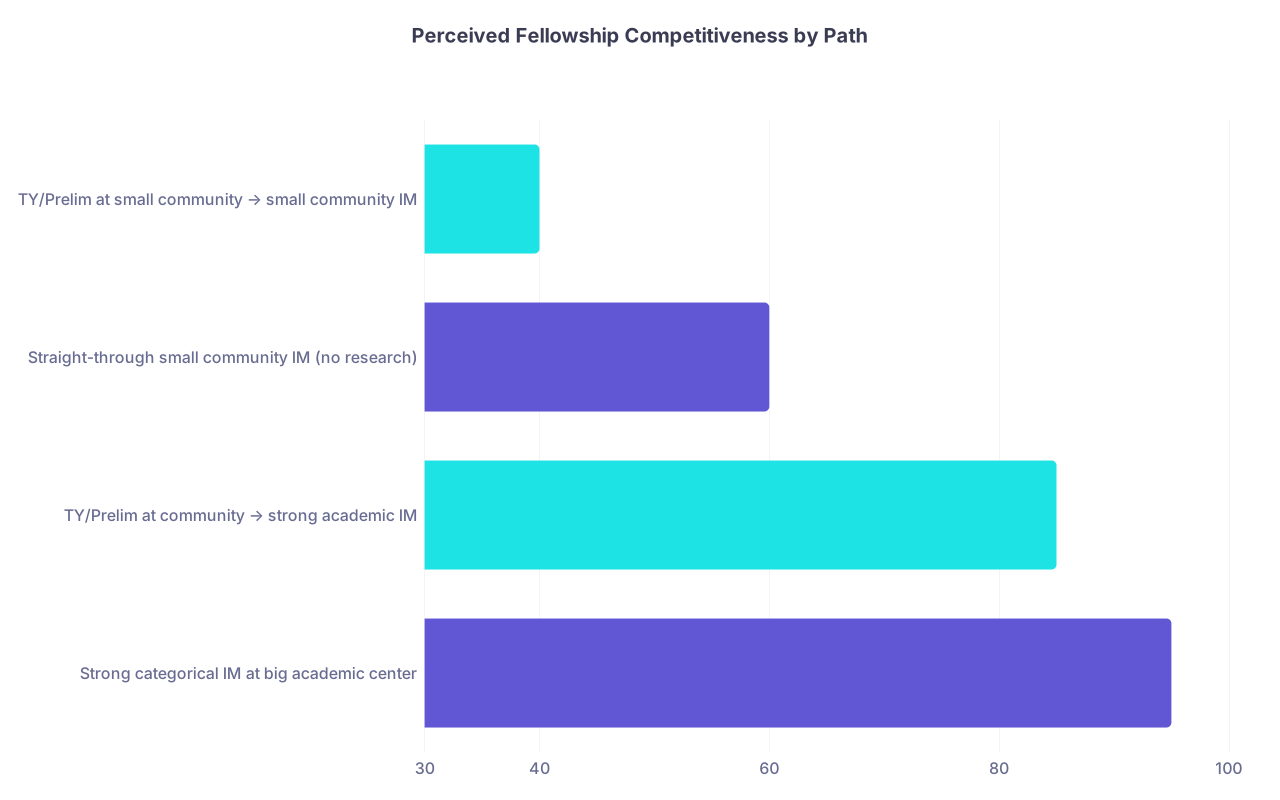
| Category | Value |
|---|---|
| Strong categorical IM at big academic center | 95 |
| TY/Prelim at community → strong academic IM | 85 |
| Straight-through small community IM (no research) | 60 |
| TY/Prelim at small community → small community IM | 40 |
Those numbers are illustrative, but the ranking is real. The TYPE of PGY‑1 year is not the decisive variable; the destination and trajectory are.
Situations where a TY or prelim year is actually an advantage
Now for the contrarian part most people never consider: sometimes a TY or prelim year makes you more competitive.
1. As a “practice run” that skyrockets your performance later
I’ve watched prelims who walked into categorical IM looking like pseudo‑PGY‑2s. They already knew the EMR, the flow of admissions, how to present efficiently, how to stay out of trouble with nursing and consultants.
Result:
They freed up brain bandwidth early to:
- Say yes to research
- Crush their first subspecialty rotations
- Impress the very attendings who later wrote them A+ fellowship letters
Meanwhile, their co‑interns were still trying to figure out how to put in a discharge order set.
Fellowship PDs see that when they read your letters and evals: “mature beyond level,” “functions at R2 level as an intern,” etc. They don’t penalize you for the extra year; they see a better product at the time that matters.
2. As a way to trade up to a much better categorical program
If your Step scores or application the first time around limited you to marginal categorical programs but you can secure a strong TY/prelim at a better institution, that year becomes leverage:
- You impress people in that system
- A categorical spot opens (it always does; people leave)
- You slip into a more academic, more connected program than you ever could have from med school directly
Now your ultimate fellowship odds improve. Without that “prelim detour,” you’d be stuck in a program with no GI service and a single overworked cardiologist who doesn’t publish.
3. As a reset after a bad match or wrong specialty choice
Residency attrition is real. People match into the wrong field all the time, then spend years trying to claw their way out while explaining poor evals and low enthusiasm.
A clean cutoff after a single TY/prelim year, pivoting into a field you genuinely like and then performing at a high level there, looks better. On paper and in actual competence.
Fellowship PDs are not allergic to non‑linear paths. They are allergic to chronic underperformance and vague, evasive explanations.
How to use a TY or prelim year without handicapping yourself
If you’re already in a transitional or prelim spot and have fellowship ambitions, here’s how you avoid turning it into a permanent scar.
Decide on your target specialty early in the year.
Not in April. Not “sometime during second semester.” As early as you can realistically commit. Because everything else flows from that choice: whose radar you need to be on, what projects you should chase, what rotations you should angle for.Identify one or two high‑value attendings and go all‑in.
Not scattered emails to 15 faculty members asking, “Do you have any research?” That’s how you get ignored. Embed yourself with one person doing work in your area of interest. Be the resident who answers emails in an hour, not a week. That’s how you get fast‑tracked onto abstracts.Treat PGY‑1 evaluations like they matter—because for narrative they do.
The actual AGCME milestones from a TY won’t decide your fellowship fate. But the language PDs and attendings use to describe you absolutely will. Words like “outlier,” “top 5%,” “would rehire in a heartbeat” stick.Craft a clean, honest narrative for the transition.
“I started as a prelim because I thought I wanted X. During that year, I realized Y. I sought out mentors in Y, did Z projects, then committed fully to Y by moving into a categorical position here.”That sounds intentional and mature, not confused and desperate.
Do not hide the TY/prelim or act ashamed of it.
The worst move is defensiveness. Programs smell it. Own it. “Yes, I did a transitional year. It made me better at A, B, and C. Here’s the progression in my work.”

| Step | Description |
|---|---|
| Step 1 | TY or Prelim Year |
| Step 2 | Targeted Mentors and Research |
| Step 3 | Limited Output |
| Step 4 | Strong Letters and CV |
| Step 5 | Need Catch Up in Categorical |
| Step 6 | Competitive Fellowship Apps |
| Step 7 | Decide Specialty |
When a TY or prelim year is a bad sign
Let me flip the lens, because sometimes the rumor has a grain of truth.
Program directors do raise eyebrows when they see:
- A prelim year followed by a gap year with no clear work or training
- Two or three different institutions in three years with vague reasons
- Prelim year + poor IM evals + mediocre exam scores + no research
In that setting, the prelim year becomes part of a negative pattern. Not the cause, but another data point suggesting either instability, performance issues, or chronic indecision.
If that’s you, it’s still not the end. But you need a strong run in your categorical program to demonstrate that the chaos is behind you. That’s the only way to reframe the story.
Bottom line: Is it a permanent handicap?
No—unless you let it be.
A transitional or preliminary year is:
- A mild headwind if it reflects prior application weakness you never outgrow.
- Neutral if you convert it into a solid categorical spot and then perform.
- A quiet advantage if you use it to mature clinically, upgrade institutions, or clarify your specialty and attack it early.
The label on PGY‑1 does not decide your fellowship future. Your performance and trajectory in your categorical residency do.
Three things to remember:
- Fellowship programs don’t care that you did a TY or prelim; they care what you did with it and what came next.
- The biggest real handicaps are lost time on research, weak letters, and a chaotic narrative—none of which are inevitable with a non‑categorical year.
- If you turn that year into mentorship, output, and clear direction, it becomes a stepping stone, not a scar.


