

The idea that a “nonlinear” training path ruins your fellowship chances is lazy mythology, not reality.
Program directors care a lot less about whether your path was straight and a lot more about why it bent and what you did with it. The data back this up, but the rumor mill in residents’ lounges is louder than any NRMP report.
Let’s dismantle the fear.
What “Nonlinear” Actually Means (And What It Does Not)
People throw around “nontraditional” and “nonlinear” like they’re self‑explanatory. They’re not.
Nonlinear training paths typically include things like:
- Taking a research year or chief year off-cycle
- Switching specialties (e.g., surgery → anesthesia; peds → peds cards track)
- Extending residency for remediation or personal reasons
- Doing a preliminary year then reapplying
- Gap years between residency and fellowship (hospitalist, locums, industry, MPH, PhD, military obligation)
That’s not the same as “red flag.” But residents mentally lump them together because anxiety loves shortcuts.
From what I’ve seen reading applications and talking to fellows who matched: the distinction that actually matters to fellowship directors isn’t “linear vs nonlinear.” It’s this:
- Intentional deviation with productivity or growth
vs. - Chaotic deviation with no clear narrative or output
The first group matches just fine—often better than the “perfectly linear” resident whose CV is a blank slate beyond required duties.
What The Data Actually Show About Gaps, Switches, and Extra Time
Let’s get concrete.
The NRMP’s “Charting Outcomes in the Match” and the Program Director Surveys (for subspecialty matches like cardiology, GI, heme/onc) lay it out pretty clearly: the heavy hitters for fellowship selection are:
- In‑training exam performance / board scores
- Letters of recommendation and reputation of training program
- Research productivity (especially for competitive subspecialties)
- Interview performance and perceived fit
Training path oddities? They show up—but they are rarely top‑tier decision drivers.
Here’s how this plays out in real life.
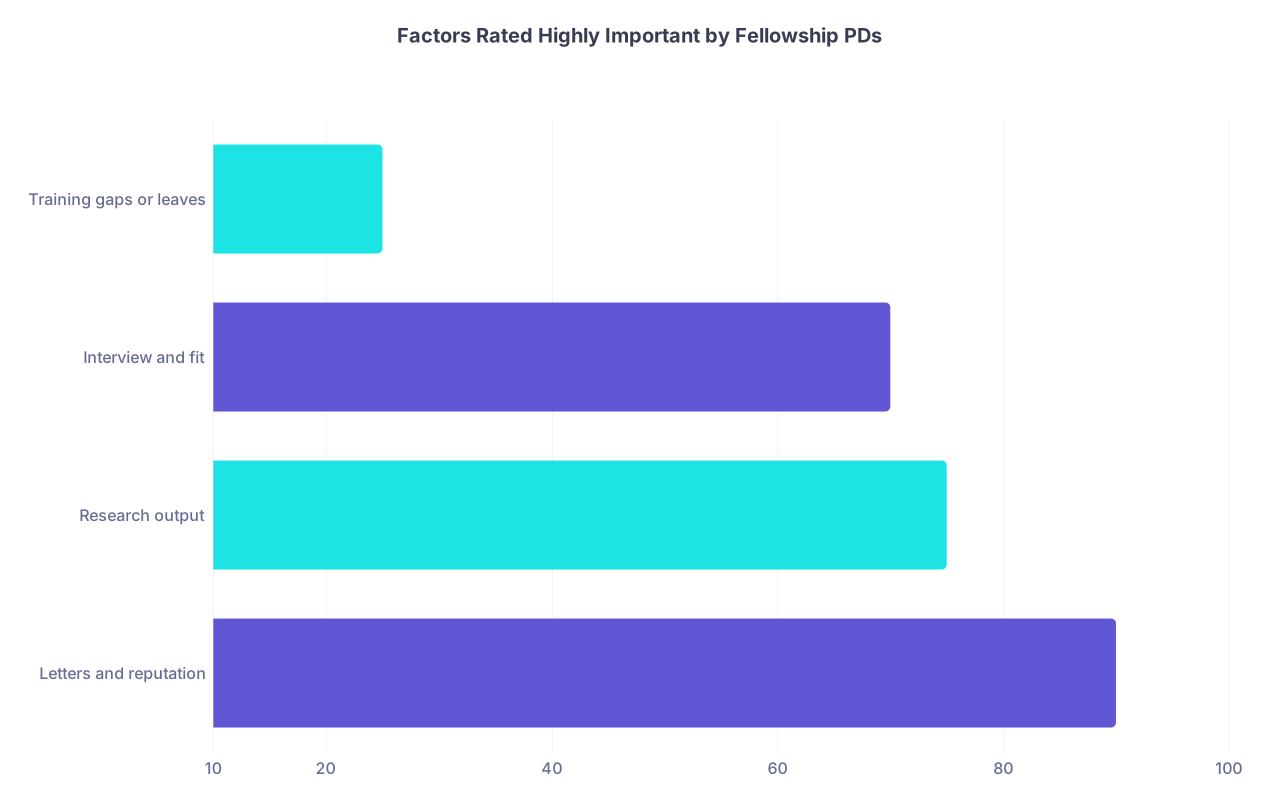
| Category | Value |
|---|---|
| Letters and reputation | 90 |
| Research output | 75 |
| Interview and fit | 70 |
| Training gaps or leaves | 25 |
Interpretation, not wishful thinking: directors overwhelmingly care about performance, letters, and productivity. They notice nonlinear paths, but they do not treat them as automatic disqualifiers.
You know what is a problem? When a nonlinear path correlates with:
- Failing or multiple attempts on boards
- Documented professionalism issues
- No meaningful activity during a gap year (no work, no study, no caregiving, just…drifting)
Residents blame the gap; PDs blame the pattern.
Myth 1: “Any Gap Year Between Residency and Fellowship Kills Your Chances”
I hear versions of this all the time: “If I do a year as a hospitalist I’ll never get cards,” or, “Once you step off the track, you’re done.”
Wrong.
In many subspecialties—cardiology, GI, heme/onc—you’ll see a sizable chunk of fellows who did at least one year as a hospitalist or nocturnist, or a chief year, or a research year. I’ve sat in rooms where PDs preferred a candidate with a year of real‑world attending experience: they were more efficient, needed less hand‑holding, and had more mature clinical judgment.
Where does a “gap” start to hurt?
- When it’s long (multiple years) and
- You cannot demonstrate clinical maintenance, scholarly work, or some coherent, defensible reason
Taking one or two structured years to:
- Work as a hospitalist while doing research
- Finish a degree (MPH, MS, PhD)
- Serve in the military or underserved areas
- Support a sick family member while maintaining part‑time clinical work
…is not what keeps people from matching. Their application quality during and after that time is what does.
| Gap Type | Typical Impact if Well-Explained |
|---|---|
| 1 year chief residency | Often positive |
| 1–2 years hospitalist + research | Neutral to positive |
| Research fellowship (funded) | Strong positive |
| 1–2 years no clear activity | Negative |
| 3+ years fully out of practice | Significant concern |
If your “gap” looks like a focused, productive interval, a lot of PDs will quietly file it under “value added,” not “red flag.”
Myth 2: “Switching Specialties Makes You Untouchable”
Switching from one residency to another gets whispered about like it’s a career-ending scandal. I’ve heard residents say, “Once you switch, nobody trusts you’ll stick with anything.”
That’s not how most fellowship PDs think. What bothers them is impulsivity and unexplained inconsistency. Not a thoughtful course correction with a clear trajectory.
Examples I’ve seen:
- A general surgery resident who switched to anesthesia after 2 years, then matched into critical care. Clear story: loved the OR and physiology; hated the surgical lifestyle and case types. Strong letters → matched without drama.
- A pediatrics resident who transferred into internal medicine after PGY‑1, then matched into heme/onc. Narrative: realized they were more interested in adult malignancies and trials. Backed by meaningful oncology research.
Contrast that with the chaotic version:
- Switched specialties twice
- Multiple leave periods, all vaguely documented
- No research or extra training to align with the “new passion”
- Lukewarm letters that hint at “commitment issues”
Directors are not allergic to change; they are allergic to risk. A single, well-explained specialty switch anchored to evidence (electives, mentors, research) does not tank you. It can actually make your story more compelling.
What will blow things up is if your documentation is sloppy or evasive. A specialty switch with missing dates, contradictory explanations in ERAS, and a vague personal statement? That looks like you are hiding something. And they will assume the worst.
Myth 3: “Extending Residency or Remediation = Fellowship Death Sentence”
Let’s separate issues here.
If you:
- Failed Step or boards
- Needed an extra year for clinical remediation
- Had documented professionalism problems
You are in a different category than “took a research year” or “did chief year.” But even then, it’s not always game over. What PDs want to see is: trajectory.
Is the story “major issue that never really resolved”? Or “early problem, then clean record and strong performance”?
I’ve seen fellows in competitive programs who:
- Failed Step 1 or 2 the first time
- Required an extended residency year to get fully up to speed
- Later produced strong ITE scores, published research, and had glowing letters that specifically addressed their growth
Programs took them because the more recent data were good and the story was coherent: early difficulties, then sustained redemption.
On the other hand, if your ITE scores stay mediocre, your letters are bland, and you have no scholarly work, then yes—extending residency will be read as pure negative. But it’s not the extension itself. It’s lack of upward slope.
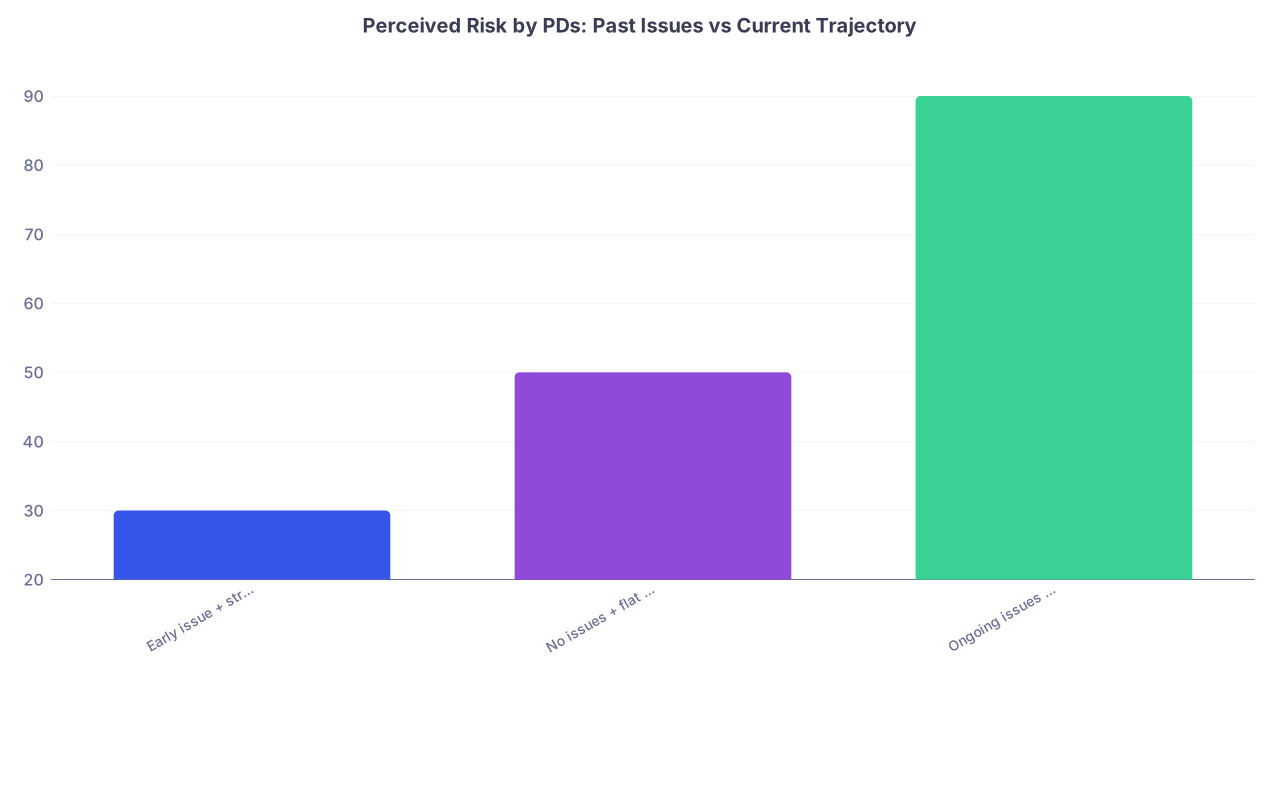
| Category | Value |
|---|---|
| Early issue + strong recent performance | 30 |
| No issues + flat performance | 50 |
| Ongoing issues + poor trajectory | 90 |
Fellowship PDs are pragmatic. They know people mature, fix bad habits, and recover from setbacks. What they don’t want is someone who’s still in the middle of the storm.
The One Nonlinear Path That Is Overrated: Random, Unfocused “Research Years”
Here’s where I’ll be blunt: not all nonlinear choices are smart.
The classic bad move: taking a “research year” because you panicked about your chances, then doing almost nothing tangible during that year. I’ve seen this more than once.
If you take a research year and end up with:
- No first-author papers
- No abstracts or posters
- No meaningful letters from research mentors
- Vague “worked on a project that’s still in progress”
Then you just added a year and proved you do not convert time into results. That’s actively harmful.
A productive “nonlinear” research year looks like:
- 1–2 first-author or co–first-author manuscripts
- Several posters/abstracts at recognizable conferences
- Clear alignment with the fellowship you want (cards research for cards, etc.)
- Strong, detailed letter from a PI with a name that PDs recognize or respect
The myth is “any research year helps.” The reality: a weak research year is worse than no research year, especially if you could have been building a strong clinical or teaching record instead.
How Fellowship PDs Actually Read a Nonlinear Timeline
Let me translate how people in selection meetings talk, because it’s very different from resident gossip.
Typical conversation over an applicant with a nonlinear path:
- “They took a year as a hospitalist—did they stay academically active?”
- “They switched from peds to IM—does their story make sense? Do their letters back it up?”
- “They were out 2 years for family reasons—did they maintain any clinical exposure? How are their current skills?”
- “They needed extra time in residency—how are their latest evaluations and ITE scores?”
Nobody is saying, “Nonlinear? Hard no.”
They’re asking: does this candidate look like a safe, productive, collegial fellow for the next 2–3 years?
You know what helps more than a perfectly straight PGY1‑3‑fellowship line?
Things like:
- A stellar letter from your PD saying, “I would gladly have this resident as my partner”
- Evidence that you can generate research, teach juniors, and function autonomously
- A credible explanation for any detour that shows judgment, humility, and growth
Nonlinearity with insight beats linearity with mediocrity.
How to Frame a Nonlinear Path So It Works For You
The “damage” from a nonlinear path isn’t in the facts; it’s in the framing. Done well, you can turn it into an asset.
A few principles:
Be specific, not vague.
“Personal reasons” and “family issues” sound evasive when overused. You don’t have to overshare, but something like “parental caregiving during cancer treatment while working part‑time as a hospitalist” tells them it was real, serious, and not about commitment to medicine.Show continuity.
Directors worry most about skills decay. Show that you:- Maintained clinical work
- Completed CME or board prep
- Stayed involved academically or professionally
Quantify productivity.
List tangible outputs: X papers, Y posters, Z lectures. “Worked on research” is noise; “First-author paper in CHEST, abstract at ACC” is signal.Align the detour with your current goal.
Connect the dots. Your path should read like a story that had to go this way, not like random pivots every six months.

| Step | Description |
|---|---|
| Step 1 | IM PGY1 |
| Step 2 | Interest in cardiology |
| Step 3 | Research year in HF |
| Step 4 | Hospitalist with cards night coverage |
| Step 5 | Strong letters and publications |
| Step 6 | Cardiology fellowship match |
Your job is to make reviewers trace that path and nod, not squint.
The Real Risks You Should Actually Worry About
Nonlinear path or not, here’s what reliably hurts fellowship outcomes:
- Mediocre or declining in‑training exam performance
- Weak or generic letters from key people (PD, division chief)
- No scholarly output in research‑heavy fields (cards, GI, heme/onc, pulm/crit)
- Persistent professionalism complaints, even minor but repetitive
- A personal statement or interview that sounds defensive, bitter, or evasive
Those are the issues that sink applications, not “took a year as a hospitalist” or “switched specialties once.”
If you fixate on the myth—“my path isn’t linear, I’m doomed”—you’ll ignore the real work: improving scores, building relationships with mentors, doing publishable work, and honing how you talk about your journey.
The Bottom Line
A nonlinear training path is not the problem. The story, output, and trajectory around it are.
Three things to remember:
- Fellowship PDs care far more about performance, letters, and tangible productivity than about a cosmetically “clean” timeline.
- Well‑explained detours with real work behind them (research, hospitalist, chief, caregiving with maintained clinical activity) are usually neutral to positive—not fatal.
- The only truly damaging “nonlinear” year is one where you do almost nothing, learn nothing, and cannot explain why it happened or what changed afterward.
Fix the substance. Then frame the path. The line does not have to be straight; it just has to be heading somewhere worth going.


